After telling an agent to stop, how do you prove access was revoked?
Separate task stops, revoked access, and provider notices; verify old credentials and follow up on work already submitted.

If you let an AI agent handle account activity and later withdraw that permission, how do you prove it can no longer act? Wells Fargo is preparing to make evidence of that withdrawal an explicit customer requirement.
On November 2, American Banker reported on the bank’s new online-access terms for AI agents. Customers must revoke authorization properly and promptly, take necessary action to stop the agent’s activity, retain evidence, and provide it when requested. The bank’s upcoming agreement takes effect on November 24, 2026.
The practical difficulty is visibility. A customer can authorize or revoke an agent outside the bank’s systems, leaving the bank unable to see exactly when it happened. A chat message saying “stopped” may therefore leave a more consequential question unanswered: which access paths still work?
To revoke AI agent access, withdraw its connection, key, or login session in the service that grants access, then verify that the old access method no longer works. Stopping a task pauses execution; previously sent messages, submitted transactions, and required bank notices need separate follow-up.
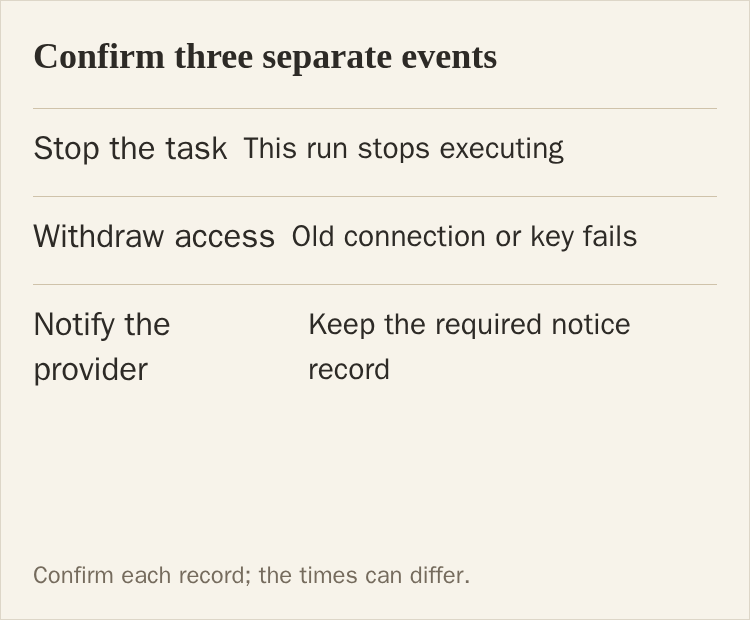
Why telling the agent to stop is only one step
Stopping a current task and invalidating its credentials are separate operations. The first is an instruction to the executor. The second must be enforced by the system controlling account access. A login session, API key, or alternate connection may remain usable after the task stops.
Wells Fargo’s terms make that distinction a concrete evidence requirement. Anyone connecting agents to business systems faces a related operational question: which paths can an administrator confirm are closed, what supports that conclusion, and what remains to be done? A clear evidence trail lets another responsible person verify the answer.
Keep four times separate
A stop request records your instruction. Interruption records the end of one run. Revocation in the authorization system records a change to a particular token, grant, or session. Receipt and processing of a notification by the resource provider records another event.
These events can originate in different systems. A chat screenshot does not establish that a refresh token expired. Removing a connection does not settle what happens to an external job already accepted. Preserve source, time zone, identity, and resource for each event, and leave missing confirmations visibly unresolved.
Find every path that could still grant access
Start from the original authorization: resource, principal, and connection method. OAuth grants, API keys, browser sessions, and delegated accounts need their respective administrators. Include future schedules, alternate connections, and work an external service already accepted. Confirm cancellation of accepted work in that service.
Assign each item to someone who can act: the account holder, credential administrator, or schedule owner. Record the action, time, receipt location, and remaining work. This distinguishes a caller that will no longer be triggered from a caller that can no longer access the resource.
The agreement separates revocation, evidence, and notice
Section 15(f) of the upcoming agreement requires customers to revoke authorization properly and promptly, take further action needed to stop the agent’s activities, retain evidence, and supply it if the bank asks. It also states that customers remain responsible for the agent’s activities, to the extent permitted by law or regulation, until they notify the bank under Section 17(d).
A stop instruction, a provider-side revocation, and notice to the bank therefore have different recipients. Completing one does not establish that the others occurred. Preserve the identity and authorization being withdrawn, the processing time, and the notice record alongside any confirmation screen.
Section 15(b) also says the bank does not monitor, review, audit, or certify third-party agents’ security or data handling. Acceptance of an account instruction does not establish that the bank inspected the agent behind it. Account owners need an list of granted connections and permissions to connect account activity with the access route that produced it.
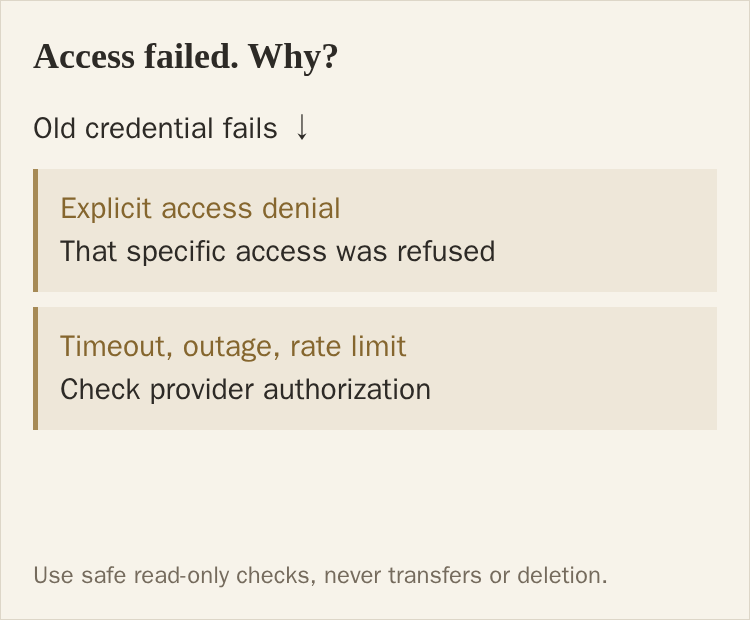
What does a failed access attempt actually establish?
Start with identity. A failure under your administrator account says little about the identity the agent used. Testing a newly generated key does not establish whether the old one still works. Check the account and login credential the agent actually used, and the file or system it accessed.
Where the provider permits a safe verification method, a minimal read-only check using the original identity can supply useful evidence. An explicit authorization denial supports a narrow conclusion: that path could not perform that read at that time. A timeout, outage, or rate limit leaves the authorization question unresolved; check the provider’s access controls instead of treating any failure as successful revocation.
Match the check to the former scope. Failure to read one file does not establish that access to an entire shared workspace ended. An invalid token does not settle a separately configured API key. Use authorization status, session controls, audit logs, and official verification methods. Do not attempt a transfer, send a message, or delete data merely to test revocation.
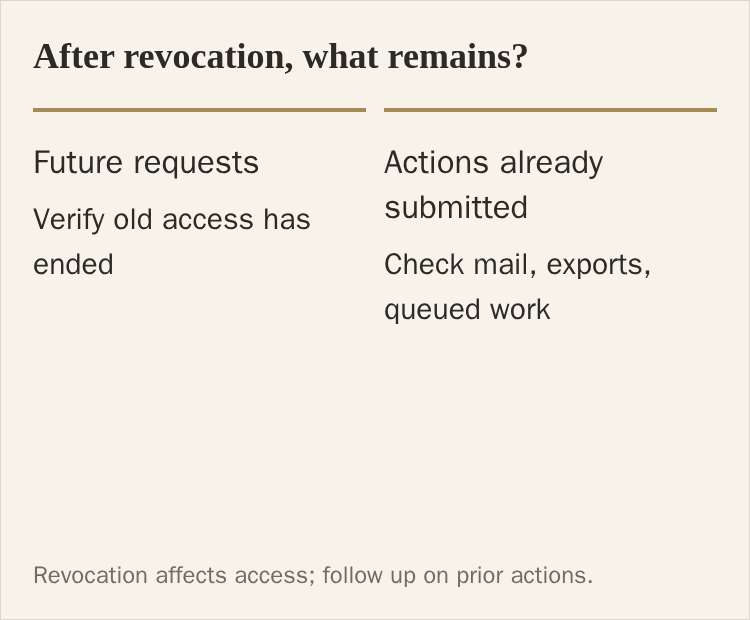
Follow through on actions already accepted
Revoking credentials addresses future requests. Previously sent messages, exported files, and instructions accepted by an external service need separate follow-up. A stopped agent cannot make a delivered message disappear. Cancellation of queued work depends on the receiving system’s controls.
Compare activity between the last known successful access and confirmation of revocation. Separate reads from external changes and outstanding instructions, then assign each unresolved item to the responsible system owner. Report account irregularities through the account provider’s formal channel rather than only questioning the agent.
A useful handoff can remain short: whose access to which resource ended, how the provider confirmed it, what was checked afterward, and which submitted actions remain unresolved. Keep credential secrets out of that record. A successor can then verify the specific conclusion without relying on an unsupported statement that everything stopped.
In Buda, tie each connection and revocation to the right agent
When connecting a work account through Buda, first identify the agent using that connection. Tools and service connections belong to individual agents; connecting one does not automatically grant the same permissions to other agents in the Space. During OAuth setup, the provider’s consent screen lists requested permissions so you can check what the agent needs to read and do.
To withdraw access, open Settings → Integrations, select that agent, and disconnect the service. Buda discards the stored token—the credential used by this connection. Then remove Buda in the provider’s connected-app settings to address the authorization retained there.
For a reviewable handoff, record the agent, service, action time, and confirmation from both ends. If several agents independently connected the same service, check each connection. Handle separately configured API keys or browser logins in the systems that manage them. This gives the post-stop review a concrete sequence: identify the connection, act at both ends, retain confirmation, and follow up on submitted actions.
What closes the handoff
Keep confirmed access-path changes, action times, and original receipts together. Assign an owner and next step to continuing access or missing evidence. Confirm the disposition of work already accepted by external systems separately.
Base the conclusion on what changed in each access path, rather than whether the agent replied “stopped.” Follow the applicable agreement for the bank’s notice and evidence requirements.