The AI-First Company Starts by Removing Work, Not Adding Tools
Question requirements, remove unnecessary steps, and automate only the work that still creates value.

Most companies do not have an AI problem. They have a work-design problem.
They buy licenses, run pilots, appoint an AI lead, and add a new interface to the stack. Then the same work continues underneath: people copy information into systems, managers reconcile reports, customers wait through approval chains, and meetings exist because nobody has a complete view.
The tool changed. The company did not.
At Buda, we think the useful question is not, “Where can we add AI?” It is, “What work should still exist once an Agent can observe context, use tools, and carry a task forward?”

AI-generated editorial illustration.
The AI Shuffle: new technology, old assumptions
In a Fortune commentary published on August 15, 2026, Collective[i] co-founder Stephen Messer calls this pattern the “AI Shuffle”: companies exchange one technology logo for another while preserving the assumptions underneath how work gets done.
The pattern is easy to recognize.
A salesperson used to fill a CRM field manually. Now an AI drafts the update, and the salesperson still copies it into the same field. A manager used to collect five weekly reports. Now the manager receives five longer AI-generated reports. A four-person approval chain remains a four-person approval chain; each person simply writes a response faster.
Every step looks more efficient. The full system is not shorter.
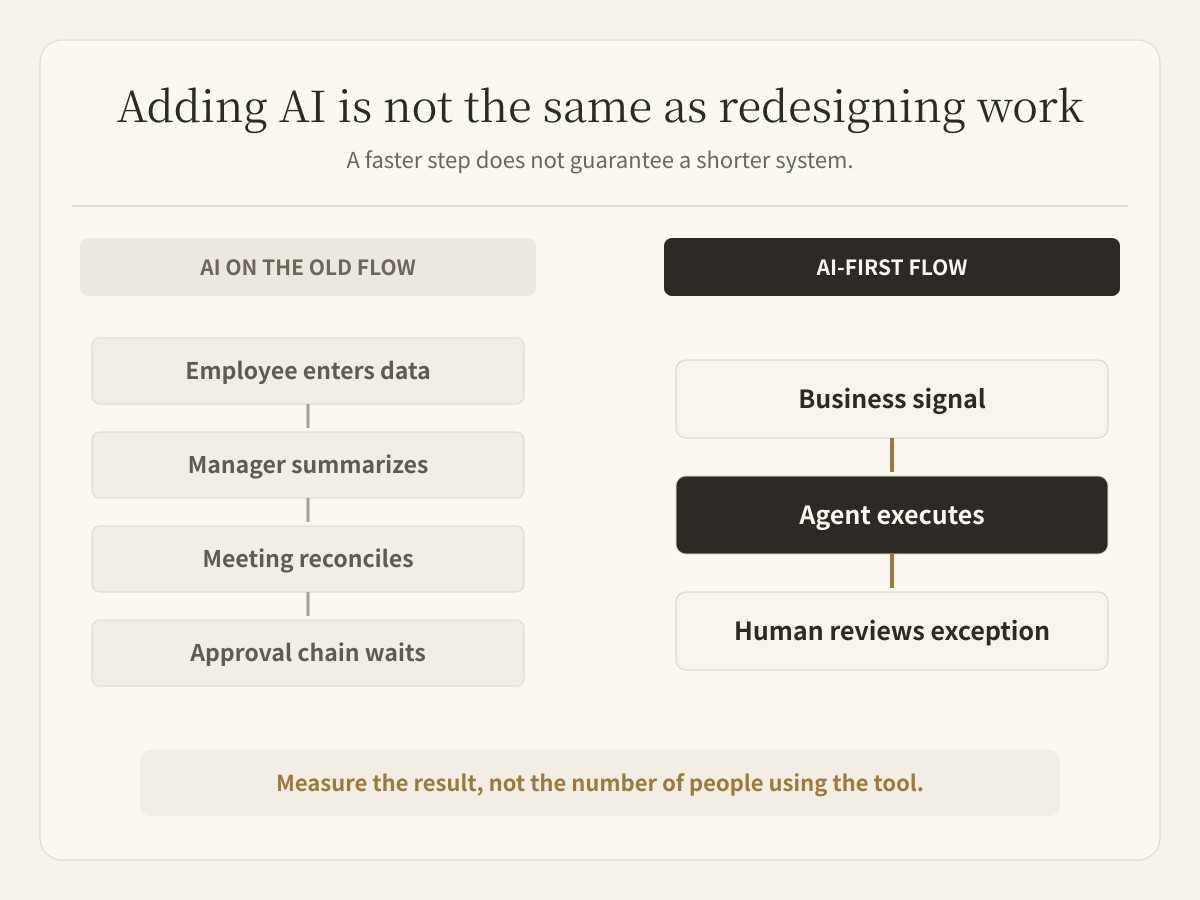
Automation can even make unnecessary work harder to see. Once a weak process has integrations, permissions, dashboards, and owners, removing it becomes more expensive than questioning it at the beginning.
Subtract before you automate
Messer proposes a more demanding sequence:
- Question every requirement. Why does this step exist? Does the original condition still apply?
- Remove unnecessary work. Delete handoffs, reports, waiting, and approvals that do not improve the result.
- Simplify what remains. Reduce the inputs, decisions, and outputs to the smallest useful system.
- Automate last. Give an Agent only the work that has survived the first three tests.
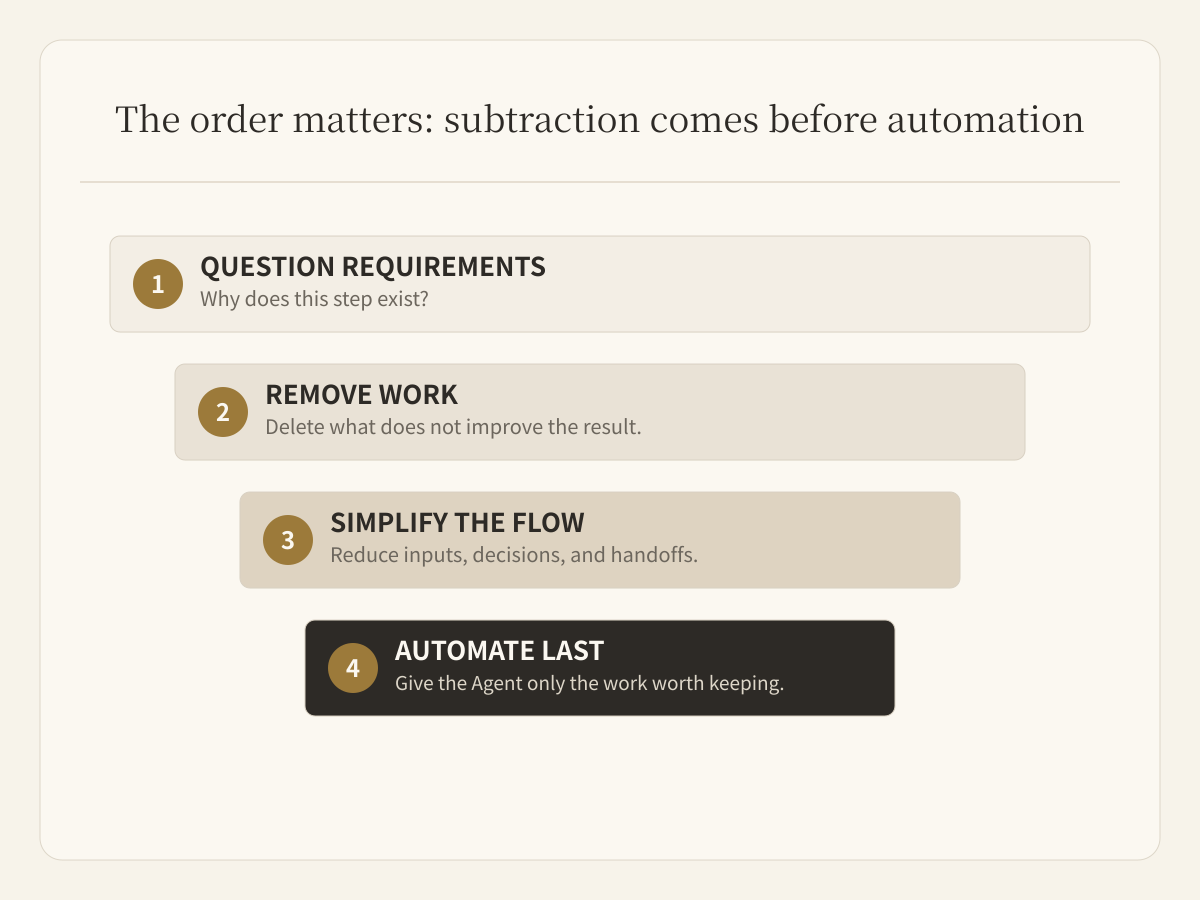
The order matters. Automating a bad process does not turn it into a good process. It makes the bad process faster, more deeply embedded, and more difficult to unwind.
This is also why adoption metrics are weak evidence of transformation. The number of employees using an AI tool says little about whether customer response time improved, fewer errors reached production, or a decision moved closer to the person with the relevant context.
An AI-first workflow begins with an outcome and a constraint, not a tool.
Sales forecasting: do we need a smarter meeting?
Messer uses sales forecasting as a concrete example.
The traditional chain is familiar: individual sellers enter projections into CRM, managers interpret and adjust them, and leadership meets to negotiate a number that everyone knows contains incomplete information and incentives.
The meeting exists partly because the system cannot observe the buying process directly.
If an Agent can continuously read buyer behavior, communication progress, timing, market changes, relationship signals, and commercial history, the goal should not be to prepare the same forecast meeting more elegantly. The better design may be a continuously updated forecast that calls people in only when there is an anomaly, disagreement, or high-risk decision.
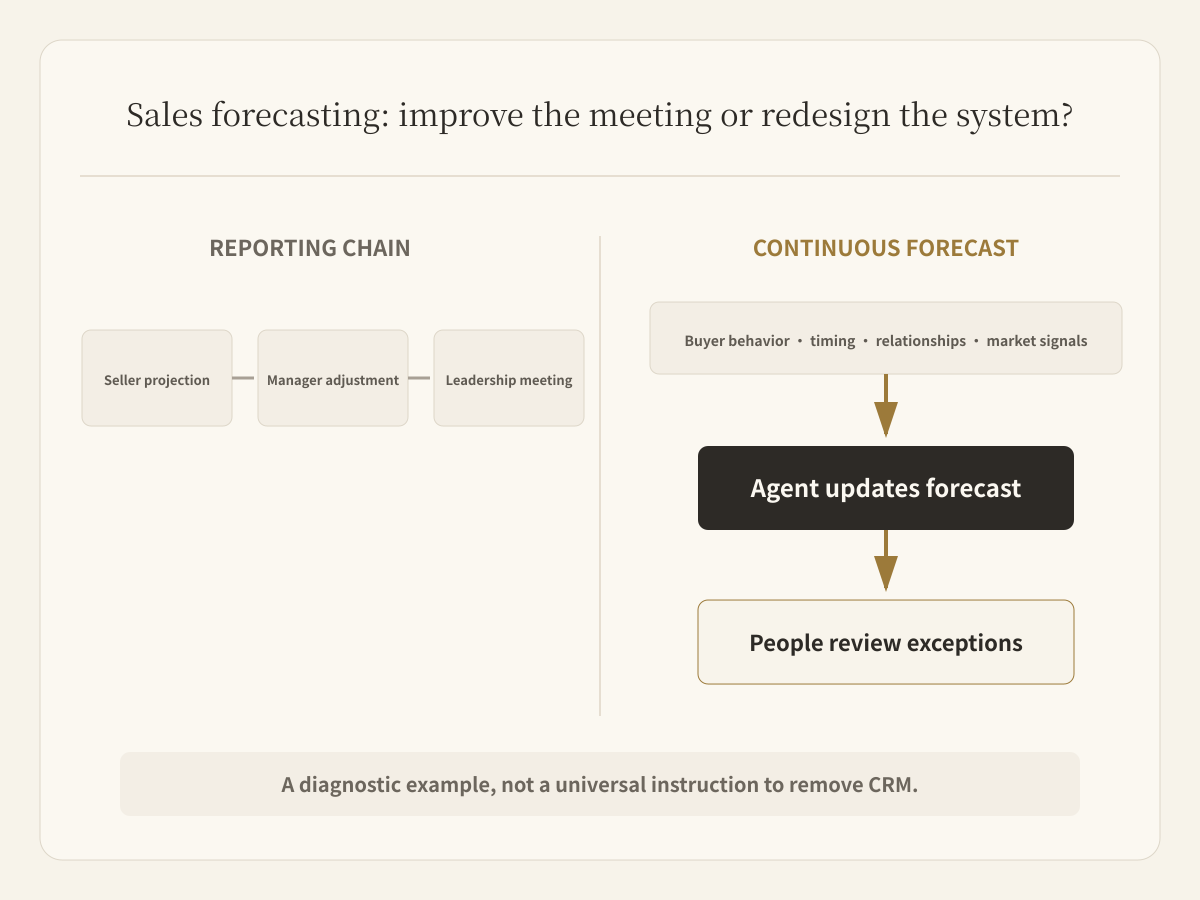
This is a diagnostic example, not a universal instruction to remove CRM or cancel forecast meetings. Data quality, permissions, commercial judgment, and accountability vary by company. The point is to ask whether a ritual creates judgment or merely compensates for a system that cannot see the work.
The company becomes a learning loop
Much of enterprise software was designed around human data entry and information movement.
People record what happened. Systems store it, route tasks, and generate reports. Managers reconstruct the situation across systems, make a decision in a meeting, and send that decision back down the organization.
When Agents can retain context, observe activity, use tools, and initiate the next step, pressure moves beyond individual software features. Roles built primarily around collecting, translating, summarizing, and relaying information also need to be reconsidered.
Leadership does not disappear. Judgment becomes more concentrated.
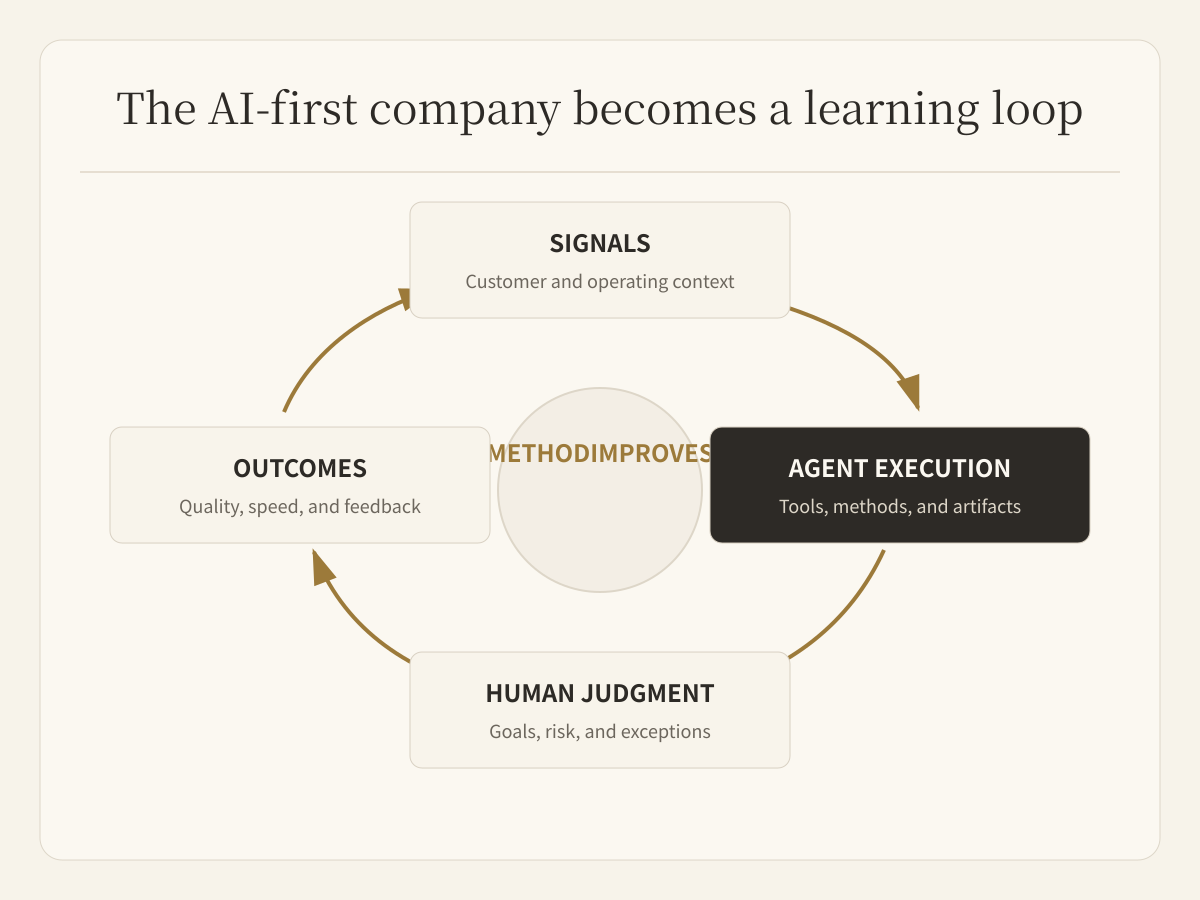
People still decide the objective, acceptable tradeoffs, risk boundaries, escalation rules, and who owns the final result. Frontline employees and people closest to customers become more important because they can see which steps create value and which exist only because the old system required them.
The organization can move from a long reporting chain to a shorter learning loop:
Business signals enter. Agents execute. People review important decisions. Outcomes update the method.
The durable advantage sits above the model
Models will improve. Prices will fall. Capabilities that feel exclusive today will become widely available.
A company cannot build a durable advantage from access to a model that every competitor can rent.
The advantage sits above it:
- proprietary business context;
- tools and permissions an Agent can use;
- methods the team has tested;
- customer relationships and operating signals;
- feedback from completed work;
- clear human review and escalation rules.
The same model can create very different value in two companies. The difference is not prompt style. It is whether the Agent receives the right context, can complete the real task, and helps the team improve the method after every outcome.
Redesign one workflow before redesigning the company
Do not begin with a company-wide transformation program. Choose one recurring workflow whose outcome is easy to inspect: customer research, sales follow-up, weekly reporting, content review, quote preparation, or support triage.
Then run a small redesign:
- Define the outcome. Choose response time, conversion, error rate, rework, or another observable result.
- Map the current work. List inputs, waits, handoffs, decisions, approvals, and deliverables.
- Classify every step. Remove, simplify, delegate to an Agent, or keep under human judgment.
- Run a bounded experiment. Start with low-risk work and explicit review points.
- Review outcomes, not activity. Compare quality, speed, and rework instead of counting prompts or messages.
Controls should match risk. Drafting from public information can move quickly. Payments, contracts, private data, and formal record changes need stronger permissions and review.
The choice is not “full autonomy” or “no AI.” It is to place judgment where the consequence requires it.
Turn the redesigned method into a working system
Buda is built for the step after the whiteboard.
Put source material and operating context in Drive and Memory. Let an Agent work inside a persistent Agent Workspace, where the conversation, files, tools, and artifacts remain visible. Turn the method that survives the experiment into reusable Skills and Automations.
The Agent carries the execution. People keep the objective, the exceptions, and the final decision.
That is how a one-off AI experiment becomes a repeatable company capability: not by adding another tool to the old process, but by removing what should no longer exist and making the remaining work easier to run, review, and improve.
Start with one real workflow in the Buda dashboard.