AI and Older Workers: Can Experience Extend a Career?
New research covered by CNBC suggests AI may shorten some older workers’ careers while helping others work longer. The dividing line is whether experience becomes a reviewable AI workflow.

For years, the AI jobs debate has focused on young workers: whether graduates can get a first job, whether junior roles will disappear, and whether entry-level work still creates a career ladder.
New research suggests the other end of that ladder is changing too.
CNBC reported on research from the Center for Retirement Research at Boston College showing that workers aged 55 and over in occupations with high AI exposure are leaving employment more often. Some transitions lead to unemployment; others reflect voluntary exits, moves into less AI-intensive work, or retirement.
The same technology could also have the opposite effect. If generative AI removes repetitive work and raises productivity, it may help experienced people work longer.
The important question is therefore not simply whether AI replaces older workers. It is whether companies use AI to discard experience—or to make that experience easier to apply.
AI can shorten or extend a career
The research describes three possible paths.
First, automation can remove enough tasks from a role that the worker becomes unemployed or exits the labor force.
Second, the pressure to adopt new systems can push someone toward a less AI-intensive job or an earlier retirement, even without a formal layoff.
Third, AI can make a job more sustainable. It can handle drafts, searches, formatting, scheduling, and other repetitive execution, leaving the person more time for judgment, communication, relationships, and complex decisions.
These outcomes are not determined by age alone. They depend on how the job is redesigned.
White-collar stability is no longer automatic
The most AI-exposed older workers in the study tend to have college degrees and higher earnings. The occupations with the highest exposure include web and interface designers, web developers, database architects, programmers, and data scientists.
That matters because education and office work traditionally helped people remain employed longer. Physical demands were lower, and expertise accumulated over time.
AI changes that protection. If software can perform more of the tasks inside a high-paying role, knowledge alone does not guarantee career longevity.
The research found that before ChatGPT, older people in highly exposed occupations were less likely to leave work. After ChatGPT, they became somewhat more likely to move out of employment, including into unemployment. The data does not prove that AI caused every departure, but it shows that previously stable white-collar careers are entering a new transition.
Experience still matters—if it becomes operational
Older professionals often hold exactly the skills that AI does not reproduce reliably: collaboration, leadership, relationship building, risk awareness, and judgment under incomplete information.
AARP and LinkedIn research cited by CNBC found that 49.4% of older workers, compared with 42.2% of younger workers, occupy roles considered more insulated from generative AI disruption.
But having experience is not the same as making experience usable.
A sales leader may know which customer signals indicate risk. A finance manager may recognize an invoice that looks normal but violates an unwritten rule. An operations lead may know which exception requires escalation.
If those judgments remain only in one person’s head, they are difficult to scale and easy to lose. If they become checklists, decision rules, examples, and review criteria, an AI agent can prepare the work while the experienced person keeps control of the important decisions.
The practical AI skill is workflow design
Learning one more chatbot is not enough. Monster research cited by CNBC found that 42% of surveyed workers did not use AI at all. Among those who did, common uses were still basic tasks such as email, scheduling, and writing support.
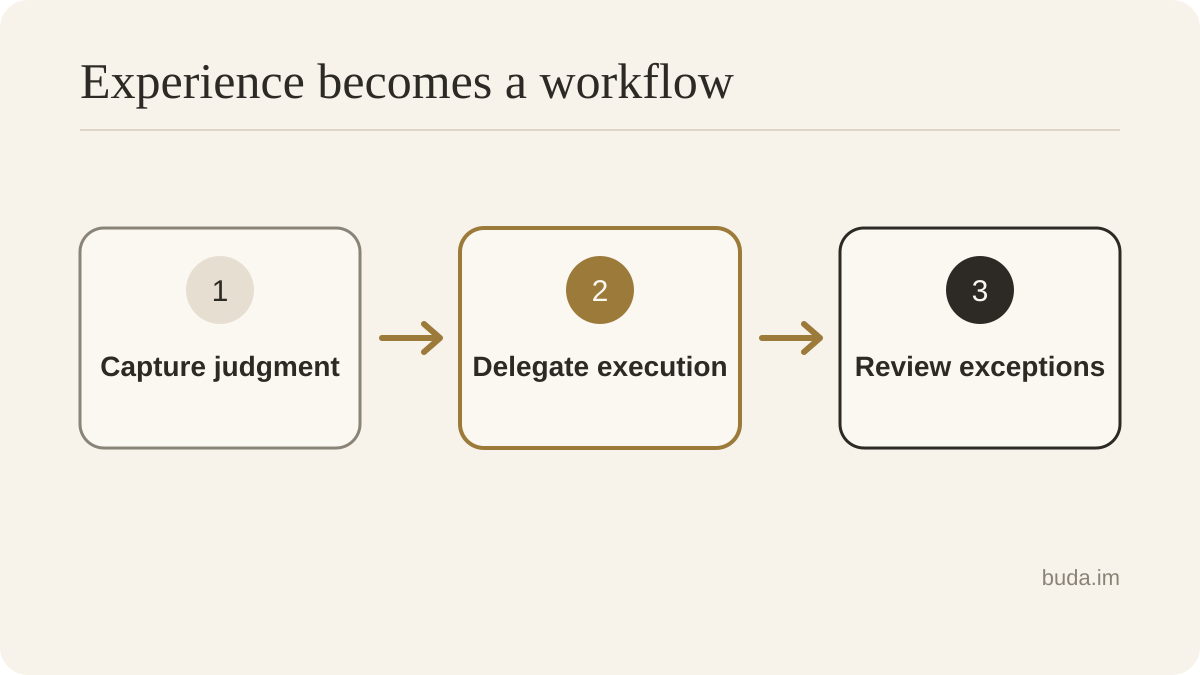
A more durable approach has three steps:
- Identify repetitive work that consumes time but needs little judgment.
- Write down the tacit rules used to evaluate quality, risk, and exceptions.
- Let agents prepare and execute, while a human reviews sensitive decisions.
This is how experience becomes leverage rather than history.
What employers should do
Companies should not treat AI literacy as a private exam that every employee must pass alone.
A better transition gives teams approved tools, role-specific use cases, time to learn, clear data boundaries, and visible review points. It also pairs experienced employees’ domain judgment with younger employees’ tool fluency instead of forcing the two groups to compete.
If a company automates the repetitive layer without capturing senior judgment, it may save short-term labor cost while losing institutional knowledge.
The Buda view: extend judgment, not just output
Buda is designed for this kind of managed AI work.
Drive gives agents persistent context. Skills turn repeatable methods and review criteria into reusable instructions. Automations handle recurring preparation. Channels bring people back when approval is needed. Sessions preserve a visible trail of what the agent did.
That makes it possible for an experienced employee to move from manually executing every step to designing the workflow, reviewing exceptions, and retaining accountability.
AI may shorten careers built only around procedural execution. It can also extend careers built around judgment, relationships, and responsibility—when those strengths are connected to a system that can execute them.
Explore the Buda Agent Workspace, or start building a reviewable workflow in the Buda dashboard.
Source: CNBC, “AI is changing older workers’ careers, research finds — here’s how,” published July 13, 2026, covering research from the Center for Retirement Research at Boston College.