AI Spending Is Heading for $2.5 Trillion. Only 34% of Executives Know Who Owns the Decisions
AI budgets are scaling faster than the leadership systems that define decisions, review, and accountability.

AI spending is approaching a number that is difficult to ignore.
Gartner forecasts worldwide AI spending of $2.527845 trillion in 2026, up 44% year over year. Infrastructure, software, and services account for most of that expansion.
Yet the larger the budget becomes, the harder it is to avoid a basic question: who decides how AI is used, who reviews the result, and who is accountable when it fails?
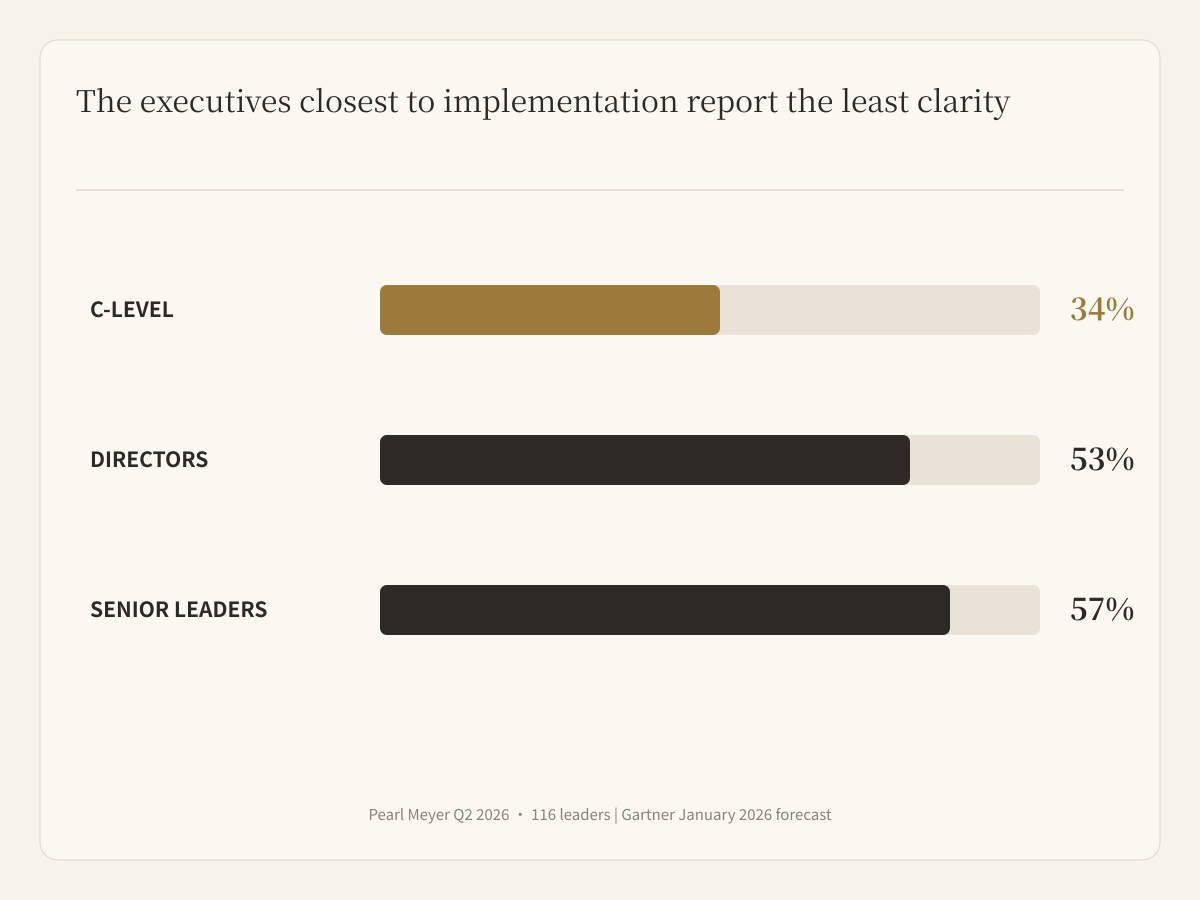
Pearl Meyer surveyed 116 directors, CEOs, other C-level executives, and senior leaders in May and June 2026. Only 34% of C-level respondents said the executive or team responsible for AI decisions is consistently clear. Directors and non-C-level senior leaders were more confident, at 53% and 57%.
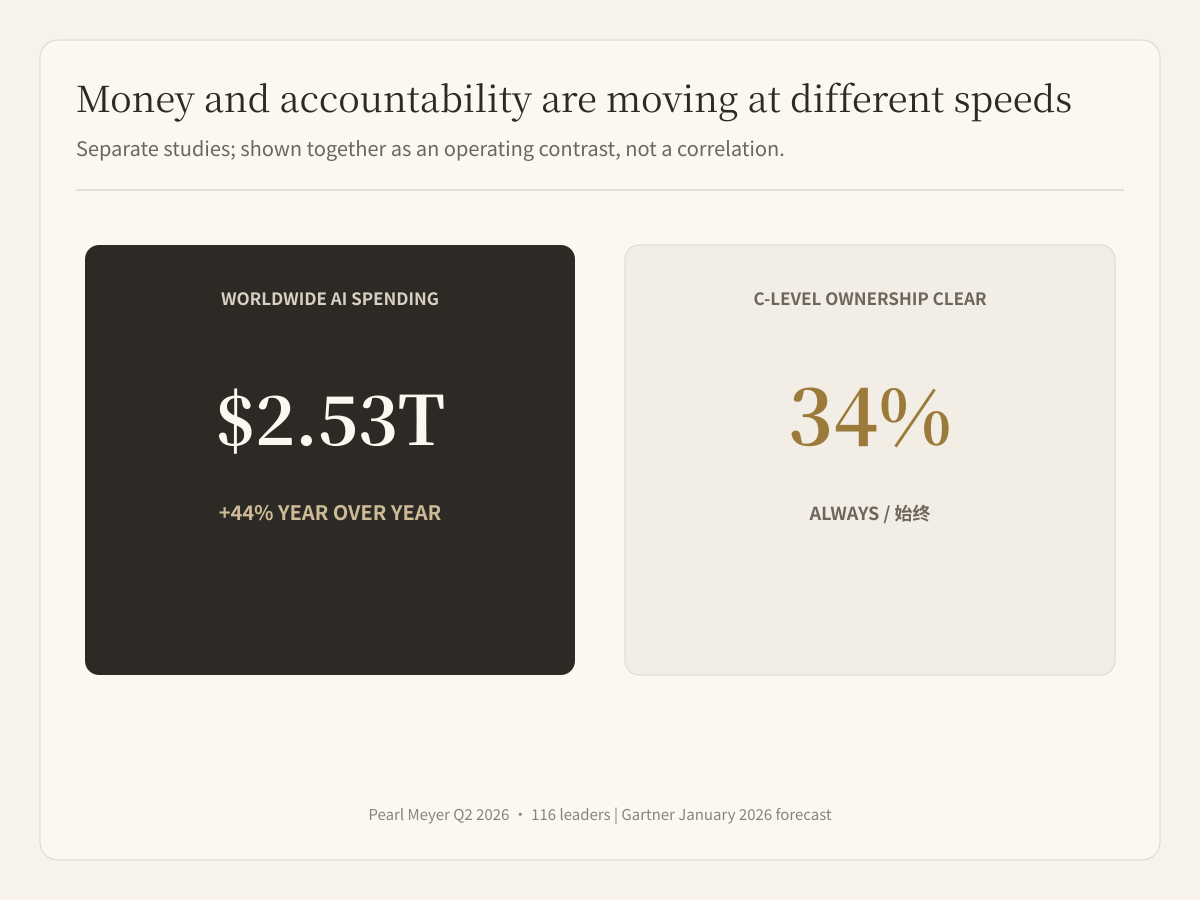
These figures come from different studies and do not establish a correlation. Together they show two systems moving at different speeds: capital and technical capability are scaling quickly; organizational accountability is not.
A leadership signal, not a census of global executives
Pearl Meyer's sample is small, and roughly one third of respondents came from financial services. It is useful for observing disagreement between leadership layers, not for estimating the views of every executive worldwide.
Gartner's $2.5 trillion is a worldwide market forecast, not the combined internal AI budgets of the surveyed companies.
The important signal is that the executives closest to cross-functional implementation are the least certain about final decision rights.
Shared participation can leave the complete outcome unowned
AI rarely belongs to one department. Technology handles systems and security. Business teams define use cases. Finance asks for returns. Legal sets constraints. HR manages roles and training. Data teams maintain quality.
Distributed work is necessary. Distributed accountability is dangerous when everyone owns one segment and nobody owns the end-to-end result.
A named “AI leader” does not fix this by itself. Each project must identify who sets the goal, who makes the Agent run, who reviews evidence and risk, who can stop an exception, and who approves the result.
CEOs see the strategic window; other executives see the load
Sixty-three percent of CEOs said employees could absorb more organizational change without becoming overstretched. Only 33% of other C-level executives and 40% of non-C-level senior leaders agreed.
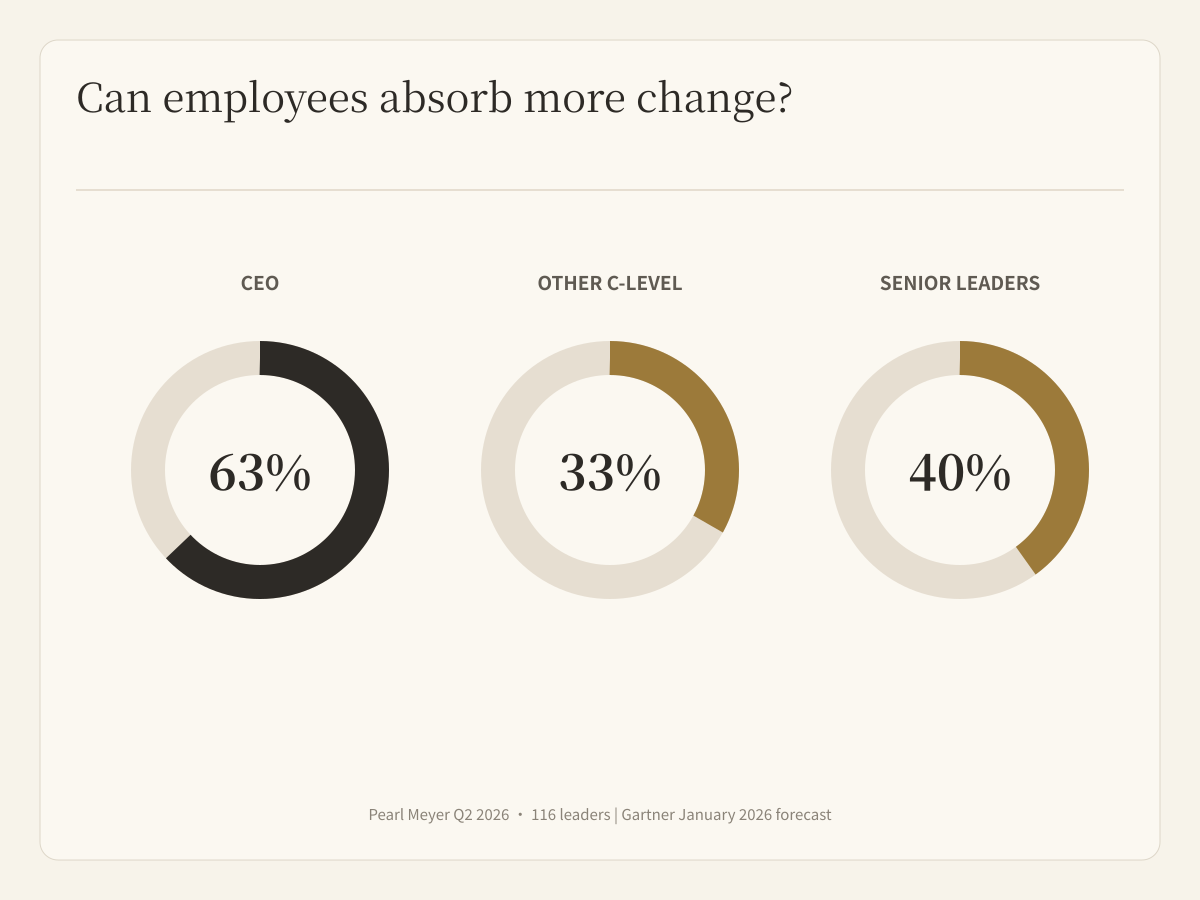
CEOs see competitor pressure and a narrow strategic window. Operating leaders see legacy systems that remain in place, new tools arriving, and employees expected to learn while meeting existing goals.
If an AI program adds tools and pilots without removing old work, redesigning ownership, and protecting learning time, it creates another layer of labor rather than transformation.
Funding is not an operating model
Eighty-eight percent of CEOs and 79% of C-level executives said their company must significantly change how it operates within three years. Only 42% of directors agreed.
An approved budget, a purchased platform, and several pilots can create the impression that the structure is ready. The difficult work is redesigning permissions, data access, review paths, performance measures, and exception handling.
When the board asks for ROI a year later, unclear accountability turns quickly into finger-pointing.
Replace “who owns AI?” with five inspectable roles
For every project, identify:
- Decision owner: approves the problem, objective, and budget.
- Executor: makes the Agent, tools, and workflow operate.
- Reviewer: checks sources, quality, permissions, and risk.
- Escalation owner: can pause work and resolve exceptions.
- Approver: decides whether the output may affect customers, operations, or trusted records.
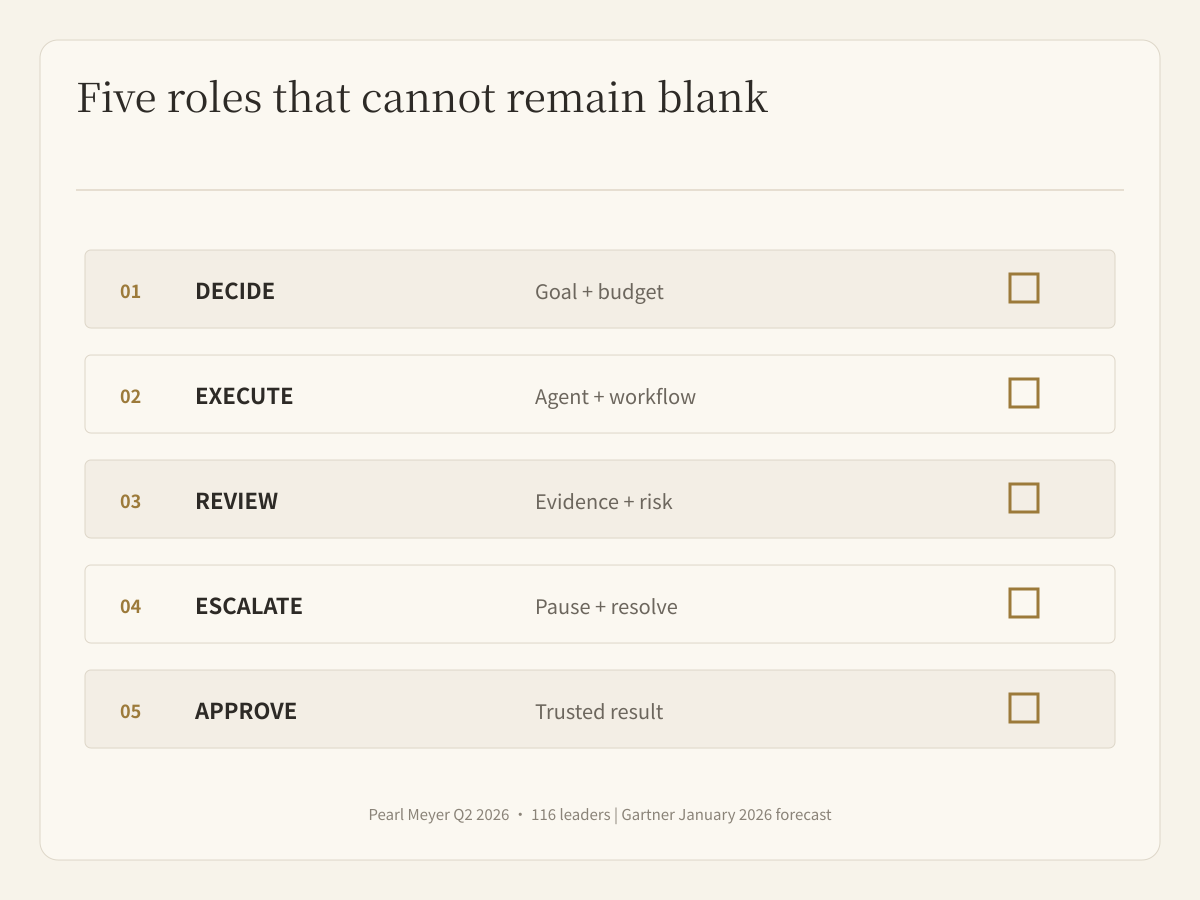
One person may hold several roles, but no role should be empty. Low-risk, reversible work can run directly. High-risk actions and trusted-record changes need explicit review.
Accountability must remain attached to execution
A responsibility matrix describes the design. Accountability lives in the run history.
In Buda, an Agent Session preserves the task, tool calls, and visible artifacts. A Skill preserves the validated method. An Automation records scheduled runs and status. Managers can inspect how work happened instead of receiving “AI did it” as an explanation.
When an Agent output must change a CRM, knowledge base, or another trusted business record, Busabase can place the proposed change in a ChangeRequest. A person reviews the exact diff, evidence, and reason before merge.
Buda makes Agent execution visible. Busabase governs which important changes become trusted records.
AI investment becomes organizational capability only when each project can answer three questions: who set the goal, who approved the result, and who accepts the consequence?
Read the Agent Workspace documentation, then choose one real AI project and assign the five roles before expanding Agent autonomy.
Sources: Pearl Meyer Q2 2026 Market Intelligence Survey, Gartner 2026 AI Spending Forecast