AI Startups Are Seniorizing Entry-Level Work
Fortune's report on AI startups hiring fewer entry-level workers points to a deeper shift: the first rung of the career ladder is being redesigned around agents and human judgment.

Fortune recently reported a sharp pattern in AI-native startups: they are hiring fewer entry-level workers and leaning more heavily toward experienced, technically strong talent.
The article cites research from Harvard Business School and INSEAD showing that AI-enabled startups employ about 15% fewer entry-level workers than comparable non-AI startups. They also have a higher share of senior employees, fewer managers, more engineers, and higher funding and valuation per employee.
That does not mean AI startups stopped hiring.
It means the first layer of work is changing.
The uncomfortable signal is not simply that young workers are being excluded. It is that many tasks once used to train new people are becoming agent work.
The first rung is getting thinner
For decades, the technology industry offered a clear story to ambitious young people: get in early, do the basic work, learn the system, and climb.
Entry-level roles were not glamorous, but they mattered. New employees learned through research, testing, documentation, spreadsheet cleanup, first drafts, bug reproduction, support triage, and small pieces of larger projects.
Those tasks created the first rung of the career ladder.
AI changes the economics of that rung.
If an agent can produce the first draft, run the first search, summarize the first dataset, or test the first version, companies may ask whether they still need the same number of people doing training work.
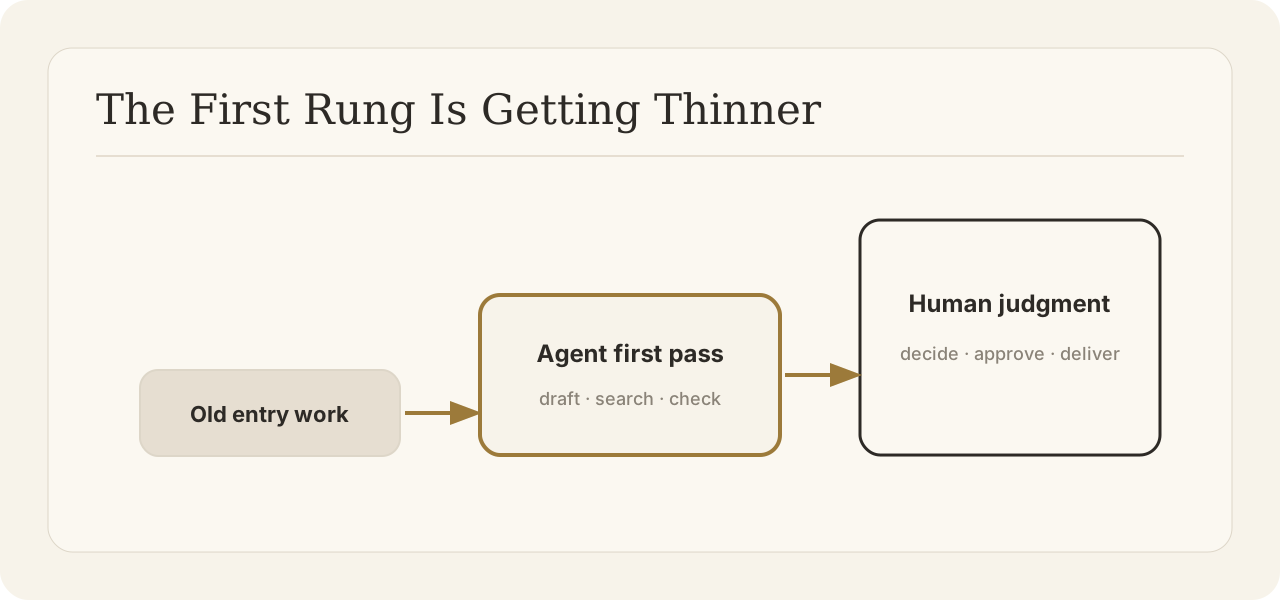
Entry-level work is becoming more senior
The point is not that every junior job disappears.
The point is that junior jobs are being asked to contain more senior behavior.
A new employee can no longer win only by being willing to execute. They increasingly need to know how to work with AI outputs: check them, improve them, connect them to the business goal, and turn them into something usable.
In practice, the entry-level filter changes from:
“Can you do the first step?”
to:
“Can you manage the first step when AI has already produced a draft?”
That is a much harder bar.
Why AI-native teams can stay smaller
AI-native startups are not simply replacing juniors with more managers. The research pattern is more interesting: fewer entry-level employees, fewer managers, more senior employees, more engineers, and smaller teams.
This points to a different organizational shape.
Agents absorb part of the basic execution and coordination layer. Senior people stay closer to the work. The team needs fewer handoffs because fewer people can move from idea to prototype to delivery.
That can make a startup faster.
It also makes the training path less obvious.
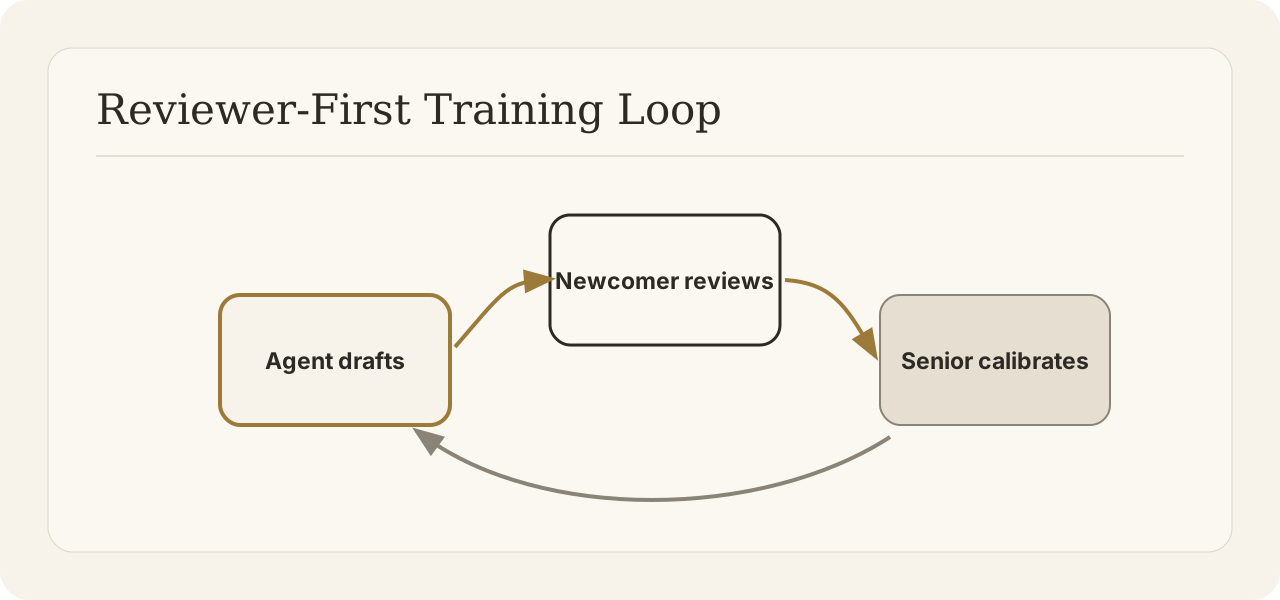
What newcomers should learn
The answer is not to panic or memorize more tools.
The answer is to train the layer AI does not automatically provide: judgment.
For newcomers, that means building three abilities early:
- understand the business problem behind the task;
- use agents to produce drafts, checks, and alternatives;
- review the output and decide what is safe, useful, and ready to ship.
The first job may no longer be about proving that you can do repetitive work patiently. It may be about proving that you can supervise machine execution responsibly.
What companies should not forget
There is also a management risk here.
If companies remove too much entry-level work, they may also remove the training ground that produces future senior talent. A company cannot only hire experienced reviewers forever. Someone has to learn how to become one.
The better strategy is not to abandon juniors.
It is to redesign junior work around agent supervision.
Let agents handle the heavy first pass. Let newcomers learn by reviewing, comparing, asking better questions, and seeing how senior people make decisions. Make the first rung less about manual execution and more about guided judgment.
The Buda view: teach people to manage agents earlier
Buda is built around this shift.
Drive gives agents context. Skills package repeatable methods. Automations watch recurring signals. Channels bring humans back into review. Sessions preserve the work trail.
That structure is not only useful for senior operators. It can also become a training environment for newcomers.
The human remains The Bunny: direction, taste, responsibility, and judgment.
The agents become The Claws: fast execution that drafts, searches, checks, and prepares.
If the first rung of the career ladder is being redesigned, the answer is not to teach people to compete with the claws. The answer is to teach them to become better bunnies earlier.
Start building a reviewable agent workflow in Buda, or learn how the Buda Agent Workspace helps teams manage AI execution without giving up human control.