Airbnb's AI Product Strategy: Ship Faster, Keep Humans in Control
Airbnb reports faster product delivery and lower support costs. Its results show how to build managed AI agent workflows without outsourcing judgment.

Airbnb says AI now participates in roughly 60% of its code. That is the number most likely to become a headline. It is not the number product leaders should manage.
The more useful evidence sits one level higher. Airbnb says some key initiatives now move from concept to delivery as much as 60% faster. In the first half of 2026, it shipped nearly 80% more features and improvements than in the same period a year earlier. Its AI support assistant resolves nearly 45% of the issues that begin with the assistant without a human agent, while support-related cost per booking fell about 16% year over year.
These figures do not prove that AI made every product decision better. They show something more practical: execution can become cheaper and faster when agents are placed inside a managed delivery system.
From Buda's perspective, that distinction matters. An AI-native team is not a team that asks a model to make every choice. It is a team that gives agents repeatable work, keeps context and artifacts visible, and leaves product direction, risk boundaries, and release decisions with people.
Three AI programs, three levels of evidence
Airbnb disclosed progress in product development, customer support, and consumer search. All three involve AI, but they are not equally mature.
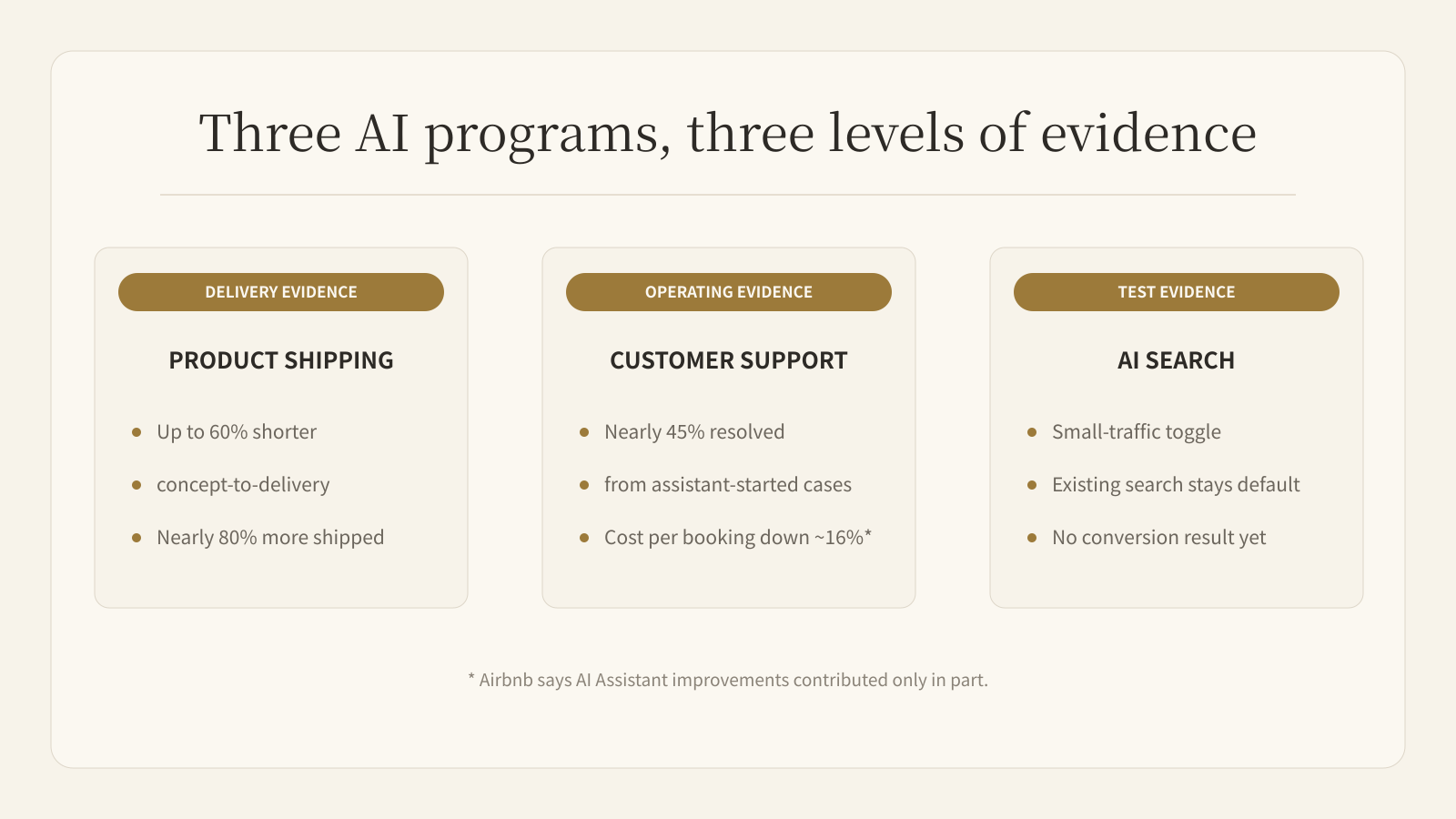
Product development has delivery evidence. Airbnb says that across some key initiatives, concept-to-delivery time fell by as much as 60%. It also reports nearly 80% more shipped features and improvements in the first half of the year. Airbnb attributes this to AI, a strong team, and better execution together, not to AI alone.
Customer support has operating evidence. Nearly 45% applies only to issues that begin with Airbnb's AI assistant. Airbnb did not disclose what share of all support issues enter that flow. The company also says the 16% decline in support-related cost per booking was driven only in part by improvements to the assistant.
AI search has test evidence. Airbnb plans to let a small group of users opt into natural-language search with a toggle while keeping the familiar search experience as the default. No conversion, booking, or retention result has been disclosed.
This is a useful maturity ladder: shipping speed, operating outcomes, and an early product experiment should not be reported as if they carry the same proof.
Code volume is not product velocity
If AI writes more code but requirements remain unclear, tests are weak, and release decisions wait in the same queue, the organization has produced more output without improving its system.
Product velocity is the time from a decision to reliable evidence. It includes research, specification, implementation, testing, launch, measurement, and correction. AI can reduce the execution cost in every one of those steps. It cannot decide which customer problem deserves the team's attention or what level of failure is acceptable.
Airbnb's more meaningful claim is therefore not “60% of code.” It is that some initiatives move from concept to delivery faster and that more improvements reach users. Those outcomes still need quality, adoption, and business metrics, but they are closer to the work a product leader is accountable for.
Faster shipping should create more learning
The value of a shorter delivery cycle is not simply more releases. It is more chances to test a judgment against reality.
A useful agent-assisted product loop looks like this:
- A person defines the user problem, success metric, constraints, and release boundary.
- Agents gather evidence, draft specifications, execute implementation work, run checks, and prepare artifacts.
- A person reviews the evidence and decides whether the work advances, changes, or stops.
- The team measures what happened in production and feeds the result into the next cycle.
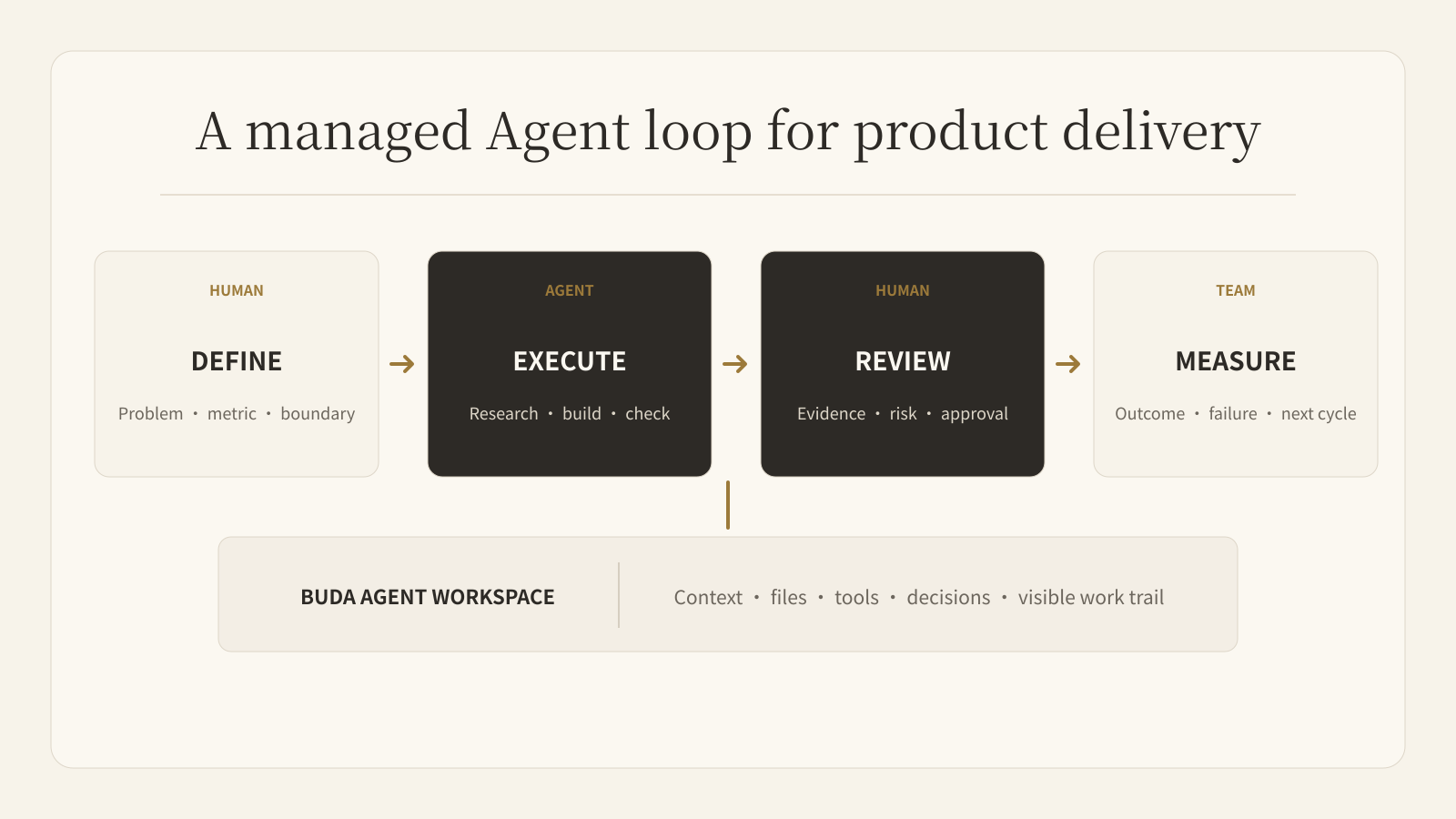
The human role becomes more important as execution accelerates. A weak requirement can now generate a large amount of polished work very quickly. A vague acceptance criterion can let the same error travel through research, code, copy, and support responses.
Speed needs explicit review points, not less accountability.
Airbnb's search toggle is a good release boundary
Airbnb is not replacing its existing search interface for everyone. It is testing AI search behind a toggle for a small share of traffic.
That choice preserves a working path while the company learns whether natural-language input produces better discovery and, eventually, more bookings. It also makes failure easier to compare. Users can opt into the new mode; the team can observe behavior before expanding it.
This pattern applies beyond search. When an agent changes a customer-facing workflow, start with a bounded task, a reversible release, and a measurable outcome. Do not turn an internal demo into a default product behavior before the evidence exists.
Support shows why escalation is part of the product
Airbnb's support result is not “AI replaced 45% of support.” The denominator is narrower: issues that begin with the AI assistant.
The important product is therefore not only the answer generator. It is the routing system around it. Standard issues should be resolved quickly. Ambiguous, disputed, or high-risk cases should reach a person with the context already assembled.
A support agent should be measured on more than deflection:
- autonomous resolution rate
- incorrect escalation and incorrect non-escalation
- resolution time
- cost per issue or transaction
- reopened cases, complaints, and customer satisfaction
Lower cost is useful only when service quality remains acceptable. A managed workflow makes both sides visible.
How Buda turns agent output into a delivery system
Buda is built around persistent agent workspaces rather than isolated chats. A product team can keep source material, requirements, decisions, generated files, and previous failures in one project. Agents can use reusable Skills to execute a method consistently, work with files and tools in a sandbox, and leave a visible trail for review.
The operating model is simple:
- People set intent: choose the problem, metric, constraints, and approval boundary.
- Agents execute: research, transform files, draft, test, compare, and prepare deliverables.
- The workspace preserves context: inputs, intermediate artifacts, and results stay together.
- Review controls progression: high-impact changes move only after a person checks the evidence.
- Skills and Automations preserve the method: successful work becomes repeatable instead of being rebuilt as a prompt every time.
Buda does not decide whether a feature deserves to ship. It reduces the friction between that decision and the evidence needed to make the next one.
Explore the Buda Agent Workspace or start building a managed agent workflow with Buda.
The management metric to keep
The strongest lesson from Airbnb's disclosure is not a code percentage. It is a change in the unit of management.
Do not ask only how much work AI produced. Ask how quickly the team reached a reviewable result, how often people caught the wrong path, what changed for the customer, and whether cost fell without quality falling with it.
Agents can make execution abundant. Product judgment is still the scarce resource.