AWS Summit New York 2026: What Bedrock AgentCore, AWS Context, and Kiro iOS Mean for AI Agents
A clear guide to AWS Summit New York 2026 AI agent announcements, including Bedrock AgentCore, AWS Context, and Kiro iOS.

AWS Summit New York 2026 was not just another cloud event.
It was a signal about where AI agents are going next.
In the official AWS News Blog roundup, AWS announced new capabilities across Amazon Bedrock AgentCore, AWS Context, Kiro, DevOps Agent, AWS Transform, Continuum, and Amazon Quick. The common thread is clear: agents are moving from demos into production systems.
That changes the question.
It is no longer enough to ask whether an AI agent can complete a task once.
Teams now need to ask whether the agent can access the right context, run safely, be monitored, be corrected, and improve over time.
That is why the AWS Summit New York announcements matter.
What AWS announced
The official AWS Summit New York 2026 roundup grouped the announcements around four kinds of agents:
- agents customers create;
- agents for security;
- agents for building;
- agents for work.
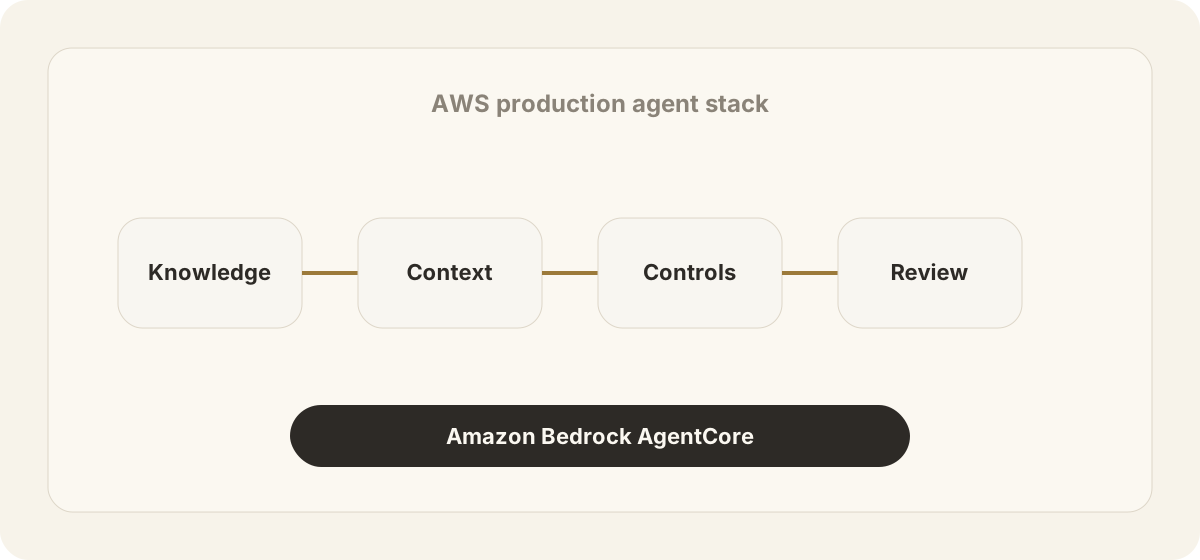
The most important product phrase for builders is Amazon Bedrock AgentCore.
AWS announced new AgentCore capabilities for connecting AI agents to organizational, web, and paid knowledge; helping teams find and fix production issues; and enforcing controls that scale as agents become more capable.
It also highlighted several related launches:
- Amazon Bedrock Managed Knowledge Base for managed enterprise RAG pipelines.
- Web Search on Amazon Bedrock AgentCore for current, cited web knowledge within a secured AWS environment.
- Bedrock AgentCore harness GA for building and running production-grade agents through configuration.
- AWS Context, a coming service that maps existing data relationships into a knowledge graph for agents.
- Kiro for iOS, a mobile surface for monitoring, steering, reviewing diffs, and approving coding-agent work.
- AWS DevOps Agent release-readiness review and autonomous release testing.
- AWS Transform continuous modernization for autonomous codebase analysis and remediation pull requests.
This is a wide set of announcements, but the product direction is narrow.
AWS is building the infrastructure around agents.
Why Bedrock AgentCore matters
Bedrock AgentCore is an answer to a practical problem.
The hard part of agents is no longer only the model. The hard part is everything around the model: knowledge, tools, permissions, execution, monitoring, incident response, and continuous improvement.
An enterprise agent needs to know where information lives. It needs approved tools. It needs a way to search current web knowledge without leaking data. It needs production telemetry when something goes wrong. It needs controls that can scale beyond one team.
That is why the AgentCore language is useful for SEO and for buyers. People will search for it because it names the layer many teams are missing.
Not the chatbot.
Not just the model.
The agent runtime and operations layer.
AWS Context is the other important phrase
AWS Context may become the more strategic idea.
According to AWS, it will automatically map relationships across existing data into a knowledge graph and provide agentic search so agents can access governed data relationships, business rules, and domain knowledge at runtime.
That matters because most enterprise agents fail quietly before they fail loudly.
They do not always fail because the model is weak.
They fail because context is scattered across files, tickets, docs, Slack threads, databases, and personal memory. The agent can reason, but it is reasoning from an incomplete map.
A context layer gives agents a better starting point.
For teams watching this category, the search term to remember is not only AI agent. It is agent context.
Kiro iOS shows the human review layer
Kiro for iOS is the most human part of the announcement.
AWS describes it as a native iOS app for real engineering work: starting sessions, checking progress, reviewing diffs, approving changes, and interacting with Kiro sessions from a phone.
That is important because AI coding agents are asynchronous by nature.
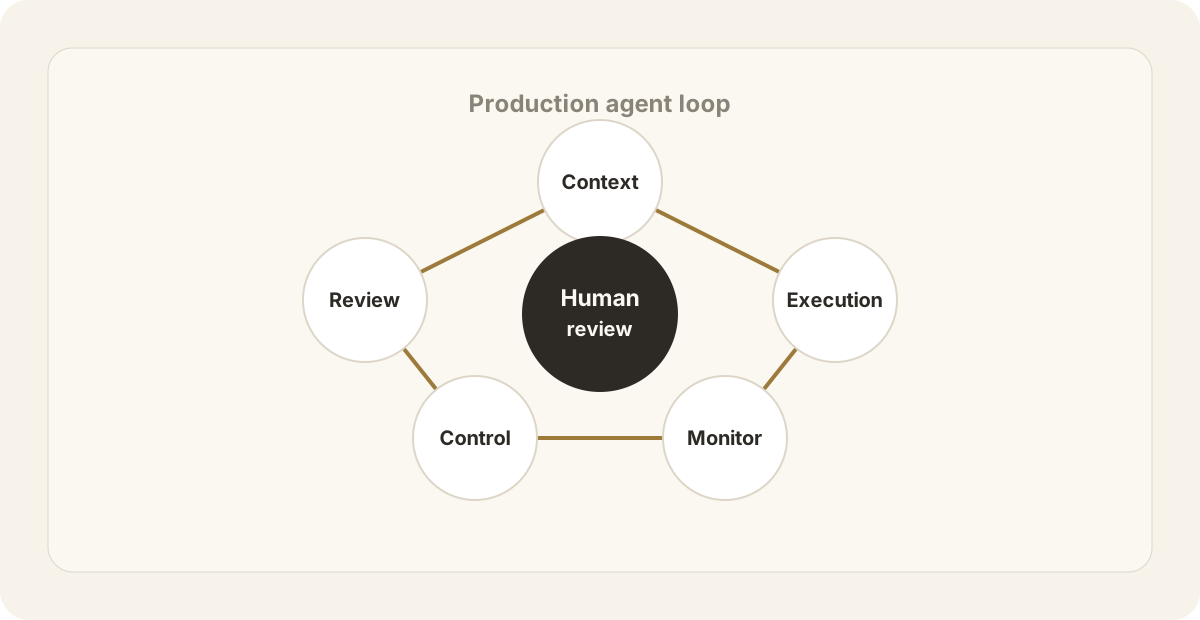
They start work. They continue while the human is elsewhere. They need checkpoints. They need approvals. They need a place where the human can inspect what changed before anything lands.
The phone is not replacing the developer workstation.
It is becoming a review surface for agent work.
How this connects to Buda
Buda is built around the same shift.
An AI Agent Workspace is not only a chat box. It is where context, tools, files, browser work, terminal execution, session history, and human review come together.
When agents do real work, the human role becomes more managerial:
- define the task;
- provide or approve context;
- inspect the tool calls;
- review the output;
- redirect the work;
- approve sensitive actions.
AWS is using cloud infrastructure language: AgentCore, Context, Continuum, DevOps Agent, Kiro.
Buda uses workspace language: Spaces, sessions, Drive, terminal, browser, tool logs, channels, and human review.
The shape is similar.
AI agents need a place to work, and humans need a place to manage them.
The SEO takeaway
If you are following AWS Summit New York 2026, the key terms are:
- Amazon Bedrock AgentCore
- AWS Context
- Kiro iOS
- AWS AI agents
- production AI agents
- agentic AI on AWS
But the deeper story is simpler.
Agent products are no longer only racing to be smarter.
They are racing to become operable.
Start building human-led agent workflows at buda.im, or read the Buda Agent Workspace docs.