Best LangChain Alternatives: 2026 Guide
Compare the best LangChain alternatives in 2026 for RAG, agents, lightweight LLM apps, structured outputs, team workspaces, and enterprise AI workflows.

The best LangChain alternatives in 2026 depend on what you are building. LlamaIndex and Haystack are strong for RAG, OpenAI Agents SDK or plain Python works well for lightweight LLM apps, CrewAI and LangGraph fit multi-agent workflows, and Buda is a strong choice for team-based agent workspaces. The real problem is not finding more tools. It is avoiding heavy abstractions, poor debugging, scattered workflows, and agent work that teams cannot easily review.
These problems get worse once an AI app moves from demo to production. Buda helps teams manage agents in a visible, persistent, and reviewable workspace instead of forcing every workflow into another complex framework.
Buda works as an integrated agent workspace for teams. It brings persistent agents, shared context, files, browser, terminal, Git, and human review into one workflow. For teams building real agent operations, this means clearer supervision, fewer black-box outputs, and a smoother path from AI experimentation to production work.

What Are the Best LangChain Alternatives in 2026?
LangChain is still one of the most recognized frameworks for building LLM applications, but it is not always the best fit for every team. In 2026, the strongest LangChain alternatives are more specialized: some focus on RAG, some on agents, some on structured outputs, and some on cloud-native enterprise deployment.
The best alternative depends on what you are actually building. A document-heavy RAG app needs a different stack from a multi-agent workflow, and a simple tool-calling chatbot may not need a framework at all.
Quick Answer: The Best LangChain Alternative Depends on Your Use Case
Choose LlamaIndex or Haystack if your main problem is RAG, private data, document search, or retrieval quality. LlamaIndex describes itself as a data framework for building LLM apps, while Haystack describes itself as an open-source AI framework for production-ready AI agents, RAG applications, and multimodal search systems.
Choose OpenAI Agents SDK, OpenAI tool/function calling, or plain Python if your app is lightweight and you want fewer abstractions. OpenAI describes its Agents SDK as a lightweight package for building agentic AI apps with very few abstractions.
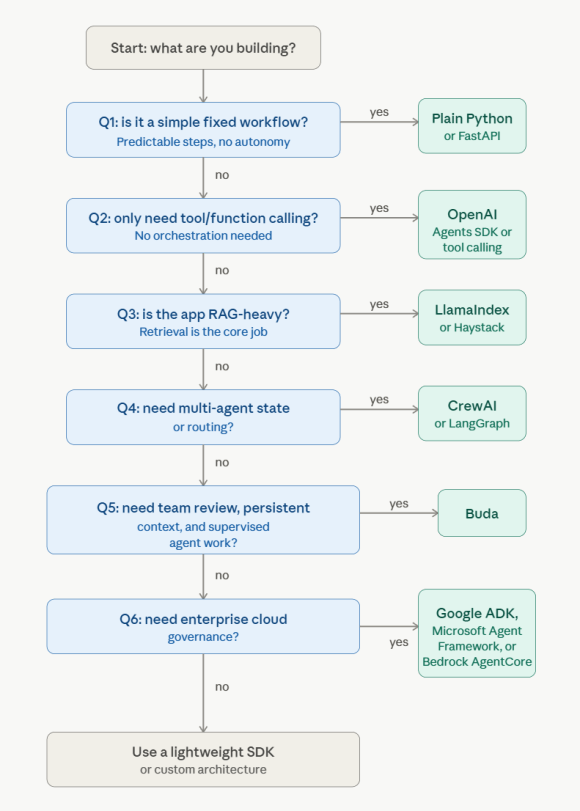
Choose CrewAI or LangGraph if your workflow needs multiple agents, roles, state, routing, or long-running orchestration. CrewAI focuses on multi-agent workflows, while LangGraph is a LangChain ecosystem option for long-running, stateful workflows and agents.
Choose Buda if your problem is team-based agent execution rather than framework-level orchestration. Buda is best understood as a cloud-native agent workspace for persistent, reviewable, supervised agent work.
LangChain Alternatives at a Glance
| Use Case | Best Alternatives | Best Fit |
|---|---|---|
| RAG and private data | LlamaIndex, Haystack | Knowledge bases, document Q&A, retrieval-heavy apps |
| Lightweight LLM apps | OpenAI Agents SDK, tool/function calling, plain Python | Simple agents, internal tools, tool calling |
| Multi-agent workflows | CrewAI, LangGraph | Role-based agents, stateful workflows, routing |
| Team-based agent workspace | Buda | Persistent agent work, team review, shared context |
| Structured outputs and routing | PydanticAI, Instructor, LiteLLM | JSON outputs, validation, model routing |
| Cloud-native enterprise agents | Google ADK, Microsoft Agent Framework, Amazon Bedrock AgentCore | Managed deployment, governance, enterprise infrastructure |
The key is not to ask, “Which tool has the most features?” The better question is, “Which tool gives my team the right level of control without making the system harder to debug?”
How I Evaluated These LangChain Competitors
I evaluated these alternatives by five practical criteria:
- Architecture fit: RAG, agent workflow, structured output, workspace, or cloud deployment.
- Abstraction level: Whether the tool hides too much or exposes enough control.
- Debugging experience: How easy it is to inspect prompts, tool calls, retrieval steps, and failures.
- Production readiness: Whether the tool supports testing, monitoring, retries, state, and team workflows.
- Migration risk: How much code or process a team may need to change.
In real projects, the best LangChain replacement is rarely the tool with the longest feature list. It is usually the one that makes the application easier to reason about after the prototype works.
Why Look for a LangChain Alternative in 2026?
Developers usually look for LangChain alternatives for one of four reasons: the app is too simple for a full framework, the framework abstractions make debugging harder, the team wants more stable production control, or the business workflow needs a different layer entirely.
LangChain remains useful, especially for teams already invested in its ecosystem. But when an app moves from demo to production, the pain points become more visible.
LangChain Can Be Too Abstract for Simple LLM Apps
LangChain is powerful because it offers many abstractions, integrations, and patterns. The tradeoff is that a simple workflow can start to feel heavier than necessary.
For example, a basic app may only need to:
- Accept user input
- Retrieve a small amount of context
- Build a prompt
- Call a model
- Validate the output
- Return a response
In that case, plain Python, FastAPI, direct SDK calls, or tool/function calling may be clearer than wrapping the same logic in chains, agents, callbacks, and memory layers.
Debugging Chains, Agents, Memory, and Callbacks Can Be Difficult
The hardest part of LLM development is often not getting the first demo to work. It is understanding why the app failed on a strange input, a bad retrieval result, a malformed tool call, or a missing piece of context.
In practical implementation, teams need direct visibility into:
- The exact prompt sent to the model
- Retrieved chunks and metadata filters
- Tool inputs and outputs
- Intermediate agent decisions
- Validation failures
- Cost and latency by step
If a framework makes these steps hard to inspect, the team may move faster in the prototype but slower in production.
API Changes and Deprecation Warnings Can Increase Maintenance Cost
LLM frameworks are evolving quickly. That is good for innovation, but it can create maintenance pressure for production teams.
When a framework changes namespaces, abstractions, recommended patterns, or agent APIs, the cost is not just code migration. The larger cost is team confusion: different engineers may start solving the same problem in different ways.
This is one reason lightweight SDKs and custom Python architectures remain attractive. They may have fewer built-in features, but they can also make ownership clearer.
Production AI Apps Need More Than a Fast Prototype
A fast prototype proves that an idea is possible. A production AI app must prove that the workflow is reliable, observable, safe, and maintainable.
A production system usually needs:
- Logging and traces
- Prompt versioning
- Retrieval evaluation
- Tool permissions
- Retry logic
- Human review
- Cost monitoring
- Failure recovery
- Security controls
This is why some teams replace LangChain with Haystack for RAG, LangGraph for stateful orchestration, Buda for supervised agent workspaces, or cloud-native tools for enterprise deployment.
When LangChain Still Makes Sense
LangChain still makes sense when your team benefits from its ecosystem, integrations, and related tools. Its ecosystem includes LangGraph for stateful workflows and LangSmith for observability. LangGraph is described as low-level infrastructure for long-running, stateful workflows and agents.
LangChain is also useful when you need to prototype quickly across many model providers, tools, and data sources.
The point is not that LangChain is bad. The point is that not every LLM app needs the same level of abstraction.
Do You Really Need a Framework or Just Plain Python?
Before choosing a LangChain alternative, ask whether you need another framework at all. Many LLM apps are ordinary software systems with one or more model calls inside them.
A clear custom architecture can sometimes be easier to test, review, and maintain than a large AI framework.
When Plain Python Beats Any AI Framework
Plain Python is often the best choice when your workflow is simple and stable.
For example:
User input → retrieval → prompt → model call → validation → response
If your system looks like this, a framework may not add much value. You can write each step as a normal function, test each function separately, and log the inputs and outputs directly.
This works especially well for internal tools, simple chatbots, extraction workflows, and controlled RAG systems.
When OpenAI Tool/Function Calling Is Enough
OpenAI tool/function calling can replace many basic LangChain agent use cases. If the model only needs to choose from a small set of tools, you may not need a full agent framework.
The OpenAI Agents SDK supports tools that let agents fetch data, run code, call external APIs, and use a computer.
This approach is easier to debug because the tool schema, arguments, and returned values stay close to the model API.
It works best when:
- The tool list is small
- The workflow is short
- The model provider is already chosen
- The business logic lives in your own app
- You do not need complex multi-agent routing
When Custom Retrievers, Prompts, and Tool Logic Are Easier to Maintain
In RAG systems, the hardest problems often live in the data layer, not the framework layer.
A custom implementation can make it easier to control:
- Chunking
- Metadata filters
- Hybrid search
- Reranking
- Prompt construction
- Citations
- Access control
- Evaluation
In practical RAG work, a simple system with clear retriever logic is often easier to maintain than a complex chain that hides how context was selected.
When a Full LLM Framework Still Saves Time
A full framework is useful when your system needs patterns that are hard to rebuild from scratch.
Examples include:
- Complex multi-agent orchestration
- Long-running workflows
- Shared state
- Persistence
- Human-in-the-loop checkpoints
- Built-in evaluation
- Deep integration with cloud infrastructure
The key is to adopt a framework when it removes real complexity, not just because it makes the first demo look cleaner.
Best LangChain Alternatives: Core Recommendations by Use Case
The best LangChain alternative depends on your app category. Below are the six most practical categories for 2026.
Best for RAG and Private Data Apps: LlamaIndex or Haystack
Recommended alternatives: LlamaIndex, Haystack
Best for: RAG apps, private knowledge bases, document Q&A, retrieval-heavy workflows, and search-based AI products.
LlamaIndex is one of the strongest starting points when the core task is connecting private data to LLMs. Its strength is the data layer: data connectors, indexes, query interfaces, and context-augmented responses. LlamaIndex describes itself as a data framework for building LLM apps and highlights connectors for APIs, PDFs, documents, SQL, and other data sources.
In practical use, LlamaIndex is most useful when the application is centered on internal documents, product manuals, PDFs, knowledge bases, or private datasets. It helps when the main question is, “How do I get the right context into the model?”
However, LlamaIndex is not always the lightest option. If you want to fully control every retrieval step, metadata filter, prompt format, and output validation path, you may still prefer custom code around your vector database and model API.
Haystack is often a better fit when you want a more modular production RAG pipeline. Haystack’s documentation describes it as an open-source AI framework for production-ready AI agents, retrieval-augmented generative pipelines, and multimodal search systems.
The practical advantage of Haystack is pipeline clarity. Haystack pipelines are directed multigraphs of components and integrations, which means teams can connect components in flexible ways instead of forcing everything through one linear chain.
Choose LlamaIndex if your app is data-connection heavy. Choose Haystack if your team wants cleaner production pipelines, clearer component boundaries, and easier step-by-step debugging.
Best for Lightweight LLM Apps: OpenAI Agents SDK, Tool/Function Calling, or Plain Python
Recommended alternatives: OpenAI Agents SDK, OpenAI tool/function calling, plain Python, FastAPI
Best for: simple agents, tool calling, lightweight production workflows, simple chatbots, and internal automation.
OpenAI Agents SDK is a strong alternative when your app is already OpenAI-native and needs agents without a heavy framework layer. OpenAI describes the SDK as lightweight and easy to use, with very few abstractions.
This category is important because many teams do not actually need a full LangChain replacement. They need a cleaner way to call tools, manage a few steps, validate outputs, and keep their business logic readable.
In real implementation reviews, the best lightweight architecture often looks boring:
FastAPI route→ validate input→ retrieve context if needed→ call model or tool→ validate output→ store logs→ return response
That boring structure is often easier to maintain than a clever agent abstraction. It also makes it easier for backend engineers, security teams, and product teams to understand what the system is doing.
Choose OpenAI Agents SDK if you want a structured agent layer close to OpenAI’s ecosystem. Choose tool/function calling or plain Python if your workflow is simple and you want maximum control.
Avoid this route if your app needs complex state, multi-agent routing, long-running processes, or advanced observability from day one.
Best for Multi-Agent and Stateful Workflows: CrewAI or LangGraph
Recommended alternatives: CrewAI, LangGraph
Best for: multi-agent workflows, role-based agents, task delegation, stateful orchestration, and complex agent routing.
CrewAI is a strong option when you want agents with different roles, responsibilities, and collaborative task flows. CrewAI describes itself as an open-source Python framework with high-level abstractions and low-level APIs for building multi-agent workflows.
In practice, CrewAI makes the most sense when the system can be naturally described as multiple roles. For example, a researcher agent, writer agent, reviewer agent, and planner agent may work together on a content, research, or analysis workflow.
LangGraph is not a completely separate external replacement for LangChain. It is better understood as a LangChain ecosystem option for stateful orchestration. LangGraph provides low-level supporting infrastructure for long-running, stateful workflows and agents, and it does not abstract prompts or architecture.
This distinction matters. CrewAI is easier to think about when the mental model is “agents working together.” LangGraph is better when the mental model is “a controlled state machine with model-powered steps.”
Choose CrewAI for role-based agent collaboration. Choose LangGraph for stateful workflows where you need to inspect and control each transition.
Both can be overkill for simple chatbots, simple RAG systems, or one-step tool calling. If you can describe the workflow in five plain Python functions, start there first.
Best for Team-Based Agent Workspaces: Buda
Recommended alternative: Buda
Best for: cloud-native agent workspaces, supervised agent execution, team-based AI operations, persistent agent work, and reviewable outputs.
Buda belongs in a different category from code-first frameworks. It is not mainly a Python RAG framework like LlamaIndex or Haystack, and it is not a lightweight SDK like OpenAI Agents SDK.
Buda is best positioned as a cloud-native AI agent workspace for teams that need to run, supervise, and review persistent agent work. Buda’s official agent workspace page highlights shared memory, files, browser, terminal, Git, and human review in one place.
This matters because some teams do not only need a way to build agents. They need a way to supervise agent work.
In real workflows, agents may need to read files, open a browser, run commands, edit documents, inspect code, update Git, and wait for human feedback. If all you receive is a final answer, the agent becomes a black box.
Buda is useful when the team needs:
- Persistent agent context
- Reviewable execution steps
- Shared files and memory
- Browser, terminal, and Git workflows
- Human review before final delivery
- Team visibility into what agents are doing
Choose Buda when your bottleneck is not the model call, but the workspace around the agent. It is especially relevant for operations, research, coding, marketing, and team workflows where reviewability matters.
Do not choose Buda if you only need a low-level Python library for a custom RAG pipeline. In that case, LlamaIndex, Haystack, plain Python, or a direct SDK will fit better.

Best for Structured Outputs and Model Routing: PydanticAI, Instructor, or LiteLLM
Recommended alternatives: PydanticAI, Instructor, LiteLLM
Best for: JSON output, schema validation, extraction workflows, multi-provider routing, model switching, and cost-control experiments.
PydanticAI and Instructor are useful when the problem is not full orchestration but reliable structure.
PydanticAI uses Pydantic to build JSON schemas for structured outputs and validates both structured outputs and tool arguments.
Instructor focuses on structured outputs with automatic validation and retries, especially when teams need reliable, validated data from LLMs.
These tools are strong for:
- JSON extraction
- Entity extraction
- Form filling
- Classification
- Typed outputs
- Validation-heavy workflows
- Simple production automation
LiteLLM solves a different problem: model routing. Its documentation says it provides a single unified interface to call 100+ LLMs, including OpenAI, Anthropic, Vertex AI, Bedrock, and more, using the OpenAI format.
This category is best when you do not need a full agent framework. You need predictable outputs, safer validation, or flexible provider access.
Choose PydanticAI or Instructor when output correctness matters. Choose LiteLLM when provider flexibility, fallback routing, or model switching matters.
Best for Cloud-Native Enterprise Agents: Google ADK, Microsoft Agent Framework, or Amazon Bedrock AgentCore
Recommended alternatives: Google ADK, Microsoft Agent Framework, Amazon Bedrock AgentCore
Best for: enterprise deployment, managed infrastructure, cloud-native security, cloud observability, and teams already committed to Google Cloud, Microsoft, or AWS.
Cloud-native tools are not always lighter than LangChain. They are usually better when your organization already depends on a major cloud platform and wants managed deployment, identity, observability, and governance. Those looking for the best enterprise AI platforms often start here.
Google ADK is a strong fit for teams building around Gemini and Google Cloud. Google describes ADK as an open-source agent development framework for building, debugging, and deploying reliable AI agents.
Microsoft Agent Framework is better for teams already working in Microsoft, Azure, .NET, or enterprise automation environments. Microsoft documentation describes Agent Framework workflows as graph-based workflows that connect agents and functions for multi-step tasks with type-safe routing, checkpointing, and human-in-the-loop support.
Amazon Bedrock AgentCore is a better fit for AWS-native teams. AWS documentation describes AgentCore as integrating with Memory, Gateway, Browser, Code Interpreter, and Observability, while supporting remote MCP servers, inline functions, and custom container environments.
Choose cloud-native tools when your company values managed infrastructure, enterprise controls, and cloud integration more than portability.
Watch out for vendor lock-in. Once your agent runtime, memory, identity, monitoring, and deployment are deeply tied to one cloud, migration can become expensive.
How to Choose the Right LangChain Alternative
Choosing the right LangChain alternative starts with your application type, not the tool list.
The wrong approach is to ask, “What is the most popular framework?” The better approach is to ask, “What failure mode am I trying to avoid?”
Start With Your Application Type
Start by naming the real application category:
| App Type | Better Starting Point |
|---|---|
| Document Q&A | LlamaIndex or Haystack |
| Simple chatbot | Plain Python or OpenAI SDK |
| Tool-calling assistant | OpenAI Agents SDK or tool/function calling |
| Multi-agent workflow | CrewAI or LangGraph |
| Team agent operations | Buda |
| Structured extraction | PydanticAI or Instructor |
| Enterprise cloud deployment | Google ADK, Microsoft Agent Framework, or Bedrock AgentCore |
If the application type is unclear, the framework choice will also be unclear.
Compare Abstraction Level Before Comparing Features
A tool with more features is not always better. More abstraction can mean less control.
Ask these questions:
- Can I see the exact prompt?
- Can I inspect retrieved context?
- Can I test each step alone?
- Can I replace one component without rewriting everything?
- Can a new engineer understand the workflow quickly?
If the answer is no, the tool may slow you down later even if it speeds up the demo.
Check Debugging and Observability Early
Debugging should be evaluated before production, not after.
For RAG, check whether you can inspect:
- Retrieved documents
- Chunk scores
- Metadata filters
- Reranking results
- Citations
- Final prompt context
For agents, check whether you can inspect:
- Tool calls
- State transitions
- Memory changes
- Failed actions
- Human review points
- Retry behavior
If the framework hides these details, production debugging will be harder.
Test API Stability and Documentation Quality
Documentation matters because LLM frameworks change quickly.
Before committing to a tool, test whether your team can:
- Follow the official quickstart
- Extend the basic example
- Find current API references
- Understand migration notes
- Build a small production-like workflow
- Explain the architecture to another engineer
A framework that looks good in a tutorial may still be hard to maintain if the docs are fragmented or the recommended patterns keep changing.
Avoid Choosing a Framework Only Because the Demo Looks Fast
A fast demo is useful, but it is not proof of production fit.
Before choosing any LangChain alternative, build a small test that includes:
- Real data
- Real tool calls
- Error handling
- Logging
- Bad inputs
- Permission checks
- Output validation
- Deployment constraints
The best tool is the one that remains understandable when the app fails.
When You Should Still Use LangChain
LangChain is still worth using in several situations. A balanced evaluation should not treat every alternative as automatically better.
The real question is whether LangChain solves more problems than it creates for your specific team.
You Need a Large Integration Ecosystem
LangChain can be useful when you want broad model, tool, retriever, and integration coverage.
If your team is exploring many data sources, vector stores, model providers, and agent patterns, LangChain may reduce setup time.
This is especially true during research, prototyping, and early product discovery.
You Already Use LangGraph or LangSmith
If your team already uses LangGraph or LangSmith successfully, replacing LangChain may not be necessary.
LangGraph is part of the LangChain ecosystem and focuses on long-running, stateful workflows and agents. LangGraph’s documentation also describes benefits such as persistence, streaming, debugging, and deployment support.
If these tools already support your workflow, the better move may be improving architecture, logging, and evaluation rather than switching frameworks.
Your Team Benefits From Existing LangChain Patterns
Some teams already have working LangChain patterns, internal templates, and reusable components.
In that case, switching away can create more cost than value.
The decision should depend on real pain points, such as debugging difficulty, customization limits, deployment problems, or team confusion.
You Need a Fast Prototype Before Rebuilding Critical Components
LangChain can still be useful for fast prototypes.
A practical pattern is:
- Use LangChain to explore the idea.
- Identify which parts are truly useful.
- Replace the fragile or over-abstracted pieces later.
- Keep only the parts that reduce real engineering work.
This approach avoids the mistake of either rejecting LangChain too early or depending on it too deeply without evaluation.
Common Mistakes When Replacing LangChain
Replacing LangChain does not automatically make an LLM app simpler. Teams can make the same architecture mistakes with a different tool.
The goal is not to switch frameworks. The goal is to reduce unnecessary complexity.
Replacing LangChain With Another Over-Abstracted Framework
Some teams leave LangChain because it feels too abstract, then choose another tool with the same problem.
Before switching, ask:
- Which abstraction caused the pain?
- Was the issue the framework or the architecture?
- Can the workflow be simplified?
- Do we need a framework at all?
If the real issue is over-engineering, plain Python may be the best alternative.
Choosing an Agent Framework for a Simple API Workflow
Not every LLM workflow is an agent workflow.
If your app follows a fixed path, use a fixed path. A deterministic workflow is often easier to test than an agent that decides what to do next.
Use agents when the task genuinely needs planning, tool selection, dynamic routing, or flexible execution.
Ignoring the Data Layer in RAG Projects
In RAG systems, framework choice is often less important than data quality.
Focus on:
- Parsing
- Chunking
- Metadata
- Retrieval quality
- Reranking
- Access control
- Citations
- Evaluation
A better framework cannot fix a weak data pipeline.
Underestimating Debugging, Testing, and Evaluation
LLM apps fail in non-obvious ways. They may return a fluent answer that is incomplete, unsupported, outdated, or based on the wrong context.
Before scaling, define how you will test:
- Retrieval relevance
- Output correctness
- Tool-call safety
- Latency
- Cost
- User feedback
- Regression after prompt changes
A good LangChain alternative should make these checks easier, not harder.
Migrating Before Defining the Real Bottleneck
Do not migrate just because a tool is popular.
Define the bottleneck first:
| Bottleneck | Better Direction |
|---|---|
| RAG quality | LlamaIndex, Haystack, or better data architecture |
| Too much abstraction | Plain Python or direct SDK calls |
| Tool calling | OpenAI Agents SDK or tool/function calling |
| Multi-agent state | CrewAI or LangGraph |
| Team review | Buda |
| Structured outputs | PydanticAI or Instructor |
| Cloud governance | Google ADK, Microsoft Agent Framework, or Bedrock AgentCore |
If the bottleneck is not clear, migration may only move complexity from one tool to another.
Final Recommendation Chart: Which LangChain Alternative Should You Choose?
| Use Case | Best LangChain Alternative | Why Choose It | Watch Out For |
|---|---|---|---|
| RAG and private data apps | LlamaIndex or Haystack | Stronger focus on retrieval, indexing, document workflows, and modular RAG pipelines | Can still be too much for very simple apps |
| Lightweight LLM apps | OpenAI Agents SDK, tool/function calling, or plain Python | Less abstraction, easier debugging, closer control over prompts and tools | Less useful for complex multi-agent systems |
| Multi-agent workflows | CrewAI or LangGraph | Better for role-based agents, task routing, state, and multi-step orchestration | Can be overkill for simple chatbots or RAG |
| Team-based agent workspace | Buda | Useful for persistent agent work, team review, shared context, and supervised execution | Not a low-level Python RAG framework |
| Structured outputs and routing | PydanticAI, Instructor, or LiteLLM | Good for schema validation, JSON outputs, model switching, and provider flexibility | Not a full orchestration layer |
| Cloud-native enterprise agents | Google ADK, Microsoft Agent Framework, or Amazon Bedrock AgentCore | Better for managed deployment, cloud security, observability, and enterprise governance | Vendor lock-in and portability risks |
FAQ About LangChain Alternatives
What is the best LangChain alternative for RAG?
The best LangChain alternatives for RAG are LlamaIndex and Haystack. Choose LlamaIndex if your main challenge is connecting private data to LLMs. Choose Haystack if you need a more modular production RAG pipeline.
Can I replace LangChain with OpenAI tool/function calling?
Yes, for many lightweight workflows. If your app only needs a small number of tools, simple routing, and direct model calls, OpenAI tool/function calling or the OpenAI Agents SDK may be simpler than LangChain.
Should I use LangChain or plain Python?
Use plain Python if your workflow is simple, fixed, and easy to describe step by step. Use LangChain or another framework when you need integrations, orchestration, memory, agents, or faster prototyping.
Is Buda a LangChain alternative?
Buda can be a LangChain alternative for team-based agent operations, but it is not a direct replacement for every LangChain use case. It is better understood as a cloud-native agent workspace for persistent, reviewable, supervised agent work.
Is LangChain still worth using in 2026?
Yes, LangChain is still worth using when your team needs its ecosystem, integrations, LangGraph, LangSmith, or fast prototyping. But for simpler workflows, production RAG, structured outputs, or team-based agent operations, more focused alternatives may be a better fit.
Conclusion
The best LangChain alternative in 2026 depends on what problem you are trying to solve.
For RAG and private data, start with LlamaIndex or Haystack. For lightweight tool calling, use OpenAI Agents SDK, tool/function calling, or plain Python. For multi-agent workflows, compare CrewAI and LangGraph. For team-based agent execution, consider Buda. For structured outputs and provider routing, use PydanticAI, Instructor, or LiteLLM. For enterprise cloud deployment, look at Google ADK, Microsoft Agent Framework, or Amazon Bedrock AgentCore.
The most important lesson is simple: do not replace LangChain just to use another framework. Replace it only when the alternative gives you clearer control, easier debugging, better production fit, or a workflow model that matches how your team actually builds AI systems.