Buda vs Aider: Who Owns the Work After the Code Change?
Compare Aider and Buda by the coding loop, Git traceability, team handoffs, and the review boundary after a code change.

Buda vs Aider: Who Owns the Work After the Code Change?
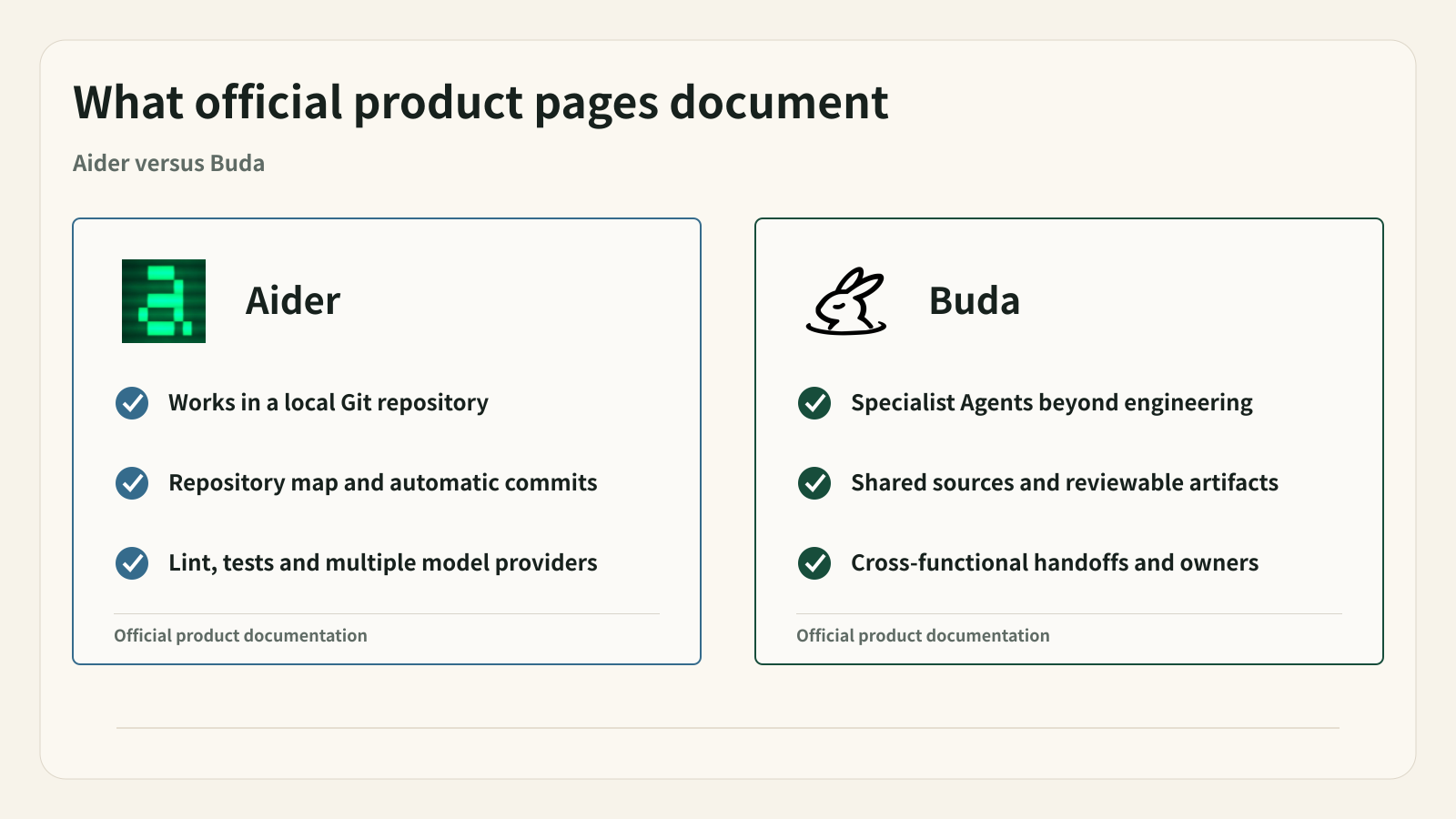
Aider is deliberately narrow in a useful way. It is an open-source AI pair programmer built around a local Git repository and a terminal. It maps the codebase, edits selected files, runs linting and tests, works with many model providers, and commits changes so a developer can inspect or undo them with familiar Git tools.
Buda should not be described as a better version of that coding loop. It solves a different problem. Buda is a cloud Agent workspace for work that crosses source files, browser research, terminal execution, Git context, business owners, review queues, and non-code deliverables.
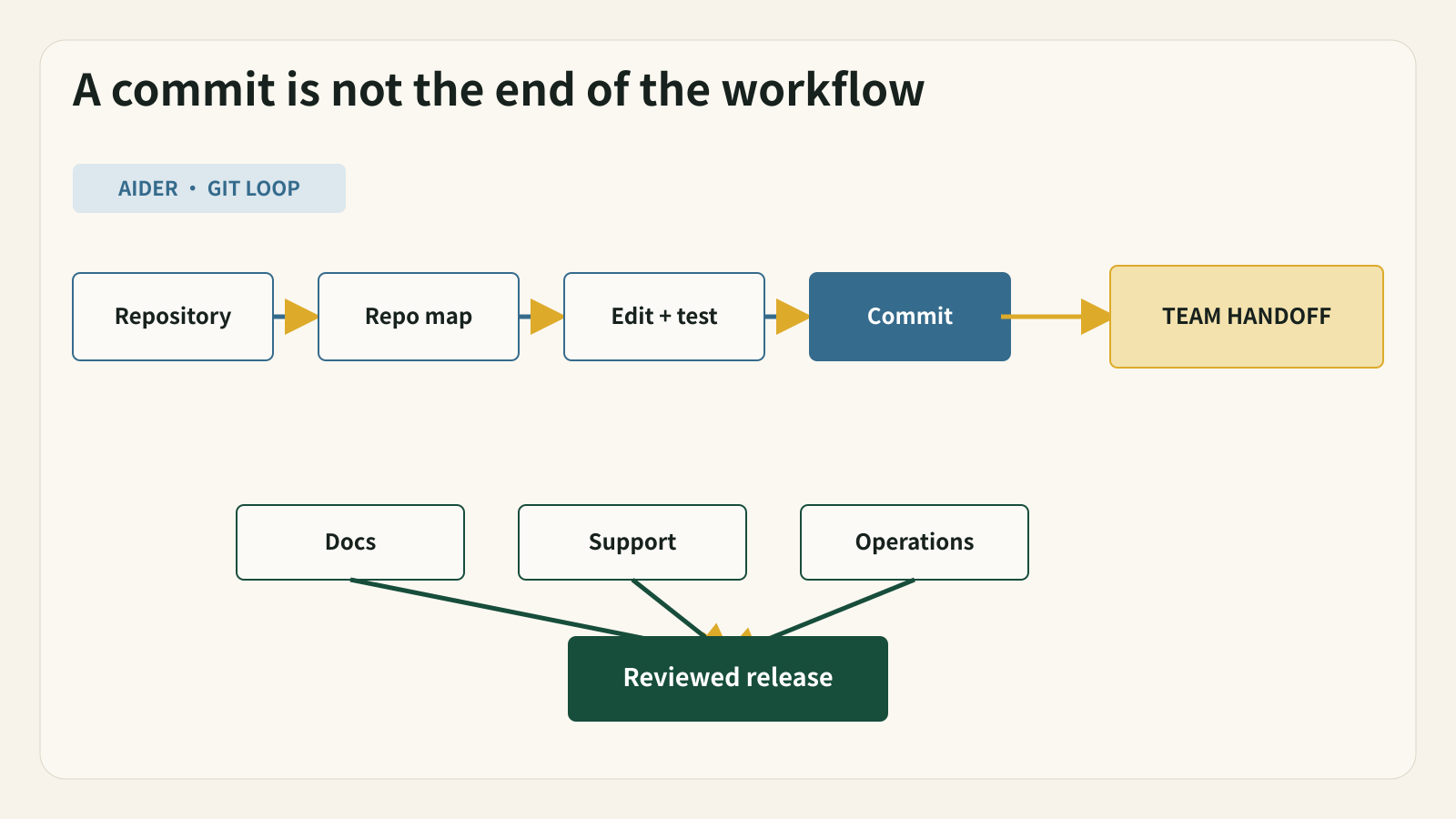
The practical choice is therefore not “which AI writes better code?” There is no evidence here for that claim. It is whether the job ends with a reviewed commit in one repository, or continues into release evidence, documentation, operations, customer communication, and accountable handoff across a team.
The comparison starts with the unit of work
| Decision area | Aider | Buda |
|---|---|---|
| Primary unit | A coding task inside one local Git repository | A recurring workflow shared by Agents and people |
| Context model | Selected files plus a compact repository map and chat context | Drive files, prior artifacts, sessions, browser evidence, terminal output, and Git context |
| Execution surface | Developer terminal, local files, lint commands, tests, Git commits | Cloud Browser, Terminal, Git, connected sources, Skills, and automations |
| Review surface | Diffs, tests, commits, /undo, and developer judgment | Reviewable briefs, drafts, tables, reports, CRM updates, PR notes, and action lists |
| Best stopping point | The code change is understood and accepted in the repository | The wider team has evidence, an owner, a reviewed artifact, and a next action |
Aider is strongest when the repository is the source of truth and the developer is the reviewer. Buda becomes relevant when the repository is only one part of a longer operating process.
What Aider does especially well
Aider's official documentation is concrete about its working model. The user starts it in a Git repository and adds the files that should be edited. Aider also builds a repository map containing important symbols and signatures from the rest of the codebase, selecting relevant portions to fit the available token budget. That gives the model structural context without sending every file.
Its Git integration is not an afterthought. Aider commits its changes with attribution, lets the developer inspect diffs, and provides /undo for changes the user does not want. It can run lint and test commands and attempt fixes when they fail. It supports several chat modes and a broad range of model providers, including local options.
This is a coherent developer tool. For a bug fix, refactor, test update, documentation edit inside the repository, or a well-scoped feature, keeping the human close to the terminal, diff, and test output is often the shortest path. A separate operating workspace would not improve a task that genuinely ends there.
Where Buda starts
Many software tasks do not end when the patch exists. A release may still need an issue summary, risk assessment, verification evidence, change log, support note, launch checklist, customer message, and named approval. Those pieces often live across a repository, ticket system, docs, browser pages, internal files, and conversations.
Buda is designed around that wider loop. An engineering Agent can inspect Git context and test output, while a documentation Agent prepares a guide, an operations Agent assembles the rollout checklist, and a reviewer inspects the resulting artifacts. Shared Drive context and prior runs remain close to the workflow instead of being reconstructed in another chat.
That does not make Buda the preferred place for every line-level edit. It makes Buda useful when code is evidence inside a cross-functional delivery process. The team can keep the implementation note, source links, risk list, release artifact, and human decision together.
Git history and an operating record are not substitutes
Aider's commits provide an excellent record of what changed in the repository. A commit can show file diffs, attribution, and a point that can be reverted. That is the right audit surface for source code.
An operating record answers different questions: Why was the change requested? Which customer or incident is affected? Which test evidence matters? Has documentation been updated? Who approved the rollout? Which follow-up is still open? A Git commit cannot carry the full responsibility of a business workflow, and a Buda artifact should not replace a proper commit or code review.
The clean architecture is to let each system preserve the record it is good at. Aider owns the local code conversation and Git changes. Buda owns the cross-functional context and reviewed handoff when the job extends beyond the repository.
Four scenarios that clarify the choice
1. A developer needs to fix and test a local bug
Start with Aider. Add the relevant files, let the repo map provide structural context, review the edits, run the tests, and inspect the commit. The human is already in the right place to judge the result.
2. A maintainer wants model freedom in the terminal
Aider is a strong fit. Its documentation supports many hosted and local model providers, configuration files, conventions, and multiple chat modes. Buda is not a reason to give up a terminal-centered workflow that already works.
3. A release requires engineering and business handoffs
Buda becomes useful when the patch must be turned into a release package: evidence, risk, docs, support copy, owner, approval, and next action. The code can still be produced with Aider while Buda coordinates what surrounds it.
4. The workflow repeats across many repositories or functions
Aider currently works with one repository at a time, although its docs describe ways to read context from another repository. If the company needs a repeated process spanning repositories, research, content, customer records, and operational review, Buda is the more natural coordination layer.
Using Aider and Buda together
A disciplined combined workflow is straightforward:
- A Buda Agent prepares the issue context, acceptance criteria, source links, and risk checklist.
- A developer uses Aider in the target repository to implement, lint, test, and commit the change.
- The diff, test result, and commit reference return to a Buda artifact.
- Documentation, release communication, or operations steps are prepared by the appropriate Agent.
- A named human approves the delivery action.
The important boundary is that neither tool declares the other tool's work complete. Aider reporting a successful edit does not approve a release. Buda collecting a PR note does not prove the code is correct. Humans review at both boundaries.
A fair pilot
Choose one medium-sized repository task with a real downstream handoff.
- Define the implementation request, tests, and acceptance criteria before starting.
- Use Aider for the code loop and record the files changed, tests run, corrections, and final commit.
- Use Buda only for the surrounding work: issue context, release note, evidence package, owner, and approval.
- Measure developer interruption, correction time, handoff clarity, and whether a second person can verify the outcome.
- Keep the smaller setup if the downstream workflow adds no value. Add the wider workspace only when the handoff is a real recurring cost.
FAQ
Is Aider only a chat wrapper for an LLM?
No. Its documented workflow includes repository maps, direct file edits, Git commits, undo, linting, testing, conventions, configuration, multiple chat modes, and many model providers. Its strength comes from fitting those capabilities into a developer's local repository loop.
Can Buda replace Aider for local pair programming?
That is not the claim. Aider is purpose-built for local, Git-native code editing. Buda is relevant when the work must persist across Agent roles, source types, reviewers, and non-code artifacts.
Does Aider support large repositories?
Aider uses a compact repository map and can work with large repositories, but its FAQ recommends thoughtful file selection and offers options such as subtree scope and ignore files. Teams should test their actual monorepo rather than infer performance from a general claim.
Which tool should approve production deployment?
Neither tool should approve it on its own. Code review, tests, security checks, deployment controls, and a named human owner remain necessary. Agent completion is evidence for review, not authorization.
Sources
Verified September 22, 2026.