Buda vs Claude.ai: One Claude Across Devices, or a Workspace for an Agent Team?
Compare Claude.ai and Buda by role design, shared context, recurring execution, and the review boundary for team work.

Buda vs Claude.ai: One Claude Across Devices, or a Workspace for an Agent Team?
Claude.ai is no longer just a chat box. Anthropic's current documentation describes Claude and Cowork as one product experience: tasks can run in the cloud, continue in the background, move between desktop, web, and mobile, use Projects, connectors, skills, plugins, scheduled tasks, files, browser access, and computer use where available.
That changes the comparison with Buda. The useful question is not whether Claude can execute work. It can. The question is how the work should be organized when one capable assistant becomes several persistent roles, shared source files, recurring workflows, and reviewable outputs owned by a team.
Claude is the direct choice when people want Claude itself to be the center of research, analysis, writing, file creation, and connected tasks. Buda is designed for a different operating model: a workspace containing specialized Agents, shared Drive context, cloud Browser, Terminal and Git, reusable procedures, and artifacts that move through visible ownership and review.
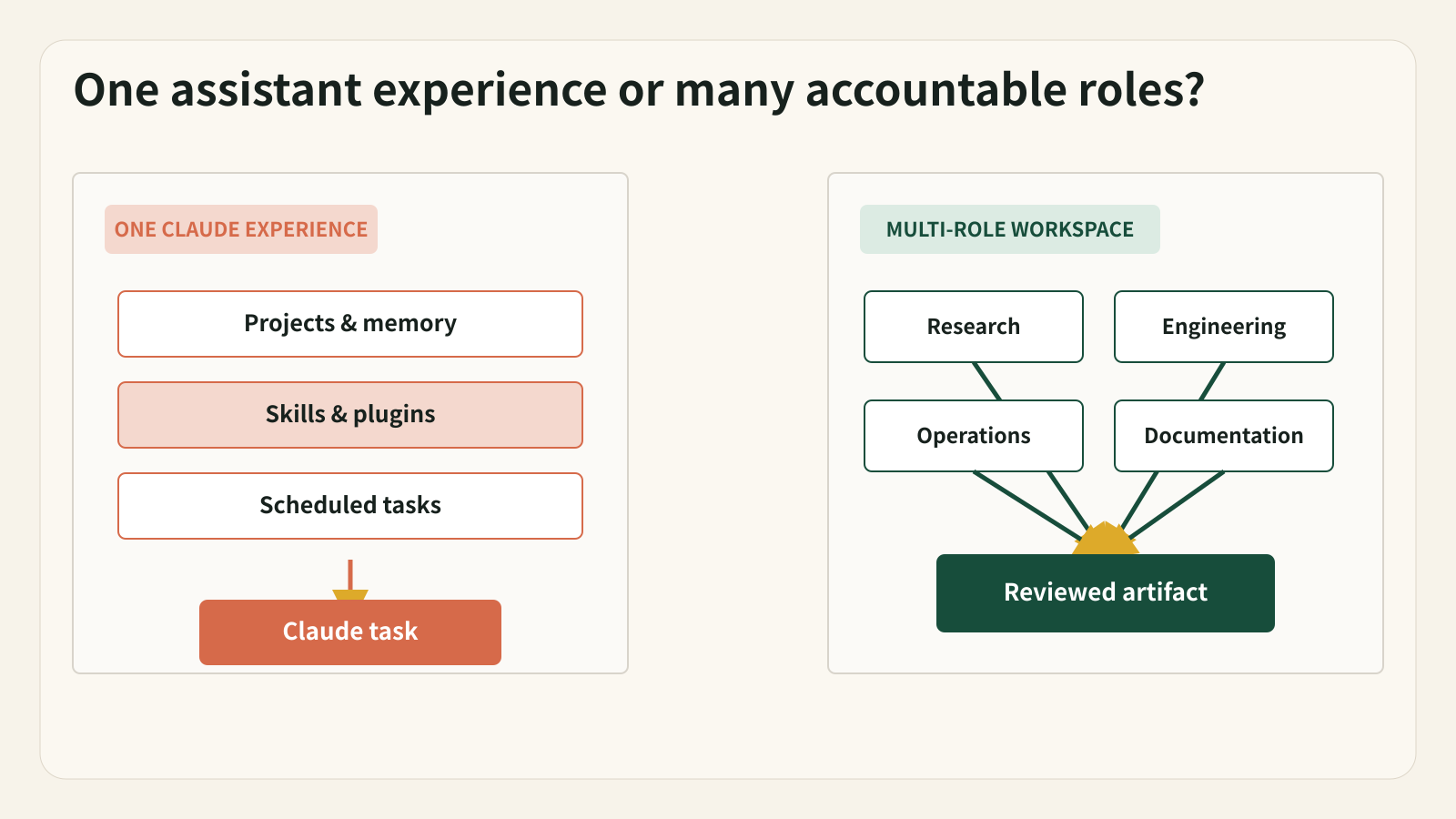
The buying decision is no longer chat versus execution
| Decision area | Claude.ai | Buda |
|---|---|---|
| Center of work | One Claude experience across chat, Cowork, Projects, and devices | A shared workspace containing specialized Agents and team roles |
| Persistent context | Project instructions, files, project memory, account sessions | Drive files, prior outputs, Agent memory, sessions, and workflow records |
| Execution | Cloud tasks, connectors, skills, plugins, scheduled tasks; local file/browser/computer access has surface-specific requirements | Cloud Browser, Terminal, Git, connected context, Skills, and automations inside each Agent workspace |
| Review surface | People start, steer, inspect, and review task outputs in Claude | Outputs become artifacts with owner, source context, status, and review close to the work |
| Natural expansion | Give Claude a broader set of tasks and connected sources | Add specialized Agents and coordinate repeated workflows across functions |
This table is not a feature score. Both products have persistent context, cloud execution, reusable capabilities, and human review. The difference is the unit being managed: a Claude-centered task and project, or a team workspace organized around multiple Agent roles and artifacts.
When Claude.ai is the more direct choice
Choose Claude first when the team already wants to work through Claude and the job benefits from one continuous assistant relationship. A Project can group instructions, files, context, and memory. A Cowork task can continue in the cloud. Scheduled tasks can run recurring research, reports, file organization, or connected-tool summaries. The same session can be checked from another device.
That is a strong operating surface for an individual or a team whose primary need is to delegate substantial tasks to Claude, inspect the result, and keep related work inside Projects. Anthropic also documents Team and Enterprise controls, project sharing, organization roles, connector administration, and audit capabilities. It would be inaccurate to present Claude as lacking team or governance features.
Claude also has a practical advantage when the desired output is naturally produced and refined in the Claude experience: a document, analysis, presentation, research result, artifact, or task that one person can steer from prompt to completion. Adding another workspace would create overhead if no separate role, handoff, or operating record is needed.
When Buda is the more direct choice
Choose Buda first when the team is not trying to create one larger Claude Project, but to operate a set of persistent Agents with different jobs. A research Agent, content Agent, engineering Agent, and operations Agent may need different source files, tools, routines, and owners while still working from one shared company context.
Buda's public Agent Workspace describes that model directly. Each workflow can keep Drive files, prior outputs, sessions, Browser work, terminal output, Git context, and reusable Skills close to the Agent performing it. The result is not only a response. It can be a brief, table, draft, report, CRM update, PR note, or action list that another person reviews.
This becomes useful when the organization asks operational questions that are larger than a single task: Which Agent owns this workflow? Which source set is current? Which output is waiting for review? What was approved? What must run again next week? Who takes the next action? Buda puts those questions into the workspace model instead of leaving the team to reconstruct them from separate conversations.
The sharpest difference is specialization, not capability
Claude can run recurring tasks and use project context. Buda should not claim exclusivity over either function. The sharper distinction appears when one workflow becomes a portfolio of workflows.
A founder may use Claude to research a market and draft a decision memo. That is a coherent Claude task. A company content operation is different: one Agent watches sources, another prepares a draft, an editor reviews it, assets are checked, publication state is recorded, and the evidence remains available for the next article. The value is no longer only the quality of one answer. It is the continuity between roles.
Likewise, a scheduled Claude task can deliver a weekly briefing. A Buda workflow becomes relevant when that briefing is one artifact in a larger operating loop: source collection, exception handling, editorial review, distribution, and a later performance check handled by different Agents or people.
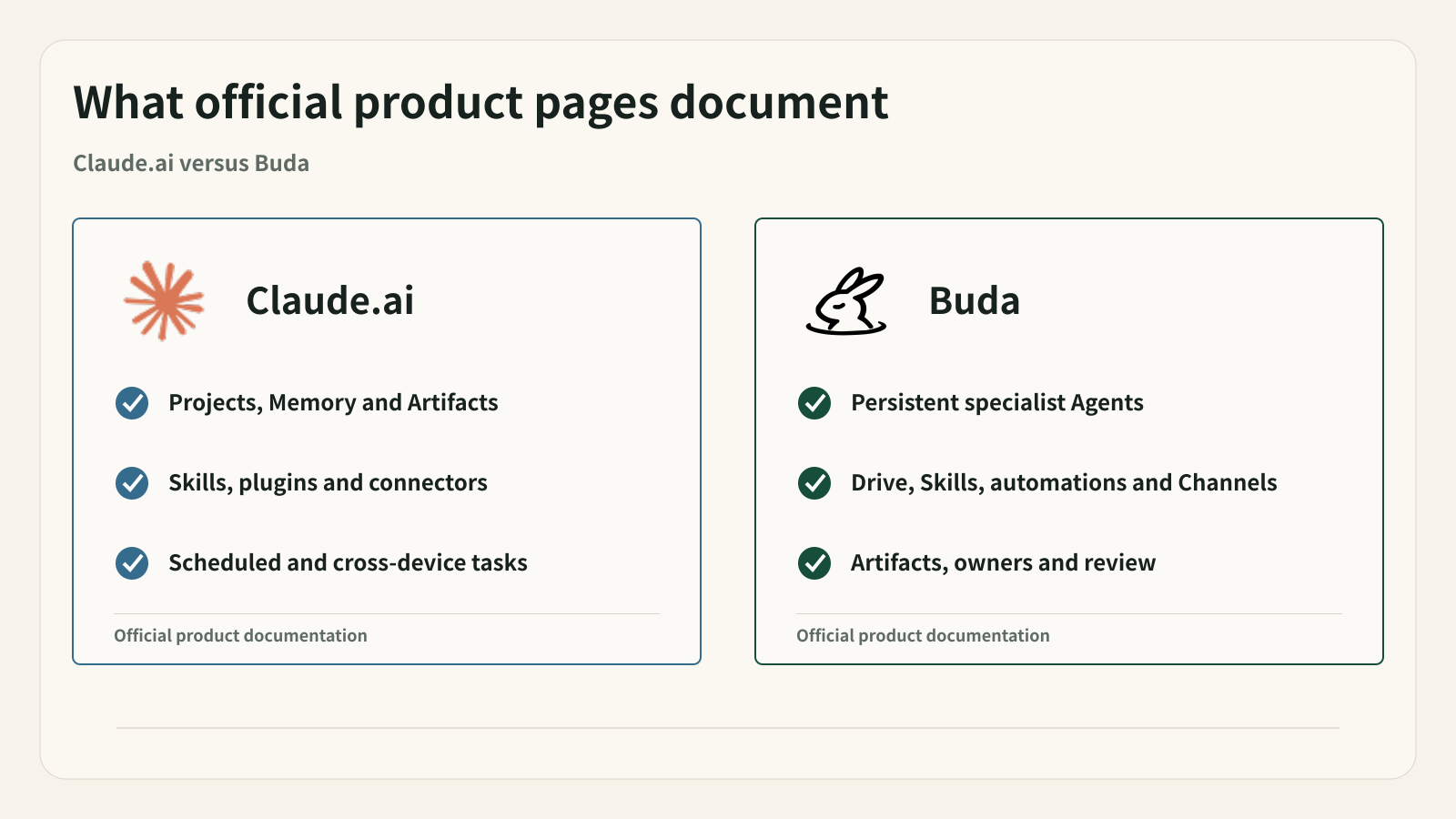
Four scenarios that make the choice clearer
1. One person wants a capable assistant everywhere
Use Claude when a person wants to start a task on desktop, inspect it on mobile, connect familiar services, and keep related instructions and memory in a Project. That is exactly the continuity Anthropic documents.
2. A team wants recurring Claude-generated deliverables
Claude remains a strong candidate. Scheduled tasks can produce reports and summaries using connected tools, and Team or Enterprise organizations can share Projects and manage access. Test the real plan, connector, and approval behavior instead of assuming those surfaces are absent.
3. A team wants several named Agent roles
Buda is the more natural surface when each role needs its own persistent context and toolset, while outputs still land in a common workspace. The team is managing an Agent organization, not only delegating more work to one assistant.
4. The output must move through a visible review queue
Buda is useful when a result needs an owner, source context, status, and a clear approval point before it reaches a customer or system. Claude can still generate or analyze the material; Buda can coordinate the wider operating record.
Using both can be the honest answer
The products do not need to be mutually exclusive. A team can use Claude where Claude is the preferred reasoning and creation surface, then use Buda to coordinate recurring work across Agent roles, files, tools, and reviewers. That combination is only useful when the handoff is explicit. Copying the same prompt and files between two products without a clear responsibility boundary creates more work, not less.
A sensible boundary might be: Claude handles an expert analysis inside a Project; Buda owns the recurring intake, source package, reviewer assignment, final artifact, and next scheduled run. Another team may choose Claude only because Projects and scheduled tasks already cover the entire workflow. The correct choice is the smaller operating system that preserves accountability.
A fair pilot
Do not compare a one-off prompt. Use one recurring workflow for two cycles.
- Define the same source set, output format, and human reviewer.
- Run the work once, then change one source or requirement before the second run.
- Measure setup time, correction time, context continuity, tool friction, and review clarity.
- Ask whether another teammate can understand the result without a private explanation.
- Expand only if the team can identify the source of truth, the output owner, and the action that still requires human judgment.
FAQ
Is Claude.ai only for individual chat?
No. Current Anthropic documentation describes cloud Cowork tasks, Projects, memory, connectors, skills, plugins, scheduled tasks, cross-device sessions, project sharing, and Team and Enterprise administration. Any comparison that reduces Claude to chat is outdated.
Does Buda have exclusive persistent memory or scheduling?
No. Claude Projects include scoped context and memory, and Claude supports scheduled tasks. Buda's distinction is how persistent context, specialized Agents, execution tools, artifacts, owners, and review are arranged in one team workspace.
Which product should a small team try first?
Use Claude first if the team wants one capable assistant and can keep ownership clear inside Projects. Use Buda first if the pilot already involves multiple roles, repeated handoffs, and an output queue that someone must review.
Which is safer for consequential work?
Neither should be selected from a comparison article alone. Verify the current plan's permissions, connectors, data boundaries, retention, audit controls, tool approvals, and human review path. Keep customer-facing, financial, legal, security, and production-changing actions under named human responsibility.
Sources
Verified September 22, 2026.