Buda vs Claude Code: What Happens After the Code Is Done?
Claude Code can finish the repository task. Buda coordinates the release work that begins when code crosses into the rest of the company.

Buda vs Claude Code: What Happens After the Code Is Done?
Claude Code and Buda solve different parts of delivery. Claude Code is built for serious work inside a software project: understand a repository, edit code, run commands and tests, and help move a change toward review. Buda becomes relevant when that accepted change has to move through documentation, release operations, support, communications, and recurring checks.
The useful comparison is therefore not “which agent is smarter?” It is where the workflow stops.
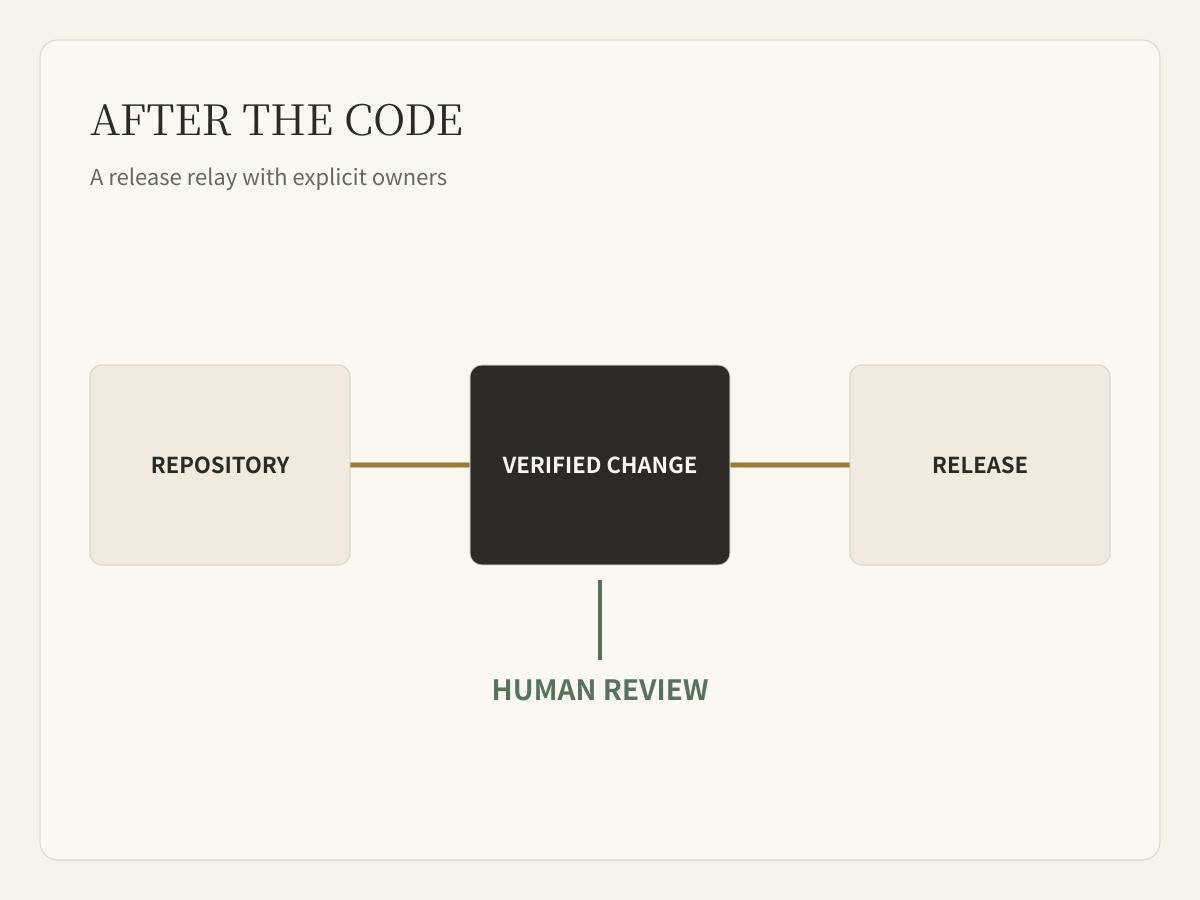
Claude Code owns the repository loop
Claude Code is available across terminal, IDE, desktop, and web surfaces. It can inspect a codebase, make changes, run development tools, work with Git, use MCP connections, support CI/CD automation, and coordinate parallel coding work. That makes it the natural primary tool when success can be judged in repository terms:
- the patch is correct;
- tests pass;
- the pull request is reviewable;
- the implementation matches the issue.
Those are substantial capabilities. Buda should not be positioned as a replacement for them.
The release creates a second workflow
Consider a product team shipping a changed authentication flow. A coding agent can implement the change and produce test evidence. Shipping still creates work outside the repository:
- Product documentation must describe the new behavior.
- Support needs a concise explanation and escalation path.
- Release notes and launch copy need the same verified facts.
- Someone must confirm that the production route works.
- The team may need checks one day and one week after launch.
This work has different owners, files, tools, schedules, and approval risks. Treating all of it as one long coding session makes the handoff hard to inspect.
Where Buda enters the release chain
Buda gives dedicated agents persistent cloud workspaces with files, browser, terminal, Git, Skills, Channels, and scheduled Automations. A team can assign the repository result to a release workflow without asking Claude Code to become the documentation, support, and operations system.
A practical design looks like this:
| Stage | Primary operator | Evidence to retain |
|---|---|---|
| Implement and test | Claude Code | Diff, commands, test output, pull request |
| Translate the change | Buda documentation agent | Updated docs and source links |
| Prepare the release | Buda content or operations agent | Release notes, support brief, launch assets |
| Accept the package | Human reviewer | Decision, corrections, approved artifact |
| Watch production | Scheduled Buda automation | Route status and follow-up findings |
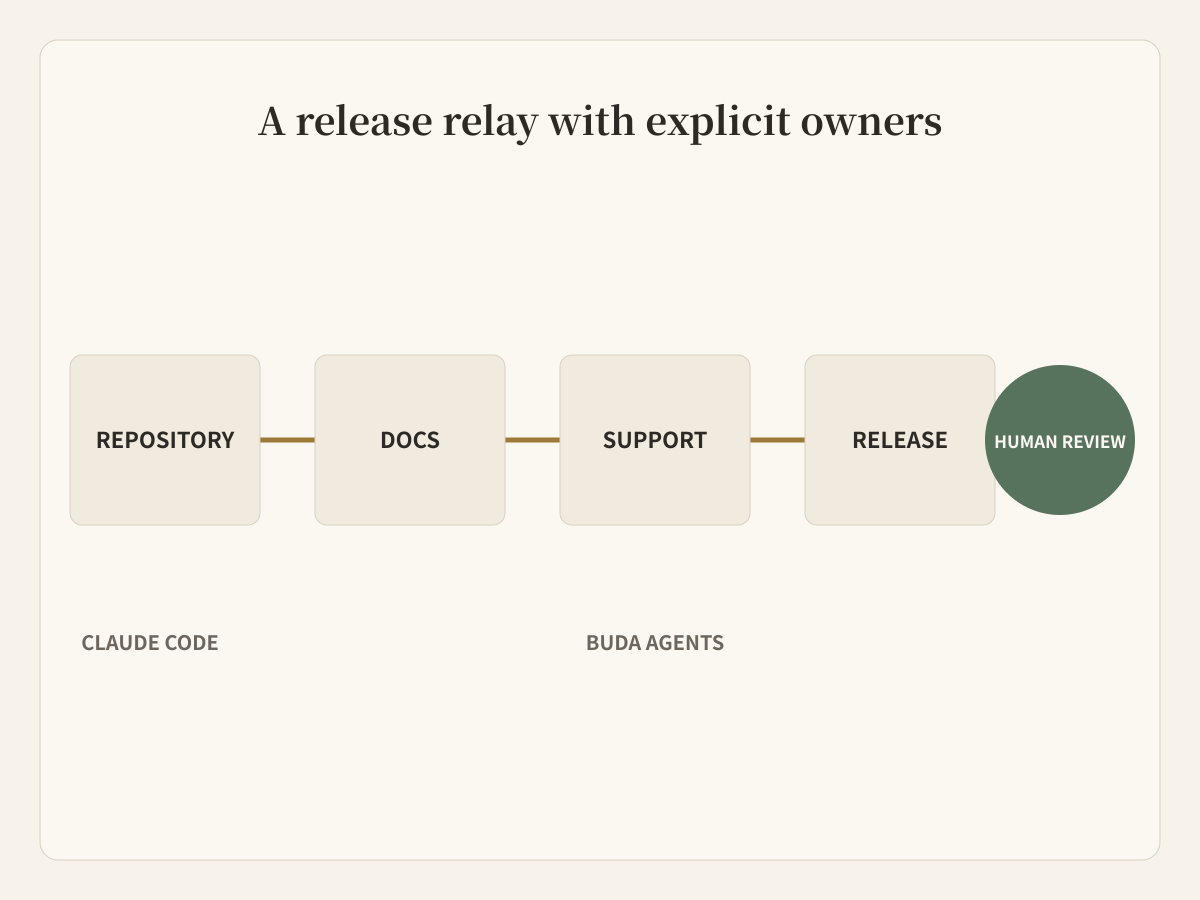
The boundary matters more than feature overlap
Both products can read files, run tools, and perform agentic work. Feature overlap does not erase product orientation. Claude Code keeps the coding loop close to the repository. Buda keeps a longer operating process attached to dedicated agents, reusable procedures, team channels, and reviewable artifacts.
The distinction becomes visible when a task leaves engineering. If the only accepted output is a code change, stay in Claude Code. If the change triggers work owned by product, content, support, or operations, add an orchestration layer instead of stretching one coding thread across the company.
Three deployment patterns
Repository-only delivery
Use Claude Code by itself when the request ends at implementation, tests, and code review. Adding a broader workspace would create coordination without a real coordination problem.
Release operations without heavy coding
Use Buda by itself for recurring documentation checks, launch checklists, research, support briefings, or channel-driven operations where repository modification is not the central task.
Combined software delivery
Use both when a repository change must become an accepted company deliverable. Define a small handoff contract: commit or pull request, test evidence, affected behavior, known limits, and the human owner. Buda agents can then continue from verified inputs.
What to test before standardizing
Run one real release through the proposed setup and measure the parts teams usually ignore: time from merged code to updated documentation, number of factual corrections, reviewer time, missing handoffs, and whether follow-up checks actually ran. A faster patch does not automatically mean a faster release.
Questions teams ask
Can Claude Code run in the cloud and use multiple agents?
Yes. Its current capabilities extend well beyond a local terminal. This comparison depends on workflow ownership, not on denying Claude Code cloud, parallel-agent, MCP, or automation features.
Is Buda a coding-agent alternative?
Only when the buyer's unmet need is broader than coding. For deep repository implementation, keep a specialist coding agent. Buda is the alternative for the persistent operating layer around work that crosses roles and schedules.
Does using both create duplicate work?
It can if the handoff is vague. Give each system a clear accepted output. Claude Code produces verified repository evidence; Buda coordinates the downstream package and its review.
Design the handoff before adding another agent
Start from the first point where code leaves engineering. Name the next owner, required evidence, review decision, and follow-up schedule. That is where a persistent agent workspace earns its place.
See how Buda workspaces operate