Buda vs Codex: Governing Parallel Coding Work Across a Team
Codex can parallelize software tasks. Buda adds the control plane for assigning, verifying, and handing those results across a team.

Buda vs Codex: Governing Parallel Coding Work Across a Team
Codex is a software-development agent available through CLI, IDE, app, web and cloud workflows. It can edit and run code in isolated environments, review changes, use Skills and MCP, work through an SDK, and split engineering work across agents. Buda addresses a different scaling problem: how a team assigns that work, retains evidence, handles exceptions, and turns many technical results into one accepted operating outcome.
If one coding task becomes ten, execution speed is only half the problem. The other half is control.
Start with the control question
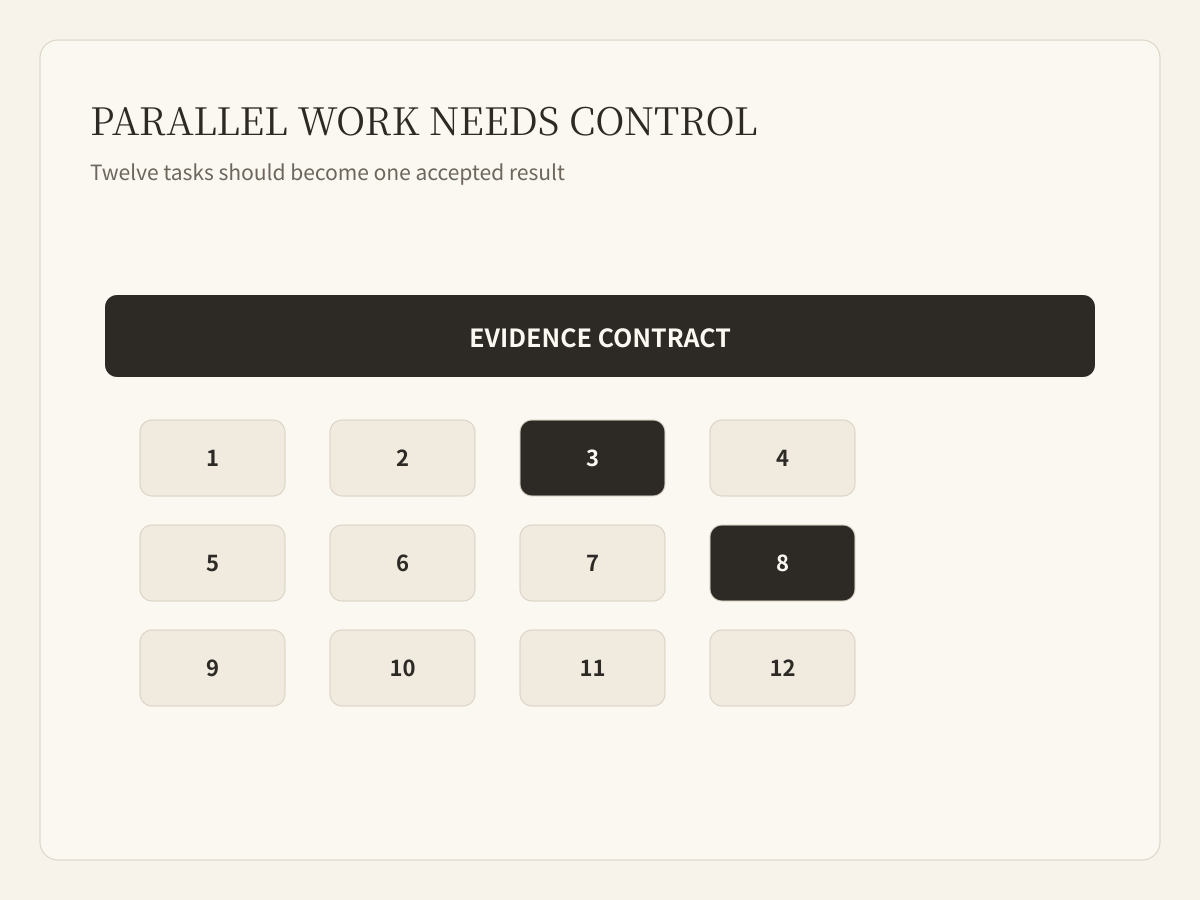
Imagine a company migrating twelve services to a new authentication library. Parallel coding agents can inspect repositories, prepare patches, run tests, and report blockers. The migration still needs a reliable answer to five questions:
- Which services are in scope?
- Which agent owns each repository?
- Which patches passed the required checks?
- Who decides how to handle an exception?
- Where does the final migration record live?
Codex can perform the software work. A persistent team workspace can provide the operating ledger around it.
What Codex contributes
Codex is strongest when the task can be delegated as a software unit: fix an issue, implement a feature, review a change, explain a codebase, or automate development through its SDK. Sandboxed execution and configurable permissions help bound the technical task. Cloud and parallel workflows allow more than one piece of work to advance at once.
The accepted output is usually technical evidence: a patch, a branch, a review, test results, or a written engineering finding.
What changes at portfolio scale
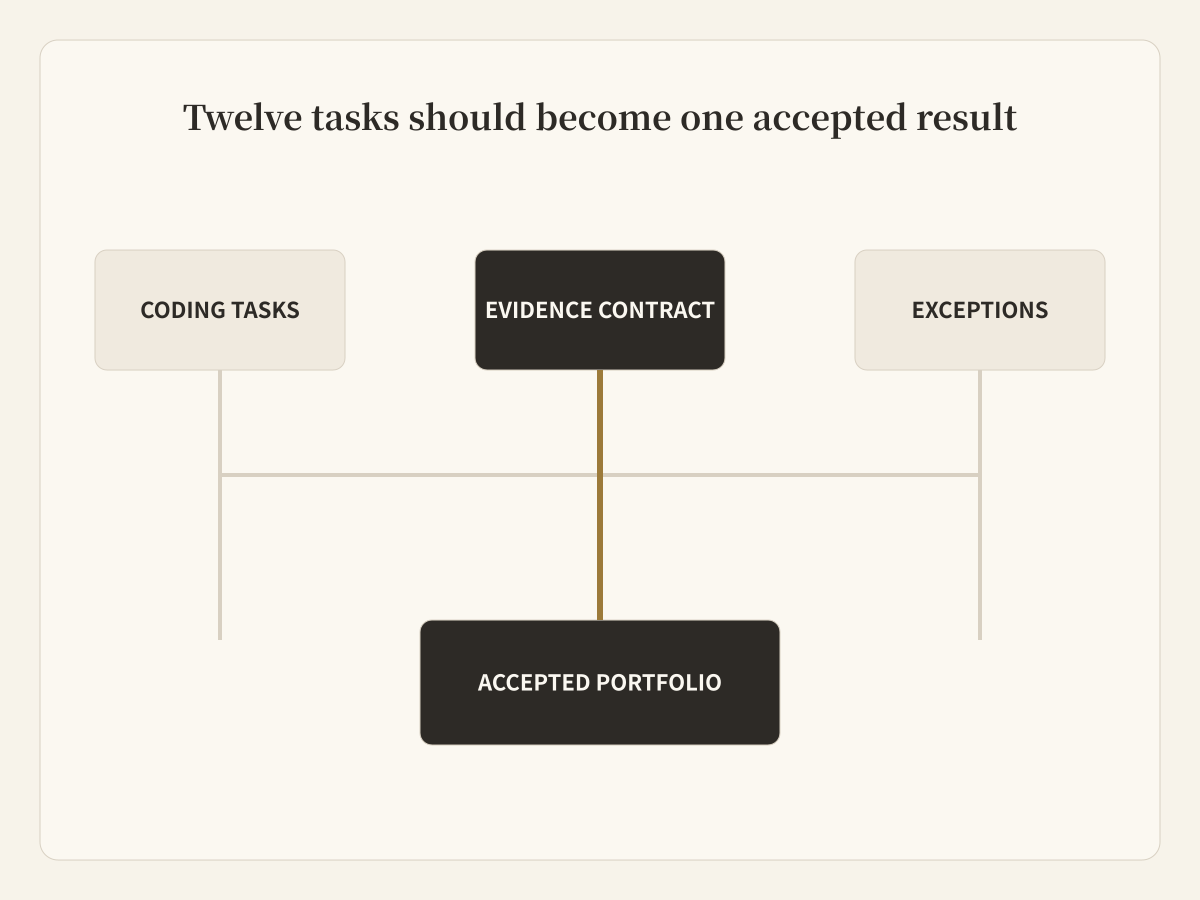
At twelve repositories, a dashboard with “11 complete” is not enough. One failed service can block the whole migration. The team needs a durable task inventory, a common evidence contract, exception routing, and a reviewer who accepts or rejects the portfolio.
That operating layer is not another coding feature. It is coordination across agents, people, files, schedules, and downstream functions.
A governed migration pattern
| Control point | Required decision | Example evidence |
|---|---|---|
| Scope | Include, defer, or exclude each service | Repository inventory and owner |
| Assignment | Match work to the correct coding agent | Task ID and environment |
| Verification | Decide which checks are mandatory | Tests, diff summary, security findings |
| Exception | Retry, escalate, or stop | Failure log and responsible reviewer |
| Acceptance | Approve the migration as a portfolio | Signed result and unresolved items |
Buda agents can maintain the inventory, invoke or coordinate specialist work through approved procedures, collect outputs into persistent files, notify the right channel, and prepare a review package. Codex remains responsible for the repository-level engineering where it is strongest.
Permissions must follow the operation
A coding agent's permission model protects the execution environment. Team governance adds another question: what may happen after the result exists? A passing patch should not automatically publish documentation, message customers, update a trusted database, or mark a migration complete.
Separate technical execution from downstream authority. Let automation collect evidence and propose the next state; keep consequential transitions tied to an explicit review policy.
Codex alone, Buda alone, or a stack?
Use Codex alone for bounded engineering tasks whose owner and acceptance process already exist in the development system.
Use Buda alone when the operation is mostly research, browser work, files, communications, recurring checks, or cross-functional production rather than code modification.
Use Codex with Buda when many software tasks feed a broader initiative. Codex handles the code units; Buda tracks the program, normalizes evidence, routes blockers, and keeps the human acceptance point visible.
Metrics that reveal whether the system works
Do not evaluate a parallel-agent setup only by tasks completed per hour. Track exception rate, reviewer load, evidence completeness, time to resolve blocked work, reopened tasks, and the percentage of outputs that become accepted deliverables. Fast unreviewed output is inventory, not progress.
Where this comparison should not stretch
This page does not compare model intelligence, benchmark performance, or token price. It also does not claim Codex lacks cloud work, subagents, review, Skills, MCP, or CI capabilities. The decision is about which system owns engineering execution and which system owns the multi-agent operating process around it.
Build a small control plane first
Before coordinating dozens of agents, choose three repositories and define one evidence schema: task, owner, environment, checks, result, exception, and reviewer decision. If the team cannot inspect that small batch confidently, adding more parallelism will only increase ambiguity.
Explore Buda for persistent agent operations