Buda vs Command Code: learn coding preferences or manage a team's workflows?
Inspect scope, examples, and rule versions before promoting learned preferences into shared standards.

Preferences can be learned automatically. Someone still has to decide where a team standard applies.
Why does code from the same assistant get accepted today and heavily revised tomorrow? Syntax may not be the problem. Projects have conventions for naming, reuse, abstraction, and error handling. Developer feedback contains these standards, but rewriting each correction as an instruction takes effort.
Command Code puts that problem at its center. Its official documentation describes continuous learning of coding taste from acceptance, rejection, and edits, stored as project-level skills. Teams can push and pull preference packages. Buda centers on persistent agent workspaces and reusable workflows. The comparison is not simply local versus cloud, nor should it assume Command lacks collaboration, background execution, or a desktop interface.
Choosing Command Code primarily means evaluating a mechanism for learning and distributing coding preferences. Choosing Buda primarily means evaluating a workspace for organizing varied agent tasks, sources, and deliverables. Where they overlap, ask how an individual's learned habit becomes a team-approved standard.
How feedback becomes Command taste
The Features page describes learning naming, patterns, and style from accept, reject, and edit signals, then writing project-level skills under .commandcode/taste/. Command can also extract taste from local projects or GitHub repositories and start from preferences associated with other agents.
Sharing uses npx taste push and npx taste pull, with namespaces and public or private visibility. Studio's Taste Library provides versions and diffs. Skills are open repository files that can go through PR review like code.
That makes learned preferences inspectable rather than only an opaque model impression. Teams can review whether a rule is accurate, project-specific, and changed appropriately between versions. For a development group repeatedly correcting naming or component habits, this is a meaningful product reason to evaluate Command.
However, accepting one change does not make it universally desirable. An emergency fix may be accepted because it minimizes immediate risk, not because the team wants that pattern everywhere. A rejection may reflect a wrong requirement rather than style. Automatic signal extraction and deciding scope are separate responsibilities.
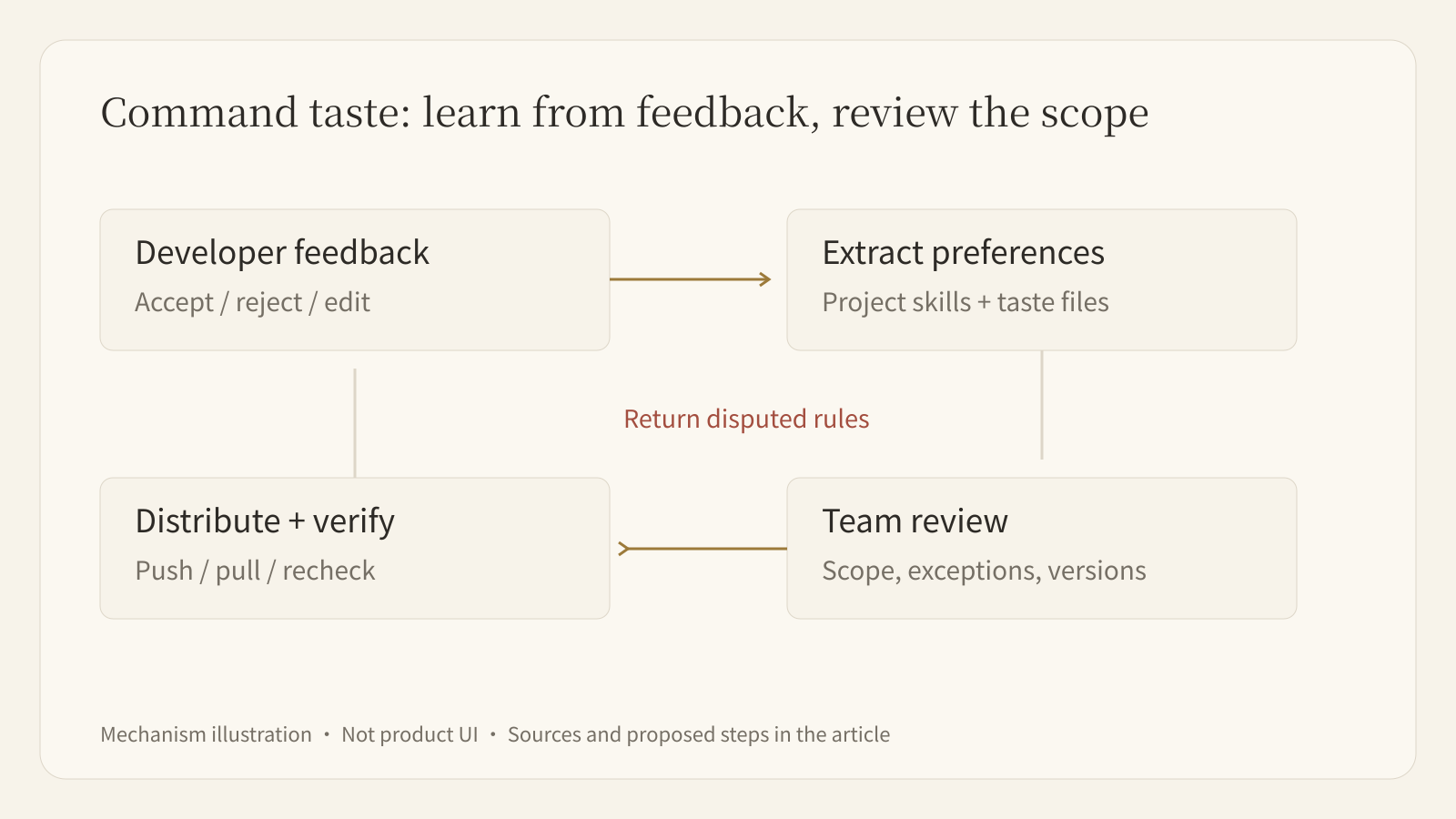
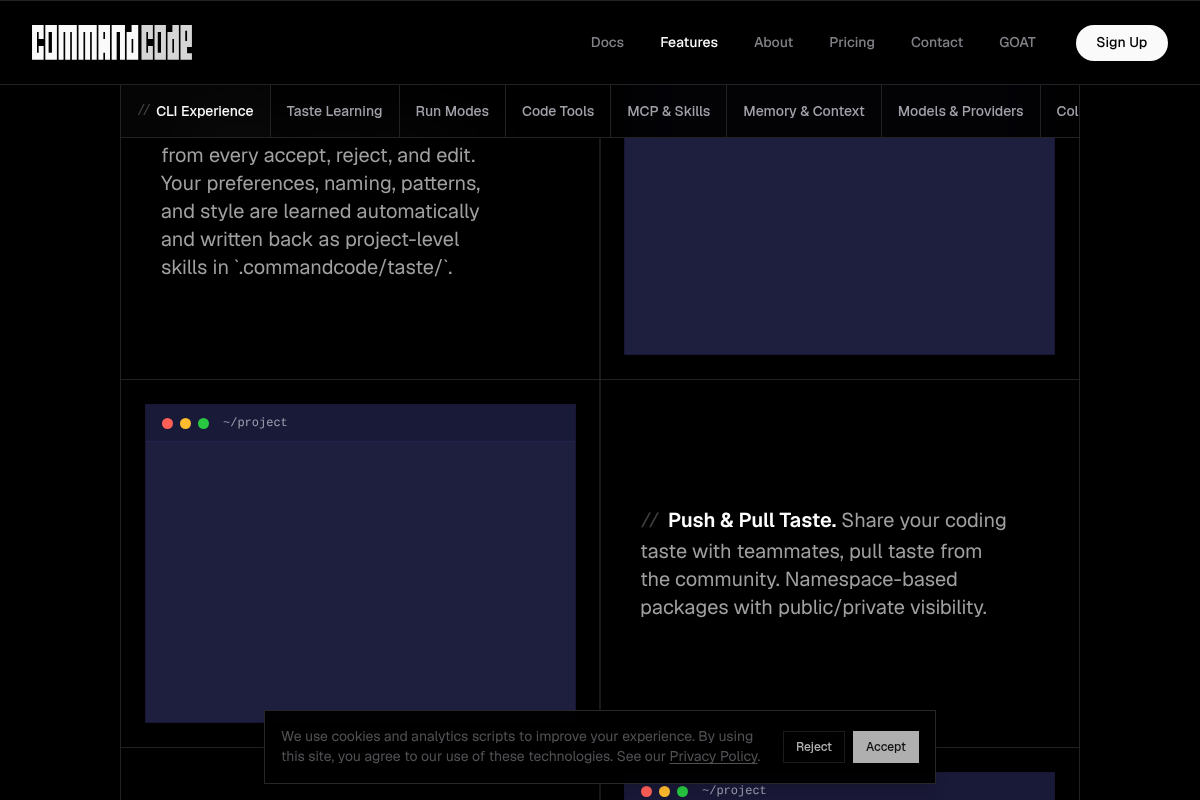
Official English source screenshot from the Features page, captured September 30, 2026. Original text is retained rather than presenting translated labels as product UI.
Separate individual habits from team constraints
Consider two repositories: a mature payment service and an experimental presentation site. A developer accepting inline styles in the presentation site does not authorize abandoning the payment service's design system. A distributed rule needs the scope and reason for its use, not just an isolated preference.
A reviewable taste should identify applicable repositories or directories, positive examples and exceptions, its owner, and the older convention it replaces. “Keep it simple” does not tell an agent when abstraction is excessive or duplication is justified.
| Layer | Example | Check before promotion |
|---|---|---|
| Individual feedback | A developer renames a function | Was this a naming preference, changed requirement, or temporary fix? |
| Project rule | This repository's error-handling convention | Does it match existing code and tests? What are the exceptions? |
| Shared rule | A package reused across repositories | Does it hold across projects? Who approves versions and rollback? |
Automatic learning can produce a useful proposal without making it authoritative. More feedback requires more attention to conflicts. A growing rule count does not establish stable style.
Command also offers execution and collaboration
Documented modes include interactive, headless, plan, auto-accept, and background sandbox. Plan supports analysis without modification; headless supports scripts and CI; background sandboxes run separate tasks that can later be resumed. Command also lists file operations, shell, web search, MCP, Skills, subagents, and /review.
Collaboration includes session sharing, organization and team management, PR-comment input, and shared taste packages. Its desktop workspace shows project switching, change inspection, tool activity, a browser, and a terminal. Calling it a terminal chat tool without team capabilities would be inaccurate.
There is overlap with Buda. Judge the difference by the dominant job: repeated mismatch with project coding preferences points directly to Command's taste mechanism. Fragmented business workflows, source files, and outputs point to Buda's unified execution and inspection environment.
Vendor speed, cache, and scale claims are not used as rankings here. A public feature description explains mechanisms, not measured superiority on your task.
A Buda Skill can describe a whole job, not only style
In Buda, a Skill can capture execution steps, source handling, and acceptance requirements. Agent Workspace provides Drive, sessions, a terminal, browsers, and Git. Installable Skills can be found and installed in the Buda AI Marketplace, then used with task-specific inputs and standards.
A documentation quality workflow, for example, reads product changes, checks public documentation, identifies outdated descriptions, and returns reviewable edits. Coding style is only part of that job. Source versions, factual accuracy, protected scope, and the final reviewer also matter.
This does not mean Buda implements Command's exact automatic accept/reject-to-taste mechanism. Keep the distinction explicit: Command documents preference learning and distribution; Buda's relevant model is reusable execution workflows inside a persistent workspace. A shared label such as Skill does not make capabilities identical.
Test one naming rule before making it a shared standard
The following is a proposed evaluation, not an executed experiment. Select two mature repositories and comparable modification tasks. Maintainers first specify conventions and exceptions; the agent then proposes changes.
In Command, record acceptance, rejection, and manual adjustments, then inspect whether extracted taste reflects the actual reasons. Do not only ask whether the next output looks right. Open the rule files and check that a temporary fix has not become a global habit and repository A's conventions have not leaked into B.
In Buda, put the same constraints and checks into a task or reusable Skill. Retain before-and-after files, check results, and human feedback. Evaluate whether colleagues can understand and reuse the workflow and whether later changes remain grounded.
Use two acceptance groups:
- Code results: passing tests, correct naming, no unrelated changes, and correct handling of exceptions.
- Rule results: inspectable instructions, explicit scope, explainable version changes, and no continuing influence after a rule is withdrawn.
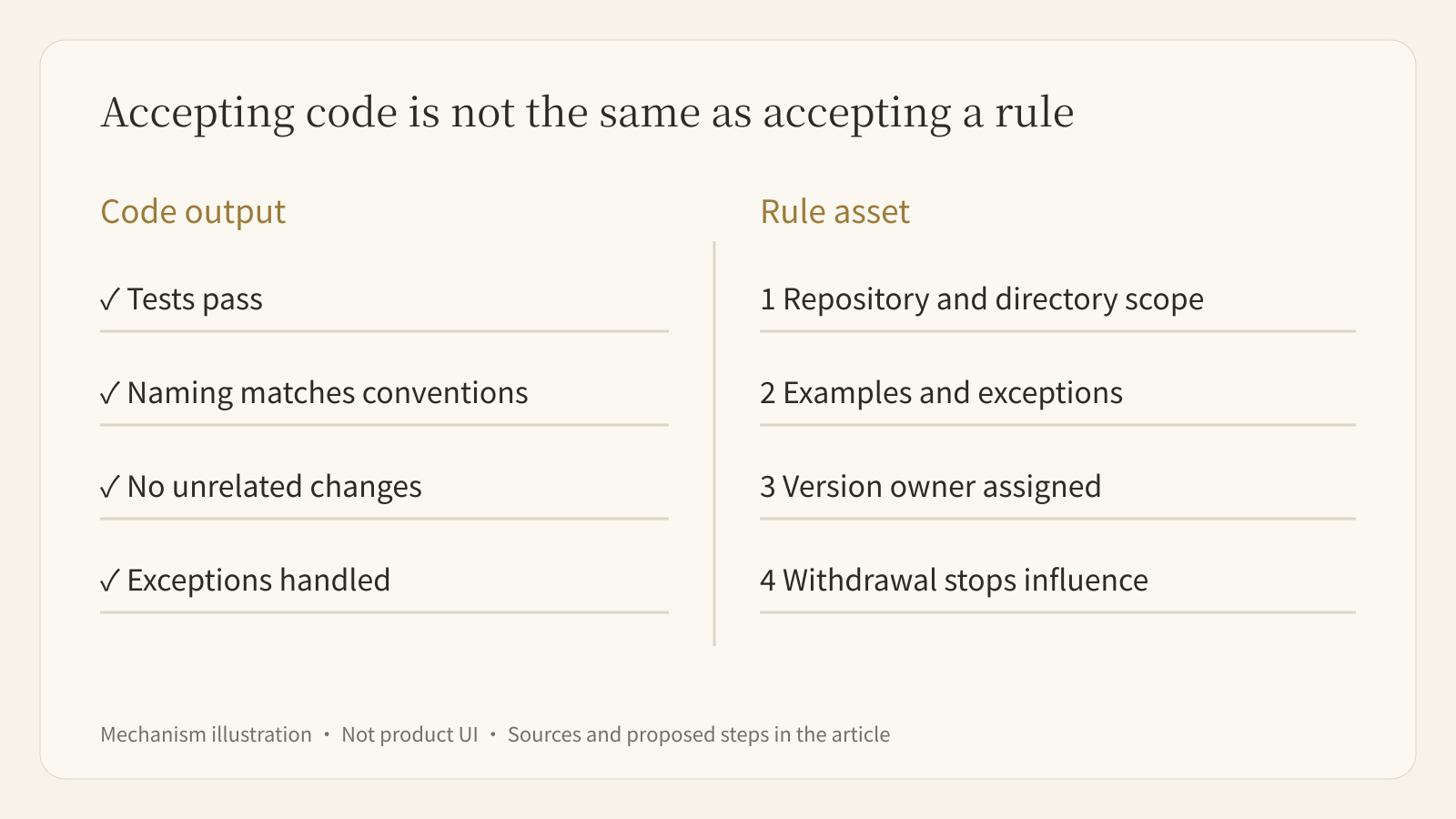
This distinguishes an agent coincidentally producing acceptable code from a team having a maintainable standard. Buy for the outcome you need, not a single polished demonstration.
Modes and permissions belong in the task design
Auto-accept reduces interaction and background execution reduces waiting; neither expands the team's approved scope by itself. A preference-learning trial should not silently authorize production commits or publication of private rules.
Command documents granular permissions, plan, and checkpoint/rewind. Buda provides workspace inspection of artifacts and execution. For either product, define editable files, allowed commands, publishable rules, and the owner checking the final commit.
Cost comparison should use actual entry points and usage. Providers, subscriptions, execution volume, and repeated corrections affect expenditure. Command Credits, upstream API prices, and Buda Credits are not a common unit. One generation does not establish labor savings.
Choose the bottleneck, not an all-purpose winner
If the main bottleneck is repeatedly correcting coding style, evaluate Command first: inspect taste files, cross-repository scope, and team distribution. Those are documented product paths and should not be ignored to favor Buda.
If sources, workflows, and deliverables are scattered, evaluate Buda: run a complete task in Agent Workspace with explicit Skill inputs, artifact locations, and acceptance. Ask whether the next colleague can continue the process, not merely whether an agent remembers a preference.
The products can serve different jobs. Handoffs need rule versions, sources, and unresolved questions. Learned preferences become shared standards only when scope and responsibility are clear.
FAQ
How does taste differ from ordinary project instructions?
Command describes taste extracted from acceptance, rejection, and edits, then stored as skills. AGENTS.md can explicitly state instructions, style, and architecture. The first uses more automatic signals; the second is more direct. Both need review for correctness.
Can Command work in the background or support a team?
Its documentation lists background sandboxes, headless mode, session sharing, organizational features, taste push/pull, and a desktop workspace. Terminal-native does not mean single-user or single-session only.
Are Buda Skills and Command taste directly interchangeable?
Import compatibility was not tested. They may contain similar instructions, but directories, loading behavior, tools, and permissions can differ. Inspect content and execution prerequisites rather than promise one-click portability.
What should be reviewed before sharing taste?
Check applicable directories, rule origins, exceptions, private project information, and version ownership. Public/private packages and diffable files support review, but visibility settings do not substitute for checking the content.
How can a team judge whether learning is useful?
Use fixed tasks and acceptance criteria to track repeated style errors, and inspect incorrect generalization. Record actual changes and human corrections rather than infer results from vendor speed or scale claims.
Sources
Verified September 30, 2026. Capabilities follow official descriptions. The two-repository evaluation is a proposed method, not a product test. No performance superiority or complete compatibility is claimed.