Buda vs Coze Space: Does the Work Continue Tomorrow?
Compare AI office deliverables with persistent team Agent operations across context, ownership, recurrence, permissions, and human review.

Buda vs Coze Space: Does the Work Continue Tomorrow?
At 4:00 PM, someone asks for a market brief. By 5:00 PM, AI has produced the writing, slides and a supporting page.
The comparison does not end when the files appear. It starts the next morning.
Who remembers why a source was accepted? Who updates the work next week? Can another responsible person take over? Does a scheduled Agent run the same process, and what exactly does a manager review?
Coze Space and Buda can both help people get work done with AI. The useful distinction is not “assistant versus agent.” It is: does the work end as today’s office deliverable, or continue as a team-owned operation?
Keep the Coze product family separate
The official Coze product-family article names four different products: Coze Space, Coze Studio, Coze Loop and Eino.
Coze’s public Space page describes an AI Agent-based intelligent office platform. Its public metadata lists AI writing, PPT generation, web development and AI design as integrated productivity tools.
Coze Studio is a separate one-stop visual development tool for creating, debugging and deploying Agents. Coze Loop is a separate lifecycle optimization surface for prompt development, evaluation and observability. Eino is a separate development framework.
This article compares Buda with Coze Space. It does not assign Studio workflows, Loop evaluations or Eino framework capabilities to Space.
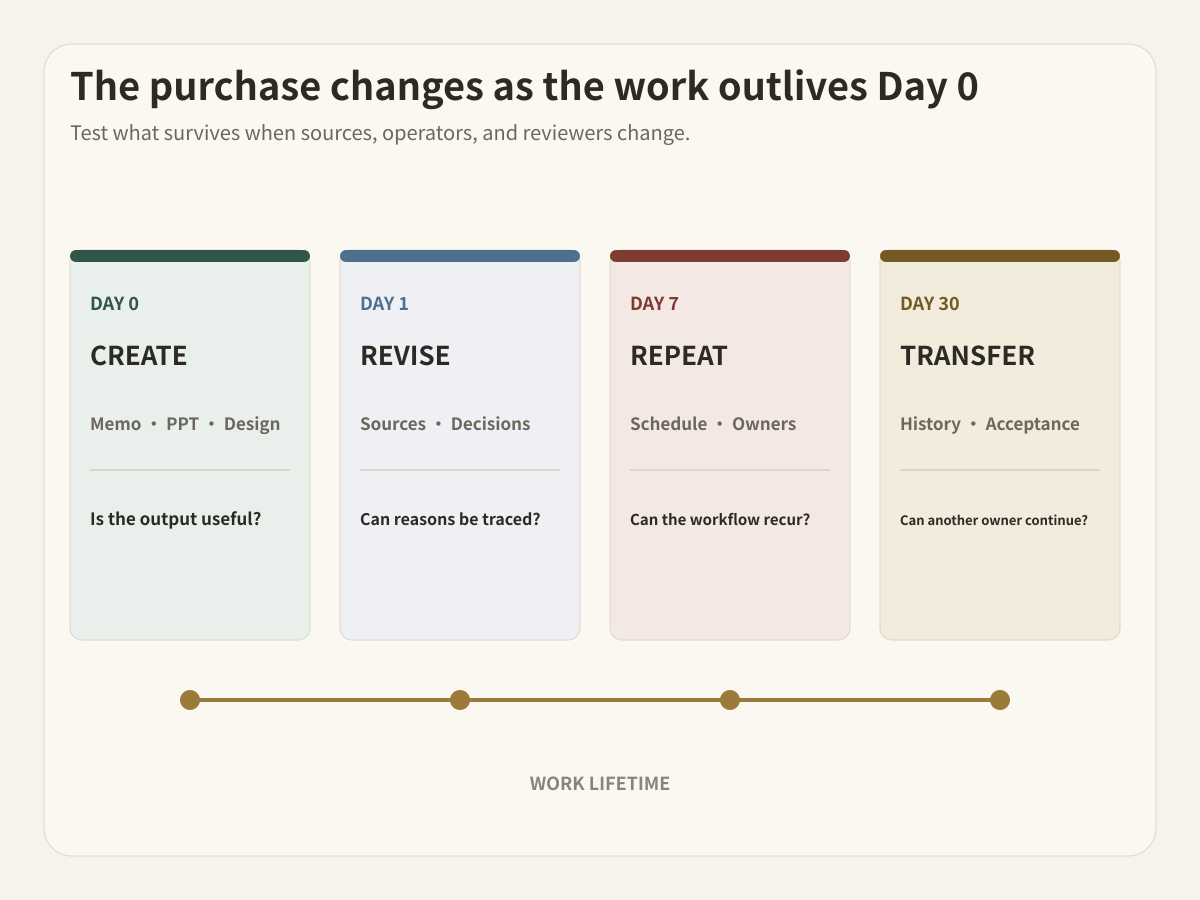
Day 0: the deliverable is the job
A founder needs a research memo, presentation or simple web output today. The inputs are available, one person can judge the result, and the work does not yet need a permanent operating owner.
Coze Space’s public positioning maps directly to this moment: general-purpose Agent assistance and an intelligent office suite that produces familiar work outputs.
For this job, requiring a persistent multi-Agent operating model may add structure before the team needs it. The fastest useful result can be the right result.
Day 1: the reasons behind the output matter
The brief comes back with revisions. A reviewer asks why one source was trusted, which assumptions shaped the slides, and what changed between versions.
Now the work is not only a document. It is a source packet, a sequence of decisions and an acceptance history.
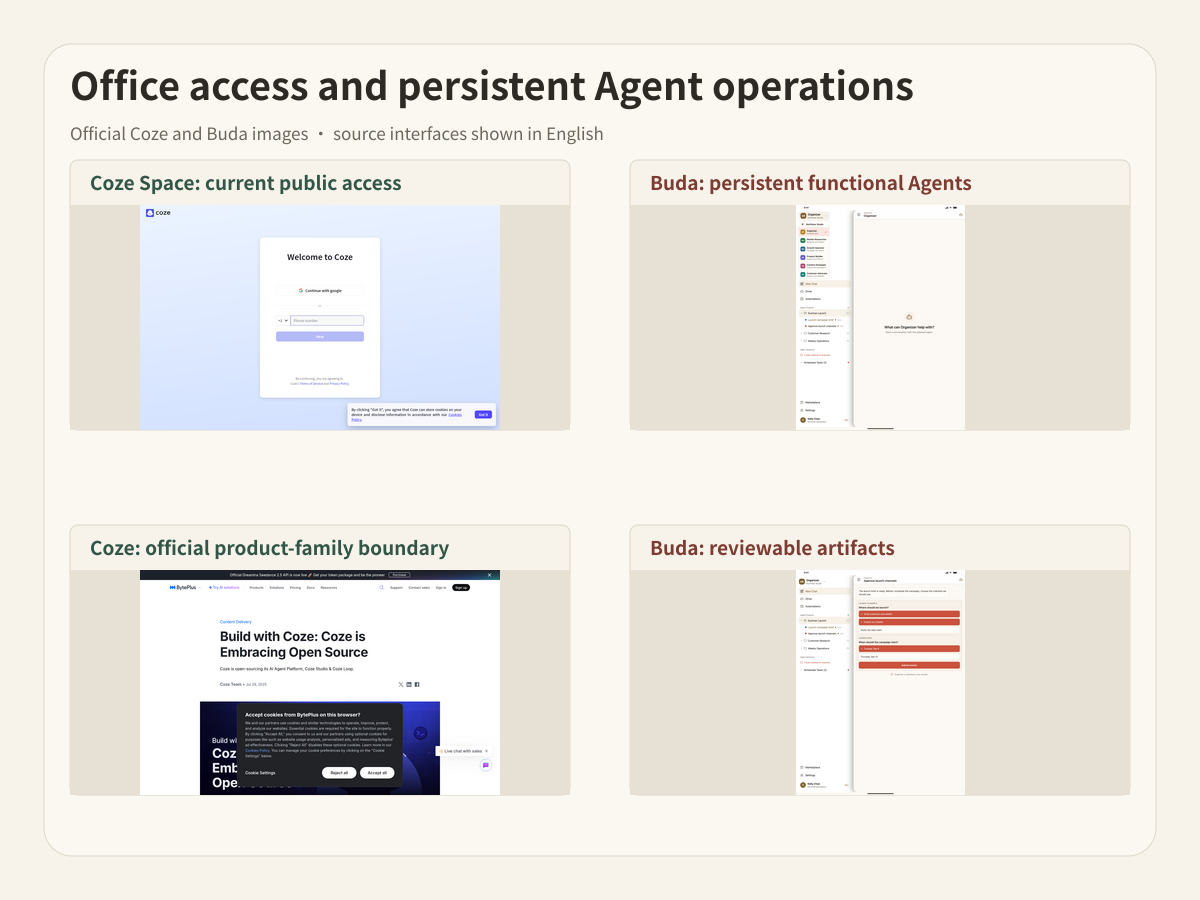
Buda keeps files, previous outputs, decisions and sessions close to persistent Agents. Browser, Terminal and Git evidence can remain beside the artifact when the workflow needs technical proof. The reviewer can inspect the deliverable rather than reconstructing a private chat.
This does not prove that Coze Space cannot retain history. The current public pages reviewed for this article do not establish the same team contract for persistent role ownership, shared Drive context, permission boundaries and artifact review. Buyers should verify those behaviors directly inside the product.
Day 7: recurrence changes the owner
The “one report” request becomes a weekly operation. New source files arrive. A research step, an analysis step and a publishing step now have different responsible people. The process must run even when the original requester is unavailable.
Buda’s operating unit is a named Agent with persistent context inside a Space. Different Agents can own different stages. Skills package repeatable procedures, Automations schedule them, Channels accept or deliver work, and owners review the resulting artifact.
The purchase question has changed. It is no longer “Can AI make the output?” It is “Can the workflow run again with the right context, owner and review point?”
Day 30: the operation needs a record
A month later, a manager wants to know which sources changed, which Agent ran, what was approved, where the final artifact went and whether the process should continue.
At this stage, the durable value is not one polished deck. It is an operating record that survives people and sessions.
Buda’s persistent Agent workspace is built for that continuity. The Space holds the team boundary, Drive holds selected working context, and artifacts make acceptance visible.
The word “workspace” can hide two different work objects
An office workspace is often organized around the deliverable: write, present, design, publish.
An Agent operating workspace is organized around a recurring responsibility: research this market every Monday, prepare release evidence after every merge, keep account briefs current, or assemble an operations report from changing inputs.
Both can be valuable. They optimize different lifetimes of work.
| Moment | What the user needs | Natural fit | What to verify |
|---|---|---|---|
| Day 0 | Produce a useful memo, PPT, design or web output | Coze Space’s public office-productivity surface | Output quality, supported tools, export and account availability |
| Day 1 | Revise with sources and decisions intact | Product-specific; test directly | Source traceability, version context and reviewer visibility |
| Day 7 | Repeat with updated inputs and named owners | Buda persistent Agents, Skills and Automations | Scheduled execution, shared files, role ownership and exceptions |
| Day 30 | Transfer, audit and continue the operation | Buda shared Space and reviewable artifacts | Permission boundaries, history, accepted output and recovery |
Three purchase situations
A person needs a finished office artifact
The goal is a report, slide deck, writing task, design or lightweight web result. The operator remains present and judges the output immediately.
Start with Coze Space. Its public product definition is aligned with this deliverable-centric job.
A builder needs to create or evaluate Agents
Do not use Space as shorthand for the whole Coze portfolio. Agent building belongs to Coze Studio. Prompt engineering, evaluation and observability belong to Coze Loop. Framework-level development belongs to Eino.
Compare those products separately with the system that actually owns the requirement.
A team needs recurring cross-functional execution
The work spans several roles, uses shared files, must run again, and produces an artifact another person accepts. The original prompt is not enough to carry the operation.
Buda is the more direct fit. Persistent Agents and their work remain visible inside the team workspace.
Human review means more than confirming an action
An assistant may ask before sending, publishing or modifying something. That confirmation is useful, but it is not the whole review model.
Teams also need to inspect the produced object: the source packet, comparison table, localized article, customer response, CRM update, release note or weekly report. A reviewer should see what entered the artifact, who owns the next step and what was accepted.
Buda is designed around this artifact-level review. The human remains accountable for judgment while Agents handle execution.
A fair comparison requires an in-product check
Coze Space’s public route currently leads unauthenticated visitors to sign-in, and the public page exposes a high-level product description rather than a detailed contract for persistence, team permissions and review.
Therefore this article does not claim those features are absent. A buyer should test them:
- Can a second member inherit the same source context without receiving a copied summary?
- Can different Agent roles use the same approved files with different boundaries?
- Can the work recur on a schedule with visible failure and recovery?
- Can a reviewer accept an artifact without reading the entire private conversation?
- Does history remain understandable after the original operator leaves?
Can Coze Space and Buda be used together?
Yes. A person can create an accepted memo, presentation or design in Coze Space and then use that artifact as an explicit input to a recurring Buda workflow.
The handoff should include the final file, source boundary, date, owner and known limitations. It should not pretend that one product’s private session history automatically becomes the other product’s trusted context.
Questions about product boundaries
Is Coze Space the same as Coze Studio?
No. Official material lists them as separate products. Space is positioned as the general-purpose intelligent office surface; Studio is the Agent development platform.
Does Coze Space only provide chat?
No. Its public metadata explicitly lists AI writing, PPT generation, web development and AI design.
Does Buda replace Coze Studio or Coze Loop?
That is not the comparison. This article evaluates Space against Buda’s persistent team Agent workspace. Studio, Loop and Eino have different product jobs.
Is every office task better as a persistent Agent workflow?
No. A one-time deliverable with one responsible operator may not need long-lived roles or automation. Persistence becomes valuable when context, recurrence, handoff and review must survive.
Run a seven-day recurrence test
Choose one task that happens at least twice. Produce the first deliverable in the preferred product. On the second run, change one source, replace the operator and require another person to approve the result.
Measure setup time, context reconstruction, owner clarity, exception visibility and review time. The test reveals whether the team needs a faster office output, a persistent Agent operation, or a deliberate handoff between the two.
Explore the Buda AI Agent Workspace, review featured Agent roles, install procedures from the Skills Marketplace, and confirm current behavior in the Buda Docs.