Buda vs Deep Agents Code: who owns the runtime, and who accepts the work?
Compare the maintenance and review work behind the two approaches.

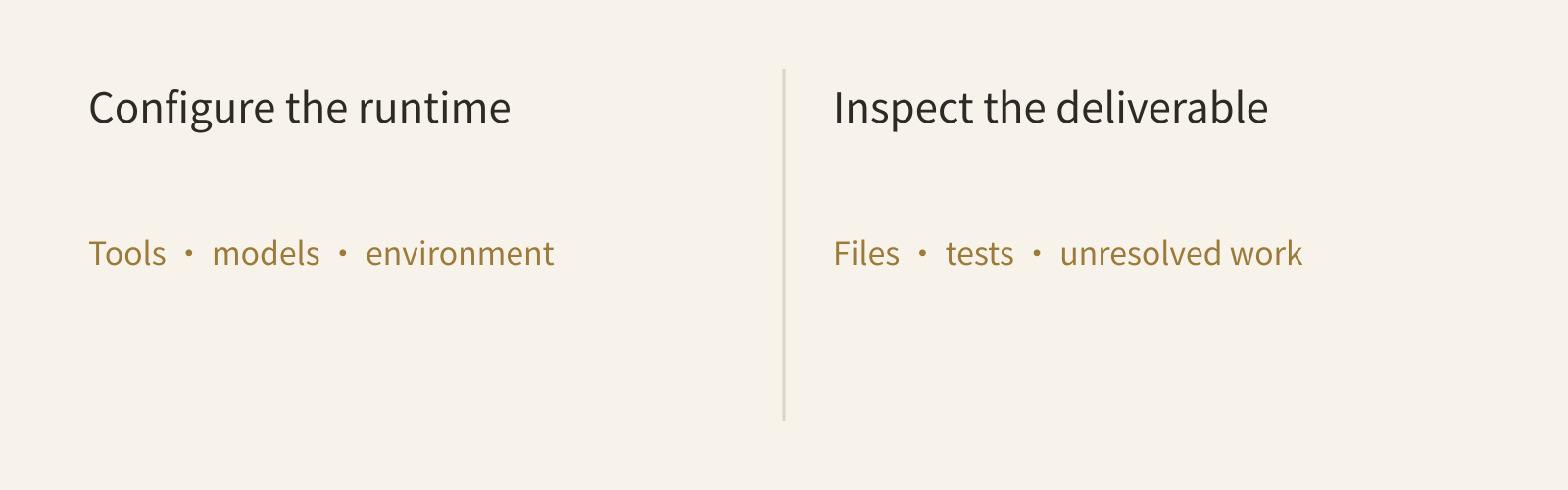
An agent demo can end when a patch appears. A team's work continues: someone must inspect the change, another person must find the evidence next week, and somebody must maintain the models, tools and execution environment.
That ownership question is a useful starting point for a Deep Agents Code alternative. Deep Agents Code suits developers who want to shape an agent runtime. Buda suits teams that want to organize tasks, observe execution and inspect files in a cloud workspace. Neither choice removes human responsibility for permissions or acceptance.
dcode is more than a local terminal
Deep Agents Code, invoked as dcode, is an open-source coding agent built on the Deep Agents SDK. The SDK is a building block; dcode is a runnable terminal interface built with it. Treating them as interchangeable obscures the actual purchase and maintenance decision.
Its documented capabilities include provider and model switching, persistent memory, context compaction, skills, MCP tools, subagents and LangSmith tracing. Tools can run in remote sandboxes. It would therefore be inaccurate to describe it as memoryless, single-agent or restricted to execution on the operator's laptop.
Goals and rubrics are particularly relevant to engineering teams. A goal lets the agent propose acceptance criteria; a rubric lets the team supply criteria it already knows. Goals can remain active across turns, be amended, paused and resumed. These controls bring a definition of done into the execution loop.
Buda's unit of organization is the Agent Workspace. Chat, persistent files, Terminal, browsers, app preview and Git are views into the same cloud computer. Files written during a task appear in the file view; an application can be opened in preview; commits can be inspected in Git. Coding is one possible workload, not the only type of deliverable.
Compare responsibilities rather than checkmarks
| Decision | Deep Agents Code | Buda |
|---|---|---|
| Define completion | Goals and rubrics participate in execution and grading | Specify outputs and acceptance checks, then inspect work in the workspace |
| Place execution | Local tools or configured remote sandboxes | Tools in the Agent's cloud environment |
| Maintain the stack | Choose providers, credentials, tools and runtime configuration | Manage Agents and task context; integrations and access still need configuration |
| Inspect a run | Terminal context and LangSmith tracing | Chat, files, Terminal, browsers, preview and Git |
| Hand off results | Design repository, file and review conventions | Keep files and execution views together; humans still accept the business result |
A hosted environment does not automatically become an organizational approval system. A grader is not a substitute for someone authorized to accept a change.
Put an engineering task through a concrete rubric
The following is a proposed pilot, not a benchmark performed for this article.
Suppose a service needs OAuth refresh handling. “Add refresh support” leaves too much undecided. An acceptance file could require:
- Expired access tokens refresh; invalid refresh tokens produce a clear error.
- Concurrent requests do not trigger an unbounded refresh loop.
- Existing tests continue to pass, with new tests for expiration, retries and concurrency.
- Unrelated modules remain unchanged and credentials never appear in logs.
- The delivery includes a change summary, test commands and unresolved limitations.
The official goals and rubrics guide offers two routes. Use /goal when the team wants proposed criteria before execution. Use a rubric file when it already has an acceptance standard. Non-interactive runs support --rubric rather than waiting for an interactive goal review.
Inspect the criteria themselves. A passing test suite does not excuse a leaked token. Automated checks may miss a login change that breaks a customer's established workflow. A different grader model or more grading iterations cannot make that business decision for the team.
In Buda, organize the same task around its repository, files and observable results. Name the patch, test evidence and preview or log location in the task requirements so a reviewer can open them. This article did not run equivalent tasks in both products and makes no speed, cost or success-rate ranking.
Engineering completion still needs a handoff package
Support may need to explain an error, product management may need to know which customer paths changed, and operations may need updated instructions. A patch alone does not answer those questions.
Ask for a change-summary.md, test output, known limitations and a non-developer explanation of the changed behavior. Tie every document to the relevant version and evidence. The next person should not have to reconstruct the final conclusion from a long terminal conversation.
dcode can create these files and extend its tool surface. The adopting team decides where they live, how people access them and where traces belong. Buda puts files and execution views in one workspace, reducing the number of surfaces a reviewer must navigate. The team still decides who may accept or share a result.
An agent's “done” message is a claim. Openable files, test evidence and reproducible behavior make it inspectable.
Run two rounds, not one polished demonstration
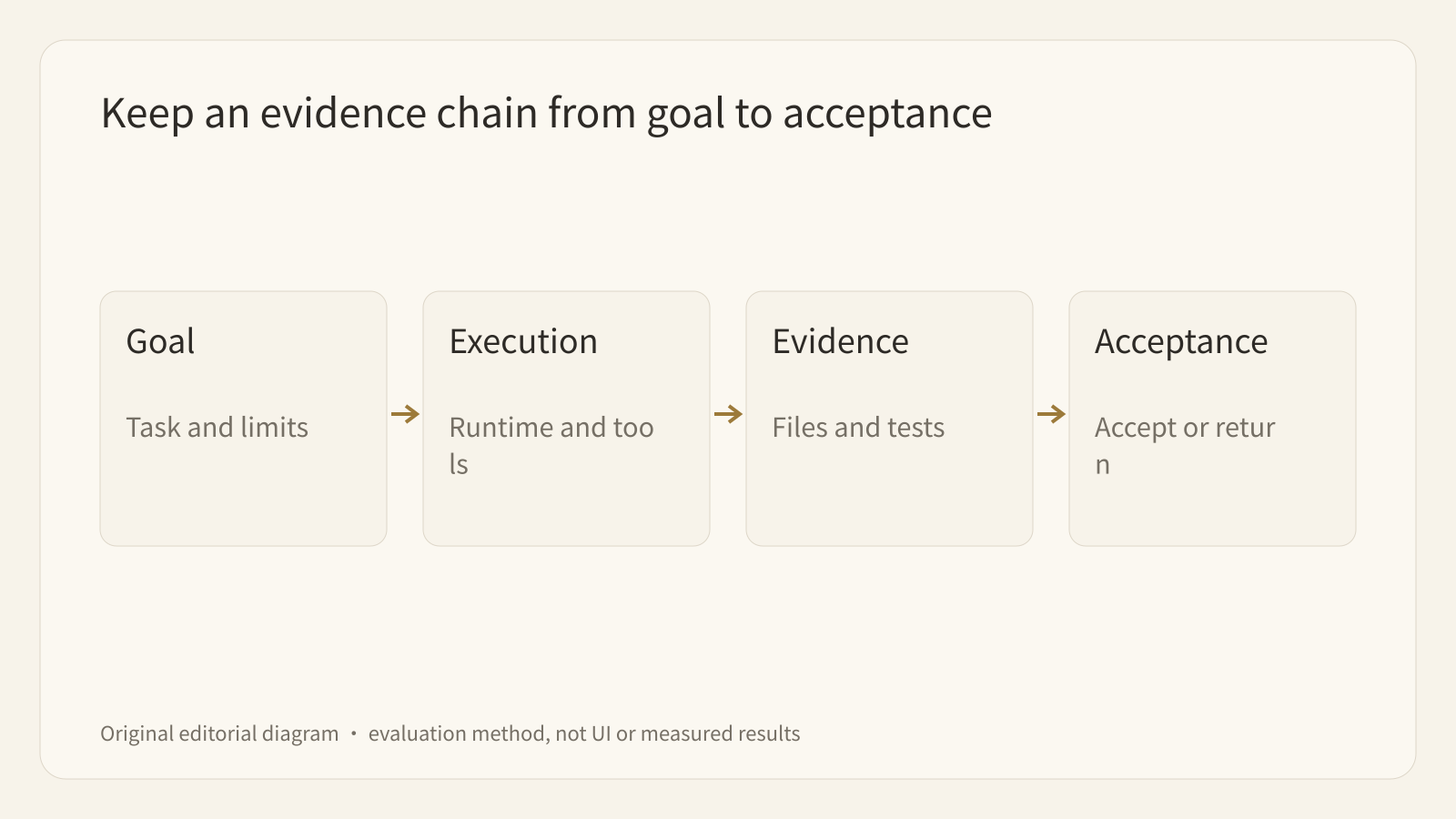
A first round often hides the setup work of the most experienced operator. Run a second round with changed input and a different person receiving the result. Record four things separately:
- Preparation: credentials, tools, permissions and environment work, including errors requiring a maintainer.
- Inspection: whether the reviewer can locate the exact version, tests and outstanding issues.
- Handoff: whether the next person can continue from the package without asking the original operator to reconstruct context.
- Change tolerance: what happens after a provider, rubric or tool configuration changes.
Keep runtime expense, configuration effort, repair work and review time separate. Otherwise a difference in operating practice can be mistaken for a stronger model. This is an evaluation design, not a promised savings percentage.
Choose the layer the team wants to control
Deep Agents Code is a reasonable choice when the team wants to shape provider routing, graders, tools and sandbox behavior inside its engineering system. Maintaining those components can be an intentional investment rather than an inconvenience.
Buda is more directly relevant when the bottleneck is finding task history, files and outputs across roles, and the team wants execution and inspection in a persistent cloud workspace. Start with one task that produces something concrete before expanding the scope.
Different teams can use both approaches for different workloads. That is a suggested division of labor, not evidence of a tested direct integration. Do not assume automatic memory, approval or file synchronization between dcode and Buda.
FAQ
Is Deep Agents Code local-only?
No. Its documentation lists remote sandboxes. A terminal interface does not establish where its tools execute.
How are goals different from rubrics?
A goal is useful when the agent should propose acceptance criteria for an objective. A rubric is useful when the team already knows those criteria. Goals have a lifecycle; rubrics can apply to one turn or subsequent turns. Review behavior depends on approval mode and configuration.
Does Buda have the same built-in rubric grader?
The workspace evidence cited here does not establish an identical native grading feature. Define acceptance in task requirements and inspect the resulting files, tests and execution evidence instead of asserting feature equivalence.
Can open-source licensing and Buda subscription prices be compared directly?
License expense is only one component. Include model usage, remote infrastructure, maintenance and review effort separately. Consult Buda pricing for current plans and Credits; this article does not claim a tested cost advantage.
Should an established dcode workflow be migrated immediately?
No. If the runtime works well, begin with a workload that has a handoff problem. Expand only after the team can inspect, accept and reuse the results with an appropriate maintenance burden.
Start with an acceptance file
Pick one real task. Write down inputs, permitted actions, output files and passing conditions. Evaluate the runtime and workspace against the same checklist, then have a second colleague receive the work. Explore the Agent Workspace to see Buda's inspection surfaces.
Sources checked October 8, 2026: the official Deep Agents Code overview and goals/rubrics guide support product facts. The OAuth scenario and two-round pilot are constructed evaluation methods, not executed comparative measurements.