Buda vs Factory Droid: Software Factory or Cross-Functional Agent Operations?
Choose by system of record: software delivery in Factory, or persistent Agent roles across the company in Buda.

Searching for a Factory Droid alternative can lead to the wrong comparison. Factory is not merely a local coding assistant. Its official product now spans a visual app, terminal and IDE workflows, browser and Slack delegation, persistent Droid Computers, headless execution, multi-agent Missions, model routing, review, and enterprise controls.
The useful decision is therefore not “local coding agent or cloud Agent workspace?” It is which operating system should own the work.
Factory is built around software delivery. Buda is built around persistent Agents with roles, files, tools, sessions, channels, and recurring responsibilities across the company. Both can use cloud computers. Both can preserve context. Both support human control. Their centers of gravity are different.
The short verdict
Choose Factory when the work begins and ends in the software lifecycle: understand a repository, plan a change, edit code, run tests, review a diff, coordinate a larger Mission, and carry the result toward a pull request.
Choose Buda when the durable unit is a business role rather than a repository: a research Agent, content Agent, operations Agent, finance Agent, or support Agent that keeps its own Drive, tools, instructions, sessions, automations, and channels.
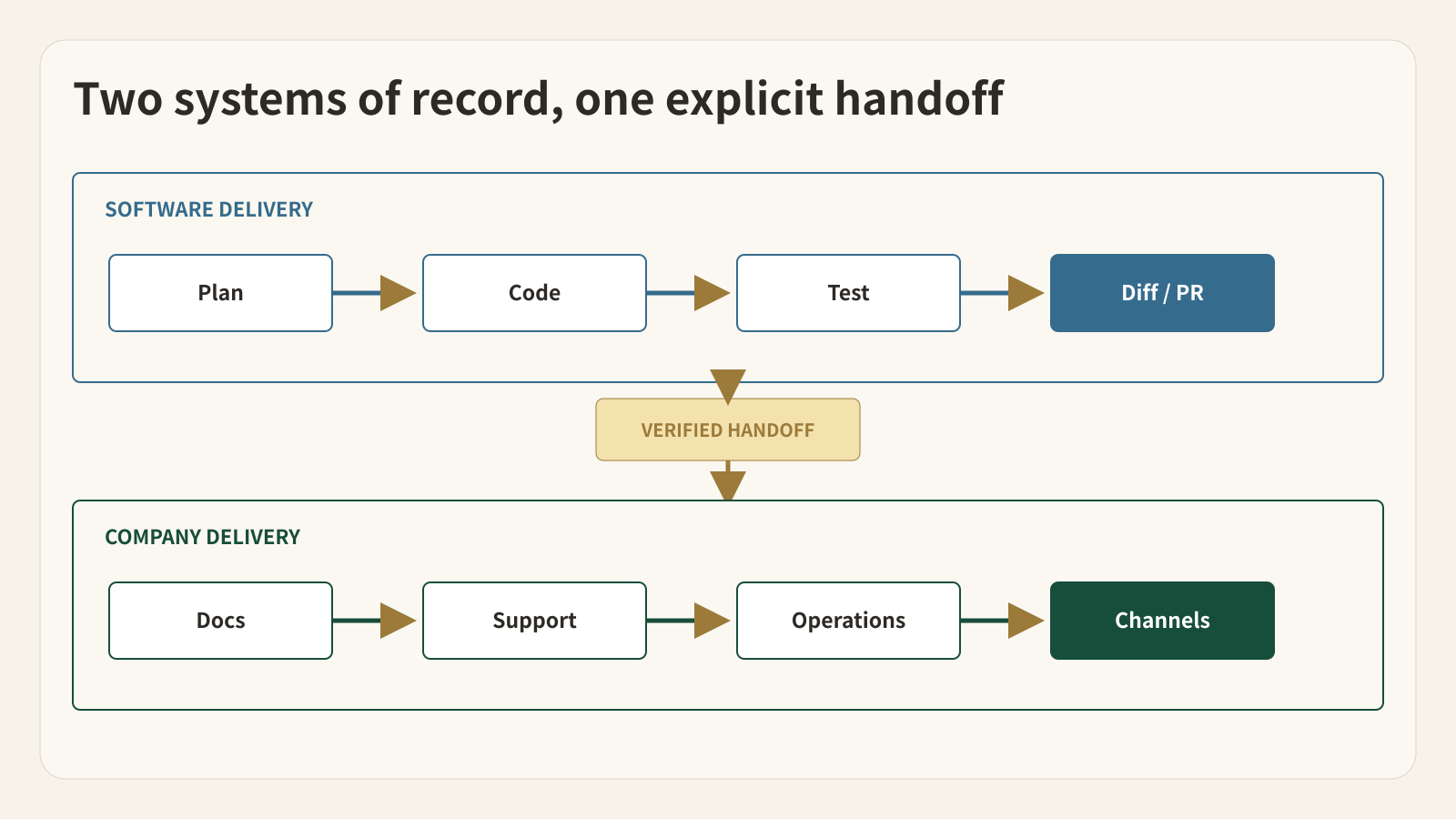
Use both when engineering delivery is only one stage. Factory can own the implementation and validation loop. Buda can own the cross-functional work that begins when the code result must become a release brief, support update, customer communication, operating checklist, or recurring follow-up.
That is a handoff between systems, not a contest over which product has more checkmarks.
Factory Droid is a software factory, not a terminal feature
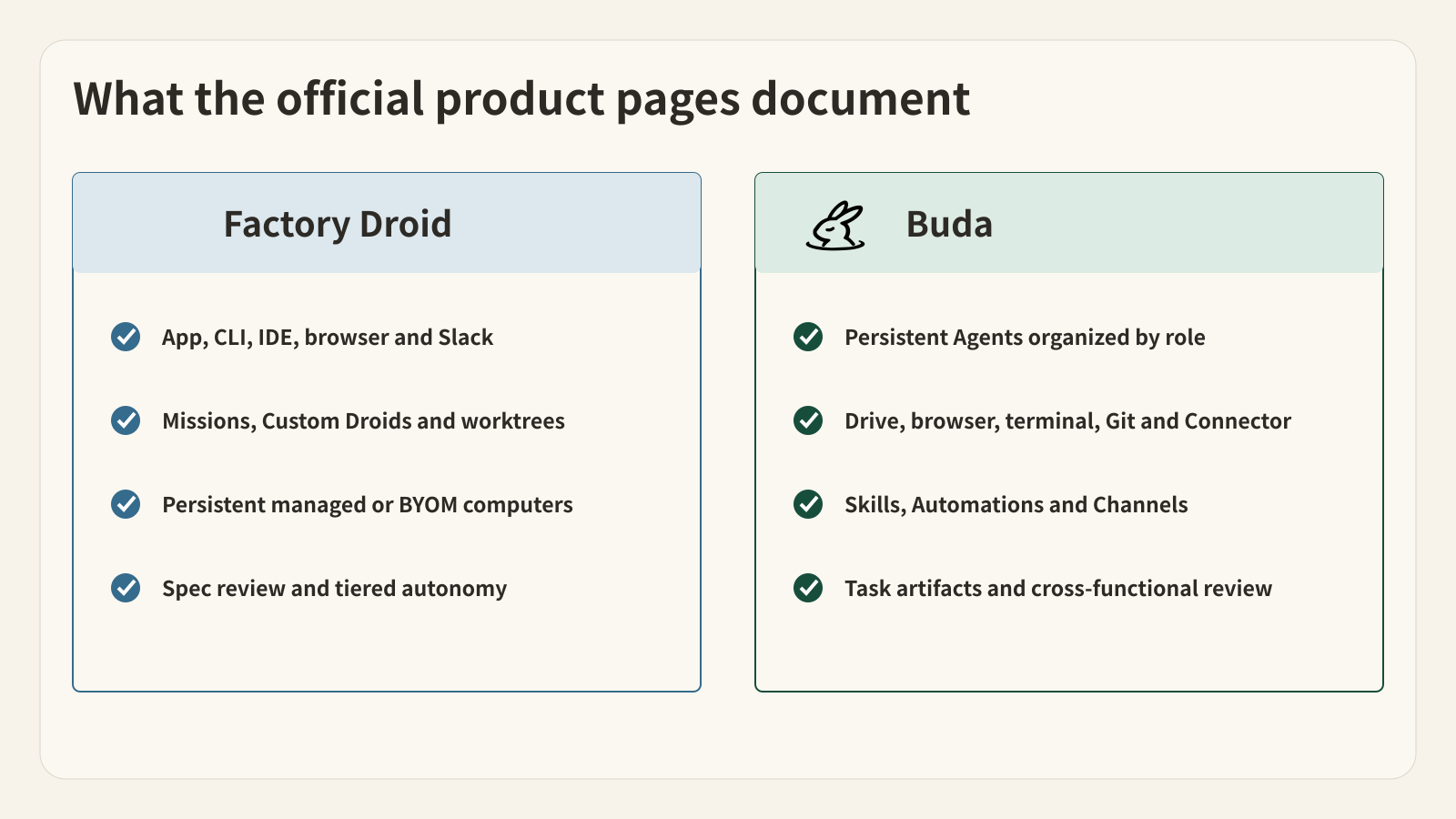
Factory's current official pages describe Droids as coding Agents that plan, write, test, and ship code across the terminal, IDE, browser, Slack, and the Factory App. The CLI exposes the same runtime, including MCP, Hooks, Skills, Custom Droids, headless droid exec, and Missions.
Missions add a planning and orchestration layer for bounded, multi-feature work. The human collaborates on a plan, reviews features and milestones, then approves execution. Mission Control coordinates workers and validation. Factory is explicit that Missions are not fire-and-forget and that reliable automated QA depends on a testable repository.
Factory also offers persistent Droid Computers. A team can use a Factory-managed machine or register its own workstation, VM, or on-prem server. Packages, files, services, and configuration remain between sessions. This directly contradicts any comparison that treats Factory as a disposable local-only tool.
Review and permissions are also substantial. Normal, Spec, and Mission modes define the shape of work. Autonomy levels control which risks can run without another confirmation. Command allowlists, denylists, blocklists, sandbox rules, Hooks, and Droid Shield provide additional controls. Factory has a stronger software-engineering control surface than a generic comparison table often suggests.
Buda starts from a different object: the Agent role
A Buda Agent has an identity, instructions, a private Drive, a cloud computer, Skills, Channels, and Sessions. A Space can hold several Agents with different jobs and different files. That makes the role, not the repository, the long-lived unit.
The distinction changes how context is organized. An engineering Agent may work with Git and a terminal. A research Agent may work with source files and the browser. An operations Agent may run an Automation and deliver the result through a Channel. Each keeps a separate operating context instead of sharing one general coding persona.
Buda's cloud computer includes files, browser, terminal, and Git, and Buda Connector can bring an Agent into an existing computer environment. But Buda is not a specialized software factory. It does not claim Factory's depth in repository readiness, Missions, pull-request automation, or engineering policy. Its value appears when one company needs several persistent Agents across functions and wants their work visible in one Space.
Compare the operating model, not the feature list
| Decision area | Factory Droid | Buda |
|---|---|---|
| Primary system of record | Repository, project, diff, test, PR, engineering systems | Agent role, Drive files, task Sessions, Skills, Channels, reviewed artifacts |
| Default job | Plan, implement, test, review, and ship software | Execute recurring and one-off work across business functions |
| Execution surfaces | App, terminal, IDE, browser, Slack, headless exec, Droid Computers | Agent workspace, cloud computer, browser, terminal, Git, Connector, Channels |
| Parallel work | Missions, workers, validators, Custom Droids, worktrees | Multiple role-based Agents and independent Sessions |
| Durable context | Repository instructions, sessions, skills, machines, connected engineering systems | Agent instructions, private Drive, persistent computer, Skills, Automations, Channels |
| Human control | Spec approval, diff review, autonomy levels, sandbox and command policy | Task review, tool permissions, visible sessions, artifact review, role and Space boundaries |
| Strongest fit | Software development lifecycle | Cross-functional Agent operations |
The table shows overlap. It does not imply equivalence. A persistent computer is not the same thing as an organizational operating model, and multiple agents are not automatically a software factory.
Scenario 1: a repository-wide migration
Suppose a platform team needs to replace an authentication library across six services, update tests, preserve behavior, and produce reviewable pull requests.
Factory should be the first pilot. The work is repository-defined, engineering validation is the acceptance bar, and the team benefits from Spec Mode, Missions, worktrees, repository instructions, tests, diffs, and PR-oriented review. Factory's own guidance also makes the prerequisites visible: long-running work needs a repository that can be exercised through automated, scriptable QA.
Buda could run code in a terminal, but choosing it as a Factory replacement for this case would ignore Factory's stronger specialization.
Scenario 2: a weekly competitor and product-operations loop
Now suppose a team needs to monitor five competitors, preserve source evidence, write a weekly decision brief, create customer-facing content, and send approved updates to Slack or WeCom.
The repository is not the main system of record. The durable objects are sources, decisions, drafts, schedules, and channel delivery. Different roles may own research, writing, review, and distribution.
Buda is the more natural starting point. A research Agent can keep the watchlist and source files in Drive. A content Agent can turn approved findings into platform versions. An operations Agent can run the schedule and deliver the result through a Channel. People retain judgment over what is accepted or published.
Factory can connect to Slack and other systems and can produce documents. But using a software factory as the permanent home of this workflow may make the repository carry business state it was not designed to own.
Scenario 3: software delivery followed by company delivery
A new feature is complete only when more than code has changed. Documentation must be updated. Support needs a response guide. Sales needs a short explanation. Operations may need a rollout checklist. The release may need monitoring and a follow-up report.
This is the strongest case for using both.
Factory owns the engineering truth: the plan, implementation, tests, diff, and pull request. Once the change reaches the agreed engineering checkpoint, a structured handoff passes verified facts to Buda. Buda's role-based Agents turn those facts into cross-functional artifacts and route them through human review.
The boundary should be explicit. Buda should not reinterpret an unverified code result as shipped functionality. Factory should not silently publish customer communication because a PR passed. Each system should hand over evidence, owner, status, and acceptance criteria.
Human review exists in both products, but at different objects
Factory review is closest to software changes. The Factory App shows diffs and generated artifacts beside the session. Spec Mode lets people review the plan before edits. Autonomy levels and policy decide which actions pause. Missions expose milestones and validation.
Buda review is closest to Agent task output and business handoff. People can inspect the Session, files, browser state, and produced artifact. Agent and Channel permissions can separate read-only support work from broader execution. Separate Agents keep role-specific files and instructions from becoming one shared context pile.
Neither model removes accountability. The question is whether the person needs to approve a code diff, a business artifact, or both.
Where Factory is the better choice
Factory is the better choice when the buyer is an engineering organization and the main outcomes are code changes, tests, reviews, pull requests, QA, and SDLC automation. Its platform is designed to carry context across the tools developers already use and to turn repeatable engineering work into controlled automation.
It is also the better choice when enterprise engineering policy is the hard requirement. Factory documents command policy, sandboxing, model controls, network rules, Hooks, data-flow options, and deployments ranging from managed to air-gapped.
Where Buda is the better choice
Buda is the better choice when the team wants durable Agents for jobs outside engineering and the work must live across files, browser tasks, automations, and messaging channels. It is designed for a company to organize several Agent roles without forcing every workflow into a repository or SDLC frame.
This is not a claim that Buda is a deeper coding system. It is a claim about the owner of cross-functional operating context.
A fair pilot
Do not compare both products on a one-line coding prompt. That proves little.
Use a real feature with a real downstream handoff. Ask Factory to plan, implement, test, and prepare the code for review. Measure accepted code changes, test evidence, tool calls, elapsed time, and reviewer corrections.
Then give the verified release facts to Buda and ask separate Agents to create the documentation update, support brief, rollout checklist, and channel-ready announcement. Measure whether each artifact preserves the engineering facts, identifies its owner, and waits at the correct approval boundary.
The result reveals whether you need one system or a handoff between two. It also exposes duplicate context, missing evidence, and unclear ownership before those defects enter production.
FAQ
Is Buda a direct replacement for Factory Droid?
Usually not. Factory is a specialized software-development platform. Buda is a broader workspace for persistent, role-based Agents across business functions. They overlap in tools and cloud execution but organize work around different systems of record.
Is Factory Droid only a local coding assistant?
No. Factory supports a visual App, terminal and IDE work, web and mobile review, Slack and issue delegation, persistent managed or bring-your-own Droid Computers, headless execution, and multi-agent Missions.
Which is better for coding?
Factory is the stronger starting point for repository-centered software delivery. It provides more purpose-built controls for planning, implementation, tests, diffs, worktrees, pull requests, and SDLC automation.
Can Factory and Buda work together?
Yes, when the handoff is explicit. Factory can own engineering execution and validation; Buda can own the reviewed cross-functional work after an engineering checkpoint. Pass evidence and status, not an unsupported summary.