Buda vs Fin: customer conversations or a workspace across roles?
Evaluate channels, knowledge upkeep, and handoffs to separate native capabilities from implementation work.

Some customer requests fit a continuous service operation: retrieve information, perform an authorized action, answer the customer, and escalate when necessary. Others become internal work—compare documents, investigate product feedback, prepare an explanation, and ask an owner to decide.
That handoff is a useful starting point for evaluating Fin and Buda. Fin organizes its product around customer conversations. Buda provides an agent workspace for building tasks across roles. Both can execute actions; their fit depends on channels, knowledge operations, work artifacts, and ownership.
Examine the conversation lifecycle first
Fin’s current product covers Service, Sales, Ecommerce, and Success. It lists voice, chat, email, social channels, and more. It is native to Intercom and supports other helpdesks. Train, Test, Deploy, and Analyze form its operating cycle.
Fin also offers Guidance, Procedures, and integrations that can read and write connected systems, with API, MCP, and data integrations listed publicly. It should not be reduced to FAQ generation. Verify the exact channel, helpdesk, action, and plan your team requires.
For a team continuously receiving customer requests, Fin’s native conversation path is a logical place to start. Evaluate whether operators can maintain behavior and knowledge, inspect results, and transfer unresolved work to people inside the existing service operation.
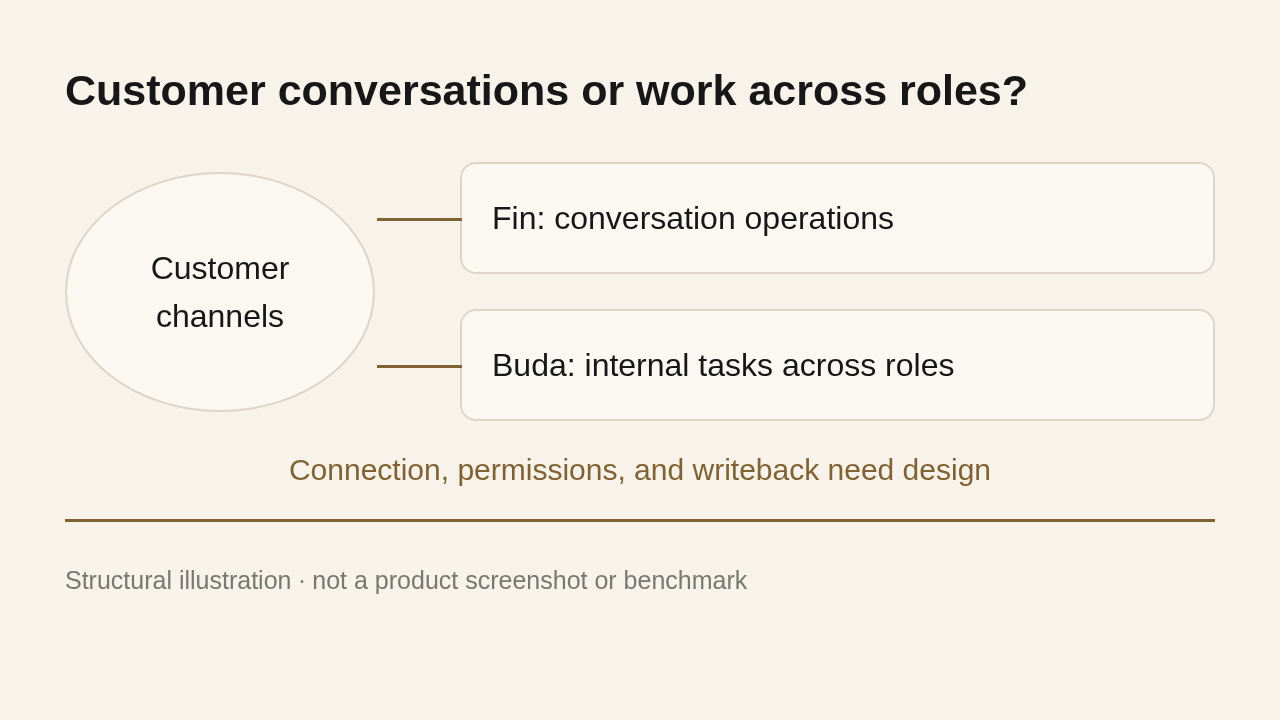
Buda organizes work around tasks and artifacts
The Buda workspace lets a team assign goals and use files, browsers, Terminal, and permitted tools. Chat preserves the task discussion; Drive holds artifacts; tool calls provide execution evidence.
A team can use this environment to build internal research and preparation. For example, ask an agent to compare supplied policies, identify conflicts, and prepare an explanation and questions for an owner. This is a workflow a team can build, rather than a claim that a ready-made support template exists.
Buda integrations require concrete connections and permissions. A support-related task in a workspace does not establish native helpdesk routing, voice agents, or Fin-equivalent service reporting. Those needs remain implementation and procurement checks.
Compare the cost of making the workflow operate
| Buying question | Evaluate in Fin | Evaluate in Buda |
|---|---|---|
| Where do customers arrive? | Supported channels, helpdesk, and escalation | How the existing channel connects and who maintains it |
| Who maintains behavior? | Training, Guidance, testing, and analysis | Source material, methods, instructions, and checks |
| What is delivered? | Conversation outcome and connected actions | Research, drafts, files, and cross-tool outputs |
| Who receives exceptions? | Human handoff with usable context | A named owner, stopping point, and writeback destination |
| How is acceptance checked? | Knowledge, actions, and escalation in the target channel | Sources, tool results, artifacts, and downstream receipt |
Use these questions to structure a trial, not to assign generic feature scores. A native integration can remove substantial connecting work; an open working environment also introduces configuration responsibilities. Include ongoing maintenance in the evaluation.
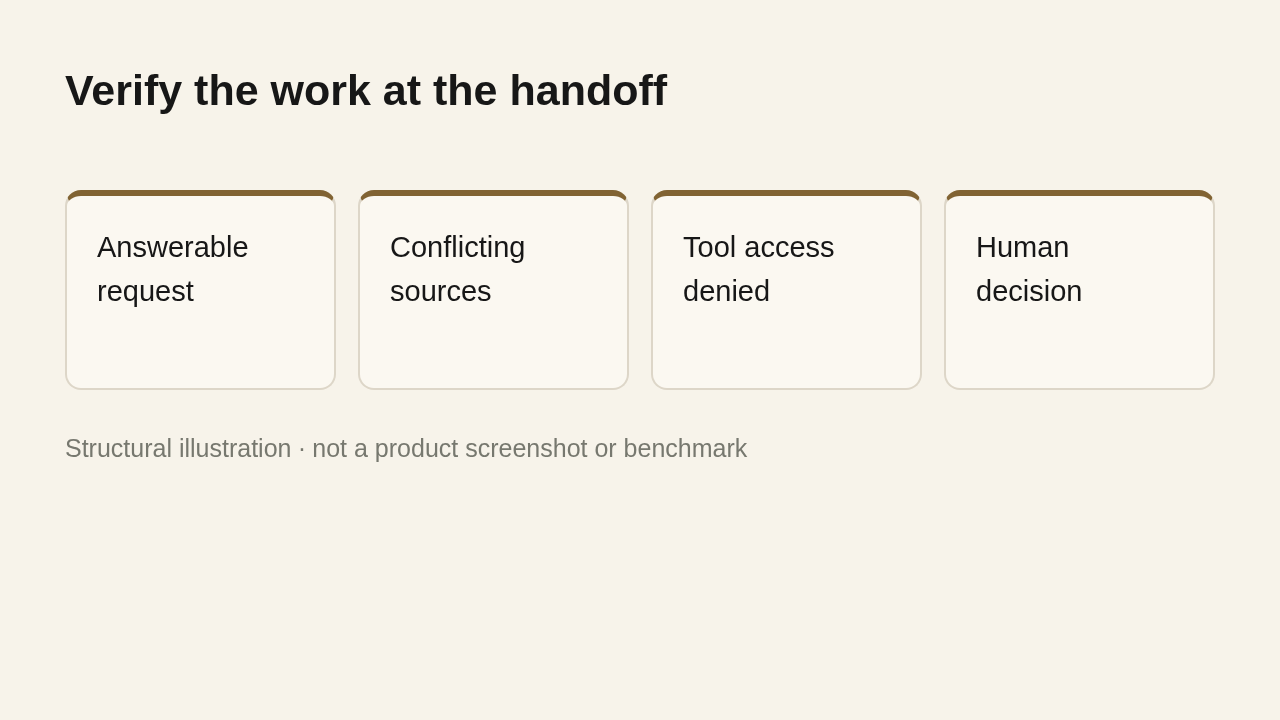
When a conversation becomes a research task
Identify the system responsible for the conversation and the environment responsible for preparing material. Transfer the original question, policy versions, permitted sources, commitments the agent cannot make, and the requested output.
A Buda instruction might be:
Compare the supplied policies and product material. Separate confirmed facts, conflicting statements, and decisions requiring an owner. Preserve sources, save an internal explanation and reply draft, and do not send or promise refunds, prices, or service scope without confirmation.
The receiving person checks evidence, current policy, and authorization. Writing the result into a helpdesk needs a specific connection and permission. Shared support for tools does not establish automatic interoperability or shared context.
Trial the failure paths
Use sanitized questions from the team’s actual work: directly answerable requests, conflicting documents, unavailable tools, and decisions reserved for people. Check whether failures are recognized and whether the human receives enough context.
Fin’s published outcome figures are vendor disclosures, not a comparative Buda benchmark. A successful Buda tool call does not establish a service resolution rate. Record actual results, maintenance effort, and remaining human work on your tasks.
Budget using current billing definitions, conversation volume, human handoff, knowledge upkeep, and integration work. A single displayed unit price cannot stand in for total operating cost.
Should the current helpdesk stay?
If it owns conversation history, routing, and SLAs, preserve those responsibilities during a trial. Verify Fin’s supported connection, or use Buda for internal preparation with an explicit return path.
Can the products work together?
A team can evaluate a design in which the conversation system handles customers while the workspace handles authorized internal tasks. Identity, data scope, connection, review, and writeback still need implementation. Validate one handoff before adopting the arrangement.
Map the largest class of requests into channel, evidence, action, artifact, and owner. Use that map to assess Fin’s conversation operation or build a bounded Buda task and inspect what it delivers.