Buda vs Goose: Run the Agent Yourself, or Give the Team a Workspace?
Test the second run: can a new owner find the evidence and finish the task?

Buda vs Goose: Run the Agent Yourself, or Give the Team a Workspace?
A developer needs an Agent to inspect a repository, edit files and run tests. Goose is a serious option: its own project describes a general-purpose, open-source Agent with desktop, CLI and API access. It works beyond coding, including research, writing, automation and data analysis. It also supports multiple model providers and MCP extensions. Calling it “just a code assistant” would make the comparison useless.
The buying decision starts when that useful work becomes a recurring responsibility shared by several people. Who owns the machine and model configuration? Where do the source files and accepted artifacts live? Can another person find the task, understand what happened and decide whether to accept the result? Goose and Buda place different responsibilities on the operator and the workspace.
A local Agent is an advantage when the machine is part of the job
Goose runs on your computer and is available as a desktop app, CLI and API. For a developer working in a local repository, that is a sensible operating model. The person who knows the environment can connect tools and models, inspect changes, and decide what to allow. Goose's breadth matters: the same operator can use extensions for work that spans more than code.
That control also means the team needs an answer for local setup, credentials, reusable configuration and the handoff to someone else. These are ownership questions, not evidence that Goose cannot do the job. If one engineer is accountable for a local build-and-test loop, adding a cloud team workspace can be more structure than the work requires.
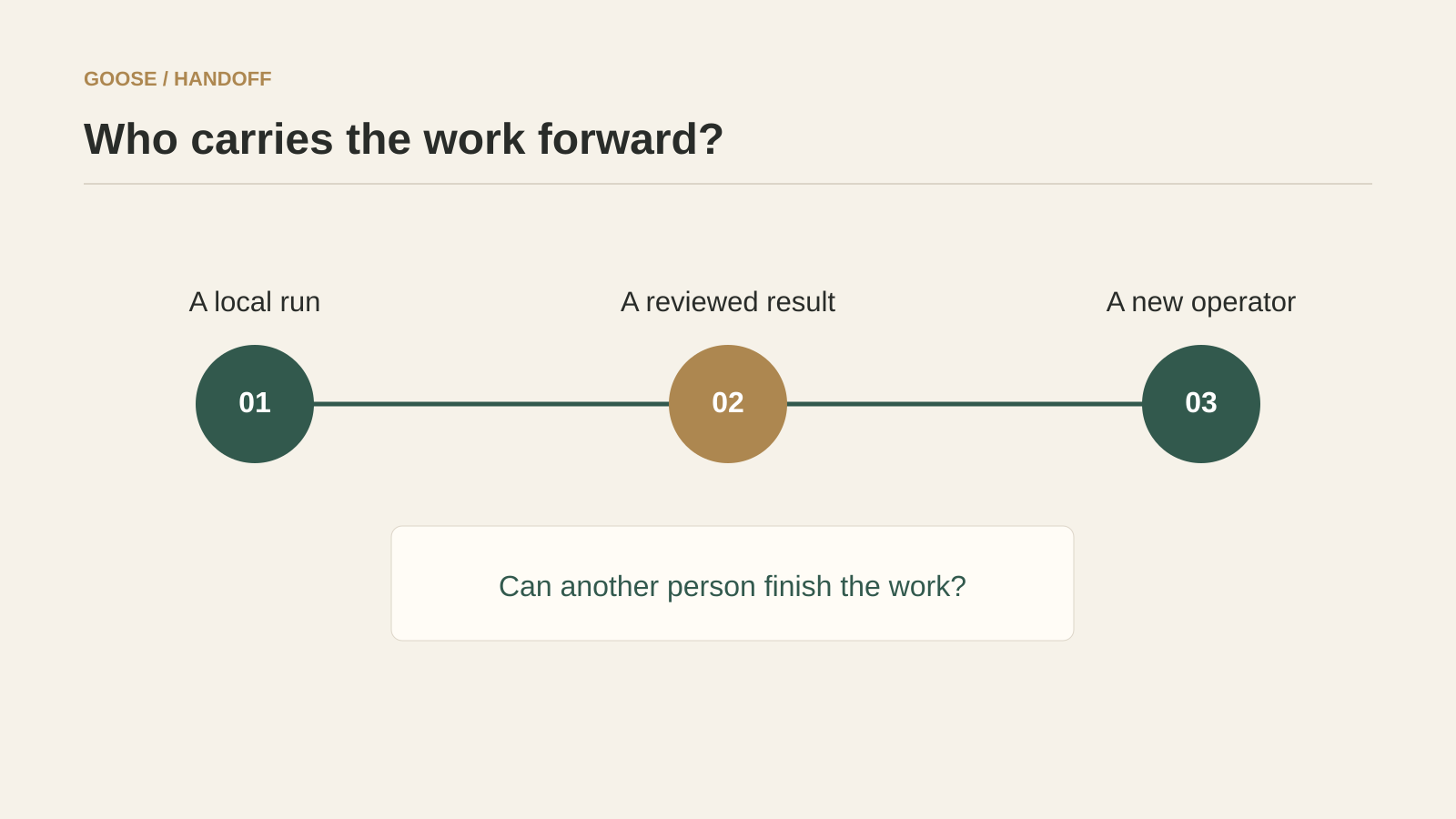
The handoff changes the unit of work
Imagine a weekly customer-issue review. One person collects support messages, another checks product context, an engineer fixes a bug, and a manager approves the response. A personal Agent can help any one participant produce an excellent answer. Yet the workflow needs more than a private successful session: current inputs, named responsibilities, intermediate files, a reviewable output and a point at which a human accepts it.
Buda organizes persistent Agents and their sessions inside a Space, with a shared Drive and visible work surfaces such as browser, terminal and Git. Skills carry repeatable procedures; Automations can run scheduled work; Channels can connect the Agent to the place the team communicates. That is an operating surface for repeating and reviewing work across roles. It does not make Goose's desktop or extension ecosystem irrelevant. A team may use Goose for a specialist local step and pass its accepted artifact into the broader process.
Test the second run, not the first demo
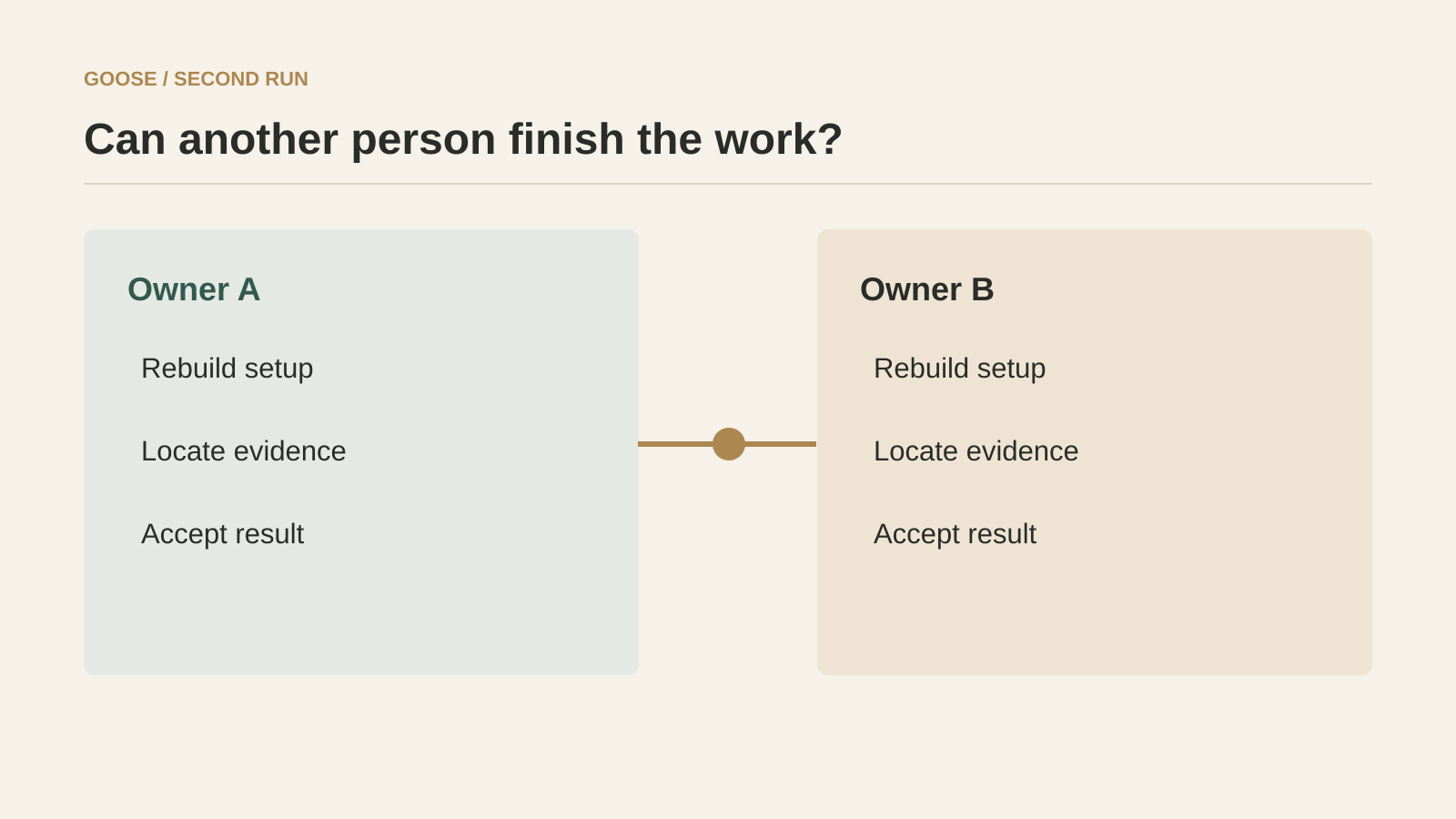
On day one, ask both setups to produce an evidence-backed issue brief. On the following week, replace the operator and one input document. Do not hand over the original private chat. Ask the new owner to identify the source of the previous claim, change only what is outdated, run the relevant tools and present a diff for approval.
This test reveals where setup lives. For a local-first workflow, document how the model configuration, permissions and extensions are reproduced. For a team workspace, check who may read the shared files, what each Agent may change, where failures surface, and how a reviewer sees the final artifact. An attractive answer that cannot be traced or resumed has not completed a recurring team task.
What to compare before choosing
| Decision | Goose | Buda | Check in your own environment |
|---|---|---|---|
| Operating surface | Native desktop, CLI and API on your machine | Cloud Space with persistent Agents and sessions | Which environment holds the work and who maintains it? |
| Scope | General-purpose tasks, including code and non-code work | Cross-role work organized around Agents, files and review | Does the task belong to one operator or several roles? |
| Models and tools | Multiple providers and MCP extensions | Workspace tools and installable Skills | Which concrete integration does the task need? |
| Continuity | Operator must define how local setup and artifacts transfer | Space, Drive and sessions provide a shared work surface | Can someone else repeat the task without a transcript dump? |
| Accountability | Test local permissions and your own approval process | Inspect task artifacts and human review points | Who accepts the final change and where is that recorded? |
This is a comparison of operating models, not a checklist awarding Buda a point every time Goose exposes a different interface. Goose may be the better fit for a developer who wants open-source local execution and provider choice. Buda may be the better fit when the recurring deliverable spans several roles and its evidence must remain available to a team.
Questions that decide a pilot
Is Goose only for coding?
No. The official project calls Goose a general-purpose Agent and lists research, writing, automation and data analysis alongside code. Evaluate its real extensions and task permissions rather than using a narrow category label.
Does a cloud workspace remove the need for local tools?
Not for every task. If the source repository or device is central to the job, the team may still need a local step and a deliberate handoff. The question is where the accepted result, ownership and next run live.
Can a team use both?
Yes. A specialist can produce and check a local artifact, then hand over the file, source links, test results and outstanding risk to a recurring team workflow. Do not assume private tool history automatically becomes shared trusted context.
Run a two-person recurrence test
Choose a real weekly task. Have one person complete it, then let another person repeat it with changed inputs and approve the result. Record setup time, context reconstruction, failed loops and review minutes. If local control and provider freedom dominate, start with Goose. If the expensive part is the handoff between people and tasks, explore the Buda Agent Workspace with one reviewable, repeatable workflow.