Buda vs Hermes Agent: Who Owns the Learning Loop?
Compare an adaptive self-hosted agent with a managed team workspace for reusable procedures, shared context, permissions, and review.

Buda vs Hermes Agent: Who Owns the Learning Loop?
The most important difference between AI agent products often appears after the first successful task.
What happens to the experience? Does the agent turn it into memory or a skill for its next run? Does a person decide whether the method is trustworthy? Can a second operator inspect, inherit and govern it?
Hermes Agent and Buda both preserve context, use tools, run scheduled work, connect to messaging channels and support more than one agent role. The decision is not “local tool versus real platform.” It is: who owns the learning loop, and how does a useful behavior become an accepted team procedure?
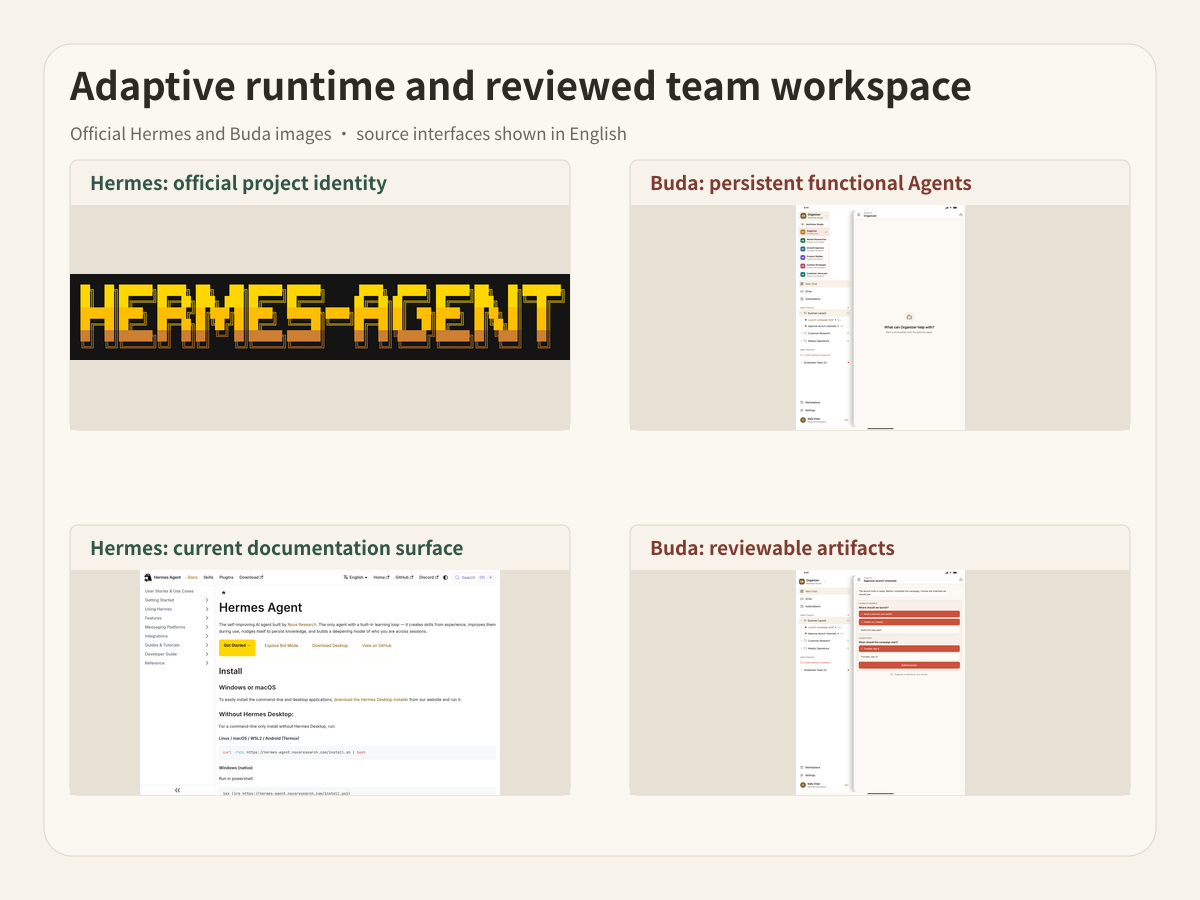
Start with the current Hermes Agent
Hermes Agent is the open, self-improving agent built by Nous Research. Its official documentation describes a closed learning loop: agent-curated memory, periodic nudges to persist knowledge, autonomous skill creation after complex tasks, skill improvement during use, full-text search across prior sessions and a model of the user that deepens over time.
It is not tied to one laptop or one model. Hermes can run through local, Docker, SSH, Singularity, Modal, Daytona and Vercel Sandbox backends. It can use Nous Portal, OpenRouter, OpenAI or other compatible endpoints. A messaging gateway connects it to Telegram, Discord, Slack, WhatsApp and many other surfaces. Built-in cron, Bot Mode, isolated subagents, MCP and portable Agent Skills extend the operating surface further.
This is a capable runtime. Describing Hermes as a terminal chatbot, a coding-only assistant or a laptop-only tool would be inaccurate.
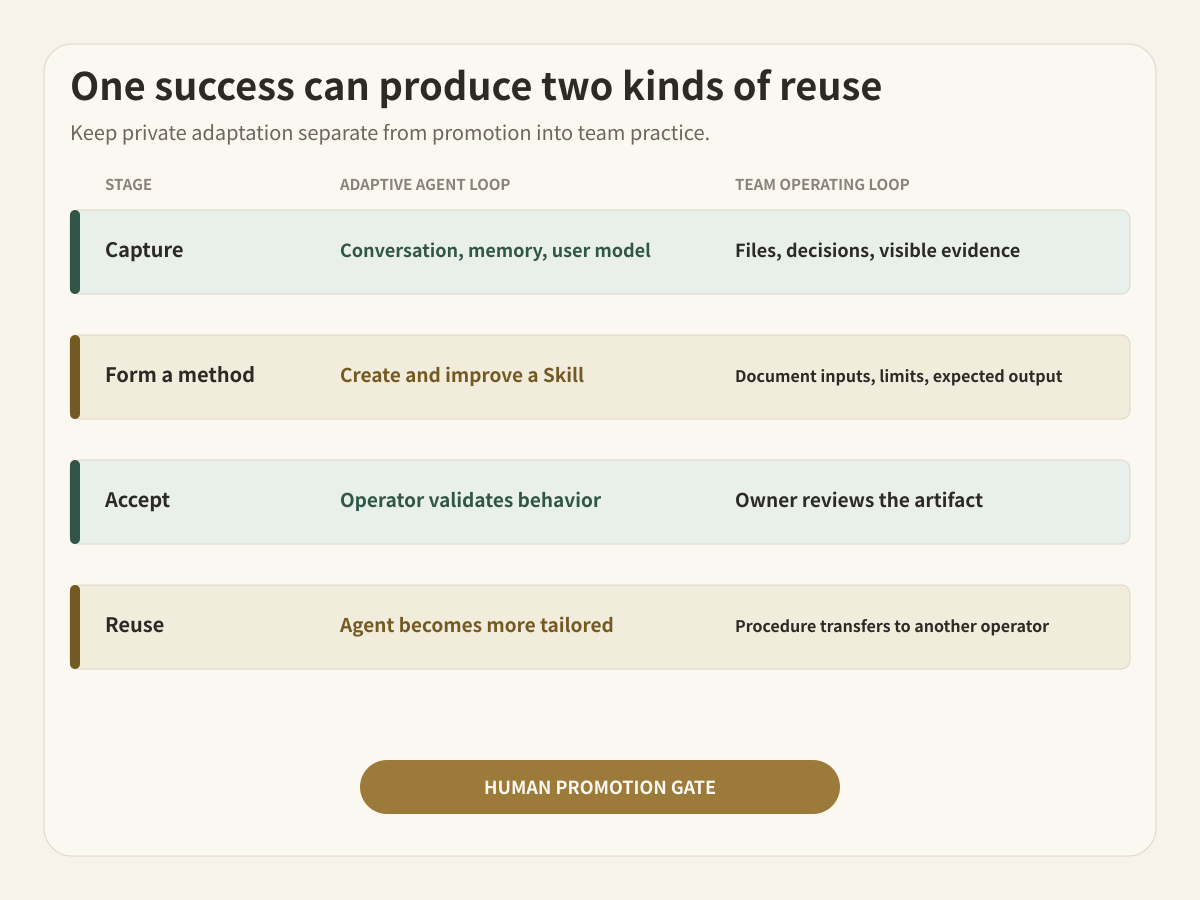
A successful run can create two kinds of value
Suppose an agent completes a difficult supplier review.
The first kind of value is adaptive continuity. The agent remembers which files mattered, learns the operator’s preferences, creates a reusable skill, and improves that skill the next time it runs. The benefit compounds inside that agent environment.
The second kind is organizational continuity. A person inspects the sources, accepts the method, names an owner, defines inputs and review points, and makes the procedure available to other responsible operators. The benefit compounds across a team.
Hermes is designed around the first loop. Buda is designed around making the second loop visible through persistent Agents, shared Drive context, reusable Skills, scheduled Automations, connected Channels and reviewable artifacts.
Buda does not claim that its Agents autonomously rewrite their own procedures after each task. Repeatability is made explicit: a Skill packages the method, an Automation schedules it, a Space controls who can see the context, and a person reviews the output.
Trace the learning supply chain
Four stages determine whether “the agent learned” is useful or risky.
1. Experience capture
Hermes can search past conversations, maintain persistent memory and build a deeper user model. This helps a long-running operator avoid reconstructing preferences and context.
Buda retains files, outputs, decisions and prior runs in persistent Agent workspaces. Its continuity is tied to visible work context: Drive files, sessions, Browser, Terminal, Git and produced artifacts.
2. Procedure formation
Hermes can create Skills from complex tasks and improve them during use. That is a core product capability, not an incidental extension.
Buda Skills are explicit reusable procedures. Teams can install them from the Marketplace or maintain a procedure for a defined role. The emphasis is less on autonomous self-modification and more on a method people can inspect and intentionally reuse.
3. Execution ownership
With Hermes, the operator chooses and maintains the runtime: local machine, container, remote server or serverless backend. They also choose providers, credentials, gateway configuration, security boundaries and update practices.
With Buda, the cloud workspace is managed. Each Agent runs in an isolated long-running cloud computer with persistent Drive and tools. The team does not maintain the underlying agent host.
4. Promotion into team practice
A behavior that works for one operator is not automatically a team standard. Someone must inspect the evidence, decide what can be shared, define permissions, name a reviewer and establish an accepted output.
Buda’s natural review object is the artifact: a brief, report, table, draft, CRM update, PR note or action list. The team can judge the result without treating raw agent behavior as policy.
Bot Mode is not the same purchasing surface as a team workspace
Hermes Bot Mode supports named specialist Bots with their own model, memory, skills, routines and chats. Bots can work in group conversations and through mentions. Hermes can also spawn isolated subagents for parallel workstreams.
That means “Hermes is single-agent” is also wrong.
The remaining distinction is operational. Hermes lets an operator compose and run a durable group of adaptive Bots inside a runtime they control. Buda organizes persistent functional Agents inside a shared company Space, with team-visible source files, sessions, role boundaries and artifacts for accountable owners.
Count of agents does not decide the purchase. Ownership of context and acceptance does.
Route four real situations
A technical operator wants an agent that grows with them
The operator is comfortable choosing models and backends, maintaining a gateway and debugging the environment. They want memory, self-created Skills, shell access, MCP, cron and a personal agent that becomes more tailored over time.
Hermes is the direct fit. Its learning loop is the product advantage.
A researcher needs a persistent agent reachable from messaging
The agent lives on a VPS or serverless backend, receives requests through Telegram or Slack, delegates subtasks and delivers scheduled findings. One technical owner controls the environment and accepts the results.
Hermes remains a strong fit. “Cloud access” alone is not a reason to switch to Buda because Hermes can run remotely and hibernate on supported serverless backends.
A team needs a recurring operating procedure
The workflow crosses research, operations, content, sales or support. Several people need the same approved source files. Different Agents own different stages. A manager needs to inspect outputs and determine what enters the next system.
Buda is the more natural surface. The work is organized around shared context, persistent roles and artifacts rather than one adaptive operator environment.
A team wants to experiment first, then standardize
An individual can prototype a method in Hermes. Once the method produces reliable evidence, a person can document its inputs, constraints and expected output, then separately implement an approved team procedure in Buda.
This is not an automatic Hermes-to-Buda integration. The human promotion gate matters. It prevents private memory, incidental credentials and unreviewed behavior from silently becoming company process.
| Decision surface | Hermes Agent | Buda |
|---|---|---|
| Reuse mechanism | Agent-curated memory and self-improving Skills | Explicit Skills, persistent files and Automations |
| Runtime | Operator-managed across local, container, remote and serverless backends | Managed isolated cloud Agent workspace |
| Multi-agent shape | Bot Mode and isolated subagents | Persistent functional Agents in a shared Space |
| Context owner | Operator and the Hermes runtime they maintain | Team Space, Agent sessions and selected Drive files |
| Primary review point | Commands, runtime behavior and delivered result | Visible business or technical artifact |
| Best fit | Adaptive personal or technical operating system | Governable recurring work across responsible operators |
Security controls and artifact review solve different risks
Hermes documentation includes command approval, authorization, container isolation, pairing and security guidance. Self-hosted does not mean uncontrolled.
Those controls answer whether an Agent may execute a command, reach a system or accept a message. A team still needs another decision: is the resulting brief, report, change or customer action correct enough to accept?
Buda places more emphasis on the second question by keeping the work and its artifacts visible. It does not eliminate the need to scope tools and permissions. It gives accountable reviewers an object they can actually approve.
The maintenance trade is broader than hosting
Choosing Hermes means owning more than a server bill. The operator owns model/provider selection, update cadence, terminal backend, secrets, gateway availability, message access, memory hygiene, skill evolution and recovery when the environment drifts.
That control can be valuable. It supports customization, portability and research. It also requires an owner who wants the responsibility.
Choosing Buda means accepting a managed execution environment and a more opinionated team workspace. The team gives up some runtime control in exchange for less host maintenance and a clearer shared operating surface.
Questions specific to the learning model
Does Hermes Agent run only on a local computer?
No. Official documentation lists local, Docker, SSH, Singularity, Modal, Daytona and Vercel Sandbox backends. Hermes can run on a VPS, cluster or supported serverless environment.
Is Hermes Agent limited to one agent?
No. Bot Mode provides named Bots with separate models, memories, skills, routines and chats, while subagents support parallel workstreams.
Does Buda have the same autonomous self-improvement loop?
That is not the claim. Buda makes repeatability explicit through persistent context, Skills and Automations, with people deciding which procedures and outputs should be reused.
Can a team use both?
Yes, but define a deliberate promotion contract. Export accepted evidence and a documented method, remove private context and secrets, assign an owner, and implement the team procedure separately. Do not treat an agent’s private memory as a shared company record.
Test whether learning survives a second owner
Choose one recurring workflow with a clear output. Let one operator run it several times in the preferred environment. Then give the accepted procedure and source packet to a second responsible person.
Measure four things: how much context must be reconstructed, whether the method can be inspected, whether permissions transfer cleanly, and whether both reviewers accept the same kind of artifact.
If the value lives mainly in one adaptive agent and one technical owner, Hermes may be the better system. If the value must survive people, roles and handoffs, a managed team workspace becomes more important.
Explore the Buda AI Agent Workspace, see featured Agent roles, install reusable procedures from the Skills Marketplace, and verify current behavior in the Buda Docs.