Buda vs Junie: Should an Agent Own a Repository Task or an Ongoing Business Role?
Compare assignment scope, planning artifacts, and review cadence before choosing an Agent workspace.

Buda vs Junie: Should an Agent Own a Repository Task or an Ongoing Business Role?
Junie by JetBrains organizes engineering work across the IDE, terminal, GitHub Action, and GitLab CI/CD. Its current site describes editable plans, human approvals, and remote progress monitoring. These are substantive task-governance capabilities, not features to ignore when searching for a Junie alternative.
The buying decision is the unit of assignment. A repository task has a proposed change, tests, and an endpoint. A business role may revisit new materials and produce another accepted report every week. Buda provides persistent Agent workspaces in which that recurring work can retain its files and instructions. Choose the operating model by the queue you need to manage—not by calling one product local and the other cloud.
Write the assignment before comparing interfaces
A repository assignment might be: migrate one dependency, preserve the public interface, and supply a reviewed diff and passing tests. A recurring assignment might be: review approved customer feedback each week, update a sourced brief, and flag unresolved questions to the product lead. Both require review, but the first ends with a particular change while the second repeats when the inputs change.
Do not assume a coding Agent cannot produce reports or that a business workspace cannot run code. The useful difference is the default organizing object and the acceptance contract you intend to maintain. State the owner, inputs, permitted actions, completion condition, and what triggers the next run. That makes the comparison inspectable.
Junie turns a code plan into a versioned artifact
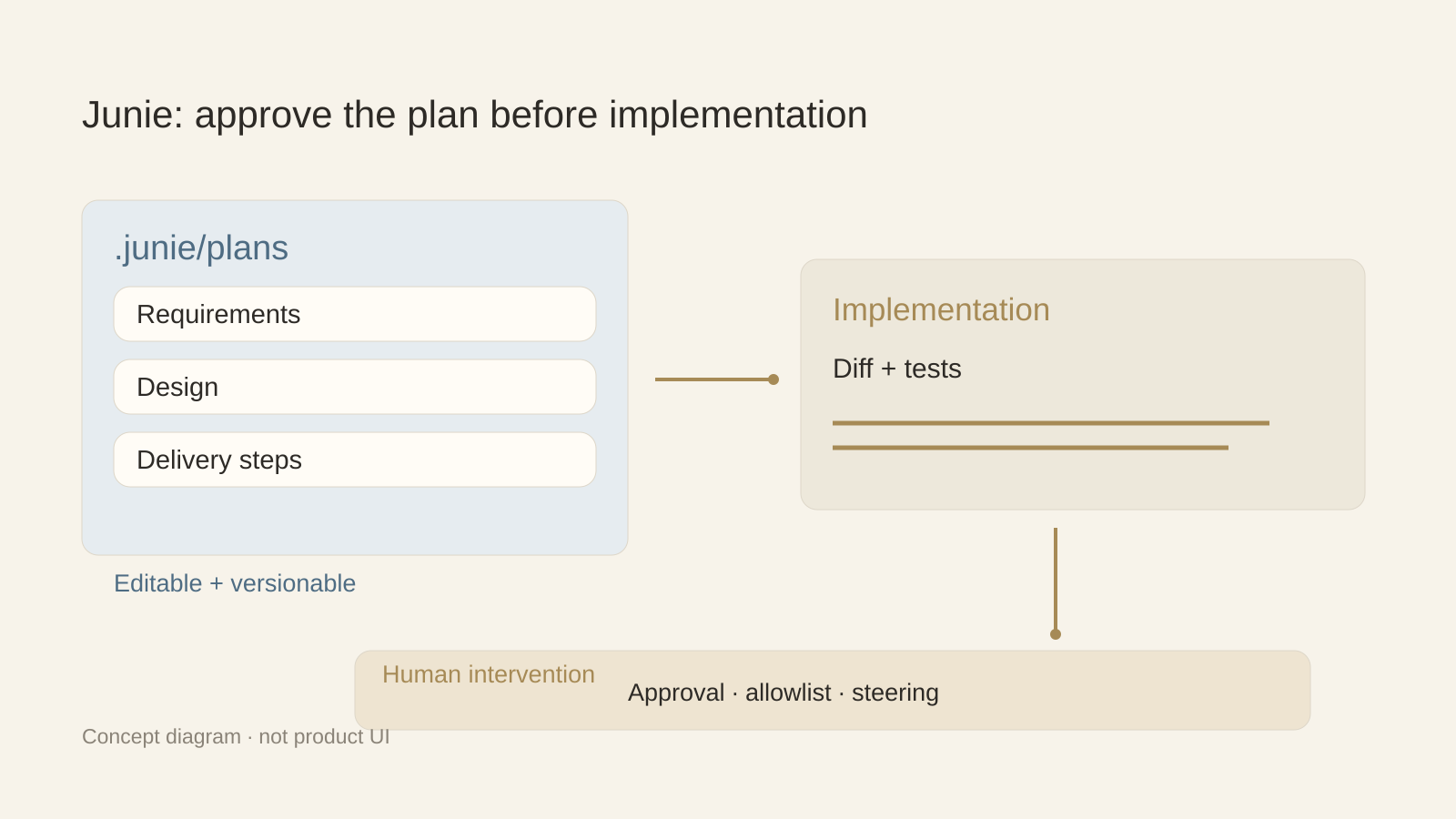
Junie describes Plan Mode with requirements, design, and delivery stages before code edits. The plan is saved under .junie/plans, where it can be edited and committed. It also describes using different models for planning and implementation. For a change with uncertain scope, this gives the engineer a concrete artifact to review before execution.
Try a dependency migration: approve allowed files and constraints, amend the plan, then inspect whether the implemented diff follows it. Keep failed tests and unresolved decisions visible. A plan stored in the repository can travel with the engineering review; it is not evidence that the deployed system has already changed. This is a proposed acceptance test, not a measured result from Junie.
Compare intervention during work, not the presence of a human
Human in the Loop, a dynamic allowlist, and Live Prompting are explicit Junie features. They address key action approvals and redirection during execution. Remote Control describes asynchronous CLI execution and web monitoring. These claims rule out a comparison based on Junie having no review or being restricted to a local IDE.
Before rolling out, test an action that requires approval, a mid-run correction, and a task interrupted by a failing test. Record who sees each event and how execution resumes. Product descriptions do not establish your organization’s access policy. Ask for the actual permission behavior and inspect it, rather than using the word autonomy as a substitute for a review design.
A recurring role needs a durable working record
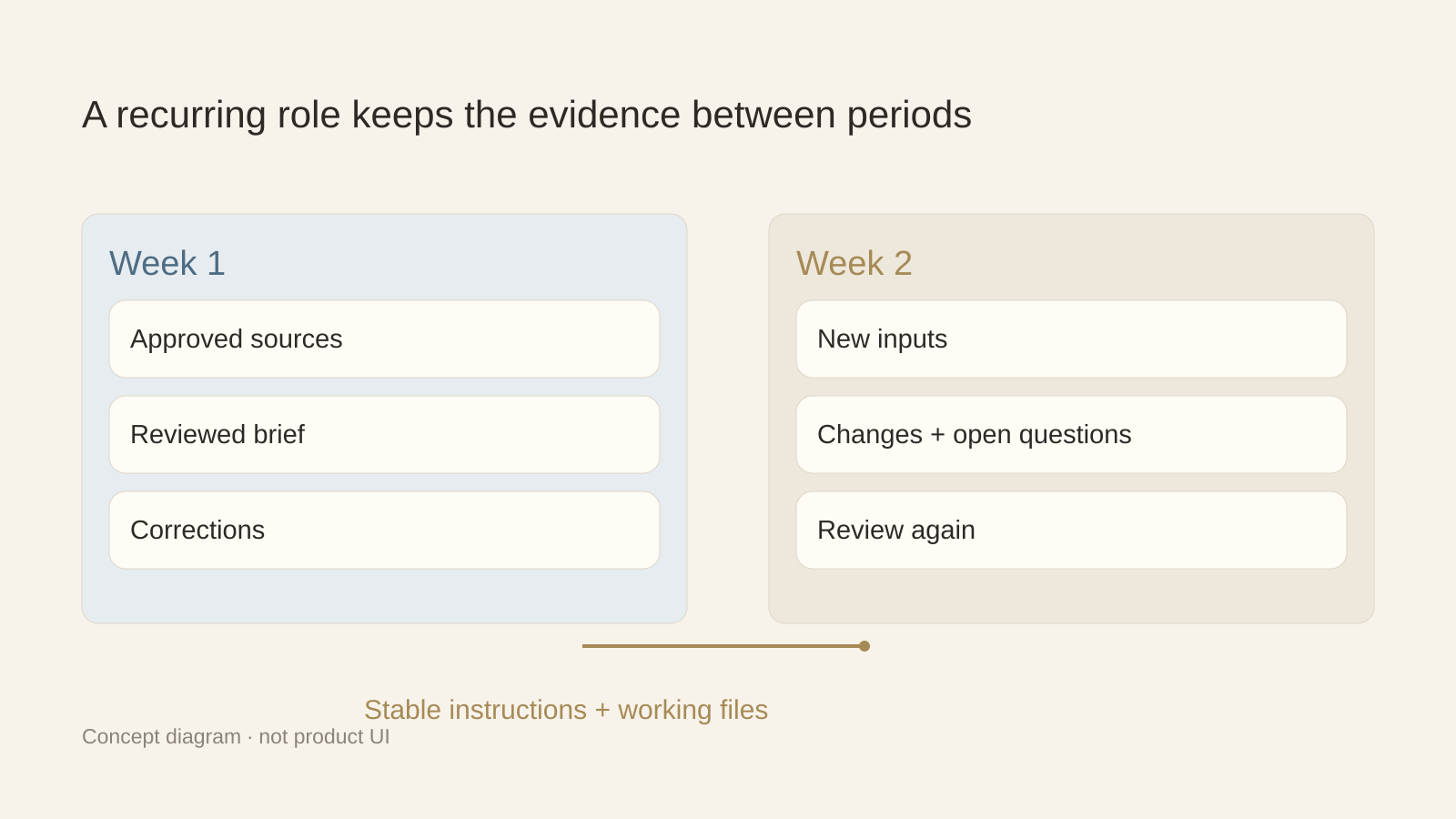
For a weekly product-feedback brief, preserve the approved source set, last week’s findings, this week’s changes, and the reviewer’s corrections. A new run should explain what changed rather than rewrite history. Buda provides a persistent cloud computer per Agent and visible files, terminal, browser, and Git views in the workspace. Use those surfaces to keep the inputs and accepted outputs together.
Persistence is an environment capability, not a promise of complete model recall, trustworthy automatic decisions, or database governance. Give the Agent a stable brief and a narrow source scope. If the task is scheduled, define the trigger and leave consequential external actions behind an approval step. The product lead should be able to find both the current draft and the evidence used to prepare it.
Run two different trials with different stopping rules
For Junie, choose one repository change. Accept it only after checking the plan, scope, diff, and agreed tests; then close that task. For Buda, run the same business role across two reporting periods. Check whether it retains approved materials, identifies changes, and incorporates reviewer corrections without inventing facts. Neither trial needs an automatic integration between the products.
In Buda AI’s Marketplace, search and install a suitable Skill when you want the recurring instructions to be reusable, then add your source and review rules. Compare setup and reviewer time alongside model usage and subscriptions. Junie advertises BYOK and AI credit plans; Credits from another product are not equivalent price units. Keep Junie where repository governance is the bottleneck; test a role-based workspace where recurring business responsibility is the bottleneck.
FAQ
Is Junie limited to an IDE?
No. Its site describes IDE, terminal, GitHub and GitLab workflows, plus remote monitoring.
What is a Junie plan used for?
Its documented Plan Mode organizes requirements, design, and delivery in an editable, versionable artifact before implementation. Test the actual plan-to-diff behavior.
Does a persistent workspace guarantee memory?
No. Keep source files, accepted results, and review notes explicitly; persistence is not proof of complete recall.
What should the trial measure?
For code, plan adherence and accepted changes. For a recurring role, source continuity, period changes, and incorporated review corrections. Measure full review and setup costs too.