Buda vs MiMo Code: resume a long task from project memory or a persistent workspace?
Test checkpoints, source withdrawal, and unfinished checks to see whether interrupted work truly resumes.

Choose around the state that must survive a session—and how you will verify the resumed work.
Yesterday an agent finished two-thirds of a task. Today it finds the modified files but forgets why another approach was rejected and overlooks unfinished tests. The files survived; the work did not fully resume.
That is a useful way to compare Buda and MiMo Code. It would be inaccurate to contrast a platform with memory against a memoryless coding CLI. MiMo's official README describes cross-session memory, automatic checkpoints, task tracking, stopping conditions, and multiple workflows. Its desktop beta also includes office and browser tasks. Buda's case must rest on its persistent workspace and inspection model, not on erasing the alternative's capabilities.
For a development project where you want control over model connections, project memory, and development workflows, test MiMo Code first. For varied business tasks that need durable files, browser and terminal execution, and inspectable outputs in one environment, evaluate Buda's Agent Workspace. The details determine whether that distinction fits your team.
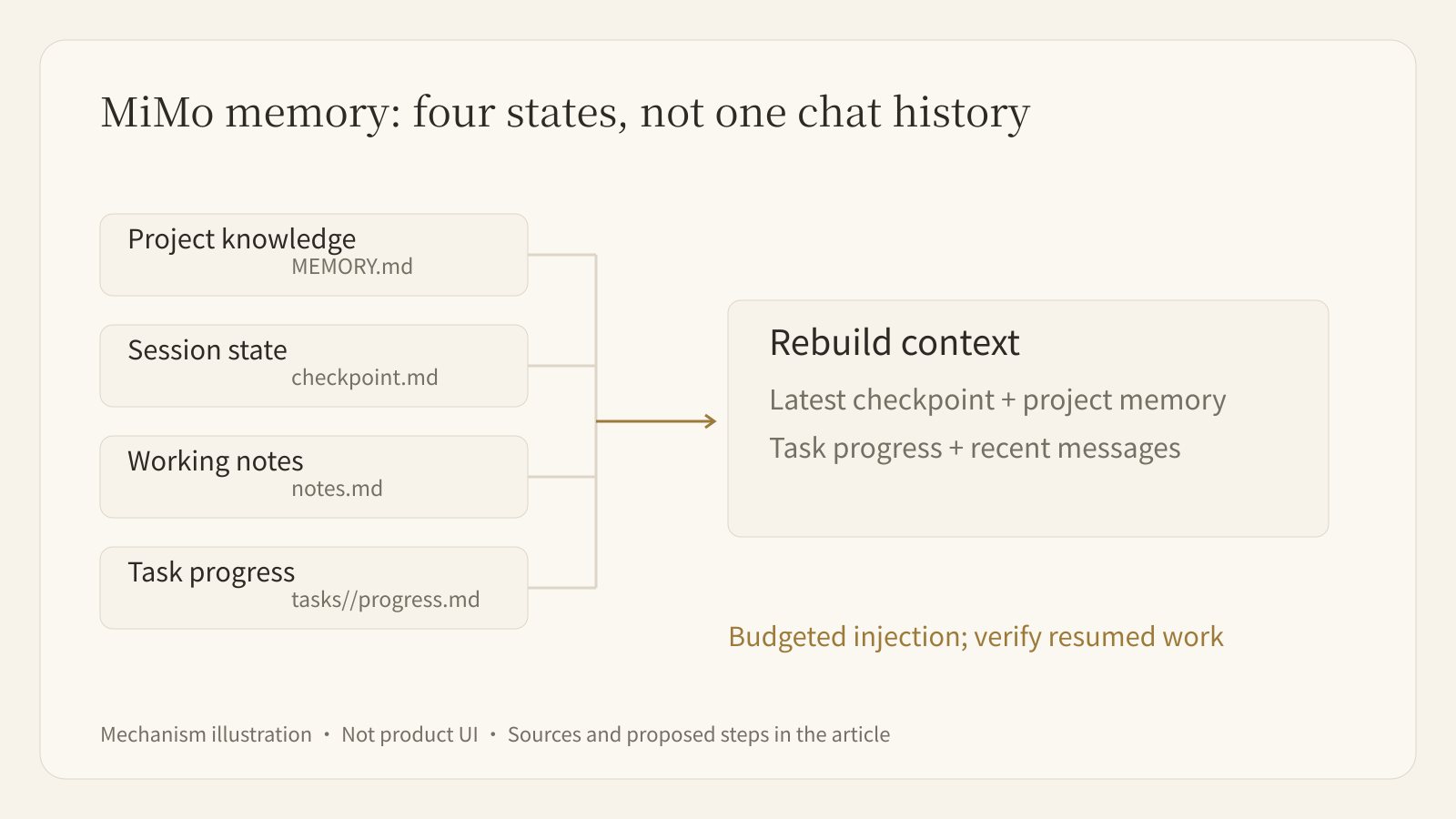
MiMo preserves at least four kinds of state
The README describes SQLite FTS5 full-text retrieval and separate project knowledge, session checkpoints, temporary notes, and task progress.
| State | Documented storage | Question it answers when resuming |
|---|---|---|
| Project memory | MEMORY.md | What are the project's rules, architectural decisions, and durable knowledge? |
| Session checkpoint | checkpoint.md | What was happening at interruption and what changed recently? |
| Temporary notes | notes.md | What leads or working notes are still provisional? |
| Task log | tasks//progress.md | Which task reached which stage? |
This is more structured than reinserting an entire chat history. The README describes rebuilding context near the conversation limit from the latest checkpoint, project memory, task progress, and retained recent messages. Injection uses a token budget and importance ranking. Users can also configure an earlier compaction point.
These mechanisms help an agent avoid rediscovering the project and retain explored approaches. They do not guarantee that every needed fact was recorded. Memory may preserve a mistaken judgment or an outdated constraint. Evaluate the behavior after resumption, not simply the presence of a memory feature.
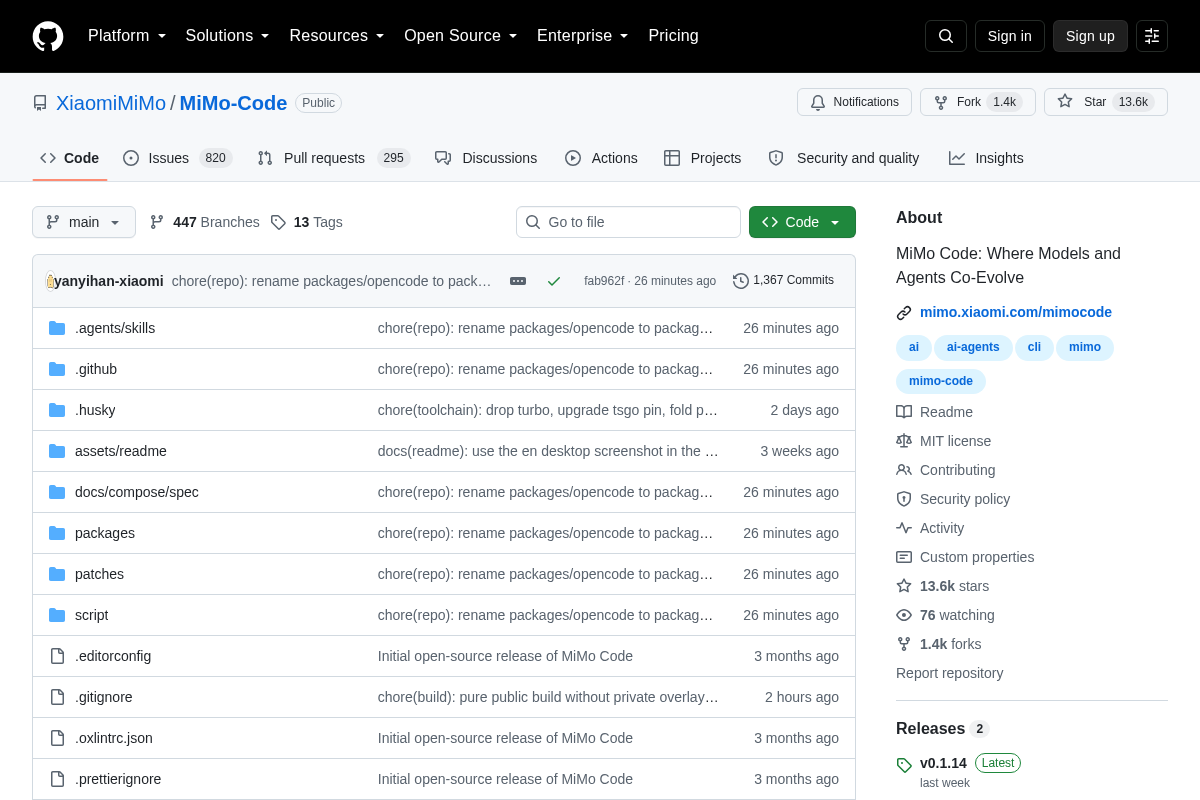
Official English source screenshot from the product README, captured September 30, 2026. Original text is retained rather than presenting a translation as product UI.
Long-running work has more than one execution path
MiMo's principal agents include build for development execution, plan for read-only analysis, and compose for orchestration. The README recommends a build-led /compose-next path on certain frontier models, progressing through requirements, specifications, implementation, validation, and review. The independent compose agent is another route.
It also lists deterministic JavaScript workflows: compose, deep-research, fact-check, and research-experiment. They can fix stage order, bound retries and concurrency, and save checkpoints. The compose workflow describes isolated Git worktrees, TDD, and structured handoffs between stages. Interactive paths support changes of direction; non-interactive workflows fit clearly scoped, decomposable work.
The /goal stopping condition adds a separate judge model when an agent wants to finish. This is another check, but it remains a model judgment. Executable tests, verifiable files, and production actions still need their own evidence and accountable release decisions.
MiMo therefore offers more than a terminal interface. Project recovery, stage orchestration, and completion checks are concrete mechanisms worth testing in an actual repository if they are central to your work.
Buda's comparison starts with what stays in the workspace
Buda combines sessions with Drive, a terminal, browsers, and Git in a persistent environment. Drive retains source files, working material, and outputs. People can inspect files and execution during a task and reuse those artifacts later.
The distinction is not memory files versus having no need for memory. Both products require clear inputs, appropriate context, and acceptance criteria. The practical choice is whether you prefer configuring and inspecting an agent around project directories or organizing different types of work and deliverables in a unified workspace.
| Job to solve | MiMo's documented route | Route to evaluate in Buda |
|---|---|---|
| Resume a project session | Memory, checkpoints, task logs, context reconstruction | Retained Drive sources and work products used in continuing sessions |
| Coordinate development stages | /compose-next or deterministic workflows | Reusable Skills specifying execution and acceptance, with terminal and Git tools |
| Inspect ongoing work | Project files, logs, agent interaction | Workspace access to files, terminal, browser, and Git |
| Handle office and browser tasks | Separate MiMo Desktop beta scope | Relevant workspace tools and reviewable outputs |
These are public mechanisms and evaluation entry points, not a performance ranking. Without matched-task testing, neither column establishes greater speed or reliability.
Check MiMo Desktop's edition boundaries separately
The desktop beta section describes multiple file formats, slides, websites, 3D assets, regional edits, version rollback, and browser control. The international edition additionally lists computer control and Record & Replay. Desktop uses MiMo Code as its core engine but is an application beta requiring access; editions have different capabilities.
For a job such as turning source material into slides and checking a website, it would be wrong to claim MiMo cannot do office or browser work. Check the actual entry point and edition before testing the whole task. The README's maximum cache-hit claim is vendor evidence, not your measured savings or a Buda comparison result.
Model access also changes setup work. MiMo documents platform login, some OAuth paths, API keys, and custom OpenAI-compatible providers. Verify the actual model, endpoint, authentication, and context budget. Buda users should check public model and plan availability for its product entry points. Upstream token prices and one product's internal Credits are not interchangeable with another product's user price.
Test interruption and resumption, not memory capacity
This is a proposed evaluation, not an executed benchmark. Use a research report with three original sources, the previous report, citation rules, and a new data file. The task must check old conclusions, update two sections, and deliver a reviewable version.
In the first round, let the agent organize sources and plan changes, then interrupt it. Resume with only the new material rather than repeating the task. Check four things:
- Does it retain confirmed sources and versions rather than treat old files as current?
- Do rejected conclusions reappear, and can the reason for rejection be found?
- Do unfinished checks remain explicit instead of disappearing during summarization?
- Can each revision be traced to evidence, with unresolved conflicts listed?
MiMo checkpoints and task logs are useful evidence. In Buda, source files, revision material, and result files should be easy to locate in Drive. Keep an independent acceptance checklist in both products; the agent's own “done” is insufficient.
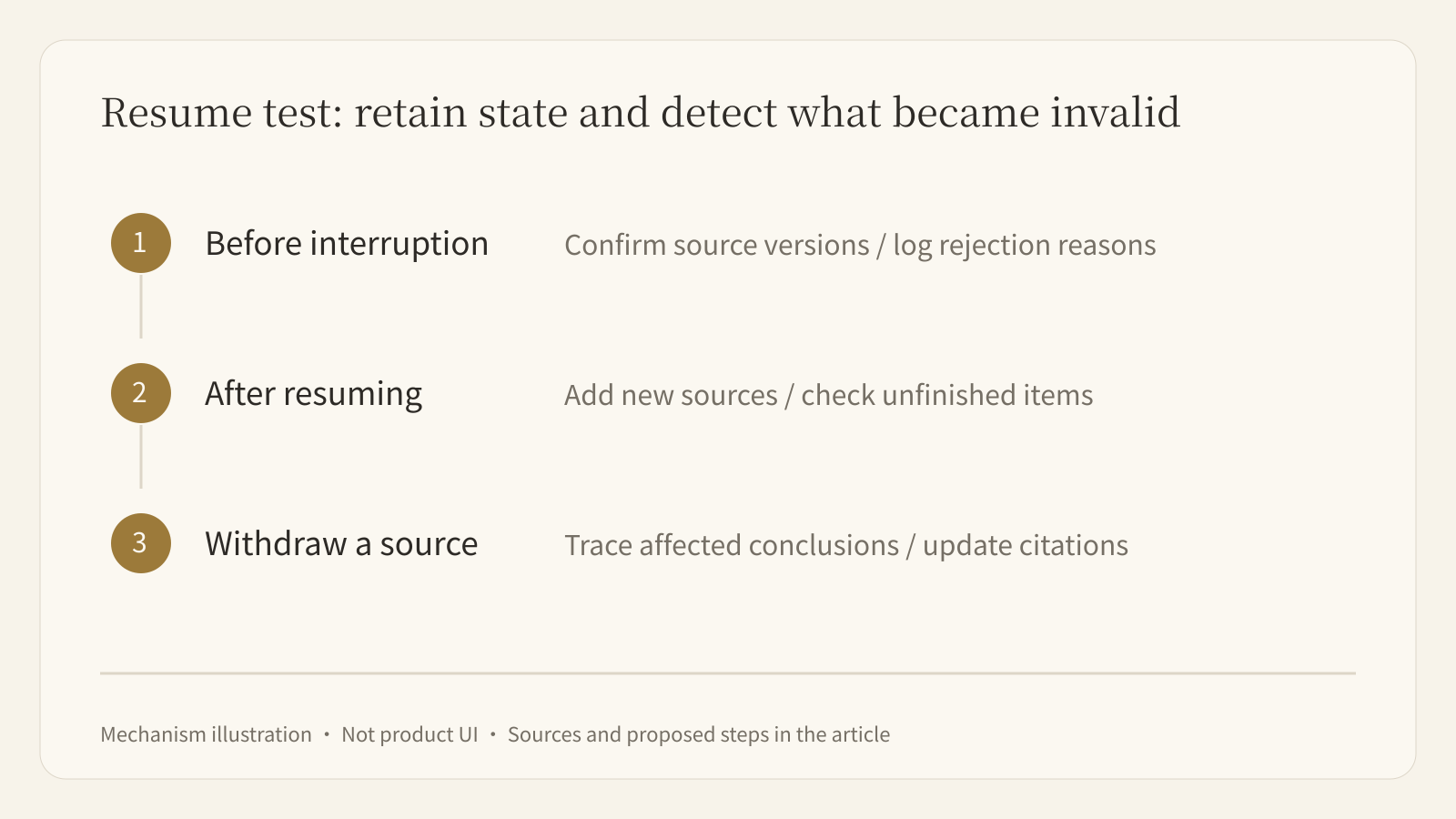
Add a deliberate change: withdraw one source and require revision of conclusions depending on it. This reveals whether outdated facts in memory are replaced correctly. Continuity includes recognizing which parts of the past are no longer valid.
Choose the management work your team is ready to do
A team centered on development projects, comfortable inspecting configuration and files, and wanting its own model-provider choices can start with MiMo Code. Test recovery quality, stage evidence, stopping conditions, and permissions—not just a generated-page demonstration.
For research, file processing, tool execution, and follow-up tasks in one continuing workspace, start with Buda. Specify sources, outputs, and checks before selecting a Skill. Installable Skills can be searched and installed in the Buda AI Marketplace. Schedule only workflows that are already stable.
A team may use MiMo for repository development and Buda for another continuing workflow. Handoffs should contain inspectable files, versions, and unresolved items rather than a copied chat summary asserting completion.
FAQ
Does MiMo Code only use Xiaomi models?
No. The README lists several providers, some OAuth options, and custom OpenAI-compatible APIs. Check authentication and model availability with the selected provider.
Does persistent memory retain every piece of context permanently and completely?
No. The documented system uses injection budgets, importance ranking, and reconstruction. Test whether important constraints survive rather than assume all past messages return verbatim.
How should a team choose build, compose, or workflows?
Ask whether the task still needs interactive redirection. Build with /compose-next is a documented recommended development path; deterministic workflows suit clearer, decomposable tasks. Follow current model and feature recommendations. A simple task does not need multiple agents merely because they are available.
Can CLI and Desktop capabilities be treated as identical?
No. The CLI is the terminal-native assistant; Desktop is a beta built around its engine, with access and edition boundaries. Computer control is explicitly listed for the international edition.
Which product prevents false completion better?
MiMo describes /goal judging and stage validation; Buda retains artifacts and execution for inspection. Without matched-task testing, neither can be declared to eliminate false completion. Executable acceptance and an accountable reviewer remain necessary.
Sources
Verified September 30, 2026. Capabilities follow public documentation. The interruption test is a proposed method, not an executed performance or efficiency comparison.