Buda vs Oh My Pi: a richer debugging session still needs a handoff
Separate runtime debugging, live collaboration and asynchronous acceptance.

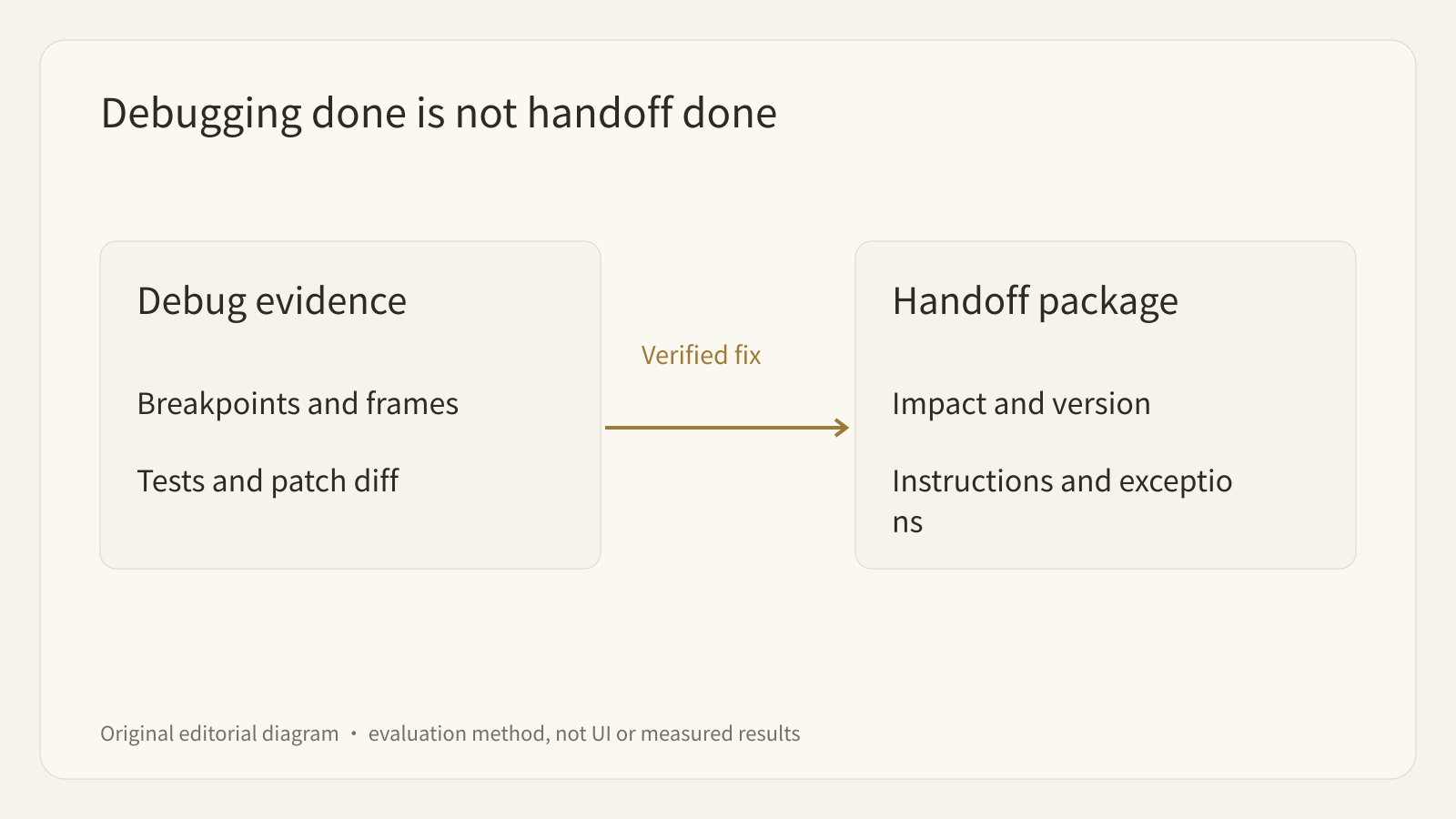
A stalled service needs more than a plausible explanation. A developer needs the thread, variable and failure point. A support lead needs something else: who was affected, what changed and how to verify the next incident.
Oh My Pi brings IDE-level tools into a terminal agent. Buda organizes conversation, files, execution and previews in a cloud workspace. The useful comparison is whether the team lacks a deeper debugging surface or a reliable place to receive work across roles.
Begin with a breakpoint
Oh My Pi, or OMP, is an open-source coding agent extended from Pi. Its README describes a coding agent “with the IDE wired in,” including LSP and a debugger.
LSP offers code semantics such as diagnostics, symbols and renaming. A debugger can inspect frames, variables and execution at breakpoints. Official examples include lldb for C, dlv for Go and debugpy for Python. These tools provide evidence about a program instead of relying exclusively on an agent's interpretation.
The documented surface also includes worktree-isolated subagents, an advisor model, code review, memory, MCP, a real browser and desktop control. A comparison that calls OMP a browserless, solitary command line would miss the product being evaluated.
Buda's Agent Workspace supplies Terminal, browser, files, application preview and Git views. The evidence cited here does not establish a native DAP tool equivalent to OMP's debugger. Buda's relevant distinction is organizing artifacts and execution views in one persistent cloud environment, not claiming every engineering tool is interchangeable.
Three different objects of review
Runtime inspection asks why the program failed at a particular moment. A frame and breakpoint are engineering evidence; they do not automatically explain customer impact.
Agent review examines the agent's actions and proposed code. OMP's advisor can use a second model to observe the main agent and inject feedback. /review focuses on code review. Those mechanisms can help, but humans still need to verify reproduction, coverage and suitability.
Delivery acceptance asks what product, support or operations may safely do next. That answer should survive as a versioned file linked to evidence, not only as a remark inside a live session.
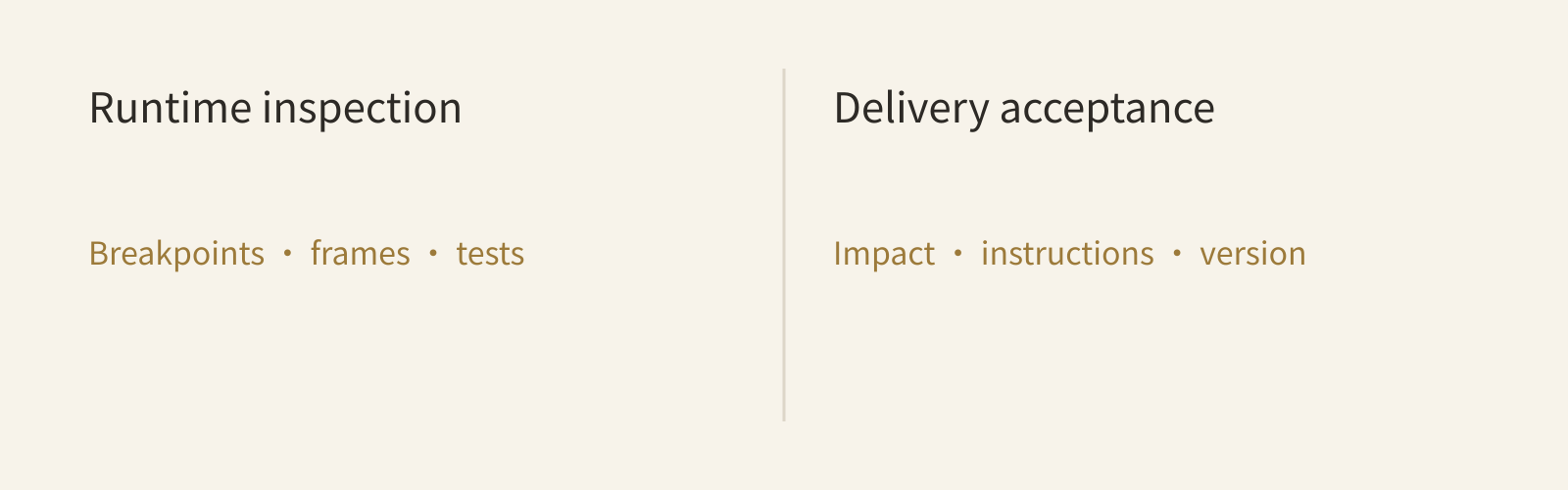
If runtime inspection is the bottleneck, deeper IDE tooling matters. If evidence disappears between technical review and business acceptance, add a delivery convention rather than assuming one more tool will solve it.
OMP has collaboration; ask what survives the session
The official README describes /collab: share a live session through a relay with a link or QR code. A colleague can join from another terminal or a browser. It distinguishes read-write participation from /collab view, and describes client-side sealing of frames.
“OMP has no collaboration” would therefore be wrong. Its live collaboration is useful for joining the same debugging scene and steering or observing the agent together.
The next question is asynchronous handoff. Which version is final after the session ends? Can someone who only watched find tests and limitations? Can a new person locate the original requirements? These questions recognize that participation and later acceptance are different jobs.
Buda's files and task views offer an inspection location. The team must still designate final artifacts and authorized reviewers. Putting material in a workspace does not establish formal approval, unrestricted sharing or compliance guarantees.
One incident, two recipients
The following is a constructed pilot, not a comparison run performed for this article.
Suppose a payment service occasionally times out. Engineering first needs to reproduce it, inspect a stack, check for lock contention and prove a correction with regression tests. OMP's debugger, LSP and worktrees are directly relevant tools to evaluate for that work.
Ask for reproduction instructions, a diff, test commands, sanitized logs and environments not yet covered. Never put customer request bodies or production credentials into demonstration material merely to make it convincing.
A support lead then receives a different package: impact scope, safe wording, customer handling steps and unresolved uncertainty. Require incident-summary.md and support-checklist.md, with conclusions linked to engineering evidence. Refunds, customer messages and production changes remain recommendations until separately authorized.
Buda can support file organization, log analysis, explanation drafts and inspection. This proposed scenario does not establish its troubleshooting performance or business benefit. Evaluate each approach by the inspection task it helps the recipient perform.
Measure how the next person finds the answer
Code-generation time is not the whole pilot. Collect:
| Check | Observable evidence |
|---|---|
| Failure reproduced | Input, failure location, expected and actual behavior |
| Correction verified | Version, test commands, passing and uncovered cases |
| Asynchronous handoff works | A person absent from the live session can locate final files and evidence |
| Sensitive actions bounded | Test credentials, permitted tools and human confirmation points |
Use a recipient who did not attend /collab. Record missing information and time spent asking the original operator for clarification. That distinguishes technical depth from handoff quality.
Keep costs separate too. Open-source licensing does not make models and infrastructure free; a Buda subscription does not make consumption constant. Check current Buda pricing, then record usage, maintenance and review effort without inventing a savings claim.
Keep the debugging surface that works
Teams regularly working with stacks, breakpoints, semantic renames and complex repositories should recognize the value of OMP's engineering tools. A unified workspace is not a reason to disregard them.
Teams struggling to locate files and task history across roles, or organize recurring work beyond code, can pilot Buda independently. Choosing a workspace does not mean abandoning programming, and cloud execution is not a performance or security guarantee.
The approaches may serve different workloads. This article has not tested synchronization of OMP sessions, memory or worktrees with Buda. Agree on exported files and accepted versions before assuming an integration.
FAQ
Can Oh My Pi control a browser or desktop?
Yes. Its README documents both. Check configuration, host environment and permissions rather than assuming every installation exposes identical access.
Is an advisor model a human approval step?
No. It is model feedback to the executing agent. A responsible person still verifies evidence and accepts the outcome.
Is read-only collaboration available?
The official README lists /collab view. Confirm final artifact versions, retention and access separately from live viewing.
Does Buda replace OMP's debugger?
The evidence here does not support equivalence. Terminal and other inspection views are not presented as a verified native DAP feature.
Do OMP's benchmark numbers prove better team fit?
Its README's performance numbers are vendor disclosures, not this article's independent tests. Editing scores do not measure cross-role handoff. Use your own workload.
Turn the fix into files someone can receive
Pick a real incident. Separate evidence engineering needs to reproduce it from material support needs to take over. Ask a second person to continue using only the delivery package. Explore the Agent Workspace for Buda's artifact views.
Sources checked October 8, 2026. The official OMP README supports capability facts. The incident, filenames and pilot are constructed examples, not customer evidence or executed test results.