Buda vs OpenHands: Engineering Agents or Cross-Functional Agent Workspace?
Compare agentic software delivery and engineering control planes with persistent Agents for shared, reviewable company operations.

Buda vs OpenHands: Engineering Agents or Cross-Functional Agent Workspace?
OpenHands is no longer accurately described as a local coding-agent demo. Its current platform spans Agent Canvas, local and remote backends, Cloud, Enterprise VPC, Automations, an Agent Control Plane and a Software Agent SDK. It can run OpenHands, Claude Code, Codex, Gemini CLI or another compatible agent across engineering workflows.
Buda also runs persistent Agents with files, Browser, Terminal, Git, Skills, Channels, Automations and human review. The overlap is real. The useful decision is not which product has more agent features. It is: is the system of action the software delivery lifecycle, or the wider company workflow that consumes engineering results?
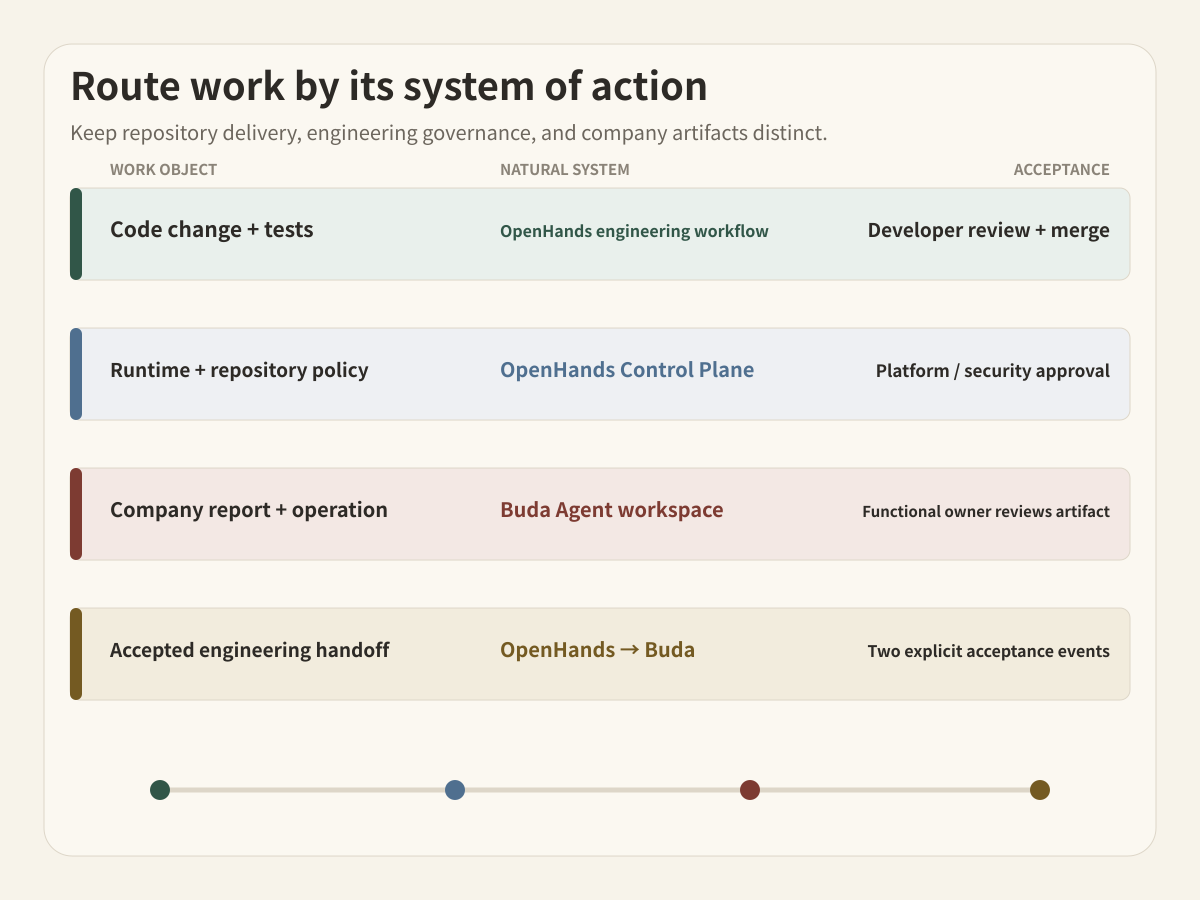
Compare the products that exist now
OpenHands’ current homepage describes an open platform for agentic software development. Agent Canvas can run multiple agents, connect local, remote and cloud backends, and trigger workflows from GitHub, Slack, Jira, Linear, schedules and supported integrations. The platform can plan, execute, validate, ship and monitor engineering work.
Its deployment surface is also broad. An individual can run locally or in Docker. A team can use a VM or shared backend. OpenHands Cloud provides managed sandboxes, while Enterprise can run in a VPC or controlled environment. The Agent Control Plane centralizes who can run agents, what they can access, where they execute, what they spend and what they change.
The SDK is explicitly built for software engineering. Official docs list Bash, file editing, web browsing, MCP, custom tools, a REST agent server, remote execution, persistent memory, security controls and multiple-agent refactors.
Any comparison that says “OpenHands is local and Buda is cloud” or “OpenHands only suggests code” is outdated.
Follow the engineering signal chain
OpenHands organizes work around signals from the engineering stack:
- A GitHub issue, PR, Slack request, Jira incident, Linear task, schedule or webhook triggers work.
- An agent plans against repository and workspace context.
- It edits files, runs commands and tests, or investigates logs.
- The workflow validates the result.
- It opens or updates the engineering artifact.
- A developer or engineering owner reviews, approves and merges.
That chain is the product’s strength. Repository changes, CI failures, security findings, dependency updates, documentation drift and incident fixes all have natural engineering objects and reviewers.
Buda can participate in technical work, but its operating unit is broader. A research Agent may browse sources, an engineering Agent may inspect Git, a content Agent may create a localized package, and an operations Agent may assemble a weekly report. The final result can be a brief, document, table, campaign, customer response or decision record rather than a pull request.
Separate the control plane from the company workspace
OpenHands’ Control Plane governs engineering agents in production: runtime, access, execution location, spend, changes, organizational policy and auditability. This is meaningful platform infrastructure, not a missing feature.
Buda’s Space and Agent model addresses another management question: which persistent functional Agent owns recurring work, which source files are shared, which tools are available, who can see the session, and which human accepts the resulting business artifact.
Both products have controls and human review. The controlled object differs.
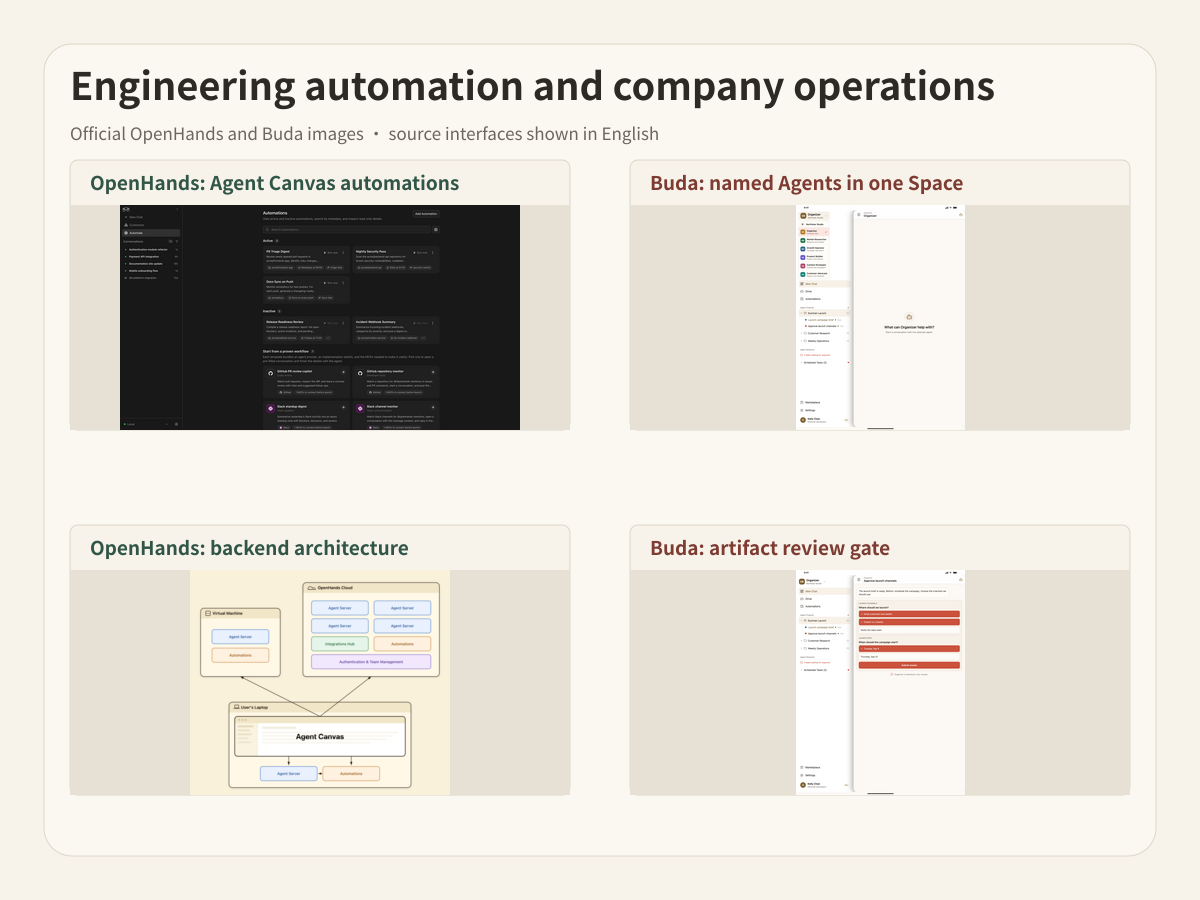
Route four workload types
Repository change
A bug, feature, dependency update or refactor begins and ends in a repository. The accepted output is tested code, a pull request, review evidence and a merge decision.
OpenHands is the direct fit. Its agents, SDK, Canvas and automations are designed around this lifecycle. Buda should not claim to replace that engineering depth.
Engineering platform governance
A platform or security team needs to standardize which agents and models run, where they execute, what repositories and secrets they reach, how much they spend and what changes they make.
OpenHands Agent Control Plane and Enterprise/VPC options are built for this job. The organization should evaluate deployment, sandboxing, identity, audit and policy behavior directly.
Cross-functional recurring operation
A weekly launch workflow begins with a merged PR but continues into product notes, screenshots, localization, support preparation, customer communication and management review. The repository is one input, not the whole system of action.
This is where Buda becomes relevant. Named Agents can retain role-specific context, share selected Drive files, use Browser/Terminal/Git and connected channels, run scheduled Automations, and return visible artifacts to accountable owners.
Engineering-to-business handoff
Many teams need both systems. OpenHands produces an accepted engineering artifact: merged commit, test evidence, architecture decision or security report. A person approves it. Buda then uses that artifact as a stable source for downstream company work.
The boundary should not be a copied chat summary. It should be a versioned artifact with one owner, known limits and an explicit acceptance event.
| Work object | Natural system | Human acceptance |
|---|---|---|
| Code change and tests | OpenHands engineering workflow | Developer review and merge |
| Agent runtime and repository access policy | OpenHands Control Plane | Platform/security approval |
| Cross-functional report, content or customer operation | Buda Agent workspace | Functional owner reviews artifact |
| Downstream work based on accepted engineering output | OpenHands → explicit handoff → Buda | Engineering accepts source; business owner accepts deliverable |
Review distance is part of the purchase decision
OpenHands documentation keeps engineers in control of review, approval and merge. That review is close to code: diffs, commands, tests, PR comments, security findings and repository state.
Buda review can sit farther downstream. The reviewer may inspect a source packet, translated article, operating report, CRM update or launch checklist. Git evidence can remain attached, but the accepted object is a business deliverable.
Neither distance is inherently better. The mistake is asking a repository review to approve a business decision, or asking a business manager to validate raw agent execution without an artifact.
Deployment is not the deciding shortcut
OpenHands supports local, Docker, VM, Cloud and Enterprise VPC paths. Buda is cloud-native and manages its Agent workspaces. Therefore “self-hosted versus cloud” is not a complete comparison.
Ask instead:
- Is infrastructure choice itself part of the requirement?
- Must agents operate against private repositories inside a controlled network?
- Does the team need an engineering control plane or a functional operating workspace?
- Is the accepted result a repository artifact or a company artifact?
- Who owns recovery when an agent, backend or downstream workflow fails?
The SDK boundary matters
OpenHands’ Software Agent SDK is a strong choice when the team is building agent-powered developer experiences or custom software-engineering automation. It is model-agnostic, exposes Python and REST APIs, and can run locally or remotely.
Buda Skills and API serve a different job: package reusable procedures for Agents operating in a managed workspace, or invoke hosted Agents without building an engineering-agent harness. Buda is not a substitute for an SDK when the SDK itself is the product requirement.
OpenHands purchase-boundary questions
Is OpenHands only self-hosted?
No. Official materials describe local, Docker, VM, OpenHands Cloud and Enterprise/VPC execution. Agent Canvas can switch among backends.
Can OpenHands run multiple agents and automations?
Yes. Agent Canvas supports parallel agents, multiple backends and scheduled or event-driven automations. The platform also supports compatible third-party agents.
Is OpenHands limited to code completion?
No. It executes engineering tasks end to end: repository changes, commands, tests, PR review, CI investigation, security remediation and other SDLC work.
Is Buda a better coding harness?
That is not the claim. Buda is relevant when the work crosses engineering, research, content, sales, support or operations and must remain visible as reviewable company artifacts.
Can teams use both?
Yes. Keep engineering execution and code review in OpenHands, then promote accepted artifacts into Buda for downstream recurring work. Define the handoff explicitly.
Run one engineering-result promotion test
Choose one engineering change that creates downstream work. Complete and review the code path in OpenHands. Package the accepted commit, tests, behavior, screenshots, risks and owner. Then run the downstream release or customer workflow in Buda.
Measure how often context is reconstructed, permissions are duplicated, owners are unclear and reviewers must reopen raw execution. The result will reveal whether the missing system is an engineering Agent platform, a company Agent workspace, or a clean contract between them.
Explore the Buda AI Agent Workspace, review featured Agent roles, install procedures from the Skills Marketplace, and confirm current behavior in the Buda Docs.