Buda vs Qwen Code: Open Developer Agent or Managed Company Workspace?
Choose between an open, provider-flexible developer Agent framework and a managed workspace built around durable company roles.

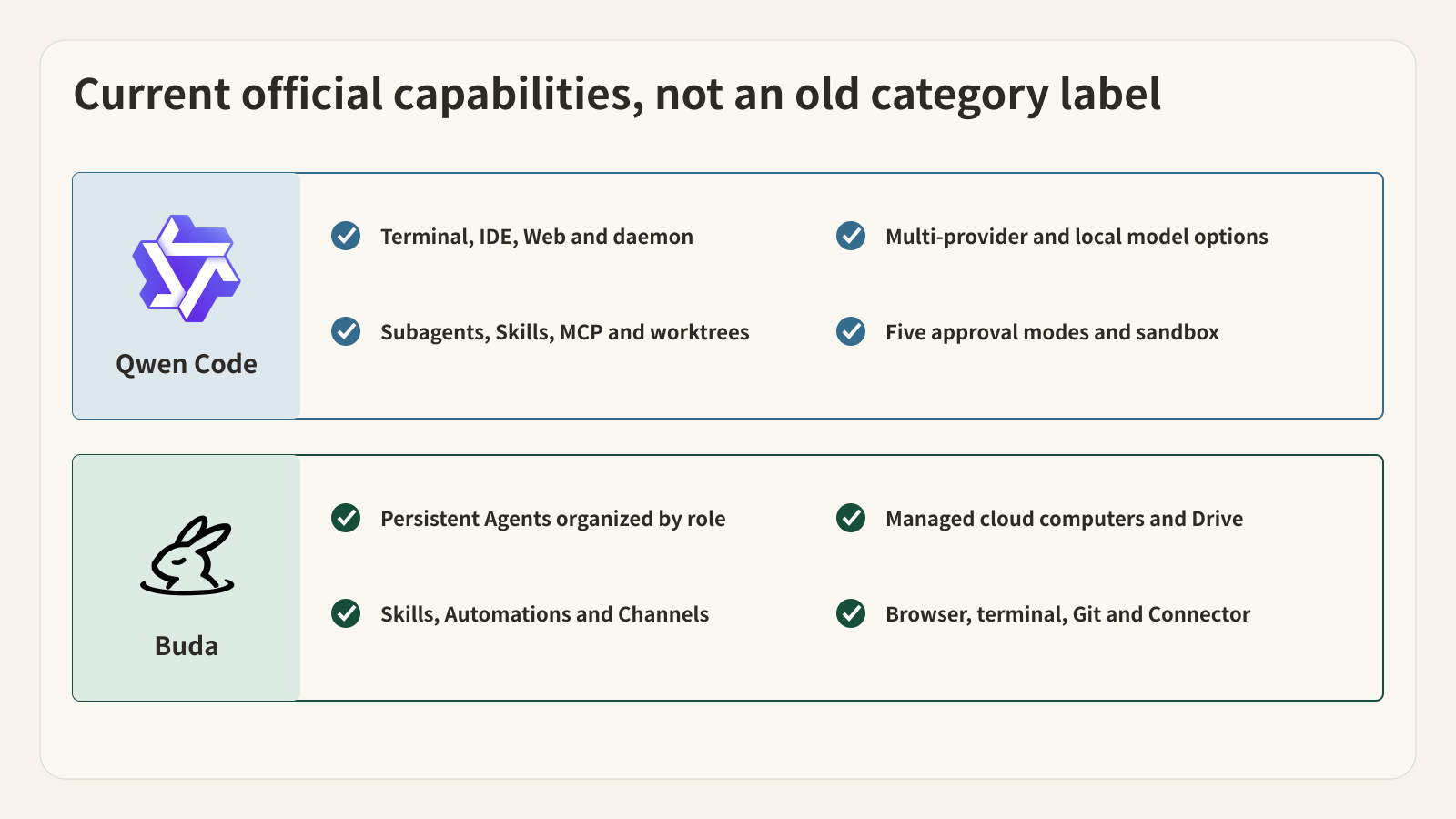
A search for a Qwen Code alternative can start from an outdated premise. Qwen Code is still terminal-first and code-oriented, but it is no longer confined to one local shell. Its official documentation now covers VS Code, Zed and JetBrains integrations, a web interface, daemon mode, chat channels, Subagents, Agent Skills, MCP, scheduled tasks, browser and computer use, multi-agent coordination, and Git worktrees.
The useful comparison is not “local coding assistant versus cloud workspace.” It is an open, provider-flexible developer Agent framework versus a managed workspace organized around durable company roles.
That distinction is narrower than a feature table and more useful than one.
The short verdict
Choose Qwen Code when you want an open-source Agent framework close to the repository, terminal, model provider, and machine configuration. It is the stronger starting point for builders who want to inspect the code, choose providers, run local or remote models, customize the harness, and make software work the center of the system.
Choose Buda when you want a managed company workspace in which research, content, support, finance, operations, and engineering Agents each keep their own instructions, Drive, computer, Sessions, Skills, Automations, and Channels.
Use both when Qwen Code owns developer execution and Buda owns the cross-functional workflow around it. The handoff should carry verified facts and artifacts, not a model-generated claim that the code is finished.
Qwen Code is broader than its name suggests
Qwen Code's official overview calls it an agentic coding tool that lives in the terminal. It can inspect a codebase, build features, debug issues, edit files, run commands, create commits, and work in CI.
But the same documentation exposes a much wider platform surface.
It supports editor integrations for VS Code, Zed, and JetBrains. qwen serve provides web and daemon paths. Channels connect Telegram, WeChat, DingTalk, WeCom, Feishu, QQ, GitHub, and GitLab. MCP extends the Agent to tools, databases, and APIs. Skills package reusable instructions and scripts. Subagents delegate focused work with their own prompts, tools, and models. Worktrees support isolated parallel work.
Qwen Code is also provider-flexible. Its current project supports Qwen and Alibaba ModelStudio, third-party providers, OpenAI-compatible endpoints, Anthropic, Gemini, and local serving options. That matters to teams that want control over model choice, cost, data path, or self-hosting.
Any comparison that calls this “just a local coding helper” would be unfair and factually stale.
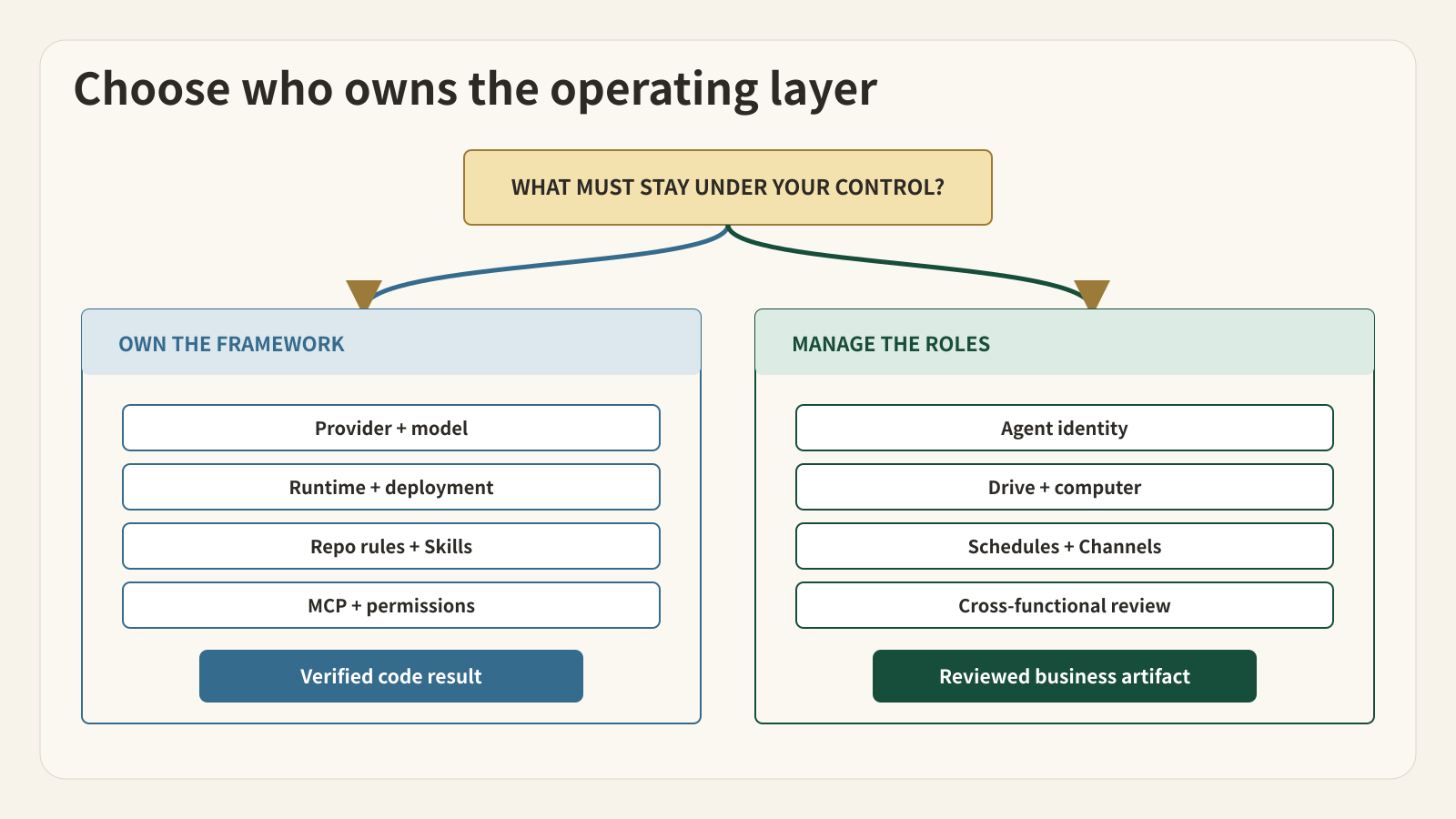
The ownership test begins with the runtime
Qwen Code gives the builder a framework. The team chooses where it runs, which model provider it calls, which MCP servers it trusts, which project rules live in QWEN.md, which Skills are committed to the repository, and which approval mode applies.
That flexibility is a strength. It is also an operating responsibility. Someone must maintain the provider credentials, local or remote runtime, trusted folders, sandbox choice, MCP configuration, channel setup, extension versions, and project rules.
Buda gives the team a managed Agent workspace. Each Agent receives a cloud computer and private Drive. The workspace already exposes browser, terminal, Git, files, Sessions, Skills, Automations, and Channels. The team primarily configures roles and boundaries rather than assembling the Agent runtime from open components.
This does not make Buda universally better. It means the product absorbs more infrastructure decisions and gives up some of the low-level control an open-source framework can offer.
Four layers that decide the purchase
| Decision area | Qwen Code | Buda |
|---|---|---|
| Primary unit | Developer session and project/repository context | Persistent Agent role inside a company Space |
| Default work | Code understanding, editing, commands, tests, Git and developer automation | Recurring and one-off work across business functions |
| Runtime ownership | User or team chooses machine, deployment, provider and configuration | Buda manages the Agent cloud computer; Connector can reach an existing computer |
| Model choice | Multi-provider, BYOK, compatible endpoints and local models | Buda model catalog and plan policy |
| Reusable behavior | QWEN.md, Rules, Skills, Commands, Hooks, Plugins | Agent instructions, Drive knowledge, Skills and Automations |
| Parallel work | Subagents, Agent Arena, multi-agent coordination, worktrees, multiple sessions | Multiple role-based Agents and independent Sessions |
| Channels | Developer-configured channel plugins and adapters | Managed Channels bound to Agents |
| Review | Plan, Ask Permissions, Auto-Edit, Auto and YOLO modes; sandbox and trust controls | Session and artifact review, Agent/Channel permissions, role and Space boundaries |
Both columns are substantial. The decision is where you want to spend operational effort and what object should still exist six months later.
Five questions that settle the choice
Qwen Code documents five approval modes. Plan mode is read-only. Ask Permissions requests approval before file changes and shell commands. Auto-Edit approves edits but not commands. Auto uses a classifier for actions. YOLO approves all tool calls and is intended only for trusted automation.
It also supports sandboxing to isolate shell commands and file changes. MCP trust and replay rules are conservative about ambiguous writes. Project Skills can include deterministic Hooks for enforcement.
Buda likewise needs explicit boundaries. A customer-service Agent can be restricted to read-only tools. Channels can expose a narrower tool set than the Agent has elsewhere. Separate Agents can isolate files and responsibilities.
The meaningful contrast is not “Qwen has autonomy, Buda has review.” Both have both. The contrast is the review object. Qwen review stays close to files, commands, code and the developer harness. Buda review stays close to task Sessions, role-owned files, business artifacts and cross-functional handoffs.
1. Do you need to own the harness?
A team wants an open-source coding Agent that can run in its existing environment, use an OpenAI-compatible gateway, keep project Skills in Git, connect to internal tools through MCP, and switch between terminal and editor.
Qwen Code is the better first pilot. It exposes the runtime and configuration surfaces the team cares about. The team can keep repository instructions with the code, audit the open-source implementation, choose provider and deployment, and decide how much autonomy each session receives.
Buda can run engineering work, but its managed model is not the main value for a team explicitly asking to own the harness.
2. Should context live with a role rather than a repository?
A founder wants one Agent to research customers, another to maintain content, another to triage support, and another to produce a weekly operating report. Teammates should review results in one Space, and tasks should arrive through scheduled runs or messaging channels.
Buda is the more natural first pilot. The primary problem is not model-provider flexibility or repository control. It is keeping roles, files, schedules, Sessions, and delivery channels organized without turning the founder into the maintainer of an Agent framework.
Qwen Code can connect to chat channels and can perform non-coding tasks. Its official showcase even includes desktop organization, data analysis, writing, and learning examples. The point is not that it cannot do business work. The point is whether the team wants to configure and operate Qwen Code as the company system for those roles.
3. Where does verified developer work go next?
A coding Agent implements a feature, runs tests, and prepares a commit. The verified result then needs release documentation, customer-facing copy, support guidance, a rollout checklist, and a scheduled post-release report.
This is a legitimate two-system design.
Qwen Code can own the repository and developer loop. Buda can receive a structured handoff containing the changed behavior, test evidence, limitations, owner, and release state. Separate Buda Agents can then generate and review the downstream artifacts.
The handoff must be evidence-based. A commit message is not proof of deployment. A passing unit test is not approval to update customers. The business workflow should start only from the checkpoint the team actually trusts.
4. Which flexibility is non-negotiable?
Qwen Code is stronger when openness, provider choice, local or self-managed deployment, and deep developer customization are requirements. It gives teams a large surface of repository-native features while remaining scriptable and extensible.
It is also attractive when the organization wants Agent behavior versioned with the code: QWEN.md, .qwen/skills, project MCP configuration, Rules, Hooks, and Commands can travel with the repository.
5. Who will maintain each functional Agent?
Buda is stronger when the buyer wants a managed environment and a visible roster of Agents for different company jobs. Each Agent can keep its own Drive and computer, and the same role can receive tasks from the dashboard, an Automation, or a Channel.
Buda reduces the need to provision a model provider and harness for each functional role. The tradeoff is less low-level control over the underlying framework than Qwen Code offers.
Three failure modes to test before choosing
The first failure is using the old local-versus-cloud frame. Qwen Code now has Web, daemon, Channels, scheduled tasks and remote integration surfaces; Buda can also reach an existing machine through Connector. Deployment location no longer settles the purchase.
The second failure is feature-checklist parity. Both products can show tools, Skills, multiple agents, Channels and review. A checked box does not tell you who configures the runtime, where durable context lives, or what the reviewer is approving.
The third failure is an evidence-free handoff. If one system says "done" and the next system turns that sentence into customer-facing output, the workflow can publish fiction at machine speed. The transfer needs a verified artifact, owner, status and acceptance criteria.
Run a total-operating-cost pilot
Do not compare chat answers. Compare accepted work and maintenance burden.
For Qwen Code, choose a repository task that requires exploration, a multi-file edit, tests, a command, and review. Record setup time, provider configuration, tool calls, accepted diff, test evidence, reviewer corrections, and the work needed to keep the environment reusable.
For Buda, choose a cross-functional recurring task that requires source files, browser research, a structured artifact, a schedule, and a delivery channel. Record Agent setup time, context reuse, artifact accuracy, reviewer corrections, and whether the next scheduled run starts from the right state.
Then test the handoff: can verified engineering facts move from Qwen Code into a Buda workflow without being rewritten, lost, or prematurely published?
The winner may be one platform. It may also be a clean division of labor.
FAQ
Does Qwen Code require a Qwen model?
No. Its official project documents Alibaba ModelStudio, third-party providers, OpenAI-compatible endpoints, Anthropic, Gemini, and local serving options. The exact data and pricing terms depend on the provider you configure.
Can Qwen Code operate outside the terminal?
Yes. It remains terminal-first, but the official product includes IDE integrations, Web and daemon surfaces, chat Channels, browser/computer use, and worktrees.
Does Buda provide the same open-source and provider-level control?
No. Buda provides a managed Agent workspace and its own model catalog. Teams that need to modify the framework or own every provider route should evaluate Qwen Code first.
What must a Qwen Code-to-Buda handoff contain?
At minimum: the verified artifact or diff, test or source evidence, the responsible owner, current release status, known limitations, and the acceptance criteria for the next task. A completion sentence alone is not enough.