Buda vs Roo Code: After the Extension Shutdown, What Should the Workflow Become?
A migration guide for Roo Code users: direct IDE successors, workflow inventory, failure tests, and when Buda is relevant.

Buda vs Roo Code: After the Extension Shutdown, What Should the Workflow Become?
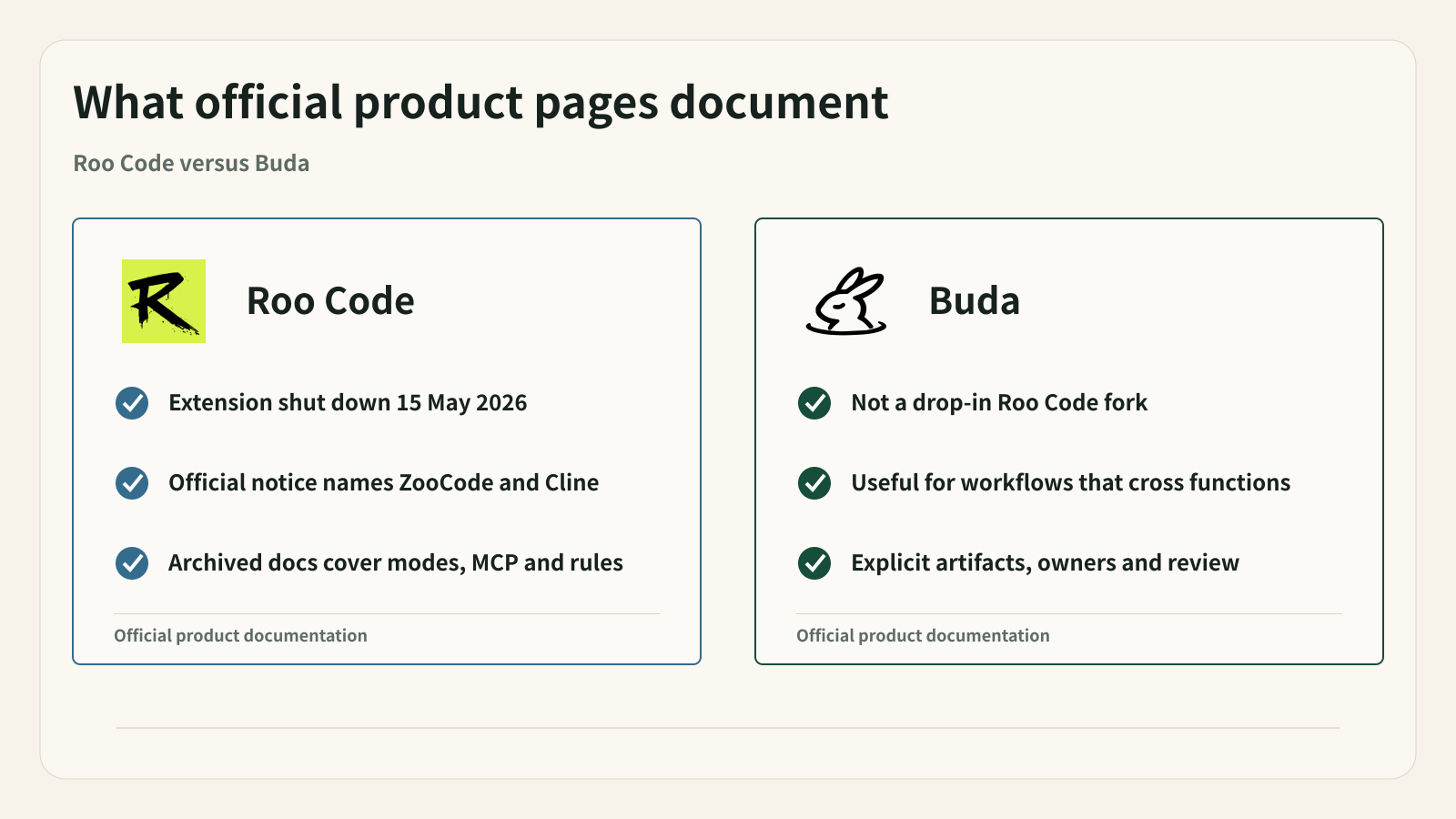
Roo Code is no longer an ordinary active-product comparison. Its official documentation and Visual Studio Marketplace page state that the Roo Code Extension was shut down on May 15, 2026. The same notice points people looking for an alternative to ZooCode, a community fork, and Cline, the project from which Roo Code originated.
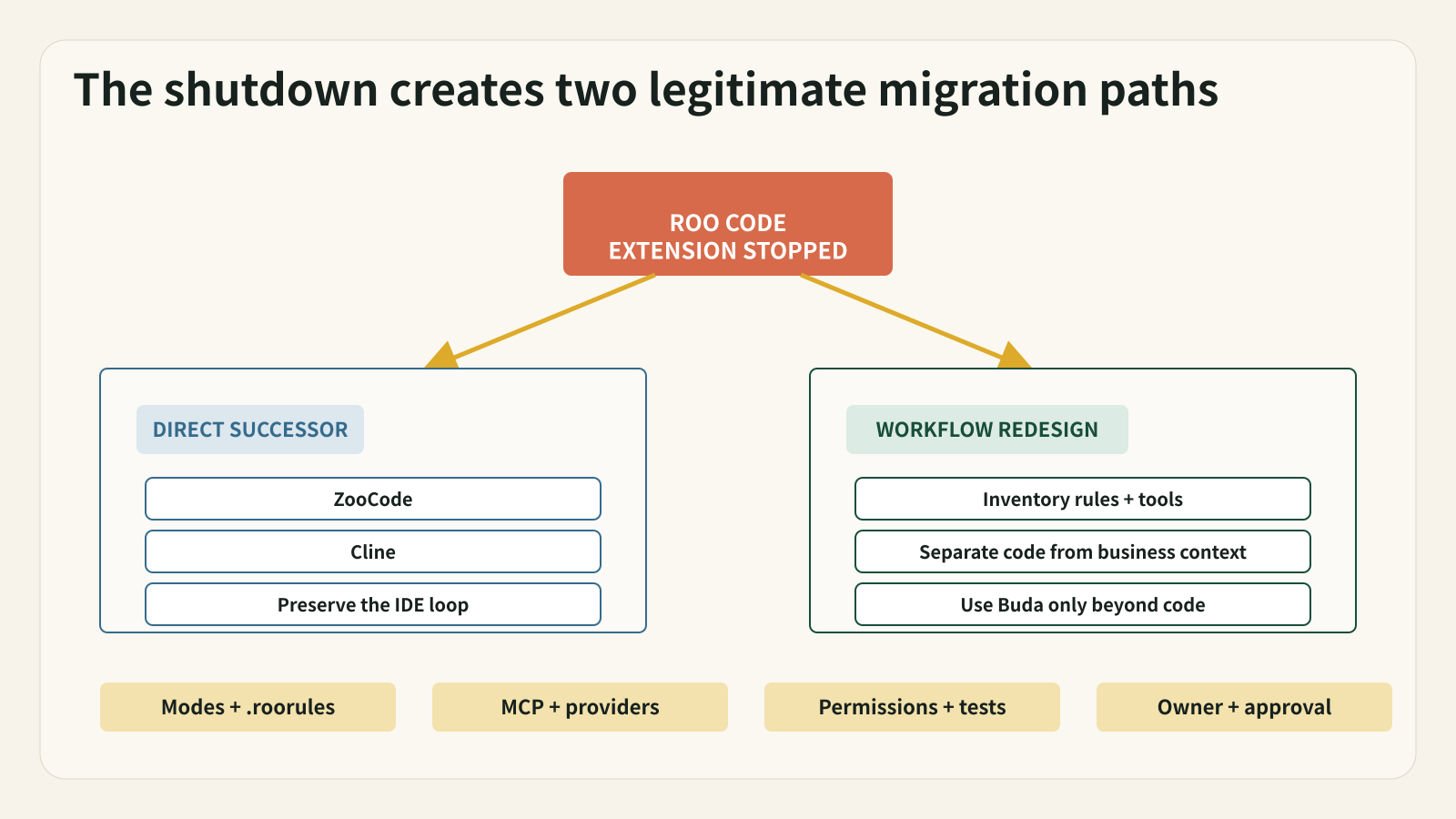
That status changes the purpose of this article. A user who wants the closest continuation of Roo's VS Code experience should evaluate those direct successors first. Buda is not a drop-in Roo Code fork and should not be presented as one.
Buda becomes relevant only when the migration question is larger: should the old IDE-centered Agent workflow be recreated in another coding extension, or should the repeatable parts become a cloud workspace shared by technical and non-technical Agents, artifacts, owners, and reviewers?
Start with the official status, not an old feature list
Roo's archived documentation still describes a capable open-source coding Agent for VS Code. It could read and write project files, run terminal commands, browse where supported, call MCP servers, use multiple model providers, and work through Code, Architect, Ask, Debug, and custom Modes. It also offered approval settings, project rules, context mentions, and multi-step workflows.
Those capabilities matter because they reveal what a team may need to preserve. But documentation of historical features is not evidence that the extension is still maintained or supported. The shutdown notice must lead every purchasing or migration decision.
The first question is therefore not “Roo or Buda?” It is “what part of Roo did the team actually depend on?” The answer determines whether the replacement should be another editor Agent, a coding platform, or a broader operating workspace.
Inventory the workflow before choosing a replacement
A useful migration begins with evidence, not a new install. Record:
- which repositories and project folders Roo could access;
- which Modes or custom instructions were used;
.roorulesfiles, coding conventions, prompts, and slash commands;- MCP servers, external tools, provider keys, and local-model configuration;
- approval settings for file writes, terminal commands, and network access;
- repeatable tasks, acceptance criteria, tests, and expected outputs;
- the human reviewer and the point where work was considered complete.
Do not export credentials into a migration document. List the integration and owner, then rotate or reconnect secrets through the destination product's approved mechanism.
This inventory separates portable procedure from product-specific state. A prompt or coding convention may move easily. A private conversation history, extension checkpoint, provider token, or local index may not.
Three migration paths, not one
| What the team wants to preserve | Most direct path | Where Buda fits |
|---|---|---|
| The same VS Code coding loop | Evaluate ZooCode and Cline first, as named by Roo's official shutdown notice | Usually not a direct substitute |
| Agentic coding across local and cloud development | Evaluate an active coding-agent platform against repository, model, review, and deployment needs | May hold issue context and cross-functional release artifacts around the coding system |
| A repeated workflow that crosses code, research, docs, operations, and review | Rebuild the process around explicit sources, roles, artifacts, and approvals | Buda can become the operating workspace for the broader process |
This prevents a common migration error: selecting a product because it has the word “Agent,” even though it manages a different unit of work.
When a direct Roo successor is the right answer
If the team's core need remains an autonomous Agent inside VS Code, a direct successor should be evaluated before Buda. Roo's official notice explicitly names ZooCode and Cline. Test whether the destination can use the required model providers, project instructions, terminal actions, MCP tools, diff review, approval model, and local development environment.
The migration should reproduce one representative task, not every old setting. Choose a bug fix or refactor that uses the real rules and tools. Compare the generated diff, tests, permission prompts, model cost, failure recovery, and developer intervention.
If that task succeeds and all downstream work still belongs to the developer and repository, there is no reason to add a broader Agent workspace.
When Buda is the meaningful migration
Buda is relevant when Roo had become an informal gateway to work beyond coding. Perhaps the Agent gathered web evidence, wrote release notes, prepared implementation plans, updated documentation, or produced handoffs that operations and product teams needed. If those tasks were trapped in one developer's editor, replacing only the extension may preserve the bottleneck.
Buda lets the organization split the process by responsibility. An engineering Agent can retain issue and Git context. A research Agent can gather source evidence. A documentation Agent can prepare an update. An operations Agent can assemble a rollout checklist. Each result becomes a reviewable artifact with an owner and next action.
The key migration is not the conversation transcript. It is the operating contract: sources, allowed tools, expected output, reviewer, approval point, and failure path. Rebuilding that contract in a shared workspace can make the workflow less dependent on one person's VS Code installation.
What must not be claimed
Buda does not automatically import Roo sessions, checkpoints, Modes, .roorules, provider configuration, or MCP setup. No compatibility guarantee is implied here. A team must translate the useful instructions and reconnect tools deliberately.
Buda is also not automatically a better coding environment. If the work ends in source edits, diffs, tests, and commits, an active coding Agent is likely the closer replacement. Buda's value appears when the work has to leave the editor and remain accountable across people and functions.
A migration plan that keeps evidence intact
Phase 1: freeze and record
Record the Roo version, repository, provider, Modes, rules, MCP servers, permissions, commands, acceptance tests, and outputs used by the workflow. Export non-sensitive instructions and examples. Store no API keys.
Phase 2: classify each part
Label each item as code-loop, reusable instruction, external integration, business context, output artifact, or human decision. Code-loop items belong in the successor coding tool. Business context and review may belong in Buda or another operations system.
Phase 3: rebuild the smallest viable path
Run one real task in the proposed direct successor. If the workflow also crosses teams, build only the handoff artifact in Buda: issue context, diff and test evidence, documentation status, owner, approval, and next action.
Phase 4: test failure, not only success
Deny a permission, cause a test to fail, remove a required source, and stop a run midway. Confirm who sees the failure, what state survives, and how the human resumes or abandons the task.
Phase 5: retire deliberately
After the replacement passes, remove stale credentials, document the new source of truth, and mark old Roo instructions as archived. Do not leave two apparently active workflows that can produce conflicting outcomes.
A fair comparison pilot
Use the same repository task and the same downstream deliverable.
- Reproduce the code task in a direct successor such as ZooCode or Cline.
- Measure setup, tool compatibility, diff quality, tests, approvals, and correction effort.
- If a cross-functional handoff exists, model that handoff in Buda without duplicating the code session.
- Ask another person to review the result from the stored evidence.
- Choose the smallest system that preserves the real workflow and named human responsibility.
FAQ
Is Roo Code still an active VS Code extension?
The official Roo Code documentation and Marketplace listing state that the extension was shut down on May 15, 2026. Public docs and source remain useful historical references, but should not be presented as proof of continuing product support.
What alternatives does Roo Code officially name?
The shutdown notice points users to ZooCode, described as a community fork, and Cline, the project Roo Code originated from. Teams wanting a close editor replacement should start there.
Can Buda import my Roo Code configuration?
No automatic compatibility is established. Treat Modes, rules, prompts, MCP servers, provider settings, permissions, and credentials as a migration inventory. Translate instructions and reconnect integrations explicitly.
When should Buda be part of the migration?
When the real workflow crosses the repository into research, documentation, operations, customer work, artifacts, ownership, and human review. If the job stays inside the coding loop, use a direct coding-tool successor.
Sources
Verified September 22, 2026.