Buda vs Warp: Optimize the Software Factory or Connect the Work Across Departments?
Separate the acceptance criteria for mergeable code from those for business deliverables before choosing an agent platform.

Buda vs Warp: Optimize the Software Factory or Connect the Work Across Departments?
A search for a Warp alternative should start with the delivery problem. An engineering lead may want low-risk pull requests to move through review faster. A business owner may want release research, customer materials, and recurring reports to stop waiting on one person. Both need agents, but they do not have the same definition of done.
Warp now presents an open development platform spanning Factories, Terminal, and Agent CLI. Comparing it with Buda as though it were only a local terminal misses the important decision. Buda organizes work around persistent agent workspaces and distinct responsibilities. Start with what the team must accept, not a simplistic local-versus-cloud distinction.
Warp puts the software lifecycle at the center
Warp describes Factories as fleets of agents connected to the SDLC. An issue, chat message, or schedule can initiate work that moves through triage, implementation, and review toward a mergeable PR. Its website illustrates factory.yaml definitions for repositories, agents, models, permissions, and checkpoints.
The platform also describes evaluations, model benchmarks, and configuration improvement loops, with Warp cloud or self-hosted VPC compute. Factories is separate from Terminal: adopting it does not require every developer to change terminals. These are meaningful engineering capabilities, not details to erase with the label “developer tool.”
The current site invites teams to request early access to Factories. Confirm deployment, access, and commercial terms before a pilot. Website illustrations and customer results are not universal performance guarantees, so they do not establish a cost or accuracy ranking here.
Make one low-risk PR the first acceptance test
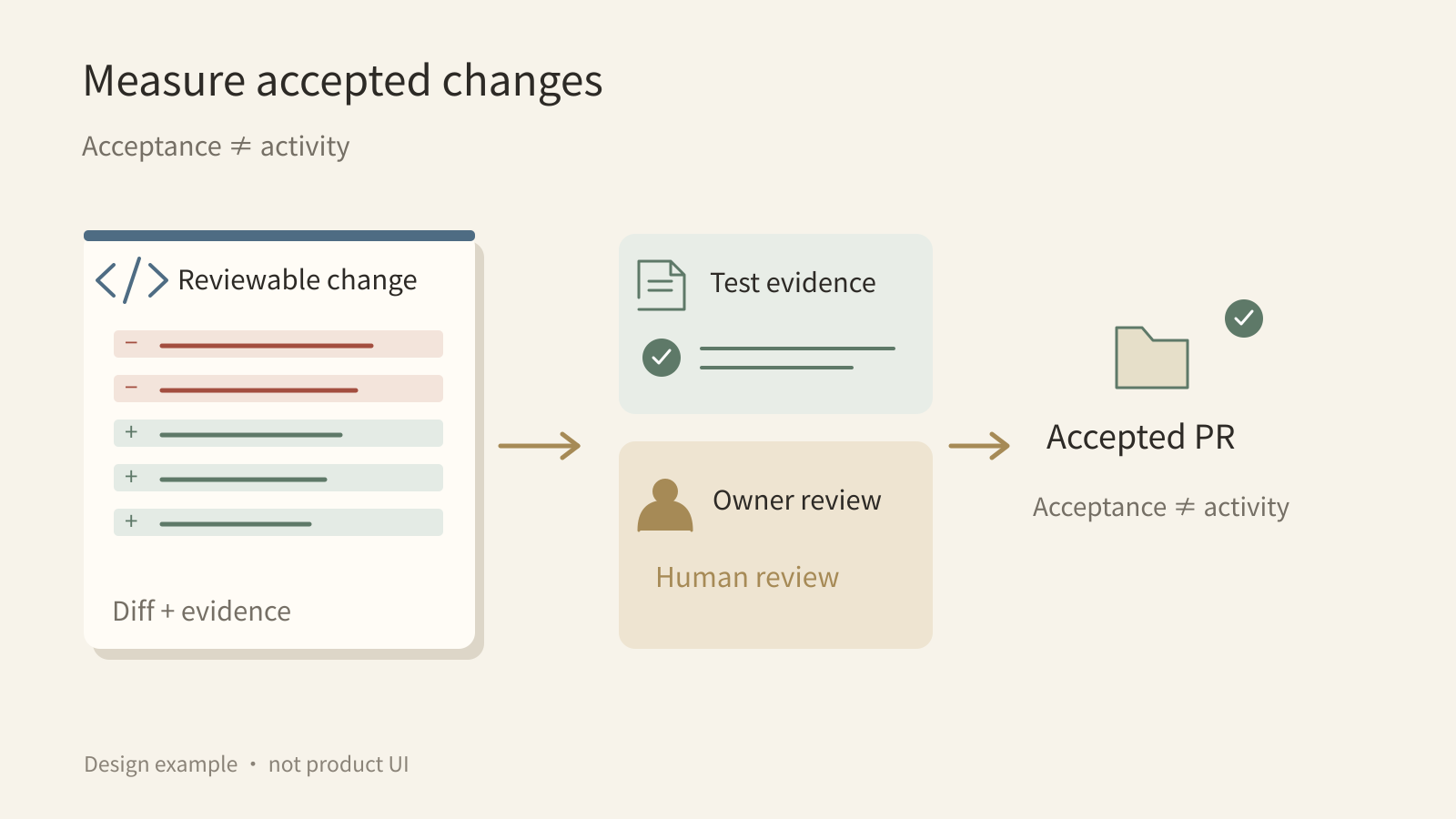
A dependency update or flaky-test investigation gives a software-factory pilot a clear boundary. Specify allowed repositories and paths, mandatory tests, required execution evidence, and changes that need an engineer. Then inspect whether the agent produces a reviewable diff, reproducible checks, visible failures, and a change the owner will actually accept.
The useful unit is an accepted PR, not the number of agent actions. Track elapsed time, retries, and reviewer effort together. If engineering review and feedback are the bottleneck, a platform designed around that loop deserves a serious trial before a broader business workspace.
Automated evaluations do not authorize production changes. Tests cannot cover every business consequence; permissions, checkpoints, and responsibility for merging still need an explicit policy.
Business deliverables need a different finish line
Imagine the code for a product update has merged. Someone still needs release notes, checked sales materials, and a list of likely customer questions. Each output has different inputs, evidence, owners, and acceptance criteria. Many do not end in a repository change.
Buda supports this work through distinct agents in persistent cloud computers. Each agent has a Drive and can execute across files, browser, terminal, and Git. Shared material supplies team context; repeatable procedures can become Skills; well-defined recurring work can run as Automations. People decide whether the output is accurate and ready to use.
This is not a claim that Warp cannot call business tools. The comparison concerns the organizing center: correctness of a software pipeline, or ongoing responsibilities across business roles. A pilot should test how easily the team manages those responsibilities, not just the quality of one generated file.
Turn acceptance into procurement questions
A company can have both needs without buying against one scorecard. For a software factory, inspect repository access, triggers, execution environments, evaluation configuration, and merge permissions. For a cross-functional workspace, inspect how material survives tasks, how roles stay separate, what the next owner can see, and where reviewed outputs live.
Both need failure handling and permission boundaries. A completed state should point to evidence: a PR to its diff and checks, a report to its sources and unresolved questions. Status is not proof. There is no universal value ranking here; compare model consumption, compute, integration effort, and human review using the tasks each platform will actually run.
Design the handoff instead of assuming it
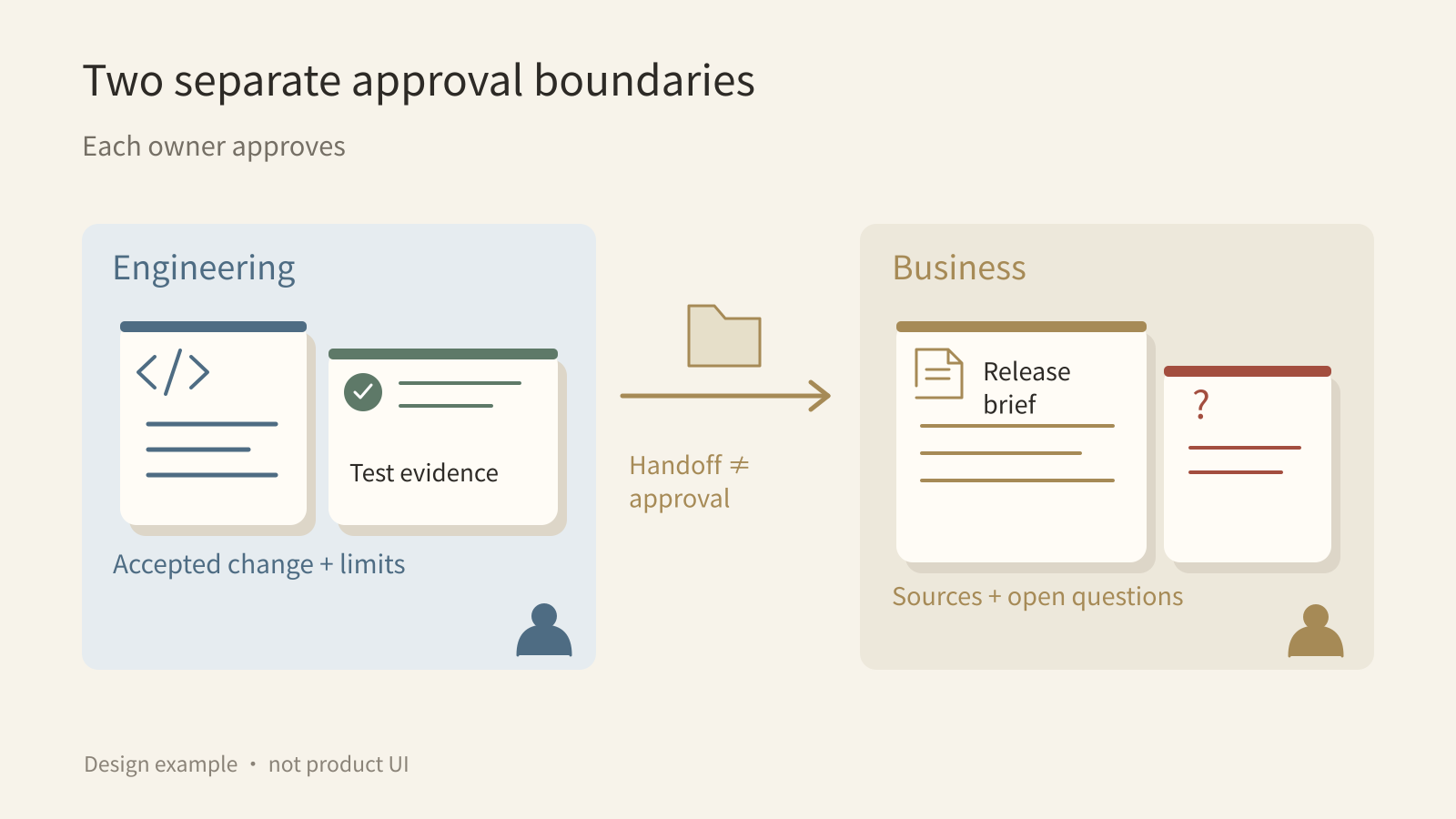
When using separate engineering and business systems, define a handoff contract. The engineering side supplies an accepted PR, test summary, impact scope, and known limitations. The business side uses those materials to draft release communications and customer responses. Do not assume an automatic cross-product integration exists.
A business agent should not promise a fix to customers from a message saying “done.” It needs engineering evidence and a route back to the owner for clarification. Likewise, approved copy does not prove code is deployed. Preserve approval boundaries at each stage.
For a Buda pilot, start with one post-release responsibility. Supply approved change material and request a source-linked draft plus unresolved questions. Search for and install a relevant Skill in the Buda AI Marketplace, then add the team’s acceptance rules. Automating the entire department is not the first milestone.
Questions before a pilot
Is Warp still just a terminal?
No. The current site separately presents Factories, Terminal, and Agent CLI. Factories describes development automation, triggers, agent orchestration, evaluations, and governance. Compare the present product rather than its earlier category.
What if a VPC deployment is mandatory?
Warp explicitly describes a self-hosted VPC option. This article discusses Buda as a managed cloud workspace and does not establish deployment equivalence. Verify the exact product, contract, and security configuration before treating either as compliant with a hard requirement.
Why does business review remain necessary after a PR review?
Engineering review checks changes to code and system behavior. Business review checks wording, commitments, and external materials. Approval to merge cannot approve a customer email on another owner’s behalf.
Which pilot should run first?
Choose the backlog with the clearest acceptance criteria and greatest current friction. Test a software factory for verifiable code changes; test a persistent business workspace for recurring research, content, or customer outputs that cross roles.