A ChatGPT Alternative for Recurring Team Operations, Not Just Projects
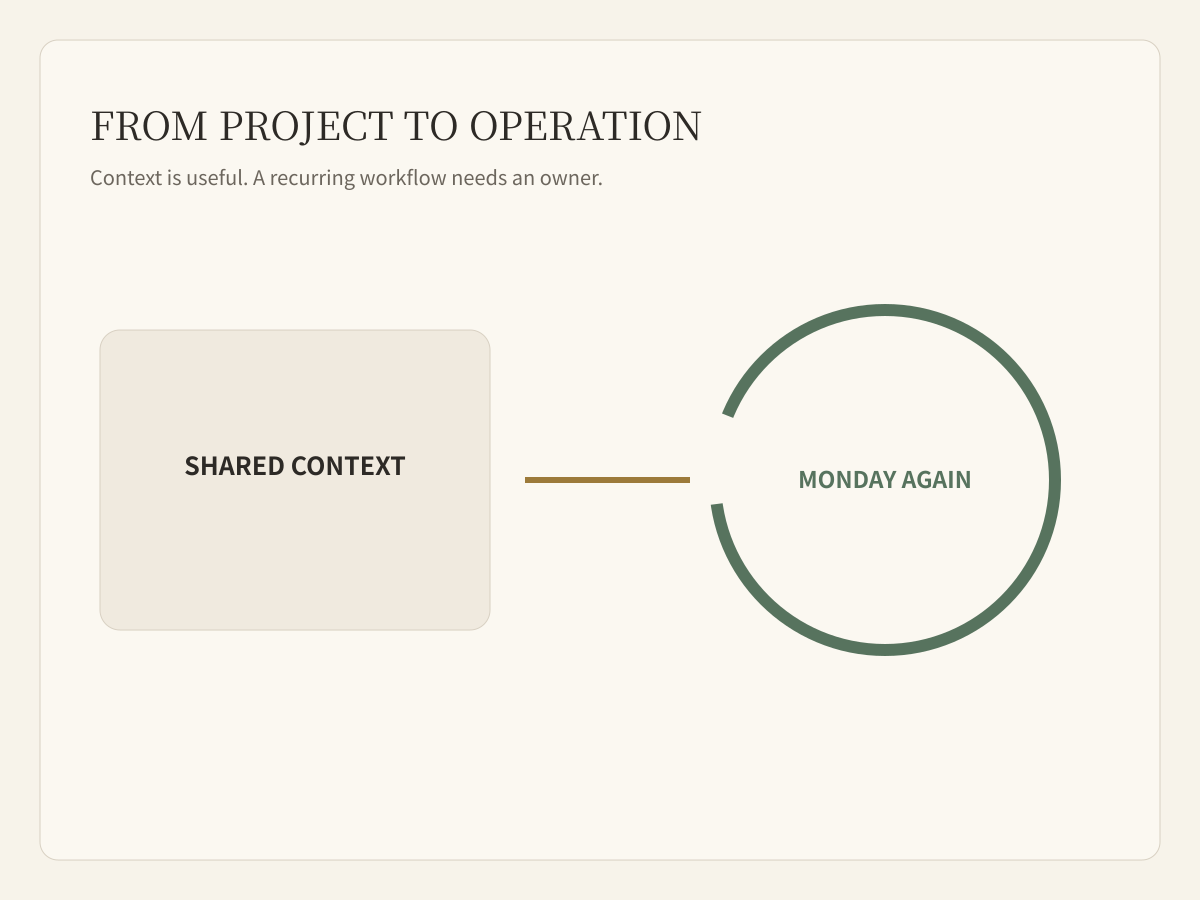
A ChatGPT Project keeps context for collaborative work. Buda is the alternative when recurring operations need dedicated agents, schedules, tools, and reviewable outputs.

A ChatGPT Alternative for Recurring Team Operations, Not Just Projects
ChatGPT Projects already gives teams a useful way to keep files, instructions, tools, memory, and shared context together. If people mainly need a place to think, research, draft, and collaborate around a topic, a Project may be enough.
Buda is the more relevant ChatGPT alternative when the requirement changes from maintaining context to running an operation: dedicated agents with persistent workspaces, recurring schedules, team channels, execution tools, visible artifacts, and defined human review.
A weekly market brief exposes the difference
Take a recurring market-intelligence workflow. Every Monday the team needs a brief covering competitor changes, source links, implications, unanswered questions, and recommended actions.
In a conversational project, a person can gather materials, ask for analysis, refine the answer, and retain the surrounding context. That is valuable. The human still owns the trigger, the sequence, the follow-up, and the final location of the accepted brief.
An operating workflow asks for more:
- run on a schedule without rebuilding the prompt;
- assign collection, verification, and synthesis to different agents;
- retain downloaded evidence and intermediate files;
- surface source failures instead of hiding them;
- route the finished brief to a reviewer;
- preserve the accepted artifact for next week's run.
What ChatGPT Projects already solves
Projects can group chats, uploaded files, project instructions, memory, and tools. Shared projects give collaborators a common context. That makes them suitable for ongoing research, writing, planning, and other work where people actively steer the conversation.
The case for Buda should not rely on pretending ChatGPT forgets every session or cannot work with files. The distinction begins when the team wants named operators and a repeatable execution lifecycle, not merely a richer conversation container.
Turn the brief into an operation
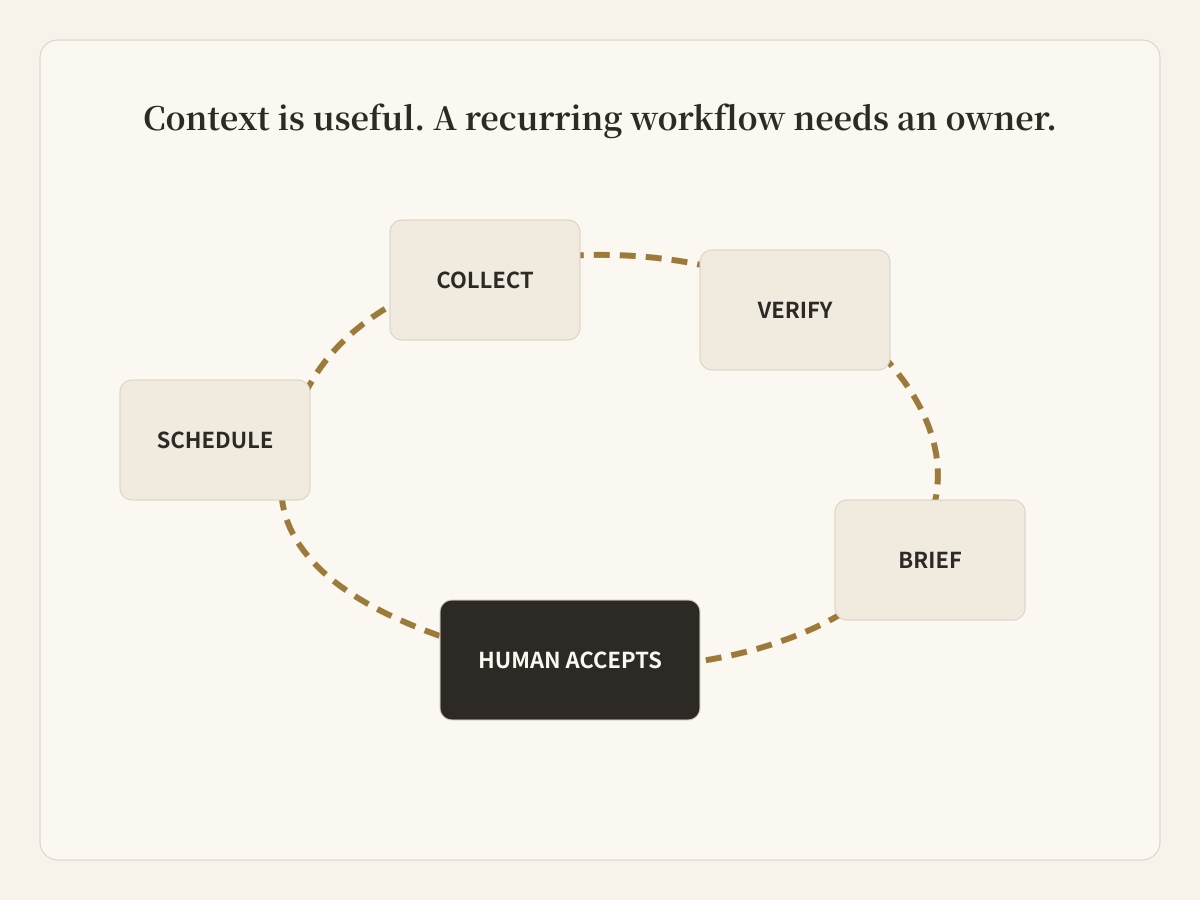
In Buda, the same market brief can be organized around dedicated agents and explicit stages:
- A monitoring agent collects approved sources on schedule.
- A verification agent checks dates, primary evidence, and contradictions.
- An analyst creates a structured draft with retained citations.
- A human reviews conclusions and requested actions.
- The accepted report remains in the team's workspace for comparison next week.
Browser, terminal, files, Git, Skills, Channels, and Automations are parts of that operating environment. The point is not to remove the human. It is to make human judgment the acceptance step rather than the mechanism that manually restarts every task.
The decision ladder
Stay with ordinary ChatGPT chats
Use a chat for an ad hoc question, exploration, rewrite, or analysis whose value is delivered inside the conversation.
Use a ChatGPT Project
Use a Project when several chats need the same files and instructions, collaborators need shared context, and people will continue to direct the work interactively.
Consider Buda
Use Buda when the workflow needs dedicated agents, persistent execution environments, scheduled or channel-triggered work, reusable procedures, retained artifacts, and an explicit reviewer.
This is not a maturity ladder in which one product is always “better.” It is a change in operating requirements.
Four questions that prevent a false comparison
- Who starts the work? A person opening a conversation, a schedule, or an incoming channel event?
- Where does unfinished work live? In chat context, a shared project, or an agent's persistent workspace?
- What counts as completion? A helpful answer, a file, a verified report, or an approved downstream change?
- Who accepts the result? The person chatting, a named reviewer, or a team workflow?
Answers to these questions are more useful than comparing model lists. Both products can provide access to capable AI; the operating model determines whether the work survives beyond a good response.
Do not automate an unclear process
Recurring execution amplifies ambiguity. Before scheduling anything, define approved sources, failure behavior, output format, reviewer, and what the agent must never do without confirmation. A persistent agent should make accountability easier to inspect, not make responsibility disappear.
A practical first workflow
Choose one process that already repeats weekly and produces a concrete artifact: a market brief, content review queue, support summary, release check, or operations report. Run it manually once, document the accepted steps as a Skill, then schedule only the parts with clear inputs and failure rules.
The result to optimize is not “more AI activity.” It is a reliable artifact that a person can review, accept, and reuse.
Explore Buda's agent workspace