ChatGPT at Work: From Asking Questions to Completing Tasks
OpenAI's global usage data shows a shift from answers to deliverables. Learn how managed Agents turn that behavior into reliable work.

Knowing how to ask a good question used to be the clearest sign that someone knew how to use AI.
OpenAI's latest country-level usage data points to a new dividing line. At work, people are more than twice as likely to use ChatGPT to complete a task or create something than they are outside work. Editing, coding, and analysis are moving AI from “explain this” toward “produce something I can use.”
That shift matters more than prompt technique. Once AI begins producing files, decisions, and records, the management problem changes. Teams need to define what the Agent can read, what it must deliver, how the result will be checked, and where a person must take control.
From Buda's perspective, the next stage of AI adoption is not better chatting. It is managed execution.
At work, people expect an output
OpenAI Signals groups message intent into three categories:
- Asking: seeking information, explanation, or advice
- Doing: creating an output or performing a task
- Expressing: sharing a view or feeling without seeking information or action
Outside work, Asking remains the largest category. At work, Doing becomes much more prominent. People are more than twice as likely to use ChatGPT this way in work settings.
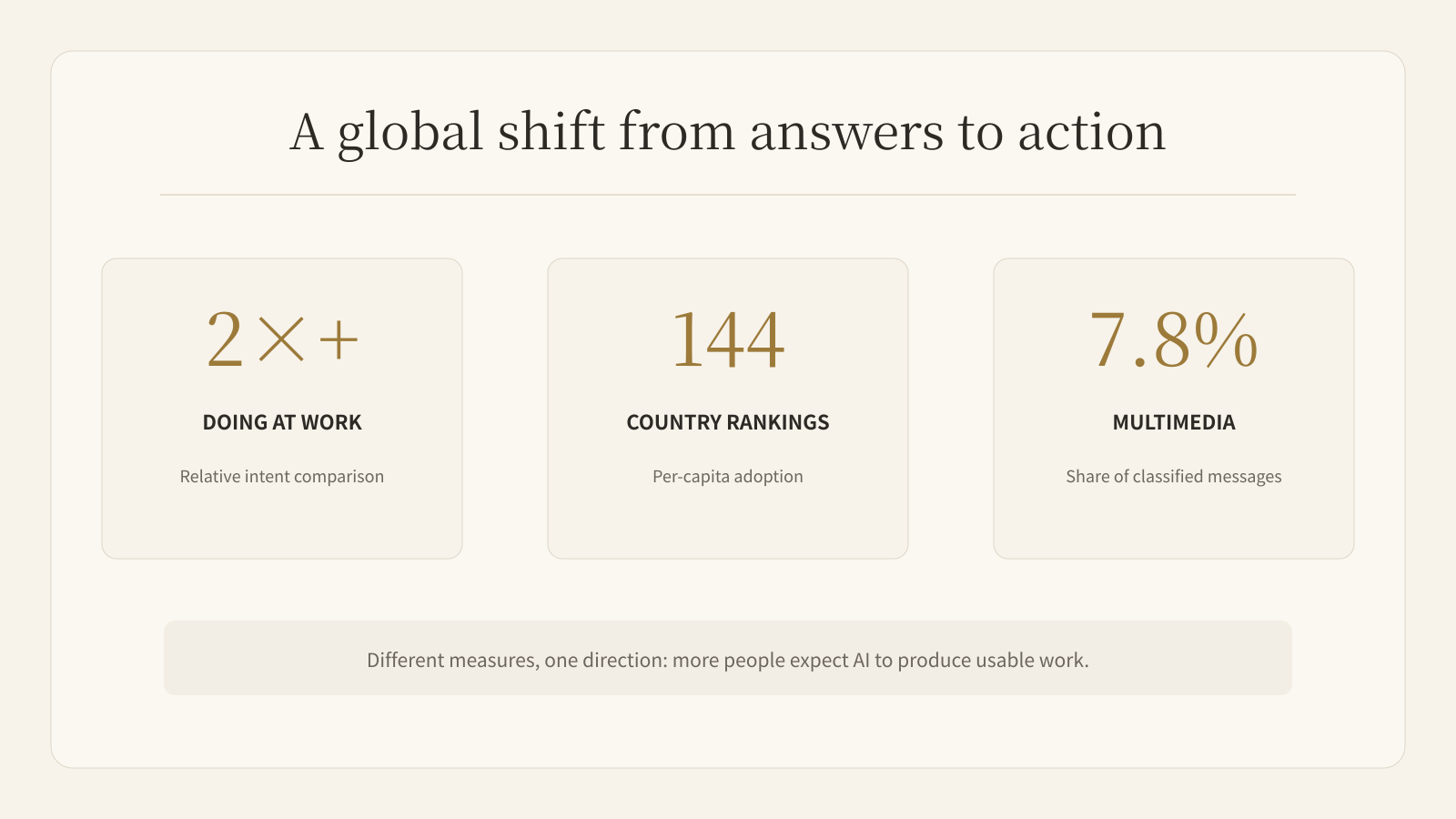
OpenAI does not publish the exact percentages behind that relative comparison. The useful conclusion is behavioral: when people enter work mode, they increasingly expect AI to hand back an artifact, not only an answer.
That artifact might be a revised document, a code change, an analysis, a presentation, or a set of records ready for review.
The data also shows AI moving beyond early adopters
The same release shows that this change is becoming broader.
OpenAI refreshed per-capita usage rankings across 144 countries. Parts of Latin America, Africa, and Oceania are catching up with early-adopter markets. Multimedia generation, analysis, and retrieval became the fastest-growing use case, reaching 7.8% of classified messages globally and more than one in ten messages in Brazil and Colombia. Among users who self-reported age, the share of messages from people over 35 rose in nearly every country.
These figures use different statistical scopes. The Asking-versus-Doing analysis reflects messages from individually managed Free, Go, Plus, and Pro accounts, excluding Enterprise and Codex. The multimedia country estimate covers 126 eligible countries, while the ranking comparison covers 144. The age analysis includes only users who reported their age.
Read together, they describe direction rather than company ROI: more kinds of people, in more places, are asking AI to work across more kinds of media.
Asking for an output is not yet a workflow
“Analyze this month's sales” sounds like a task. Operationally, it still leaves most decisions hidden.
Which order table should the Agent read? What baseline should it use? What form should the result take? Which anomalies need escalation? Who approves the final numbers?
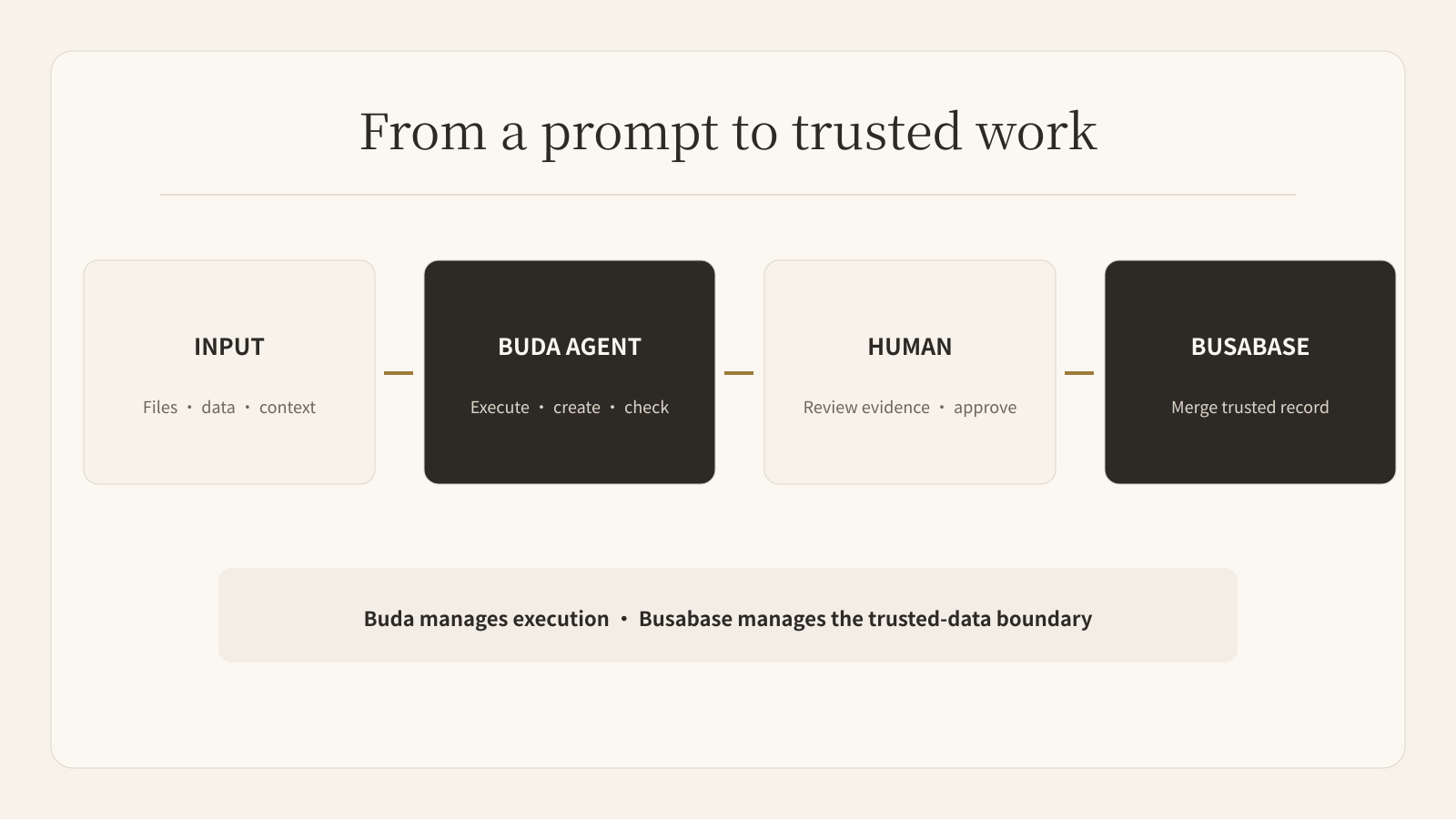
A task becomes manageable when it defines four things:
- Inputs: files, data, context, and tools the Agent can use
- Deliverable: the document, table, code, or proposed records it must produce
- Acceptance criteria: evidence, quality checks, and failure conditions
- Human review: exceptions and actions that require approval
A stronger sales-analysis task would tell the Agent to read the current month's orders and last month's baseline, identify the five products with the largest revenue movement, flag unusual refunds, create a Markdown report with supporting data, and separate uncertain cases for review.
The difference is not prompt polish. The second version defines a work contract.
Buda manages the execution layer
One-off chats scatter context across conversations. A managed Agent needs a place where the source material, instructions, tools, generated files, and review decisions remain together.
Buda provides that persistent execution layer. In an Agent Workspace, an Agent can read project files, use tools in a sandbox, work across multiple steps, and leave visible artifacts. A successful method can become a reusable Skill. Time-based or recurring work can become an Automation. The person responsible for the work can inspect the trail and decide what moves forward.
This changes the human role from repeatedly explaining the task to managing the system:
- choose which work should be delegated
- define data and tool access
- inspect evidence and exceptions
- update the method after failure
- decide which results are accepted
The Agent performs execution. The person owns judgment.
Busabase manages the trusted-data boundary
Some Agent outputs stop as files. Others need to enter customer, finance, project, content, or operational systems. That step needs a stronger boundary than “the model finished.”
Busabase provides an approval-first data layer. Instead of changing a canonical record directly, an Agent proposes a ChangeRequest. A reviewer can inspect the field-level diff, comment, approve, or reject it. Only an approved change is merged, with provenance and audit history preserved.
The division of responsibility is clear:
- Buda: context, tools, multi-step Agent execution, artifacts, Skills, and Automations
- Busabase: proposed data changes, human review, trusted records, and audit trails
Together, they turn “AI can produce an answer” into “AI can execute work without silently deciding what becomes true.”
The next AI skill is task management
OpenAI's data captures a real shift. People are beginning to expect work from AI, not only explanations.
The advantage will not belong to whoever writes the cleverest prompt. It will belong to people and teams that can define a task, give an Agent the right context, inspect the evidence, and preserve a successful method.
Start by choosing one recurring task. Define its inputs, deliverable, acceptance criteria, and review point. Then run it in a Buda Agent Workspace. When the result needs to become trusted operational data, put a Busabase ChangeRequest between Agent execution and the canonical record.
That is how AI moves from conversation into work.