Claude Cowork Data Shows AI Agents Are Taking Over Office Busywork First
Anthropic's 1.2M Claude Cowork session analysis shows the biggest AI agent use case is not coding, but business operations, documents, reports, checklists, and other office busywork.

When people talk about AI agents, coding still gets most of the attention.
Repositories, bugs, tests, pull requests, terminals, and coding agents make for better demos. But Anthropic's Claude Cowork usage data points to a less glamorous and probably larger market: ordinary office work.
According to Anthropic's analysis, summarized by The Decoder, the sample covered 1.2 million anonymized Claude Cowork sessions from May 11 to May 31, 2026, across more than 600,000 organizations. The sessions were grouped into 20 work categories.
The largest category was not software development. It was business process and operations.
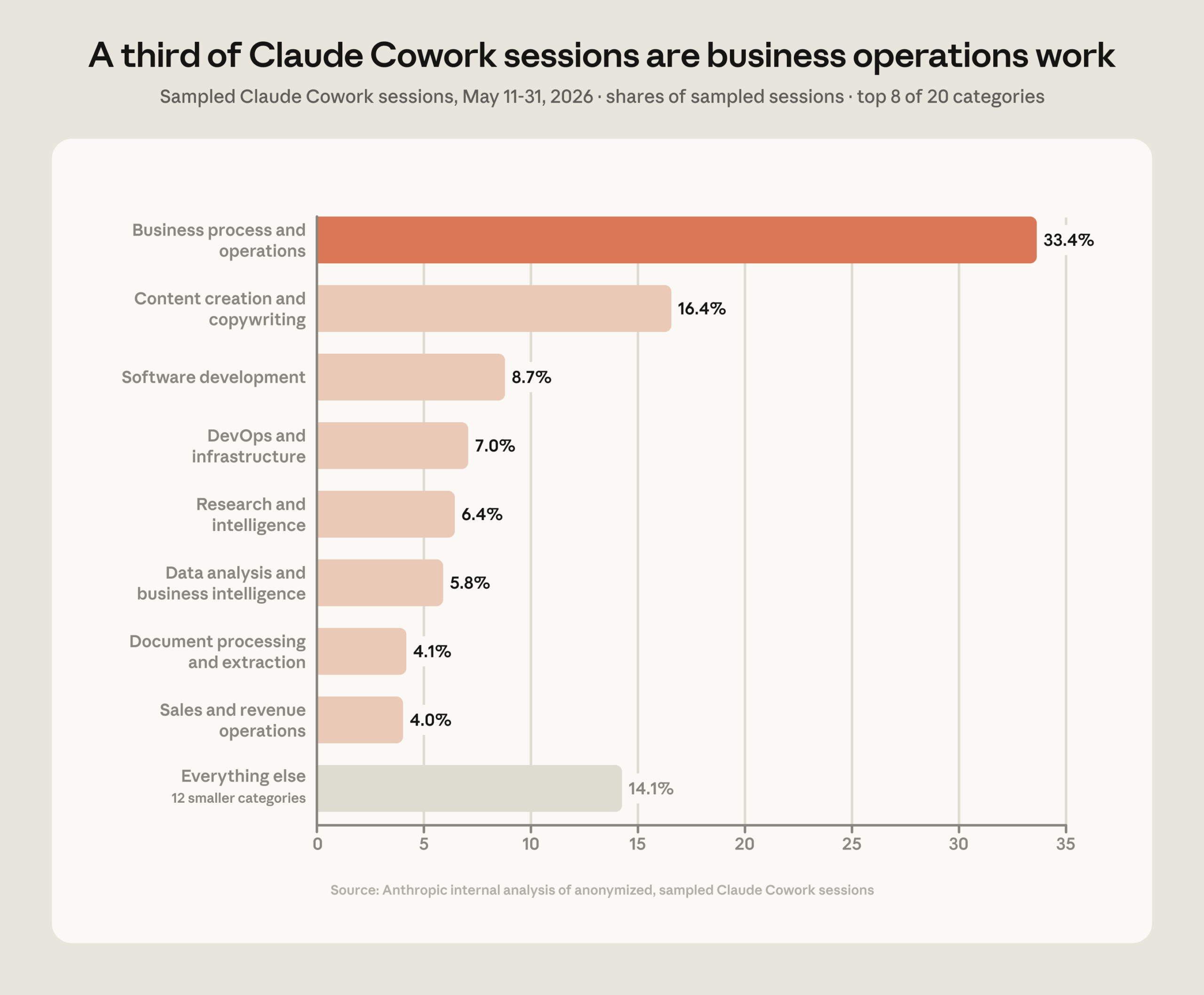
The Key Numbers: 33.4%, 16.4%, 8.7%
The first numbers matter more than the long tail.
| Claude Cowork category | Share of sessions |
|---|---|
| Business process and operations | 33.4% |
| Content creation and communication | 16.4% |
| Software development | 8.7% |
| DevOps and infrastructure | 7.0% |
| Research | 6.4% |
| Data analysis | 5.8% |
The story is clear: Claude Cowork is being used heavily for the work around the work.
Reports, summaries, slides, checklists, onboarding materials, spreadsheet cleanup, status updates, customer notes, meeting follow-ups, and internal drafts may not sound exciting. But every company runs on them.
Why Coding Is Not the Biggest Category
The 8.7% software development share does not mean developers are ignoring AI.
It likely means developers have more specialized entry points, such as Claude Code and other coding tools. Product surface shapes behavior. Put an agent in a terminal, and it becomes a developer tool. Put an agent in a workplace product, and the work expands into operations, documents, communication, and coordination.
That is the more important lesson: AI agents are not only spreading through expert technical workflows. They are entering the office through recurring administrative and operational tasks.
Office Busywork Is a Natural Agent Use Case
Office busywork is not always intellectually hard. It is hard because it is fragmented, repeated, and nobody wants to own it forever.
A weekly update may require emails, meeting notes, spreadsheets, project docs, and customer context. A sales follow-up may require CRM notes, call summaries, open invoices, and a careful tone. A hiring summary may require interview feedback, role requirements, and a structured recommendation.
These tasks usually have three properties:
- Inputs are scattered. The real work is finding and aligning context.
- Outputs are structured. Reports, checklists, slides, summaries, and tables follow repeatable formats.
- Decisions still need humans. The agent can prepare the work, but a person should approve the next step.
That makes them a strong fit for AI agents: let the agent prepare, normalize, draft, and compare; let the human review, decide, and send.
The Real Shift: From Prompting to Repeatable Workflow
Many teams still use AI like a better chat box:
"Summarize this."
"Write a draft."
"Clean this table."
That helps once. It does not automatically become a reliable business process.
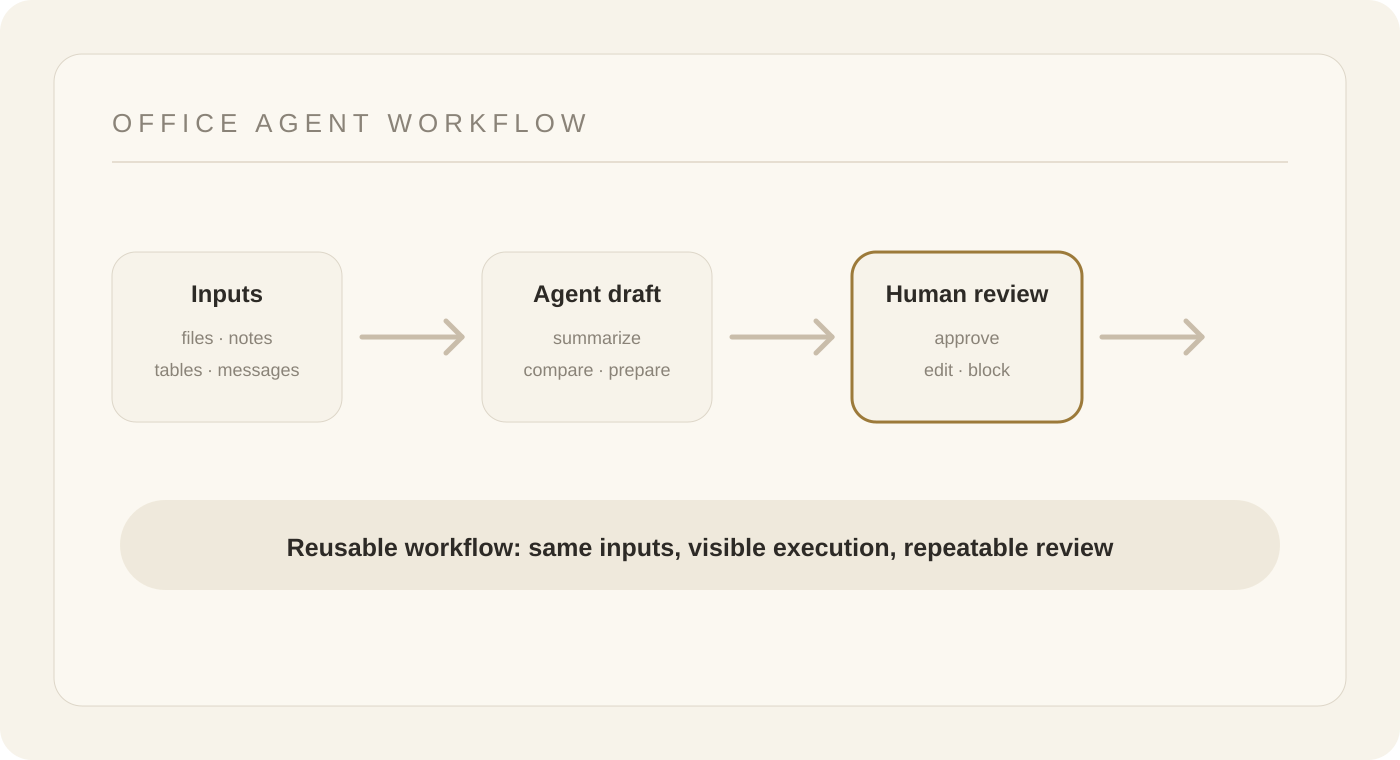
To make office work repeatable, a team needs to define the workflow:
- What inputs does the agent use?
- What does the agent do first?
- What output format should it produce?
- Where must a human review the result?
- Where does the approved output go?
- Can the same workflow run again next week?
This is the difference between a prompt and an operating workflow.
How Buda Fits This Pattern
Buda is built for exactly this layer of work: turning recurring office tasks into managed AI agent workflows.
Inside Buda, an agent can work with files in Drive, use tools, run inside a visible session, keep task history, and bring outputs back for review through channels. A Skill can package the method so the team does not rewrite the same prompt every time.
That matters for business operations because the goal is not to make AI sound smart once. The goal is to make the work visible, repeatable, reviewable, and easier to hand off.
A finance anomaly review, sales follow-up draft, onboarding checklist, meeting summary, content distribution plan, or weekly operations report should not depend on whoever remembers the right prompt. It should become a reusable workflow with clear inputs, agent execution, human review, and final delivery.
What Managers Should Take From Claude Cowork
The Claude Cowork data is useful because it makes the AI agent market less abstract.
The first wave of practical agent adoption may not start with replacing elite specialists. It may start with the office work that drains time across every department.
For managers, the useful question is not only "Which AI model should we buy?"
It is:
- Which recurring office tasks consume team time every week?
- Which of those tasks have scattered inputs and structured outputs?
- Where should the agent prepare work, and where must a human review it?
- Which workflows should become reusable Skills instead of one-off prompts?
That is where office AI becomes operational.
Start building managed agent workflows in the Buda dashboard, or read more about the Buda Agent Workspace.