Claude Fable 5.1: What Changed, Migration Risks, and When to Upgrade
A practical test plan for tool forcing, thinking blocks, cache economics, and safe rollout.

Claude Fable 5.1: What Changed, Migration Risks, and When to Upgrade
Claude Fable 5.1 is Anthropic's current Fable model for demanding reasoning and long-horizon agent work. It keeps the same headline API list price as Fable 5, cuts cache-read pricing to one quarter, and adds controls that matter in long-running workflows. It also introduces three compatibility changes that make a blind model swap a bad migration plan.
The short answer: use Fable 5.1 when a task is difficult enough that Opus 5 still falls short in your own evaluations. Do not make it the default for every agent step. Migrate behind an evaluation set, check tool behavior and thinking-block compatibility, and compare cost per accepted result rather than price per token alone.
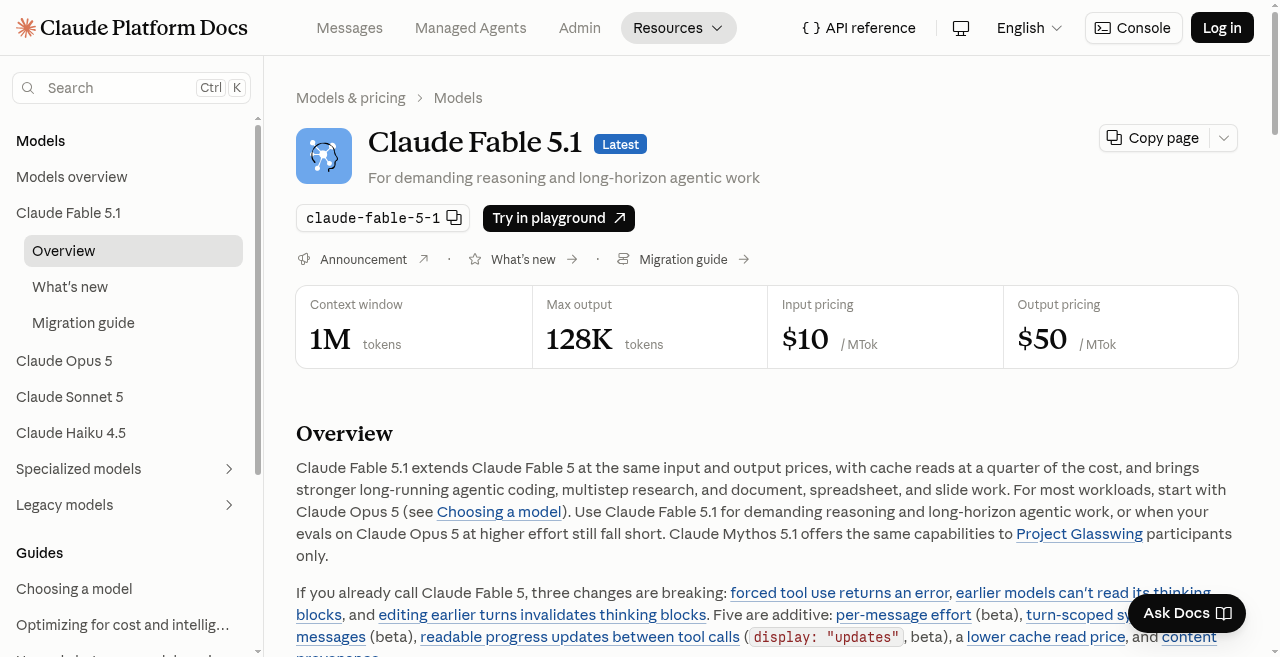
Source: Anthropic Claude Platform documentation. Captured September 2, 2026.
What is Claude Fable 5.1?
Anthropic released Claude Fable 5.1 on September 1, 2026. The model has a 1 million-token context window, a maximum output of 128,000 tokens, always-on adaptive thinking, and a June 2026 knowledge cutoff.
Anthropic positions it for demanding reasoning and long-horizon agentic work, including complex coding, multi-step research, and work across documents, spreadsheets, and presentations. The same documentation gives an important qualification: for most workloads, start with Claude Opus 5. Fable 5.1 is the escalation path when Opus 5 at higher effort still does not meet the bar.
That distinction is useful. A premium model should be a routed specialist, not an expensive habit.
Fable 5.1 vs Fable 5: the verified changes
| Area | Fable 5 | Fable 5.1 | Practical effect |
|---|---|---|---|
| Status | Active, legacy | Active, latest | New evaluations should target 5.1 |
| Context | 1M | 1M | No headline context increase |
| Max output | 128K | 128K | No headline output increase |
| Upstream input/output list price | $10 / $50 per MTok | $10 / $50 per MTok | Base token rates are unchanged |
| Cache read | $1 per MTok | $0.25 per MTok | Reused long context is materially cheaper |
| Agent controls | Earlier behavior | Per-message effort, turn-scoped system messages, readable progress updates | More control inside long runs |
| Provenance | Earlier behavior | Content provenance | Better traceability for supported outputs |
These are Anthropic's upstream API list prices. They are not Buda prices. A Buda workflow may use Credits, multipliers, minimum charges, tool calls, cache behavior, and other accounting rules. This article does not claim that Fable 5.1 is currently available in Buda.
The three migration risks
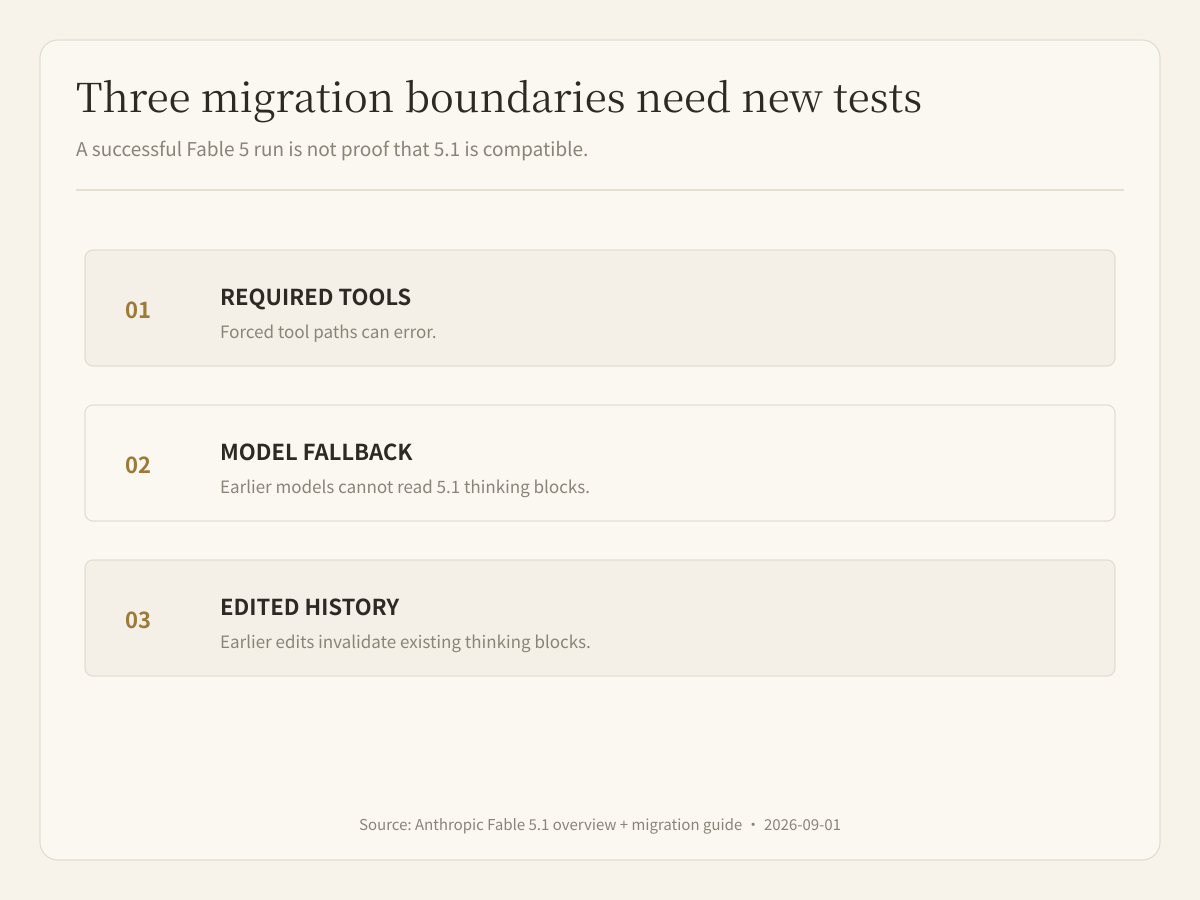
Fable 5.1 is not a drop-in replacement in every harness.
1. Forced tool use can return an error
If an application forces a tool choice, requests that worked with an earlier model can fail. Test every route that uses required tool selection, especially automated workflows that assume a tool call will always be accepted.
2. Earlier models cannot read its thinking blocks
A workflow that switches from Fable 5.1 to an earlier model may not be able to carry its thinking blocks forward. Model fallback and router logic need explicit tests; a successful first turn does not prove that a mixed-model session is safe.
3. Editing earlier turns invalidates thinking blocks
Some agent products rewrite or prune history to manage context. If your harness edits earlier messages, retained thinking blocks can become invalid. Test summarization, transcript repair, retries, branching, and human edits before using 5.1 in a long-running production process.
When should you upgrade?
Upgrade when all of the following are true:
- The task is long-running, multi-step, and expensive to get wrong.
- Opus 5 at a suitable effort level still misses your quality target.
- Your harness has been tested against the three compatibility changes.
- Repeated context is substantial enough for lower cache-read pricing to matter.
- A person reviews the final deliverable or high-impact action.
Stay on a cheaper model, or route selectively, when the task is repetitive, low-risk, latency-sensitive, or easy to verify. The best model for planning does not have to be the best model for extraction, formatting, browser work, or routine tool calls.
Why the lower cache-read price matters
Long-running agents repeatedly carry instructions, files, tool definitions, and prior work. If stable context is cached effectively, reducing cache reads from $1 to $0.25 per million tokens can lower one component of the bill substantially.
It does not mean the total task costs 75% less. Total cost also depends on uncached input, output, reasoning, tool calls, retries, subagents, failed runs, and human correction. The useful equation remains:
Cost per accepted task = model spend + tool spend + failed runs + retries + review + rework
A model can cost more per token and still be cheaper per accepted task if it avoids repeated failures. The reverse is also true.
A safer migration checklist
- Pin the exact model ID
claude-fable-5-1in a staging environment. - Run a representative evaluation set, not one impressive prompt.
- Test forced tool use and every required-tool route.
- Test model fallback across thinking blocks.
- Test transcript edits, compaction, retries, and branching.
- Compare accepted-task cost, latency, retries, and reviewer corrections.
- Roll out to a bounded workload before changing the default route.
- Keep a rollback route that does not depend on incompatible thinking state.
What this means for teams running agents
A stronger model does not remove the need for operating discipline. It increases the amount of work an agent can attempt before a person sees the result. That makes visibility, permissions, evaluations, and review more important, not less.
Buda is designed around that operating layer: agents work with persistent files and real tools, while people can inspect sessions and retain approval over consequential outputs. Model choice is one part of the system. The larger question is whether the work remains visible, bounded, and reviewable.
For a broader routing framework, read How to Choose the Right Model for Your AI Agents. For the previous release context, see Claude Fable 5 Is Now Available on Buda. Availability and Credits for Fable 5.1 should be checked against Buda's current product surface before use.
FAQ
Is Claude Fable 5.1 cheaper than Fable 5?
The upstream input and output list prices are unchanged at $10 and $50 per million tokens. Cache reads fall from $1 to $0.25 per million tokens. Total workload cost depends on actual cache hits, output, tools, retries, and rework.
Should every Fable 5 workload migrate immediately?
No. Run evaluations and compatibility tests first. The three breaking changes can affect tool forcing, mixed-model sessions, and edited histories.
Is Fable 5.1 better than Opus 5 for every task?
Anthropic recommends starting with Opus 5 for most workloads. Use Fable 5.1 when demanding reasoning or long-horizon work still falls short in your own Opus 5 evaluations.
Is Claude Fable 5.1 available in Buda?
Model availability and Credits can change. Check Buda's current model list before selecting it. Anthropic's catalog prices in this article are upstream reference prices, not Buda Credits.