Claude Fable 5 Pricing: API Cost, Buda Credits, and When It Pays Off
Fable 5 costs $10/$50 per MTok upstream and carries a 3.3x Buda multiplier. Estimate the cost of accepted work, not one prompt.

Claude Fable 5 Pricing: API Cost, Buda Credits, and When It Pays Off
Claude Fable 5 costs $10 per million input tokens and $50 per million output tokens on Anthropic's Standard API. A cache hit costs $1 per million tokens, and Batch processing is $5 input and $25 output.
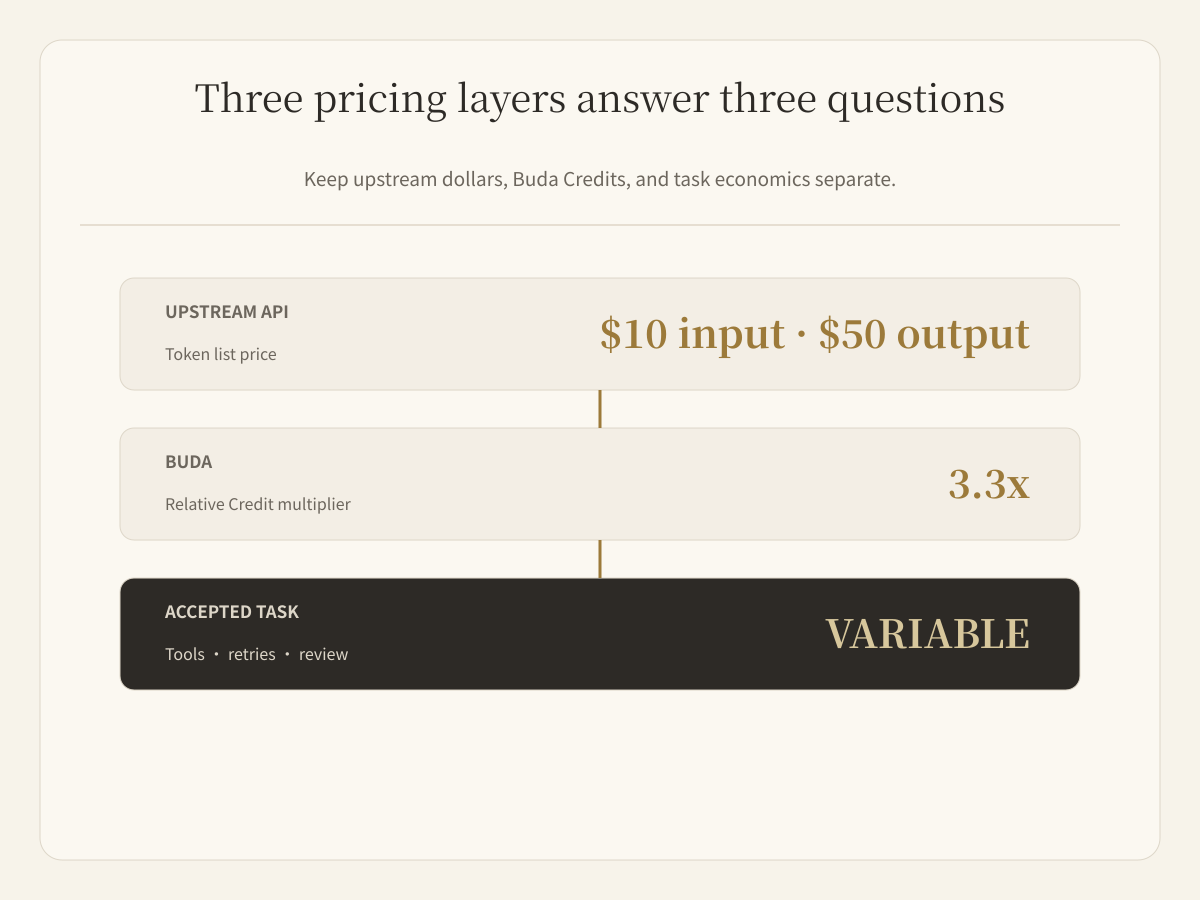
In Buda, Fable 5 is currently shown with a 3.3x credit multiplier. That multiplier is for relative model comparison. It is not a promise that one prompt costs a fixed number of Credits. Actual usage depends on input, output, cache behavior, tools, retries, and task complexity.
Those are three different layers. Mixing them is why model pricing often looks simpler than the bill for a finished job.
The direct pricing answer
| Layer | Published value | What it tells you |
|---|---|---|
| Anthropic Standard API | $10 input / $50 output per MTok | Upstream token list price |
| Anthropic cache hit | $1 per MTok | Price for reused cached input |
| Anthropic Batch API | $5 input / $25 output per MTok | Discounted asynchronous processing |
| Buda | 3.3x | Relative Credit multiplier shown on Buda pricing |
| Finished task | Variable | Model, tools, failed runs, review, and rework combined |
MTok means one million tokens. Input includes system instructions, files, retrieved context, tool definitions, tool results, and conversation history. Output includes answers, plans, code, reviews, and reports.
The upstream price is useful for comparing API workloads. The Buda multiplier is useful for comparing models inside Buda. Neither number alone predicts the cost of a completed agent task.
A simple API cost example
Suppose one request uses 100,000 uncached input tokens and produces 8,000 output tokens:
- Input:
100,000 / 1,000,000 × $10 = $1.00 - Output:
8,000 / 1,000,000 × $50 = $0.40 - Standard token total: $1.40
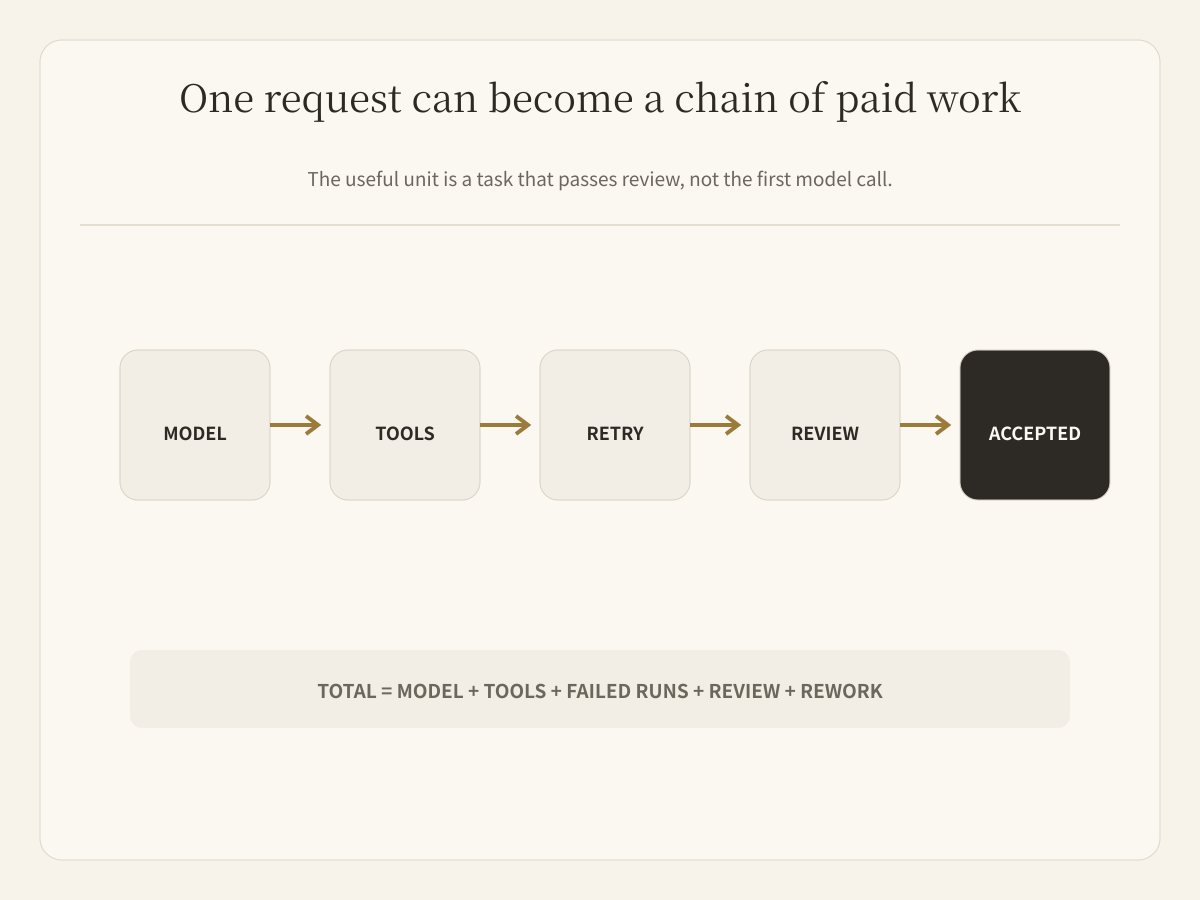
That calculation is correct for that single API request before other modifiers. An agent may plan, call tools, receive large results, retry a failed step, and verify its work. Each additional model call changes the task total.
Cost per accepted task = model usage + tools + failed runs + retries + review + rework
Why output and retries matter most
Fable 5 output costs five times more than its uncached input. Long code rewrites, verbose reports, repeated self-checks, and unnecessary explanations can therefore dominate the bill.
Retries multiply both sides. If an agent repeats a long-context call three times, the relevant question is not whether each call looked affordable. It is whether the final result passed review after all three attempts.
Track at least four measures together:
- first-pass acceptance rate;
- total model and tool usage;
- elapsed time;
- reviewer correction time.
A premium model can be cheaper per accepted task when it prevents expensive failure. It can also be wasteful when used for formatting or extraction that a smaller model could verify easily.
Does the 1M context window cost more?
Claude Fable 5 includes a one-million-token context window at standard per-token rates. A 900,000-token request uses the same rate as a 9,000-token request, but it contains 100 times as many tokens.
The context window is capacity, not free memory. Do not send an entire repository, document archive, or conversation history simply because the model can accept it. Retrieve the files and sections needed for the current decision.
When caching and Batch help
Prompt caching helps when stable context is reused. Anthropic lists Fable 5 cache reads at $1 per MTok, compared with $10 for uncached input. Cache writes cost more than normal input, so savings depend on reuse.
Batch cuts input and output rates by 50%. It fits offline evaluations, bulk document review, classification, and other work that does not require an immediate response. It is less suitable for interactive agent sessions.
These discounts solve different problems:
- caching reduces repeated context processing;
- Batch reduces the price of asynchronous volume;
- model routing avoids paying Fable rates for routine steps.
Fable 5 or Fable 5.1?
Anthropic now lists Claude Fable 5.1 as its current Fable model for demanding reasoning and long-horizon agent work. Fable 5 remains in Anthropic's pricing table, but new evaluations should normally include 5.1.
Both models keep the same $10 input and $50 output headline rates. Fable 5.1 lowers cache reads from $1 to $0.25 per MTok. It also has compatibility differences that should be tested before migration. See Claude Fable 5.1: What Changed, Migration Risks, and When to Upgrade.
This page continues to answer Fable 5 pricing because that is the model and search intent it owns. It does not turn into a second Fable 5.1 launch page.
When Fable 5 is worth using
Fable 5 is most defensible when the task is difficult, long-running, ambiguous, or expensive to get wrong:
- architecture and migration decisions;
- repository-scale review;
- synthesis across many documents;
- final review of a high-impact deliverable;
- agent planning where a weak decision would cause costly execution.
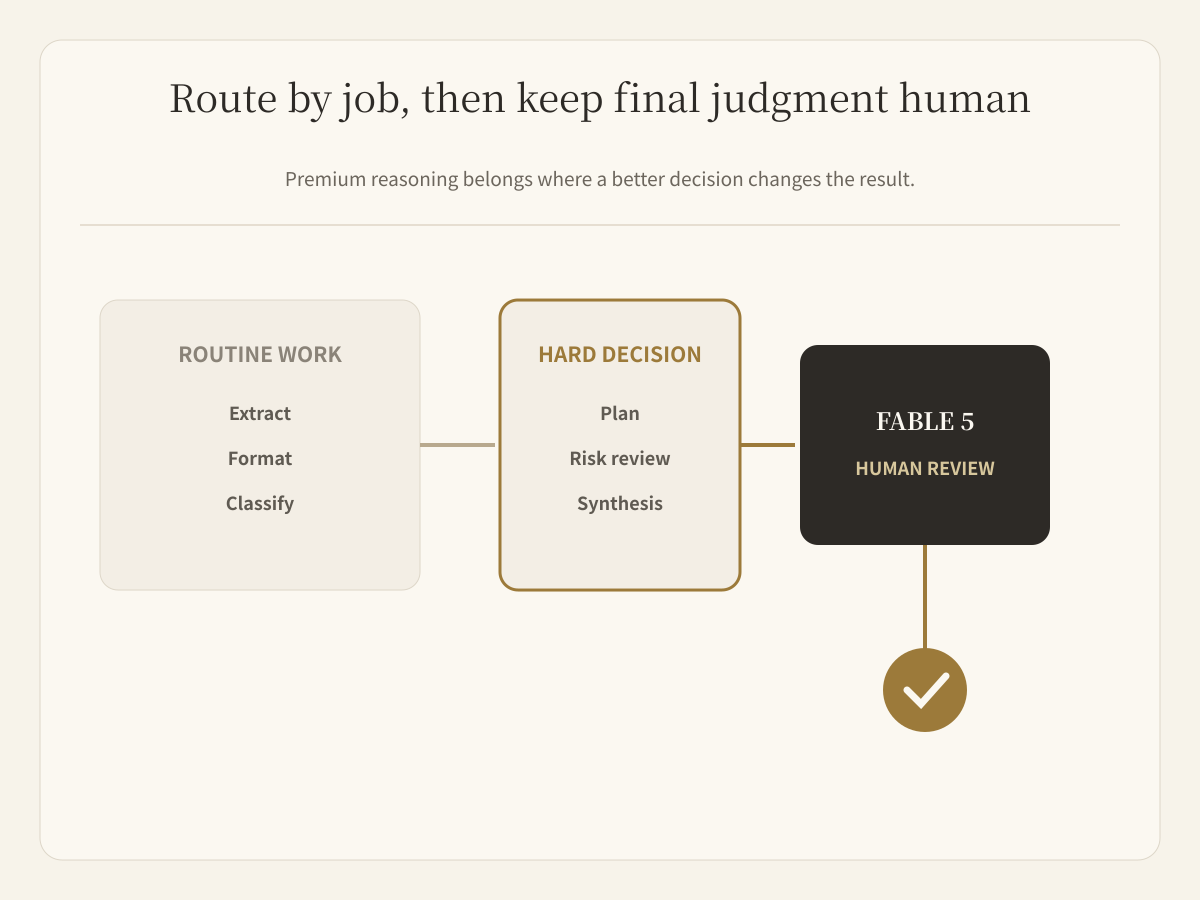
Use a lower-cost model for extraction, formatting, simple classification, and repetitive tool loops when the result is easy to verify.
How to read the Buda 3.3x multiplier
Buda's current pricing page lists Claude Fable 5 at 3.3x and labels it for highest-tier reasoning. The multiplier lets you compare relative Credit intensity with other models in the selector.
It does not convert Anthropic's dollar price into a fixed Credit charge. Buda Credits depend on the work actually performed. Check the current product surface before running a large task because model availability and multipliers can change.
The practical operating pattern is simple: use faster models for routine execution, route the hard reasoning step to Fable 5 only when it changes the outcome, and keep a person responsible for final acceptance. For a broader framework, read How to Choose the Right Model for Your AI Agents.
FAQ
How much does Claude Fable 5 cost through the API?
Anthropic's Standard list price is $10 per million input tokens and $50 per million output tokens. Cache hits are $1 per million tokens. Batch input and output are $5 and $25.
Does Fable 5 cost 3.3 Credits per request in Buda?
No. 3.3x is a relative Buda multiplier, not a fixed per-request charge. Actual Credits depend on usage and task behavior.
Is a one-million-token request included for one flat price?
No. The model supports a one-million-token context window, but tokens are still billed according to usage.
Is Fable 5.1 cheaper than Fable 5?
Their Standard input and output rates are the same. Fable 5.1 has a lower cache-read rate: $0.25 instead of $1 per MTok.
Should every Agent step use Fable 5?
No. Reserve it for the reasoning steps where better judgment can prevent expensive failure. Route routine, low-risk work to lower-cost models.