Introducing Claude Haiku 5.5: stronger capabilities and 90% lower short-prompt prices
Adjustable effort and stronger computer-use results give frequent, bounded tasks another option.

Anthropic released Claude Haiku 5.5 on October 7, 2026. The update brings substantial gains over Haiku 4.5 in computer-use and reasoning evaluations, the first adjustable effort setting in the Haiku family, and a 90% reduction in token prices for prompts up to 100,000 tokens.
Its focus remains high-volume, cost-sensitive work: summaries, classification, database queries, context compaction, and narrowly scoped subagent tasks. For applications that call a model repeatedly, the relevant question is which previously expensive or unreliable steps now merit another look.
Where the capabilities improved
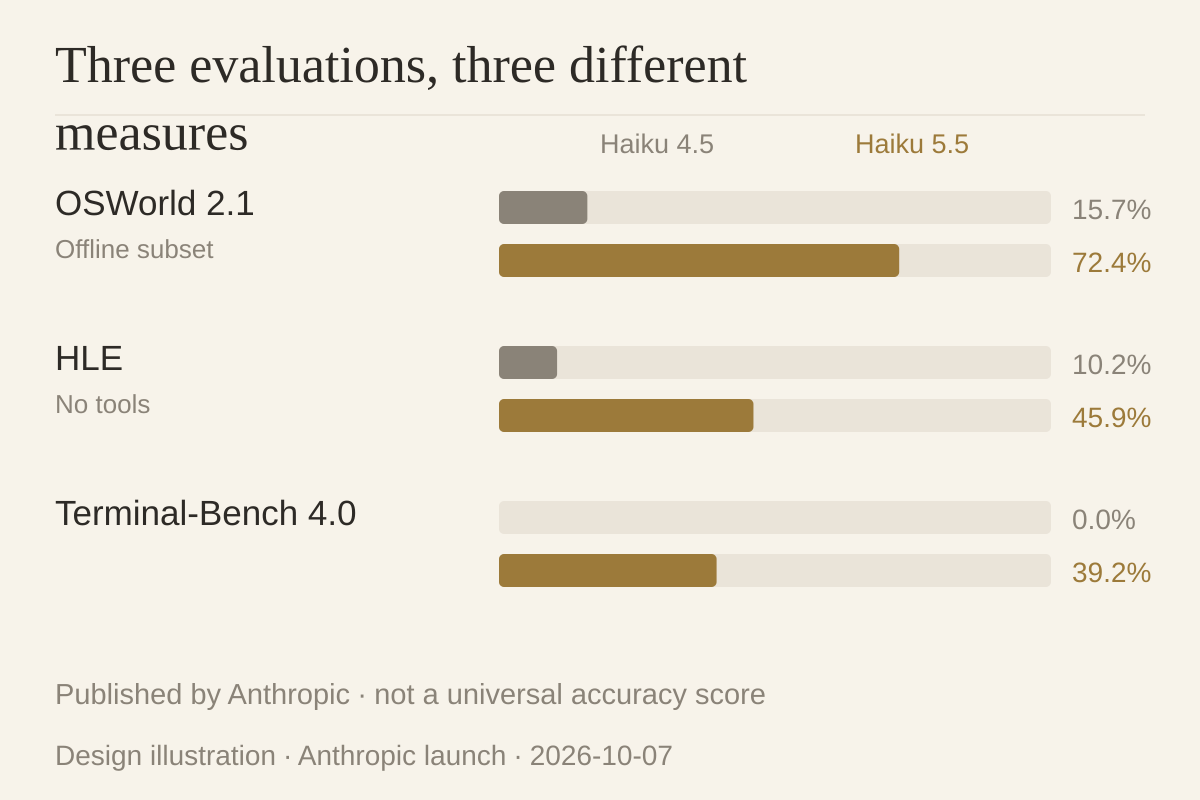
The launch reports evaluations across professional work, computer use, reasoning, coding, and chart understanding. Three results illustrate the change from Haiku 4.5:
| Evaluation | Haiku 4.5 | Haiku 5.5 | What it tests |
|---|---|---|---|
| OSWorld 2.1, offline subset | 15.7% | 72.4% | Multi-step computer tasks |
| Humanity’s Last Exam, no tools | 10.2% | 45.9% | Expert knowledge and reasoning |
| Terminal-Bench 4.0 | 0.0% | 39.2% | Complex command-line tasks |
These are results published by Anthropic, with methods and settings documented in its system card. They measure different capabilities rather than a single overall accuracy score.
Computer use stands out. Alongside the model, Anthropic is adding beta computer-use and browser-use support to its Python and TypeScript SDKs. This advances both the model and the development tools for applications that act on webpages or desktops. The application still needs to manage its integration, permissions, and verification of results.
Adjustable effort reaches the Haiku family
Haiku 5.5 is the first Haiku-class model with adjustable effort. The launch plots performance and cost at low, medium, high, xhigh, and max settings.
A short classification need not use the same reasoning investment as a harder analysis. Developers can also try more effort before moving a task to a larger model. The useful setting depends on task quality, latency, and cost; there is no single launch-page setting that is optimal for every workload.
Anthropic calls Haiku 5.5 its fastest Claude model at standard speeds, explicitly excluding Opus Fast Mode from that comparison. Asana’s early testing reported over 30% lower task-completion latency and up to 2.5x faster inference per agent turn. Those results belong to Asana’s evaluation suite, not a universal speed guarantee.
The strongest fit is a repeated step, not the whole project
Customer examples make the intended division of work concrete:
- AlphaSense: short questions over documents. Ask in Document handles about eight million production calls a week. In a test of 400 queries, the company reported a result of 0.84 versus 0.76 for Haiku 4.5, using its own evaluation measure.
- HubSpot: bounded CRM work. Haiku 5.5 averaged 92.8% over three runs of a suite using simulated customer portals. One audit task involved identifying stale but ambiguous records.
- Rogo: a lookup subagent. A larger model builds a presentation while a Haiku subagent retrieves the required segment-revenue line from a 10-K.
These are customer early tests included in Anthropic’s announcement. Their common feature is a bounded, frequent step whose output can be inspected: classification, extraction, a short summary, or a lookup. That is easier to evaluate than handing an entire project to a smaller model.
Complex agentic coding remains a different purchase decision. The same launch reports 70.6% for Sonnet 5.5 on Terminal-Bench 4.0, versus Haiku 5.5’s 39.2%. Anthropic continues to recommend Sonnet and Opus for complex coding, with Haiku handling narrower work.
Two price tiers: 90% lower for short prompts, 50% for long prompts
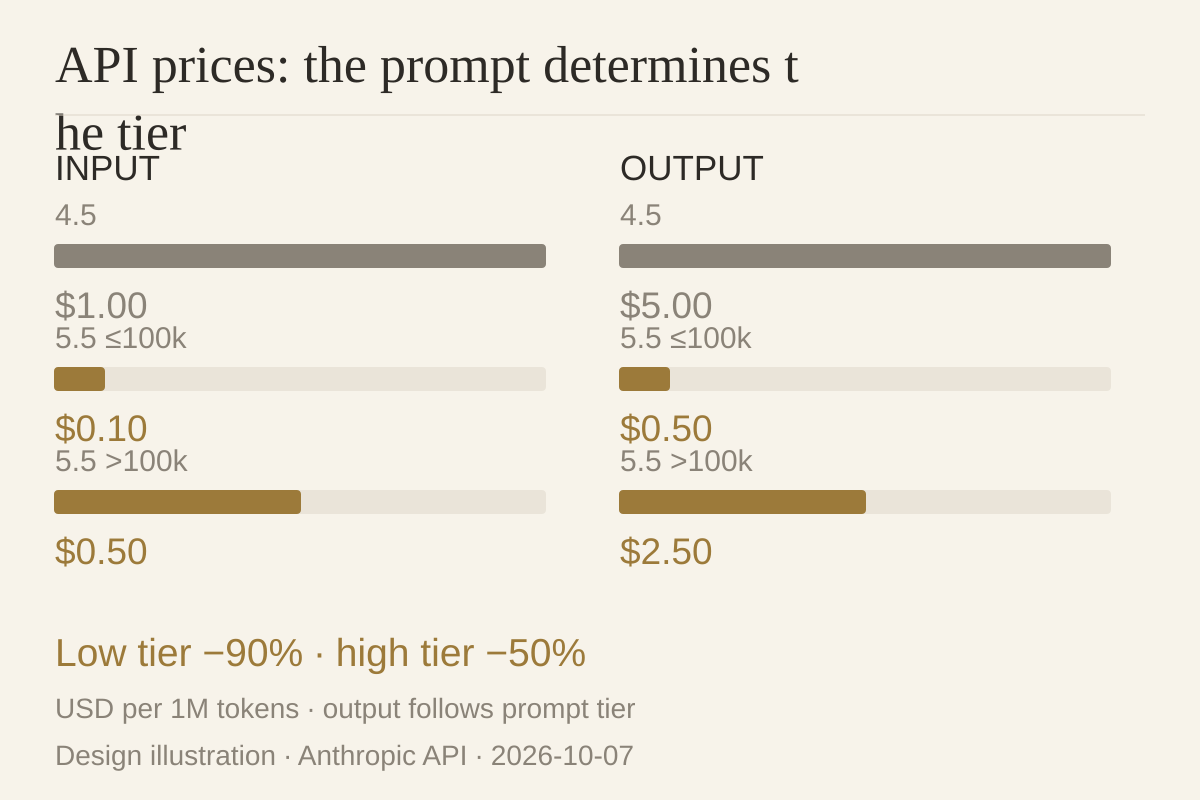
Anthropic’s published API prices per million tokens are:
| Item | Haiku 4.5 | 5.5 prompt ≤100k | 5.5 prompt >100k |
|---|---|---|---|
| Input | $1.00 | $0.10 | $0.50 |
| Output | $5.00 | $0.50 | $2.50 |
| Cache read | $0.10 | $0.01 | $0.05 |
| Cache write | $1.25 | $0.125 | $0.625 |
All four low-tier rates fall 90%; high-tier rates fall 50%. The output rate follows the request’s prompt tier, so $0.50 per million output tokens does not apply to every request.
Anthropic says about 90% of requests to the previous Haiku model were within 100k tokens. That request share is separate from the 90% price reduction, but explains why the lower tier matters to existing workloads.
Why the average task-cost estimate is about 75% lower
Cheaper tokens do not mean the same work costs exactly 90% less. The official migration guide says the newer tokenizer produces approximately 30% more input tokens for the same text, depending on content. Effort, output length, and retries also affect usage.
Anthropic’s approximately 75% average cost reduction accounts for changes in tokens needed to complete work, not only the low-tier rate. Evaluate the same task set for completion quality and total cost. Recount with 5.5, particularly for prompts near the 100k boundary.
For an application, this creates room to reconsider summaries, document questions, or subagent calls previously limited by cost. Whether to increase volume should follow measured outcomes and bills rather than the price table alone.
Availability and a brief upgrade note
Anthropic announced availability on the Claude Platform, AWS, Google Cloud, and Microsoft Azure. The fixed Claude API model ID is claude-haiku-5-5.
Existing integrations still need compatibility checks. Managed Agents requires only a model-name update according to its guide; Messages API integrations have changes involving thinking, response parsing, sampling parameters, assistant prefill, and tools. Consult the migration guide before scaling traffic after an ID change.
The main development is a more capable, lower-priced small model for frequent, bounded work. Identify the step that actually repeats in your application, then compare quality, latency, and cost to decide where the update belongs.
Verified October 9, 2026. Evaluations, prices, and customer early tests are attributed to Anthropic’s announcement; tokenizer and compatibility details come from its migration guide. No independent model tests were performed.