Employees Are Outgrowing Their Companies on AI
Workers are integrating AI faster than companies can turn individual skill into shared, governed execution.

Companies are still debating how broadly to deploy AI. Employees are already using it to research, analyze, draft, and hand entire parts of a job to an Agent.
This is no longer a difference in enthusiasm. It is an organizational gap: people are learning and redesigning work faster than companies are updating workflows, training, and governance.
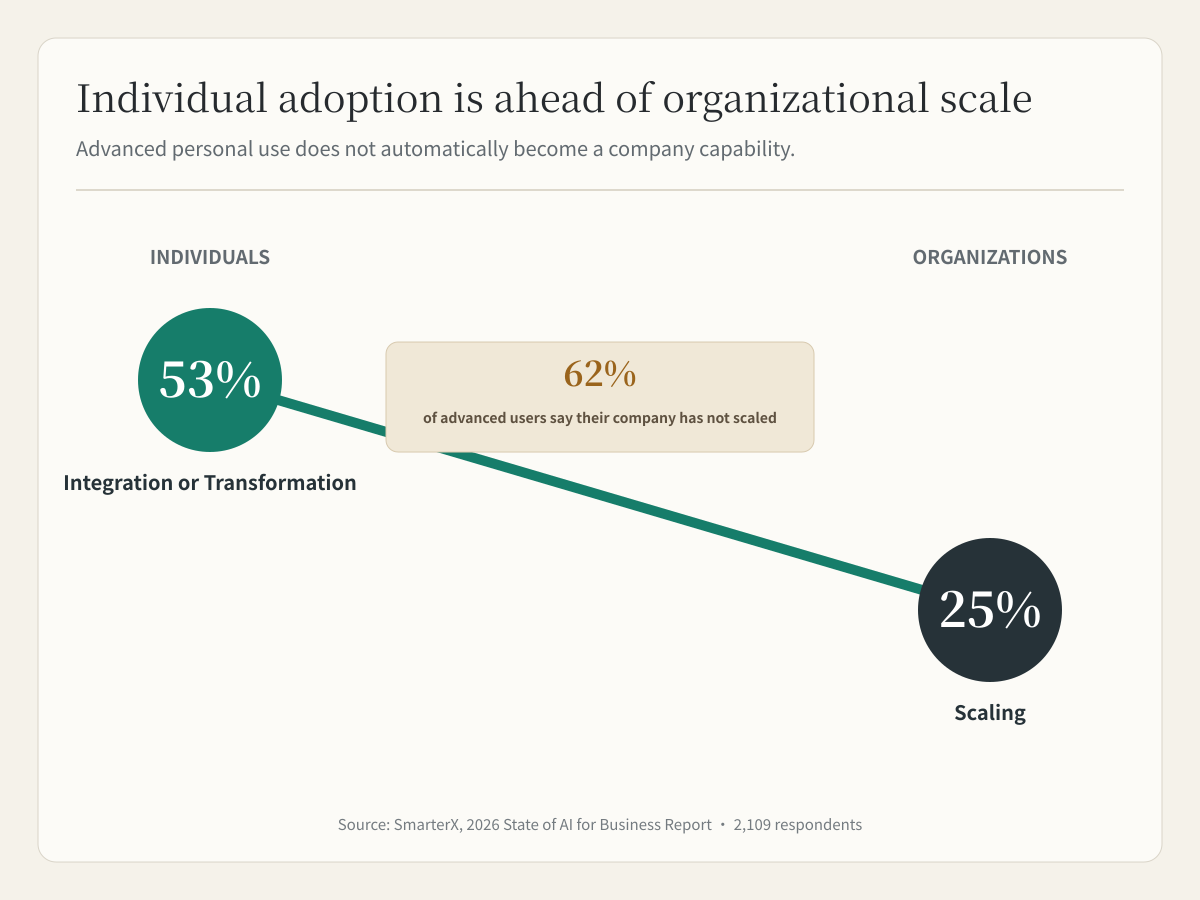
SmarterX's 2026 State of AI for Business Report surveyed 2,109 professionals. Fifty-three percent place themselves in the Integration or Transformation stages of AI adoption. Only 25% say their organization has reached Scaling. Even among those advanced individual users, 62% report that their organization has not scaled AI.
The management question is not which model won. It is whether the company can absorb the capability its people are already developing.
This is a leading-adopter signal, not the entire workforce
The survey spans functions, industries, and company sizes, but it was promoted through SmarterX and Marketing AI Institute channels. Eighty-two percent of respondents were in the United States, 48% were senior leaders, and 80% influenced AI purchasing. The researchers note that the audience likely skews more AI-forward than the broader workforce.
The figures should not be projected onto every company. They are still useful because they show where the operating system breaks first once employees move beyond experimentation.
Individual capability is not organizational capability
One employee can draft a sales proposal with AI. That does not give the sales team a reliable workflow.
One manager can ask an Agent to prepare a weekly report. That does not make the method reusable. If the sources, decision standards, steps, and review boundary remain in one person's head, the capability still belongs to that person.
Organizational capability must answer four questions:
- Where does the Agent get current sources and prior decisions?
- Which proven method can another person run?
- Where is the result visible, inspectable, and ready for the next step?
- Which risks require human confirmation, and which steps can run automatically?
That missing layer explains the distance between 53% and 25%. Employees gained execution power. Their companies have not yet made it shared and manageable.
The constraint is the organization's capacity to absorb change
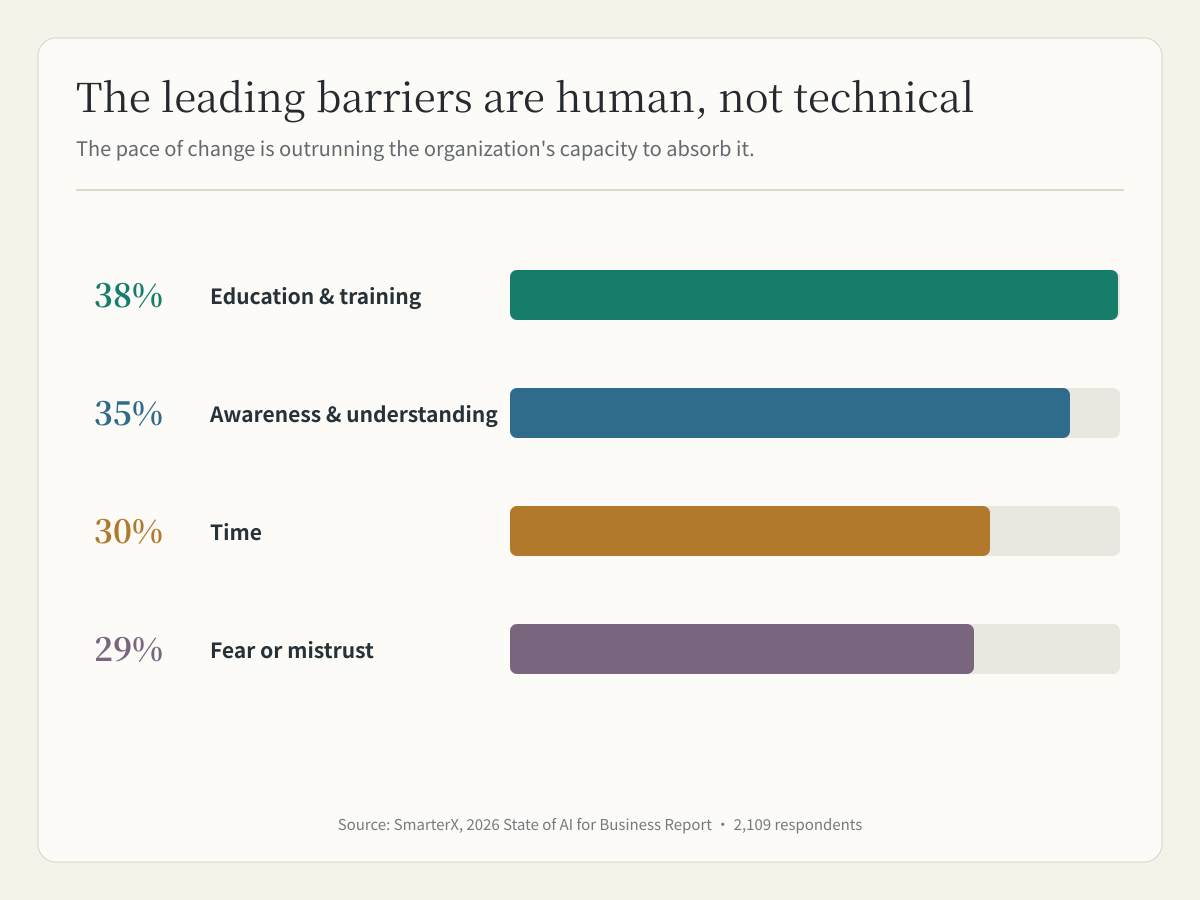
The four leading adoption barriers are human: education and training at 38%, awareness or understanding at 35%, time at 30%, and fear or mistrust at 29%.
Buying access is quick. Redesigning work is not. A team must decide which steps an Agent can execute, which sources it may access, what a good result looks like, and who owns an exception.
Many companies deliver a product demo and call it training. Employees learn a few Prompts but still carry context between tools, check every output, and repair downstream mistakes. A few motivated people advance while the operating process stays unchanged.
At scale, the training goal cannot be “more people used AI.” It should be “the team now owns more verified, reusable ways of working.”
Workers are asking for workflows, not Prompt tricks
The most requested learning topics are integrating AI into existing workflows at 58%, using AI agents at 51%, and building no-code assistants at 45%. Prompting was selected by 15%.
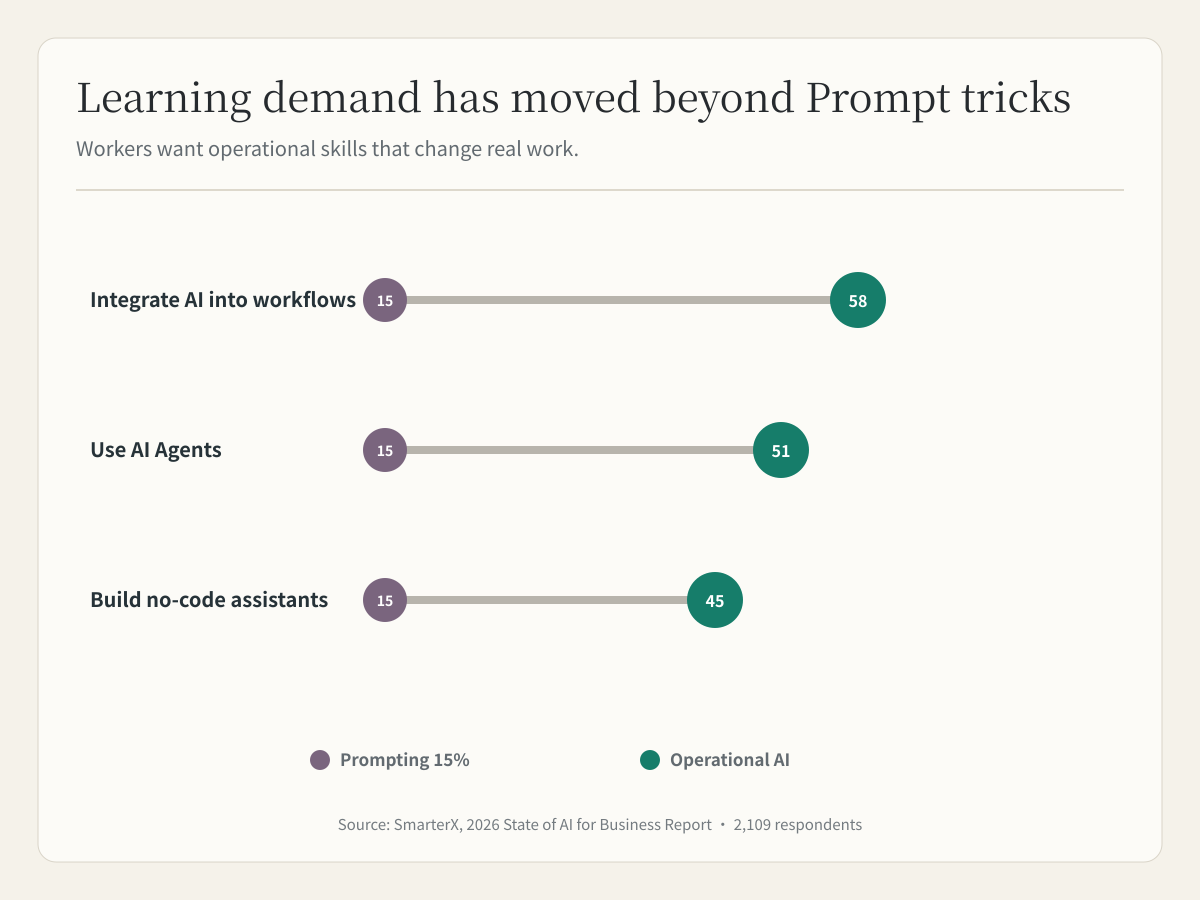
Prompts still matter because they express intent. But a better question improves one conversation. Work changes when an Agent can keep context, use tools, produce a visible artifact, accept review, and preserve the corrected method for another run.
The smallest useful unit of AI training is therefore not a lesson. It is a real project: choose a recurring task, let the person closest to the work define the outcome, have an Agent execute it, review the result, and preserve what worked.
Governance belongs inside the workflow
Only 13% of respondent organizations have all four foundations named in the report: an AI roadmap, an AI council, a generative AI policy, and an AI ethics policy. Thirty-two percent have none.
Useful governance does not require a large committee before anyone can begin. It should make each workflow explicit:
- what data and tools the Agent may access;
- which high-risk outcomes require human judgment;
- how inputs, artifacts, and run status remain observable;
- how changes to trusted records are reviewed before they become canonical.
Clear boundaries let people execute with confidence. Governance is not there to stop Agent work. It tells the organization where that work is allowed to run.
Turn personal skill into a team execution system
Do not begin with another company-wide instruction to “learn AI.”
Choose one frequent task with an inspectable result: competitor monitoring, feedback classification, lead research, or an operating exception review. Run it once with the person who understands the work, then make the proven method reusable.
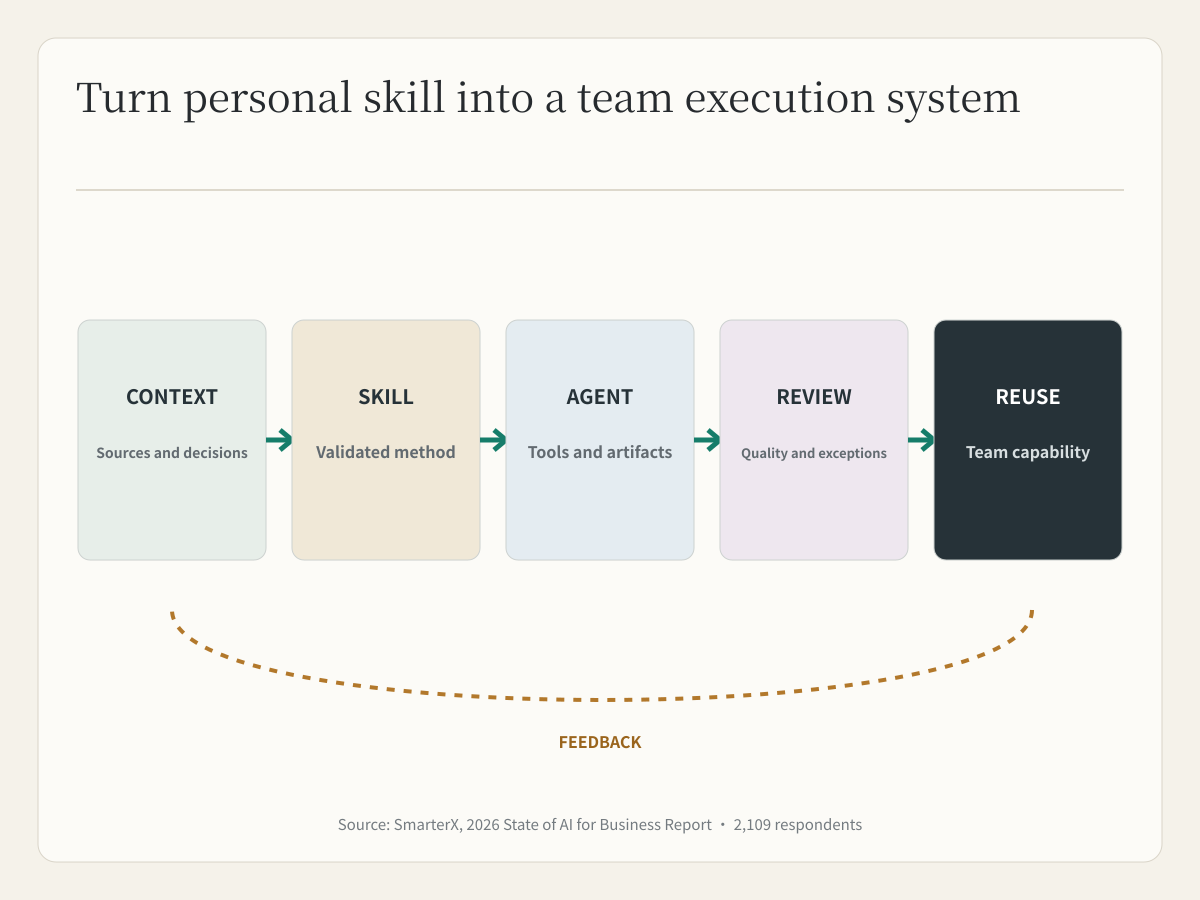
In Buda, Drive keeps task context, a Skill preserves the validated method, an Agent uses tools and returns visible artifacts, and an Automation runs mature work on schedule. People manage goals, quality, and exceptions instead of rebuilding context every time.
When an output must enter a trusted business record, Busabase can place the Agent's proposed change in a ChangeRequest. A person reviews the diff before merge. Buda handles execution; Busabase governs what becomes canonical.
Companies do not need to slow advanced employees back to the average. They need to turn proven individual methods into systems that colleagues can use, managers can inspect, and the organization can improve.
Read the Skills and Automations documentation, then start with one low-risk task whose result is easy to judge. Prove how an Agent can do one job well before asking the whole company to “adopt AI.”