A Contract Redline Can Hide in the Definition: Build a Clause Deviation Table
Read liability bases, exceptions, and cross-references together before counsel decides which changes to accept.

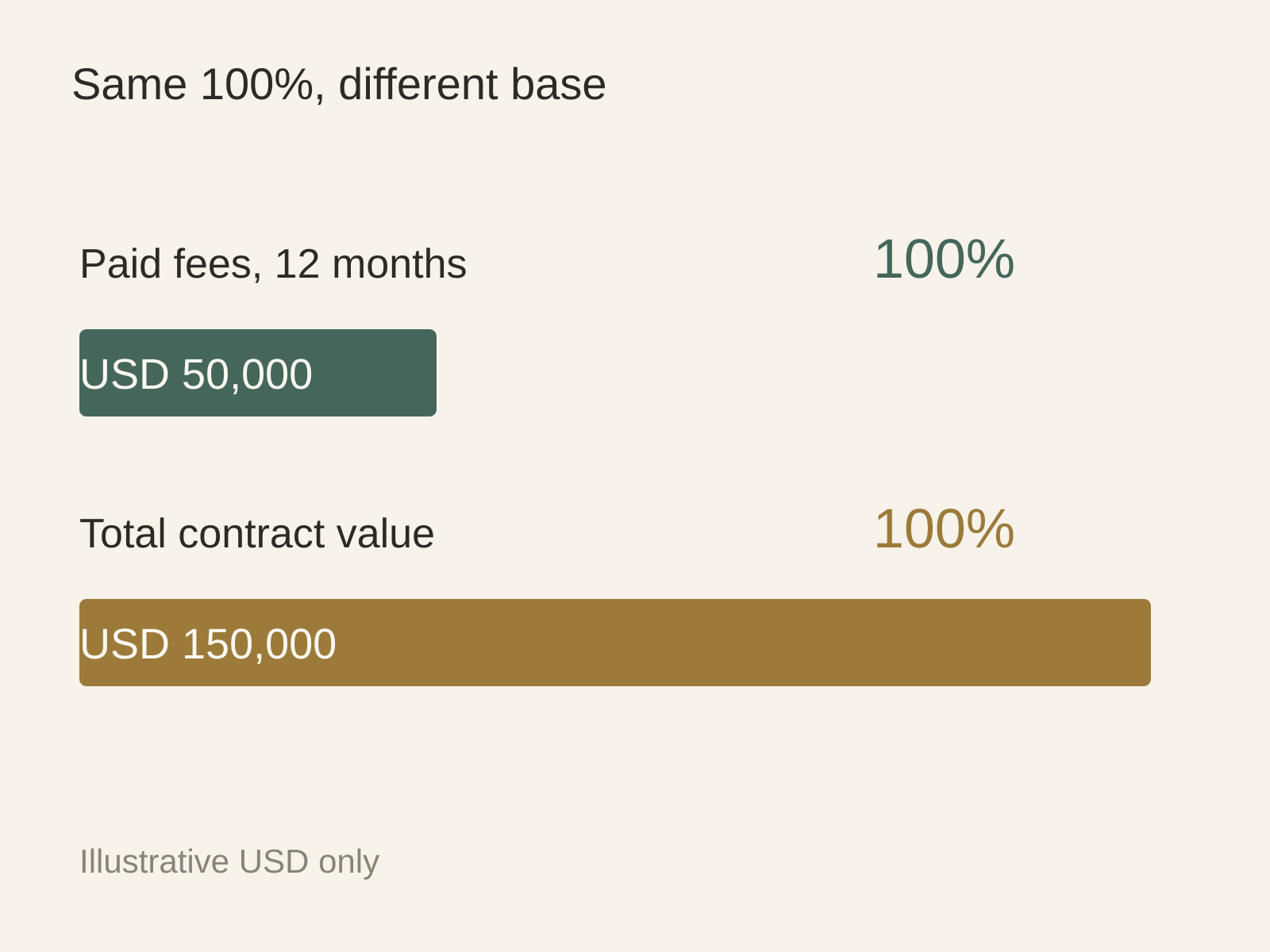
Both clauses say “100%,” but one calculates that percentage from fees paid in the preceding 12 months and the other from the total contract value. A text comparison can highlight changed words without explaining what changed in the obligation.
A legal workflow you can build with Buda supports preparing clause tables and reviewable drafts from supplied sources. The useful first deliverable is a deviation table with quotations and questions for counsel. The lawyer decides interpretation, acceptable exceptions, redlines, and signature; the agent prepares the comparison.
Establish which playbook applies
Use the authorized draft contract, a versioned approved playbook, and the approved exception list. Record document identity, version, scope, and approval evidence. An older template may help locate a clause, but it does not override the currently applicable rule.
The following four clause comparisons are fictional teaching material. They do not provide legal advice or report a completed contract review.
| Topic | Approved rule P-R1 | Draft D-R1 | Question for counsel |
|---|---|---|---|
| Liability cap | 100% of preceding 12-month paid fees | 100% of total contract value | Which base applies, including defined fees? |
| Cap exceptions | List in P-R1 section 4 | Confidentiality added by reference | Which obligations leave this cap? |
| Termination | Either party, 30 days’ notice | Supplier only, 30 days’ notice | Is the asymmetric right acceptable? |
| Assignment | Prior consent required | Affiliate transfers excepted | Does an approved exception cover this scope? |
The number is only one part of a cap
Suppose, only for arithmetic, that preceding 12-month paid fees are $50,000 while the contract total is $150,000. At 100%, the two bases produce $50,000 and $150,000. This illustrates a difference in calculation inputs; it does not establish the enforceable liability amount.
Copy the definitions and cross-references that determine “fees,” the relevant period, aggregation, and which claims are within scope. A confidentiality exception may remove particular obligations from this cap, but that alone does not prove they have no other limit. Read the exception alongside the main clause and any separate provisions.
The termination example also keeps 30 days in both texts. The changed subject—either party versus supplier only—is the decision-relevant difference. Assignment requires a similar scope check: an affiliate exception approved for another transaction is historical evidence, not approval for this agreement.
Build a source-backed table, not a risk score
In clause-deviations.csv, retain clause ID, contract quote and page, playbook quote and version, definitions and referenced sections, difference, missing text, applicable exception evidence, and the question requiring counsel. The two quotations should be readable together.
Use distinct states for located, not located in the supplied material, unreadable, and absence confirmed by the responsible reviewer. An OCR failure cannot become “no termination clause.” Ask for the missing page or a readable source. If the playbook has no rule for a topic, say that the policy decision is missing rather than labeling the draft compliant.
Prepare counsel-questions.md with specific decisions: confirm the cap base; determine the scope of confidentiality exclusions; accept or reject unilateral termination; verify the affiliate-transfer exception. Include the source locations and any missing material. Do not send a redline or amend the document as part of preparation.
Keep version changes visible
When D-R2 changes a defined term, recheck every affected comparison, even if the visible cap sentence remains unchanged. Preserve D-R1’s quotations and the reason a row was reopened. When the playbook changes, confirm applicability and review its impacted rows; the latest upload timestamp is not approval evidence.
A bounded instruction can say: “Compare D-R1 against approved P-R1 and the authorized exception list. Quote source text and referenced definitions with locations. Separate factual differences, missing evidence, and questions for counsel. Do not issue legal conclusions, risk scores, redlines, signatures, or external messages.”
Questions before the comparison is used
What if definitions are in another section?
Attach the relevant definition and reference to the same row, with its location. Leave the comparison pending if the referenced document is not supplied.
What if the contract is a scan?
Mark unreadable passages, keep page references, and request a clearer copy or manual verification. Do not infer that a clause is absent from failed OCR.
What if the playbook is silent?
Route the policy gap to its owner. The agent can identify the topic and quote the draft; it cannot invent the approved position.
Can a prior exception be reused?
Only after the authorized reviewer confirms its scope, version, and applicability. A similar counterparty or old signed template is not blanket approval.
Reuse the comparison method, retain legal judgment
Keep approved rules, draft versions, the deviation table, and counsel’s decisions in the Agent Workspace. Accept one table by tracing its quotations and references, then make the preparation method a reusable Skill. Search for and install suitable Skills in the Buda AI Marketplace, or adapt your own process. A good comparison tells counsel exactly what changed and what still needs a decision.