CRM and operations disagree? Review field conflicts before syncing
Preserve both values, definitions and authority rules so owners can judge a proposed change without automatic overwrites.

The operations export says an order is “completed”; CRM says “pending.” An agent sees a newer CRM timestamp and proposes resetting operations to pending.
But the fields may mean different things: fulfillment completed versus sales follow-up pending. AI data-sync conflict review begins with field meaning and authority—not identical column names or last-write-wins.
operations workflow you can build with Buda surfaces discrepancies for human decisions. A review packet built from authorized exports is a bounded first step before synchronization.
Four confirmed entities, not a matching exercise
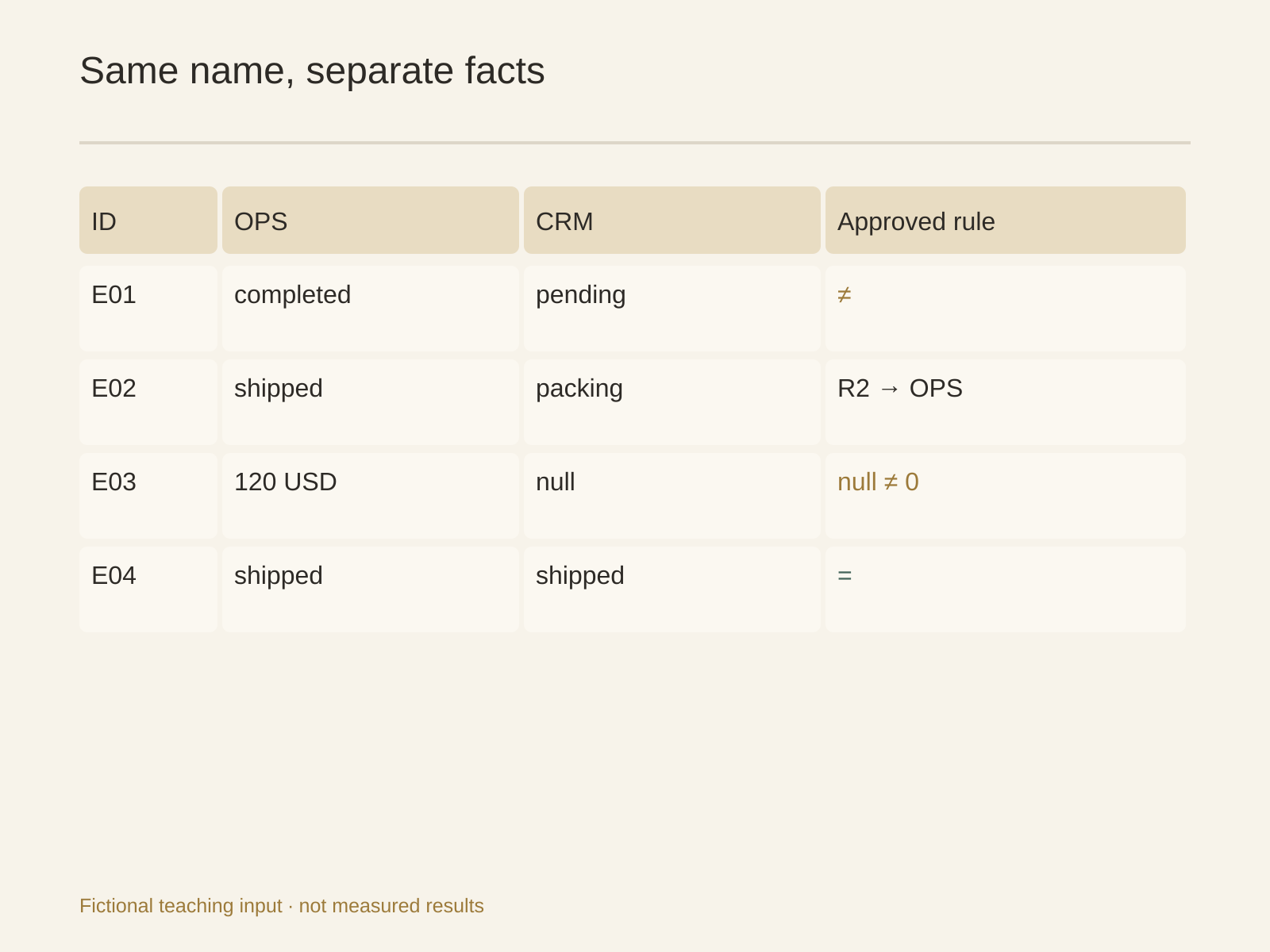
These two four-row exports are fictional teaching data, not production records or executed results. An administrator has already supplied canonical entity IDs and source mappings. No fuzzy contact matching or name-based merging occurs.
| Entity | Operations source / status | CRM source / status | Context |
|---|---|---|---|
| E01 | OPS:11 / completed | CRM:81 / pending | Compare definitions first |
| E02 | OPS:12 / shipped | CRM:82 / packing | CRM source timestamp is later |
| E03 | OPS:13 / ready | CRM:83 / ready | OPS total=120.00 USD; CRM total=null |
| E04 | OPS:14 / shipped | CRM:84 / shipped | Equal now; sources may change later |
Preserve namespaces and record IDs across all eight rows. export-time records extraction, not the business update time of every row. Missing genuine updatedAt stays null. E02's ordering comes from fictional row metadata, not from export time.
If identity mapping is unconfirmed, stop for mapping review. A missing row does not establish deletion either.
Put definitions before differences
For each field, record business meaning, units, currency, timezone, cutoff, nullability, allowed values and owner. These are invented team rules, not product defaults:
| Field | Operations meaning | CRM meaning | Comparable? |
|---|---|---|---|
| E01 status | Fulfillment progress | Sales follow-up task | No: different meanings |
| E02–E04 status | Fulfillment; shipped means dispatched | Mirror of fulfillment | Under approved mapping |
| total | USD order total excluding tax | Same definition, nullable | Yes, but interpret null first |
| updatedAt | Source business time with timezone | Same type; missing stays null | Ordering evidence, not authority |
Subtracting amounts in different currencies creates false discrepancies. Guessing a timezone for an undated local timestamp does the same. Use deterministic conversion scripts after rules are supplied; a model should not guess units, date formats or null semantics.
Classify before proposing changes
No change: E04 agrees in the current snapshots, so no write proposal is needed. A later version change requires checking again.
Representation difference: an approved mapping can establish that shipped and another system's localized label mean the same thing. Keep raw values and mapping version. This sample has no additional row for that category; do not invent one to fill a quota.
Real conflict: E02 represents fulfillment in both systems. Fictional rule R2 makes operations authoritative and CRM a mirror. That supports a candidate setting CRM:82 to shipped—not letting a newer CRM timestamp overwrite operations.
Unknown or missing: E03's null is not zero or deletion. Determine whether export omitted a field, the source never had it, or someone explicitly cleared it. Without a rule, keep unknown; greater detail on one side is not authority.
E01 is a semantic mismatch: pause that mapping and ask the owner to define distinct fields. The correct decision can be not syncing the columns at all.
Include reasons not to change anything
conflicts.csv preserves entity, field, both source IDs and values, versions, update and export times, class, rule version, counterevidence, gaps, reviewer and input fingerprint.
proposed-changes.csv contains only supportable candidates: target system/record/field, current and proposed values, authority basis, review state and expected source versions. It is a review table, not an executable patch.
C02 (fictional)
E02: OPS:12 v7 = shipped; CRM:82 v9 = packing
R2: operations owns fulfillment; CRM mirrors it
Target proposal: CRM:82.fulfillment_status = shipped
Counterevidence: CRM is newer; check for a manual correction
Review: fulfillment owner verifies fact; CRM admin checks mapping
Preconditions: sources remain v7/v9 and R2 is unchanged
State: proposed, awaiting review, not written
Without an approved R2, leave authority undecided. Name who must choose the rule and what evidence they need.
A file hash identifies the reviewed snapshot, not the current live state. Re-read source versions or actual business update evidence later. If those are unavailable, expose the gap and require manual verification.
Approval does not make a proposal timeless
If OPS:12 changes to v8 after C02 is accepted, do not execute the old row. Re-read both sides and the rules, recalculate differences and review whether the proposal still holds.
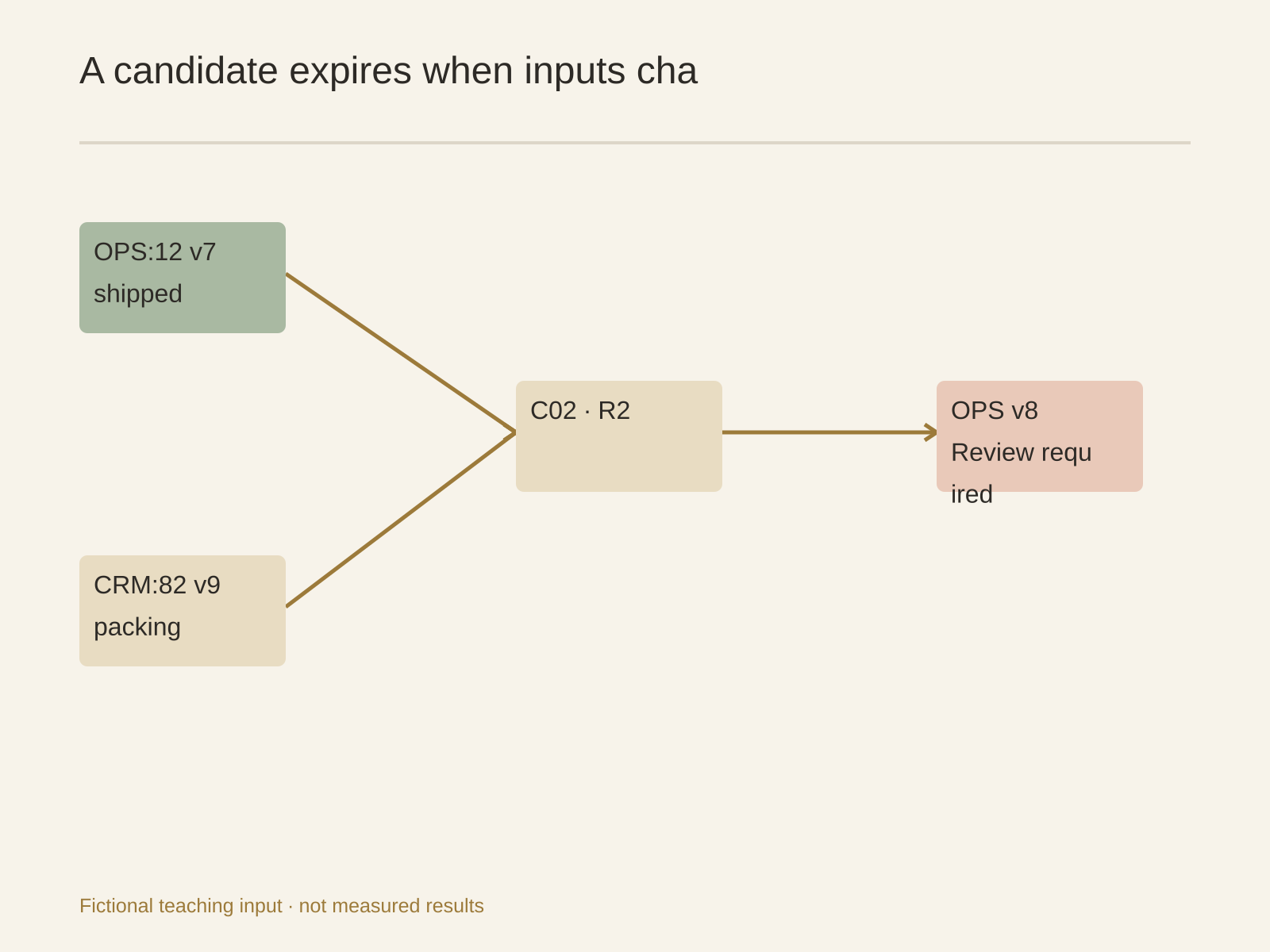
That is a pre-write review requirement, not a claim of cross-system transactions, automatic repair or native rollback. Administrators must verify conditional-update support and partial-failure handling in a separately authorized writing workflow. Without write approval, stop at the packet.
Do not introduce a second writer for a field already maintained by native synchronization. Keep stable sync boundaries and let owners decide how to repair mappings.
Four inputs for one read-only comparison
Use authorized redacted exports, a definitions dictionary, confirmed source-map and authority-rule versions. Store inputs and packets in Buda Drive. Agent and Space Drive have different sharing scopes; separate Sessions do not isolate file permissions.
Read only the named exports and approved rules. Use confirmed entity IDs; retain both raw values and source versions. Classify unchanged, representation differences, conflicts and unknown/missing. Stop semantic mismatches; mark absent authority undecided. Produce conflicts.csv and proposed-changes.csv. Do not write production, sync, delete or infer zero/deletion events.
Agents can organize evidence and explain differences. Fixed mappings, unit conversion and diff computation belong in deterministic scripts with explicit rules.
Four proposed acceptance cases
These checks have not been executed: same-named fields with different meanings must not yield overwrites; newer non-authoritative values must not win; missing fields must not become zero or clearing instructions; a source version change after review must expire the candidate. Validate stopping behavior, not a fabricated sync success rate.
RevOps governance calls for field owners. This packet makes ownership specific to each conflict. Contact deduplication establishes identity; finance reconciliation examines order/invoice/payment relationships; report triage distinguishes missing data from business deviation. None replaces field authority for an already-confirmed entity.
Which system should be authoritative?
The owner of that business fact decides by field—not by one universal winning system. Without a rule, pause the proposal and submit both sources for a decision.
What if update timestamps are missing?
Keep null and retain export time separately. Ask for source versions or change history. Do not recommend automatic overwrites when freshness cannot be established.
Can the conflict file backfill automatically?
Its existence grants no writing permission. Obtain separate authorization, verify target fields and recheck versions; changes require review again.
What does the administrator need?
Both source records, definitions and rule versions, proposed target, counterevidence, gaps, decision and version preconditions—not a lone “correct value” column.
Review one redacted export batch manually, then search for and install an appropriate data Skill in the Buda AI Marketplace. Inspect inputs, rules and stopping conditions. Configure live connections and schedules separately; first make every disagreement explainable.