Which policy should a support agent trust when two sources disagree?
Separate applicability from document recency, and give reviewers the evidence behind each proposed reply.

A customer asks for a refund. The agent finds “30 days after purchase” in an old PDF and “14 days for selected plans” in a new announcement. Both sentences have a source. Neither settles this customer's eligibility.
Finding a document is not the same as establishing which rule applies. A support workflow needs to expose that decision before producing a confident customer promise.
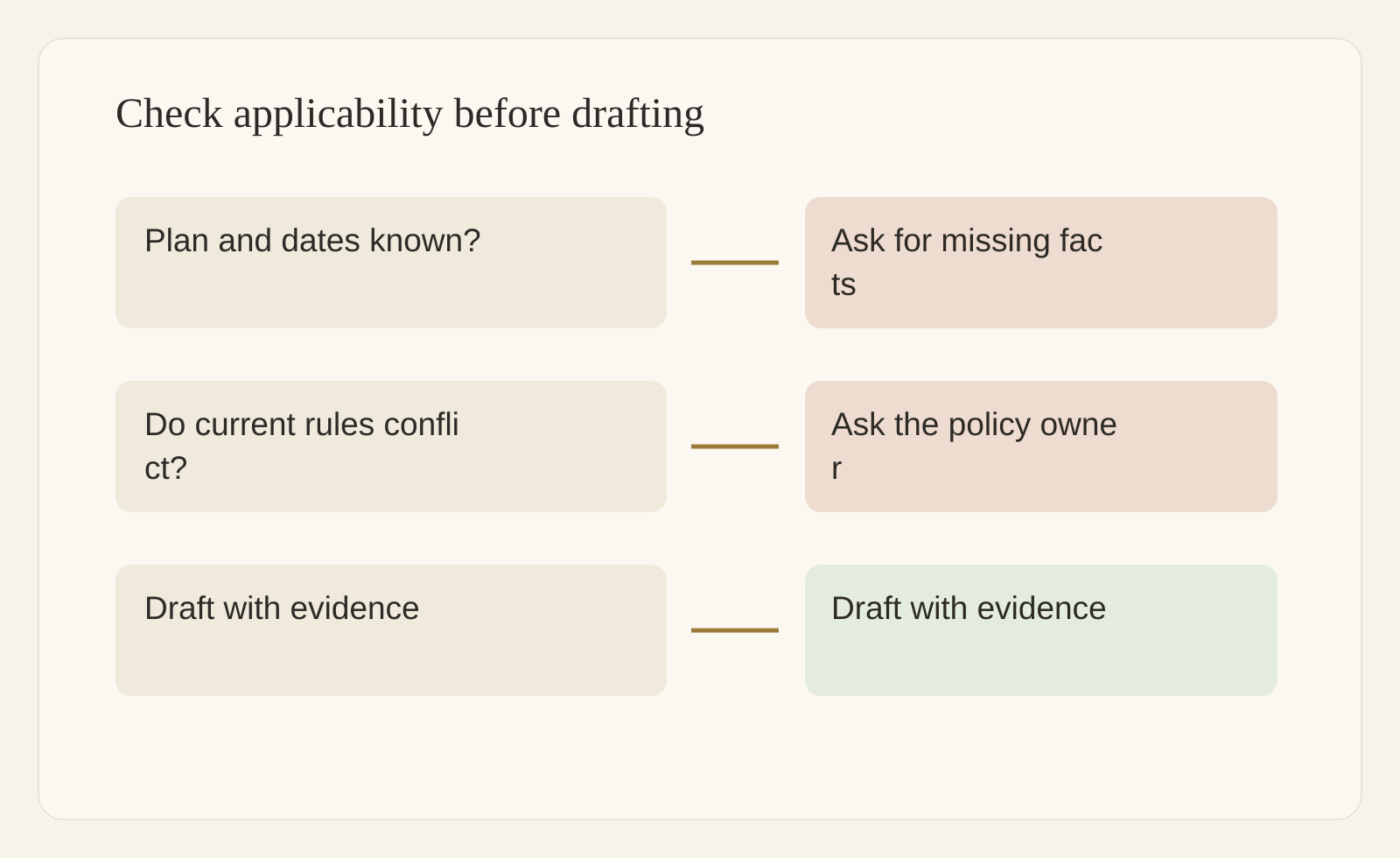
Turn disagreement into specific questions
Consider a fictional example: an older policy gives all products 30 days; a new notice gives the professional plan 14 days from October 1. The customer says only “I bought it last month.” These are illustrative rules, not a company's actual refund terms.
Check the plan, purchase date, effective date and transition arrangements. Does the change apply to existing orders? Does eligibility depend on purchase date or request date? A newer publication cannot answer those questions by itself.
Ask the agent for candidate rule A, candidate rule B, the conflicting fields and the missing decisions. The customer can supply order facts. A policy owner must resolve an unclear transition rule. Route those questions separately.
Maintain an approved-source list
Separate current sources, historical documents and drafts. Folders such as support/current/, support/history/ and support/drafts/ are team conventions, not automatically enforced policy states.
For each source, record its path, publisher or accountable owner, product scope, effective period, approval state and unresolved exceptions. An old refund PDF may remain historical reference; a new plan notice may require a decision about existing purchases; the owner's written confirmation can then update the current list.
Do not let a filename containing final or a recent modification timestamp decide business authority. “Use the latest one” is not a useful record unless it identifies the applicable rule. Keep customer-specific order facts separate from a shared policy library, with only the details needed for the task.
Prepare the materials in Buda
Upload reference files through Drive, then identify their paths in the task. Files persist across tasks. Agent Drive and Space Drive distinguish an agent's own working materials from shared team materials.
Start with the approved list and the referenced policies. Instruct the agent to use current sources for conclusions, label historical material and list gaps where no applicable clause exists. A retrieved passage is evidence to inspect, not a guarantee that the policy search is complete.
The Buda support workflow separates knowledge search, reply drafts, escalation summaries and QA into reviewable work. Begin with search and drafting only; do not attach customer sends, refunds or account changes to the pilot.
Require a reply package, not just an answer
Use an instruction like this:
Read support/current/source-list.md and the files it identifies.
Prepare a reply draft for this ticket.
Include:
- Proposed reply; withhold definite promises if sources conflict.
- Evidence: file path, section or paragraph, supported claim and applicable dates.
- Open questions: facts for the customer and decisions for the policy owner.
- Next step: ask, escalate or submit for support review.
Do not send a message, issue a refund or change an account.
A reference to “section 3: 14 days” is not enough. Explain why the clause applies to the plan and order. Match each proposed promise to supporting evidence and remove unsupported promises.
A customer draft may ask for purchase date while an internal note asks the owner to clarify transition rules. Customers do not need the entire internal dispute, but polished language must not conceal an unresolved commitment.
Check five ticket types before scaling
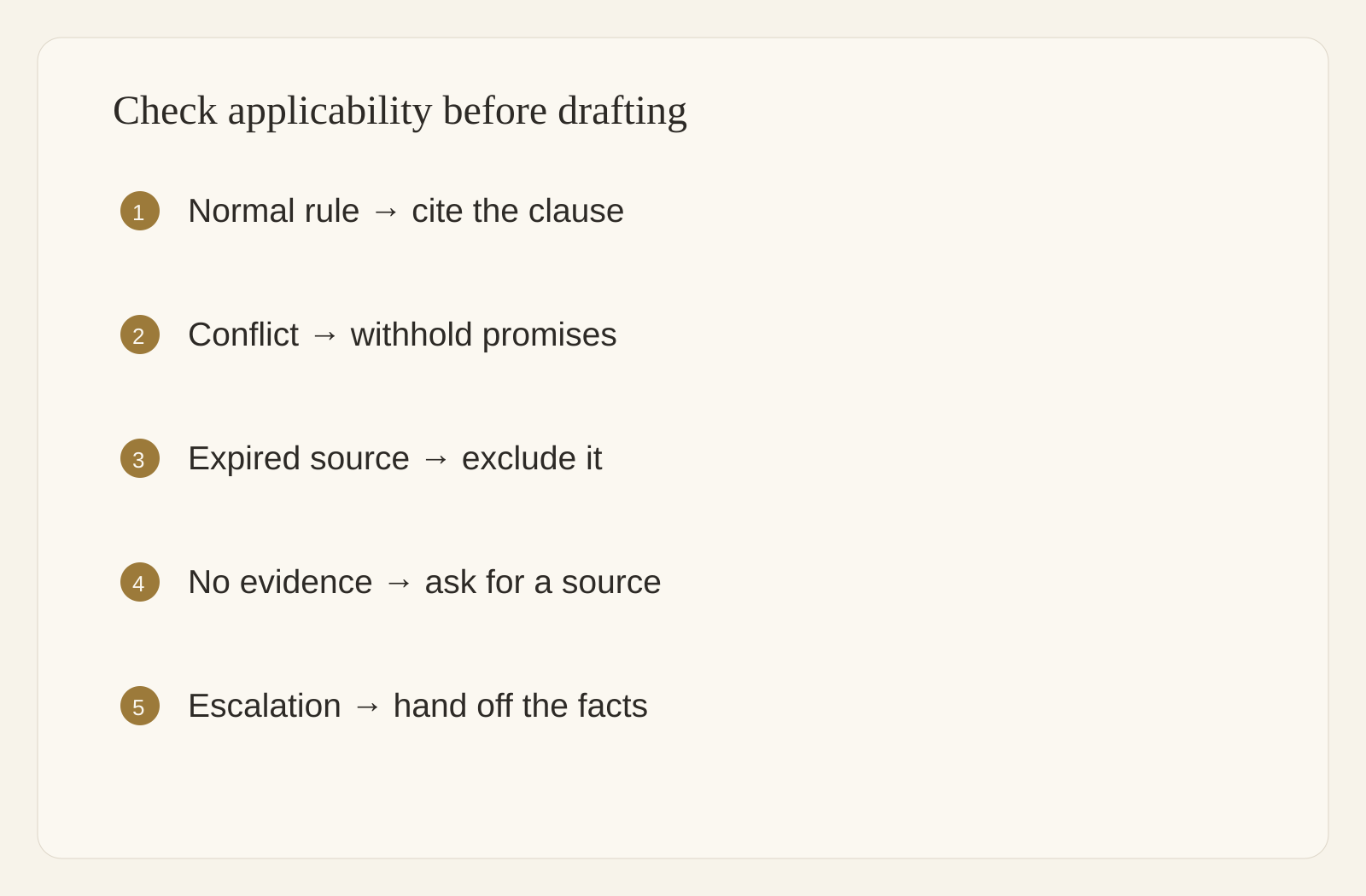
Build a small acceptance set. These are recommended tests, not reported results:
- A normal case with a known plan and date: cite the applicable clause.
- Two conflicting current sources: stop the promise and show the disagreement.
- An easy-to-find expired rule: keep it out of the final decision.
- No supporting clause: list the missing evidence instead of inventing policy.
- An exception or sensitive action: prepare an escalation with facts and owner.
For every case, check source selection, applicability, missing questions and stopped actions. Assessing tone alone leaves policy risk untouched.
Update the cases when the rule changes
Once the owner resolves transition arrangements, update the list and source text, move superseded files to history and record what replaces them. Keep the change date, owner and affected ticket types. Re-run normal, conflict and legacy-order examples to check that citations still reach current clauses.
For repeated work, search and install a suitable Skill in the Buda AI Marketplace, then inspect its procedure and outputs. If none fits, use Skill Creator to package the accepted search-and-draft method. Reuse the method; do not embed a particular customer's data in a shared Skill.
Will uploading a new file make it the preferred policy?
Do not rely on file order. Maintain the approved list, specify it in the task and require applicability with every conclusion. Test an old-policy example to catch accidental reuse.
What if the business has not settled on a single policy?
Send the named owner the conflicting clauses, affected products and decision needed. The agent can prepare that handoff and a provisional draft, but it cannot create policy authority. Withhold definite refund promises until the rule is settled.
What should a colleague receive at handoff?
Ticket facts, the current source-list version, cited passages, unresolved questions and the owner's next action. A finished-looking reply without this package loses the reasoning needed to review it.
Start with five cases and one approved-source list. The useful support agent is not the one that answers most confidently; it is the one that makes evidence inspectable and sends unresolved decisions to the right person.