The Less People Use AI, the More They Fear Losing Their Jobs: What 1,686 People Revealed
The sharpest anxiety appears among people who see AI changing work but have not yet built a repeatable practice.

The usual assumption is that people who use AI most often should be the most aware of the threat it poses to their jobs.
A survey of 1,686 people found the opposite divide. Daily users were the only group with a net-positive view of AI's effect on their current job security.
Among daily users, 27% felt more secure because of AI and 22% felt less secure. Weekly users split 10% to 25%. For people using AI once a month or less, the gap widened to 3% versus 24%.
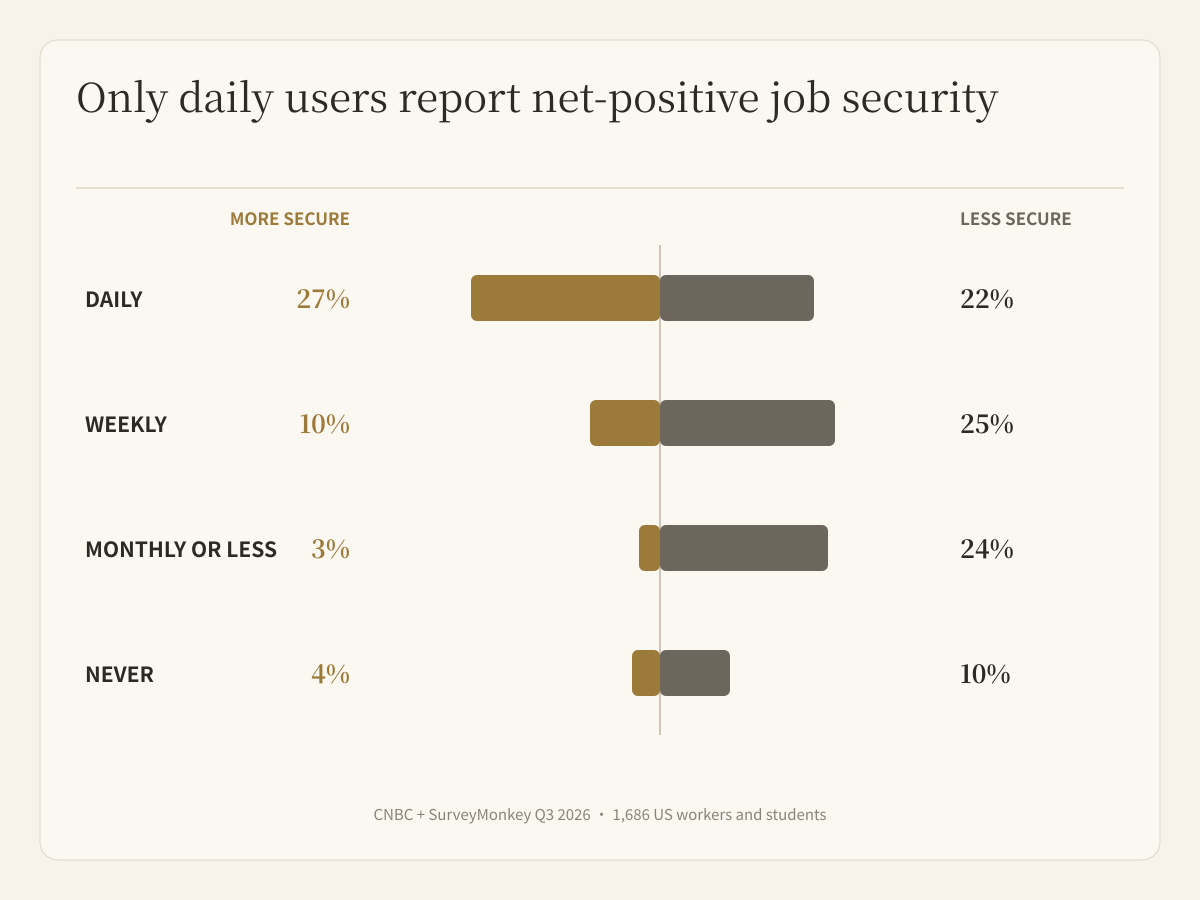
This is not a straight line in which every reduction in usage creates more fear. Among people who never used AI at work, 4% felt more secure and 10% felt less secure, a smaller negative gap than among weekly and low-frequency users.
The most revealing group sits in the middle: people who can see AI changing work but have not yet turned it into a repeatable capability.
The survey measured perception, not layoffs
CNBC and SurveyMonkey surveyed 1,686 US workers and students from July 22–27, 2026 and published the results on August 19.
The findings are self-reported associations between usage, confidence, and career attitudes. They do not show that daily AI use prevents layoffs. Job type, employer support, existing skill, and exposure to change may affect both usage and confidence.
The useful question is not whether AI will “take jobs” in the abstract. It is why people who have integrated it into real work feel more control than people who only encounter it at the edge of their role.
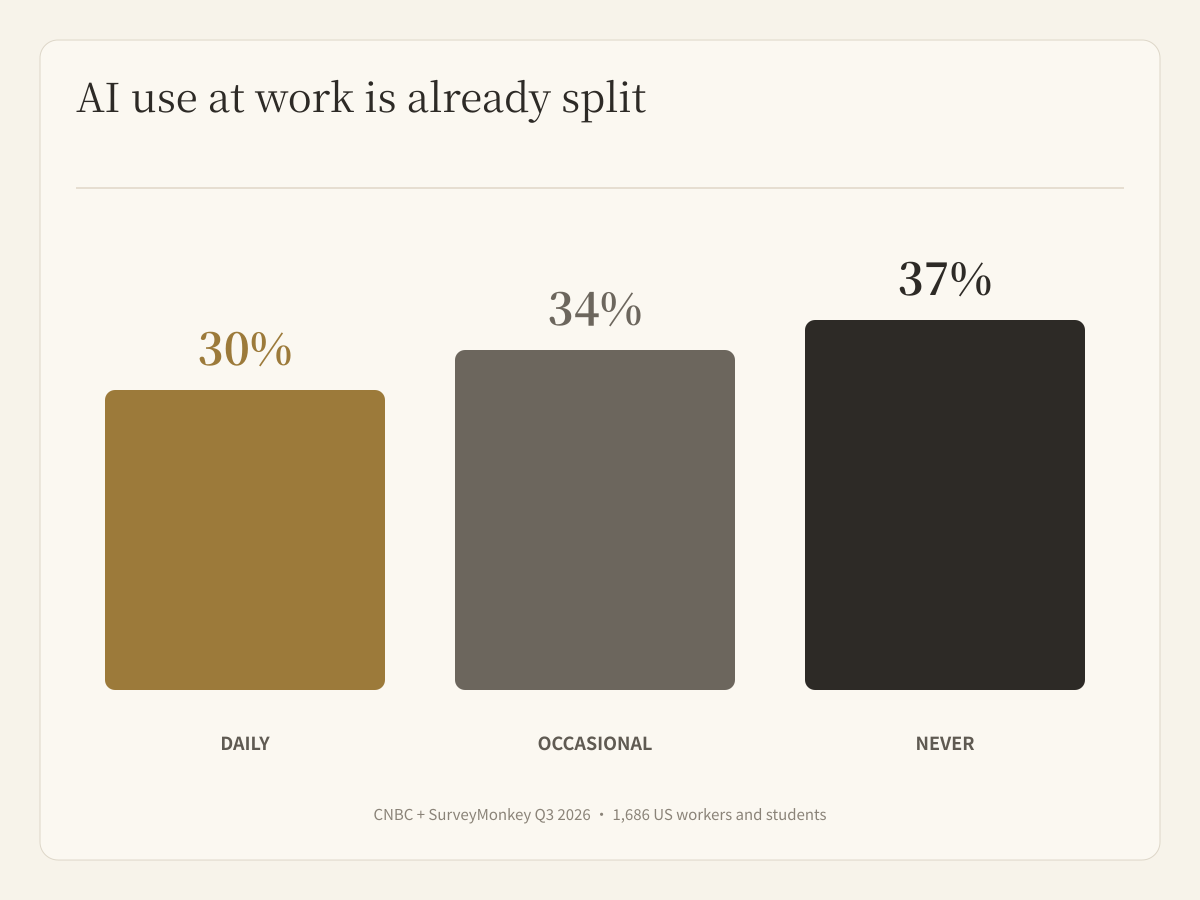
Thirty percent use AI daily; 37% never do
The workplace is already divided. Thirty percent of workers use AI daily, 34% use it occasionally, and 37% never use it at work. The published rounded values total 101%.
Daily users do more than search. They use AI to brainstorm, write messages and reports, analyze data, summarize long documents, and organize work.
That gives them concrete feedback every day: which tasks are worth delegating, where a model fails, how an output must be checked, and where human judgment remains essential.
Low-frequency users receive a different signal. They see coworkers produce faster and hear leaders demand AI adoption, but they rarely complete a task from input to delivery. The change is visible while their own capability remains uncertain.
Some non-users may work in roles that are less exposed, or may not yet experience AI as an immediate threat. Low-frequency users are already at the threshold: they know the change is real but lack enough evidence to know how they fit.
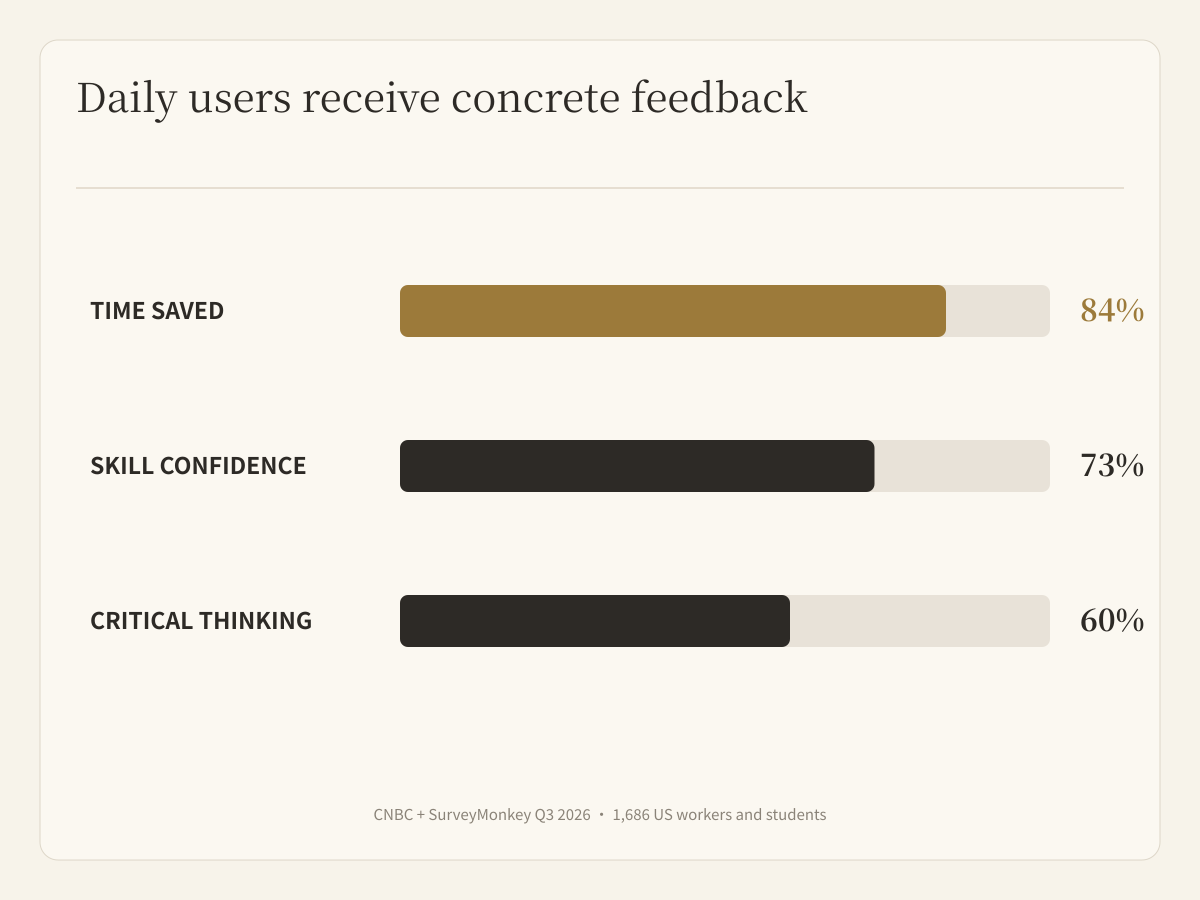
Daily users receive three forms of concrete feedback
Among daily users, 84% said AI saved time, 73% felt more confident in their skills, and 60% said it improved their critical thinking.
These remain perceptions rather than controlled productivity measures. But completing tasks, correcting errors, and seeing time saved produces a practical map:
- repetitive execution that an Agent can handle;
- evidence and outputs that must be reviewed;
- decisions and accountability that cannot be delegated;
- validated methods that can be reused.
Job security does not have to come from a promise that a company will never reduce staff. A more durable source of confidence is knowing that, as work changes, you can still define the problem, manage execution, review the result, and deliver something useful.
That is why collecting prompts rarely reduces anxiety. A conversation proves that a tool can answer. A completed project proves that a person can make it work.
Employers demand adaptation without creating the conditions
Fifty-five percent of respondents worked at companies with no official AI policy. Another 34% said use was optional. Only 6% worked where AI was required, while 5% worked where it was prohibited.
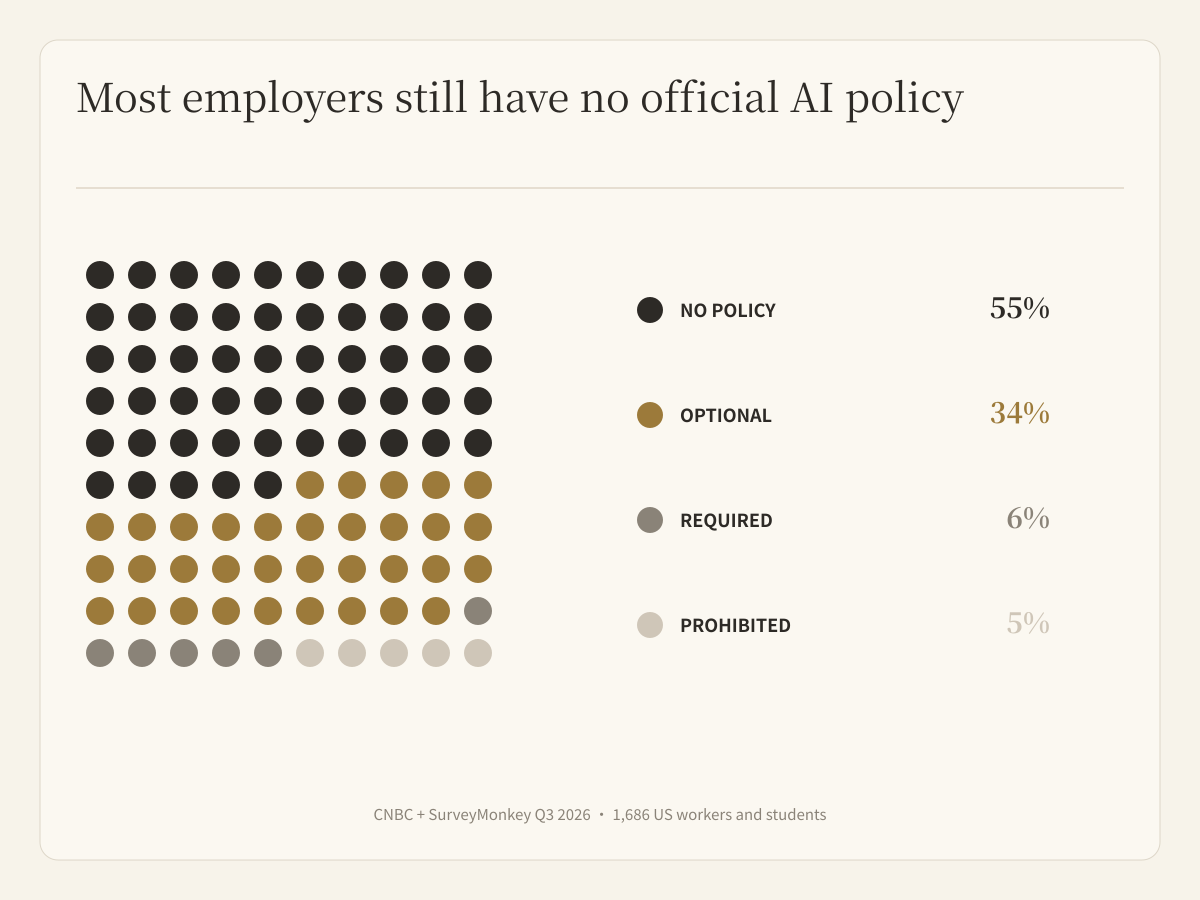
Employees receive conflicting messages: AI matters and productivity must rise, but nobody explains which data may be used, which tasks are suitable, who reviews outputs, or who owns a mistake.
The tension is sharper for junior employees. Forty-two percent supported AI use with clear rules and limits, 14% supported use under supervision, 35% wanted it prohibited, and only 9% supported unrestricted use.
A ban removes practice. Unrestricted use can let people skip foundational learning and send unreliable work downstream. A better model is risk-based: allow practice on low-risk, reversible tasks; require explicit review when work affects customers, money, permissions, or trusted records.
Train complete work, not chat frequency
Opening an AI tool every day does not automatically create capability. Repeatedly finishing real work does.
Start with one low-risk task that occurs every week and has an inspectable output: meeting notes, customer research, a weekly report, competitor tracking, or a first draft.
Record the original inputs, time, and common errors. Let an Agent handle research, organization, or drafting. Have a person review sources and results. Then preserve the validated method as a Skill and keep the task, tool calls, and artifacts in a visible Session.
After several runs, the team has evidence rather than adoption theater: where time was saved, which errors repeat, what should be reused, and who owns the final result.
In Buda, Agents can operate across real files, tools, and tasks. Sessions preserve execution and artifacts, Skills preserve validated methods, and Automations rerun mature work on a schedule. People keep judgment and accountability while moving out of repetitive execution.
Reassurance is not a practice environment
Employees do not need another promise that “AI will not replace you.” They need a controlled way to participate in the change.
Companies can begin with four answers: which tasks encourage AI use, which information must stay out of models, who reviews which results, and how a proven method becomes reusable across the team.
Individuals should not measure progress by the number of chats they open. A better measure is the number of useful artifacts they can show, review, and run again.
Anxiety grows when change is visible but participation feels undefined. Confidence comes from different evidence: I have completed the work, I know where judgment belongs, and I can run the method again.
Start with the Agent Workspace documentation, choose one low-risk task, and replace the next unstructured AI conversation with a complete execution.