What Is the Dynamic Workflow Claude Code Is Talking About?
A practical explainer of Claude Code dynamic workflows: what dynamic workflow means, why it matters for AI agents, and where human review still fits.
Anthropic published Introducing dynamic workflows in Claude Code, describing a new way for Claude Code to handle large software tasks.
The phrase is worth pausing on: dynamic workflow.
It will likely become one of the key terms people use when they talk about AI agents. It also raises a practical question: if Claude Code has dynamic workflows, what does a platform like Buda do differently?
The short answer: they solve different layers of the same future.
Dynamic workflows help one powerful agent handle large, complex tasks. Buda helps humans coordinate many agents as a company: with context, review, handoff, and accountability.
What is a dynamic workflow?
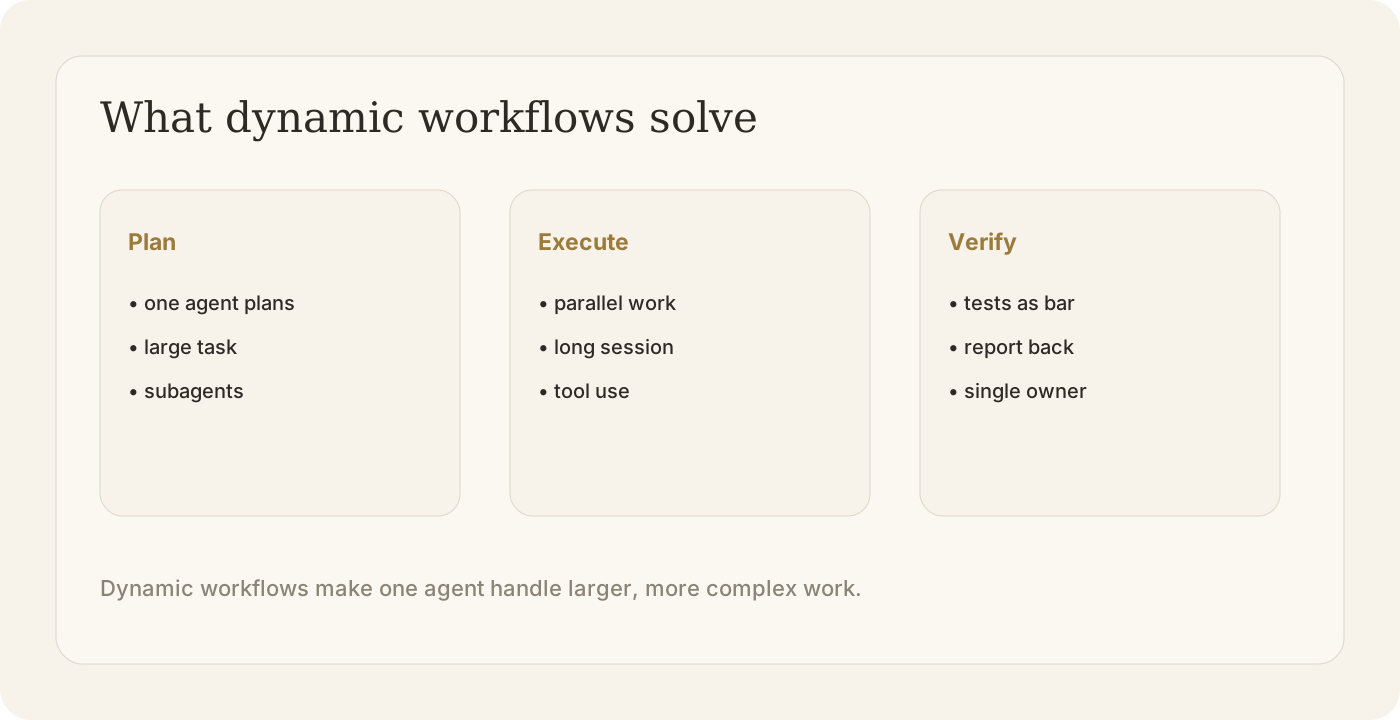
A dynamic workflow is an agentic process where the AI does not simply follow a fixed checklist. Instead, the agent can inspect the task, plan the work, split it into subtasks, run subagents in parallel, adapt as new information appears, verify the output, and report back.
In Claude Code, Anthropic describes this as a way for Claude to take on bigger tasks: plan work, run many parallel subagents in one session, and verify outputs before returning to the user.
That matters because many real engineering tasks do not fit a linear prompt-response pattern.
A migration may require scanning a codebase, identifying dependencies, changing files, running tests, fixing failures, checking edge cases, and preparing a final summary. A fixed script can help only if the path is already known. A dynamic workflow is useful when the path must be discovered while work is happening.
Dynamic workflow vs multi-agent system
A dynamic workflow often uses multiple agents or subagents, but the idea is more specific than “multi-agent.”
A multi-agent system means more than one agent is involved. A dynamic workflow means the agentic process can change shape during execution.
So the important question is not only “how many agents are there?”
It is also:
- Who plans the work?
- Who decides when to split it?
- Who checks the result?
- What counts as done?
- Where does the human intervene?
This is where the concept becomes operational rather than just technical.
What dynamic workflows solve well
Dynamic workflows are especially useful for deep single-task execution.
They help when one large problem needs to be decomposed inside an agent session:
- codebase-scale migrations;
- broad refactors;
- test-driven repair loops;
- research tasks with many branches;
- browser or computer-use tasks that require adaptation;
- long-running work where the agent must choose the next step.
In these cases, a dynamic workflow gives an agent more room to operate. The user does not need to manually prompt every step. The agent can plan, execute, and verify more of the path.
That is a real improvement.
But it is not the whole management problem.
What dynamic workflows do not replace
Even if an agent can dynamically coordinate subagents, the final output still enters a human organization.
A human still needs to decide whether the result is acceptable. A teammate may need to review the diff. A manager may need to understand the risk. A customer-facing team may need to approve the message. A founder may need to decide whether the work aligns with the company’s intent.
This is why “human in the loop” is not a temporary training wheel. It is a structural requirement.
As Protagoras is often summarized: human is the measure of all things. In AI work, this means human judgment remains the measure of usefulness, risk, taste, and responsibility.
The stronger agents become, the more important this measure becomes.
How Buda relates to dynamic workflows
Buda’s idea is not in conflict with dynamic workflows.
It is a different layer.
Dynamic workflow answers: How can one agent handle a large, complex task?
Buda answers: How can humans coordinate many agents so they serve human intent?
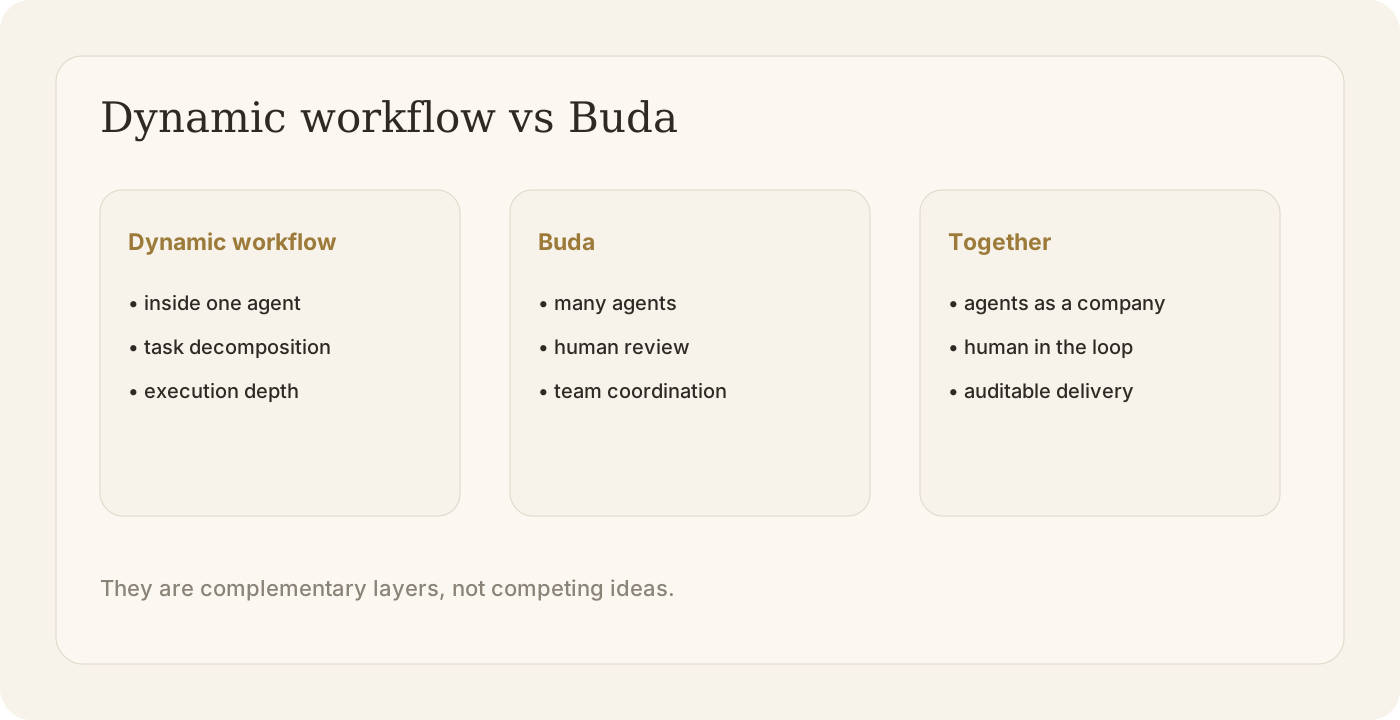
Buda is built around agents as a company. That means AI agents are not treated as one chat box. They are treated as an execution layer that humans can assign work to, supervise, review, and improve.
In Buda, humans can manage sessions, files, browser work, terminal execution, artifacts, skills, automations, and channels. The point is not to make AI autonomous for its own sake. The point is to make AI execution accountable to human goals.
A dynamic workflow may help an agent complete a complex task.
Buda helps a team ask:
- Which agent should own this task?
- What context should it have?
- Who reviews the result?
- Which outputs should be published, merged, sent, or rejected?
- How do multiple agents work together without losing human direction?
That is the company-level layer.
Is Buda competing with Claude Code dynamic workflows?
No. The concepts are complementary.
Claude Code dynamic workflows make an individual coding agent more capable. Buda gives humans a workspace to coordinate agent work across projects, files, tools, teammates, and review loops.
A team could use a strong model like Claude Opus 4.8 inside Buda, assign work through Buda sessions, and still benefit from dynamic workflow ideas inside individual agent tasks.
The better framing is not Buda vs Claude.
It is dynamic workflow inside the agent, Buda around the agents.
Why the keyword matters
“Dynamic workflow” is important because it names a shift in AI software.
Early AI tools were prompt boxes. The user had to push every step.
Agentic tools let AI take actions.
Dynamic workflows let AI decide how the action sequence should evolve.
But as AI takes more initiative, humans need a stronger management interface. Otherwise, the organization gets powerful outputs without enough visibility, review, or accountability.
That is where Buda’s philosophy matters.
Agents should not replace human direction. They should expand it.
The future is not one agent doing everything alone. The future is humans managing AI execution systems that can think, act, verify, and report back.
Dynamic workflows are one important building block in that future. Buda is the workspace for making that future human-led.
Start building human-led agent workflows at buda.im, or learn more in the Buda Agent Workspace docs.