AI Return Triage: Check the Order, Policy, and Missing Evidence
Prepare a case-by-case review queue with traceable conditions and questions for the operations owner.

A customer writes “unopened,” and a photo shows a sealed-looking box. Before recommending a return, an operations specialist still needs the order, the delivery record, the request timestamp, and the applicable policy. Each answers a different question.
You can use Buda to build an ecommerce workflow to prepare return recommendations from order records and approved policies. Start with authorized exports and a named reviewer. A prepared recommendation is the handoff; refund execution and customer commitments require a separate decision.
Define the policy before counting days
Consider a fictional policy P-R1, approved for the four orders below: standard items may be considered for return within 14 elapsed days of delivery if unused. An authorized reviewer has confirmed the elapsed-time convention, the inclusive 14-day endpoint and the relevant time zone. This is a teaching rule, not a statement of statutory rights or every store’s policy. Promotional bundles require a separate exception review.
Preserve the policy’s approval, effective interval, item scope and source section. A new document date alone does not decide which policy governs an earlier purchase. When applicability is disputed, identify the conflict and ask the policy owner.
Four requests, four different next steps
All timestamps below use Asia/Shanghai. These are fictional records, not executed customer cases.
| Case | Evidence | Proposed queue |
|---|---|---|
| R01 | Delivered Oct 1 at 10:00; requested Oct 15 at 10:00; unused-condition evidence accepted by the named reviewer | Rule match for human review: exactly 14 days |
| R02 | Requested Oct 15; delivery confirmation unavailable | Obtain delivery evidence; window unknown |
| R03 | Delivery and request show 10 elapsed days; packaging photo supplied; use condition unverified | Ask for evidence addressing use condition |
| R04 | 7 elapsed days; promotional bundle and gift | Exception review; confirm bundle rule |
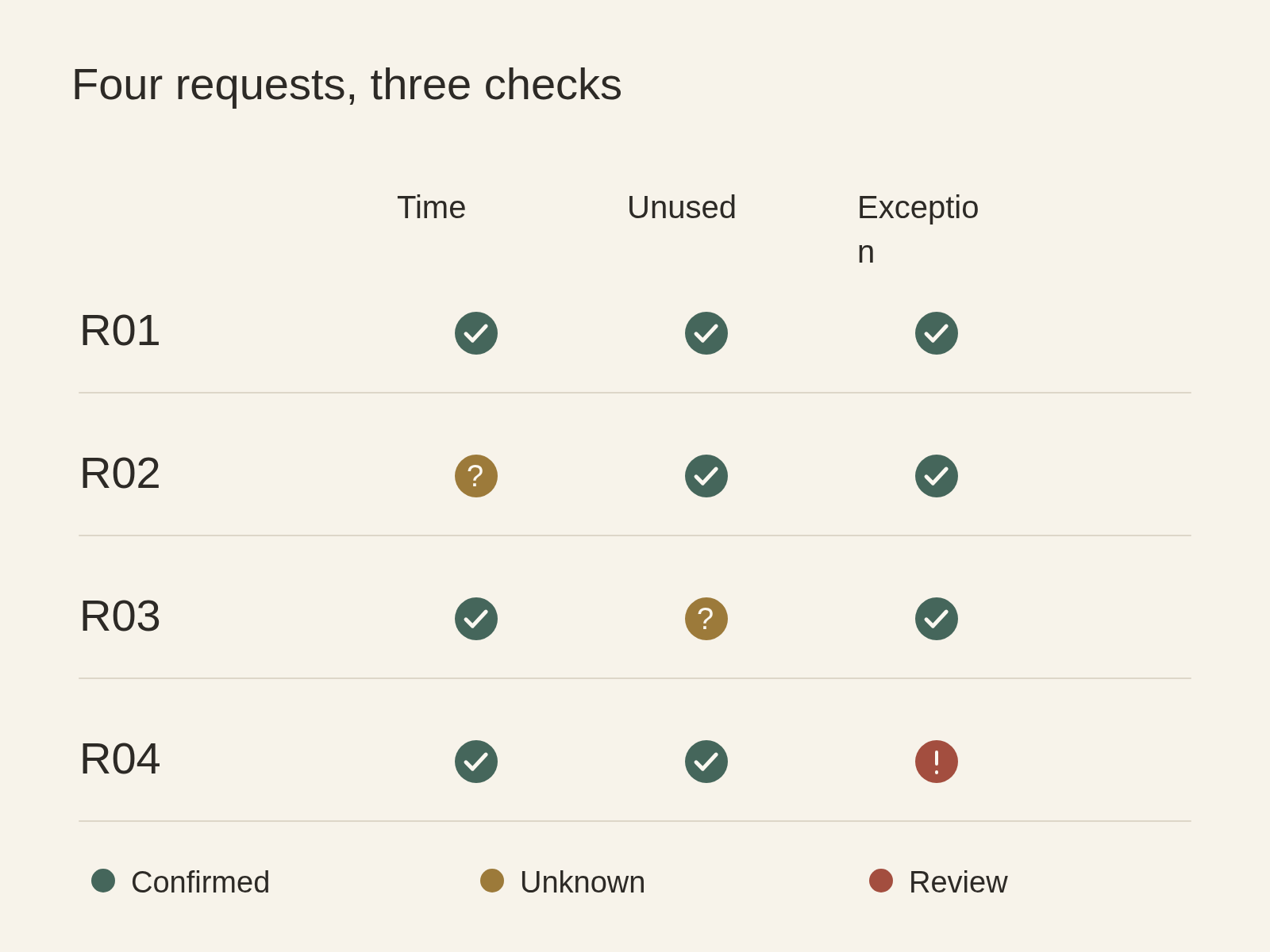
R02’s blank delivery timestamp stays unknown. The job’s current time never replaces the customer’s request time. R03’s photo proves only what is visible; it does not settle whether the item was used. R04’s fast application does not answer the bundle question. None of these evidence gaps is a rejection decision.
Make each recommendation inspectable
Use return-triage.csv with one stable request ID per row. Include order ID, category, source file and row, policy version and section, delivery and request times with offsets, use-condition evidence, exception status, recommended queue, unanswered question and reviewer. Keep confirmed, missing and conflicting values distinct.
In return-review.md, explain each policy condition separately. A useful R03 note says: “Window supported by order export row 3 and request R03; packaging photo received; unused condition remains unverified; ask the customer which evidence is available under the approved process.” It gives a support person a concrete next step without promising eligibility.
Duplicate attachments should share a source reference; they should not inflate the evidence count. Similar customer names or identical amounts do not authorize merging requests. A corrected export creates a new version of the packet and identifies affected rows.
Give the agent a bounded assignment
Read only the supplied order export, request records and approved P-R1 policy. Produce return-triage.csv and return-review.md. Cite a source for every condition. Keep absent values unknown. Flag policy conflicts and bundle exceptions. Do not edit orders, issue refunds or contact customers. Deliver proposed queues for the operations owner to review.
Put source files and output in the Agent Workspace. Select only the tools and data access authorized for this task. A prompt sets the assignment; configure actual provider permissions separately. Review one rule match, one missing-source case and one exception before reusing the procedure. A reusable Skill can preserve the input checklist and output contract; install relevant Skills by searching Buda AI’s Marketplace when one fits your work.
Questions that change the decision
What if the time zones differ? Keep original timestamps and offsets, convert both instants to the agreed zone, then apply the policy’s day-count convention. If a date-only source cannot establish the boundary, ask for confirmation.
What about gifts and bundles? Preserve the purchased bundle and gift relationship. Ask the authorized owner which return and value-allocation rule applies before preparing a recommendation.
What if the evidence conflicts or the rule is not met? Preserve both sources and the unmet condition. Route to the person responsible for exceptions or customer remedies. An agent may explain the mismatch; the responsible person decides the response.
Start with four historical, authorized cases and check every proposed queue against its sources. Expand the workflow only after a reviewer can reconstruct each recommendation.