A checked onboarding list does not mean a new hire can start
Separate scheduling and applications from completion evidence so HR, IT and managers can resolve the actual dependencies.

The laptop has shipped. The account request is submitted. Training is booked. Every box looks checked, but the new hire cannot enter the business system on day one.
An AI onboarding checklist should distinguish evidence-backed completion from pending confirmation. It should not translate “arranged” into “done.” HR owns the preparation template, IT confirms equipment and accounts, and the manager confirms role readiness. The agent organizes their evidence into a traceable handoff.
HR workflow you can build with Buda includes onboarding checklists and employee-information preparation. A read-only review of authorized redacted copies does not require production HR writing.
Three inputs and one explicit cutoff
Everything below is fictional teaching material, not employee records or an executed onboarding project. The stable person ID is EMP-A; do not match on name. Inputs are authorized redacted copies of HR-plan-v1, IT-note-v2 and training-note-v1. The as-of time is October 21, 2026, 10:00 Asia/Shanghai.
- The HR plan supplies tasks, owners, dates and regional template. Its checkbox records coordination, not necessarily completion proof.
- The IT note treats equipment and accounts separately. One completed item does not establish overall readiness.
- Training records distinguish booking, attendance and approved exemption. An absent attachment does not prove absence from the course.
Identity documents, health data, pay and access credentials are excluded. Keep only necessary task data. A redacted filename is not access control; check Drive sharing first.
Four states are more useful than one checkbox
Keep original wording and apply an explicit team rule: confirmed complete, pending action, pending confirmation, not applicable. These are proposed table categories, not native Buda HR states.
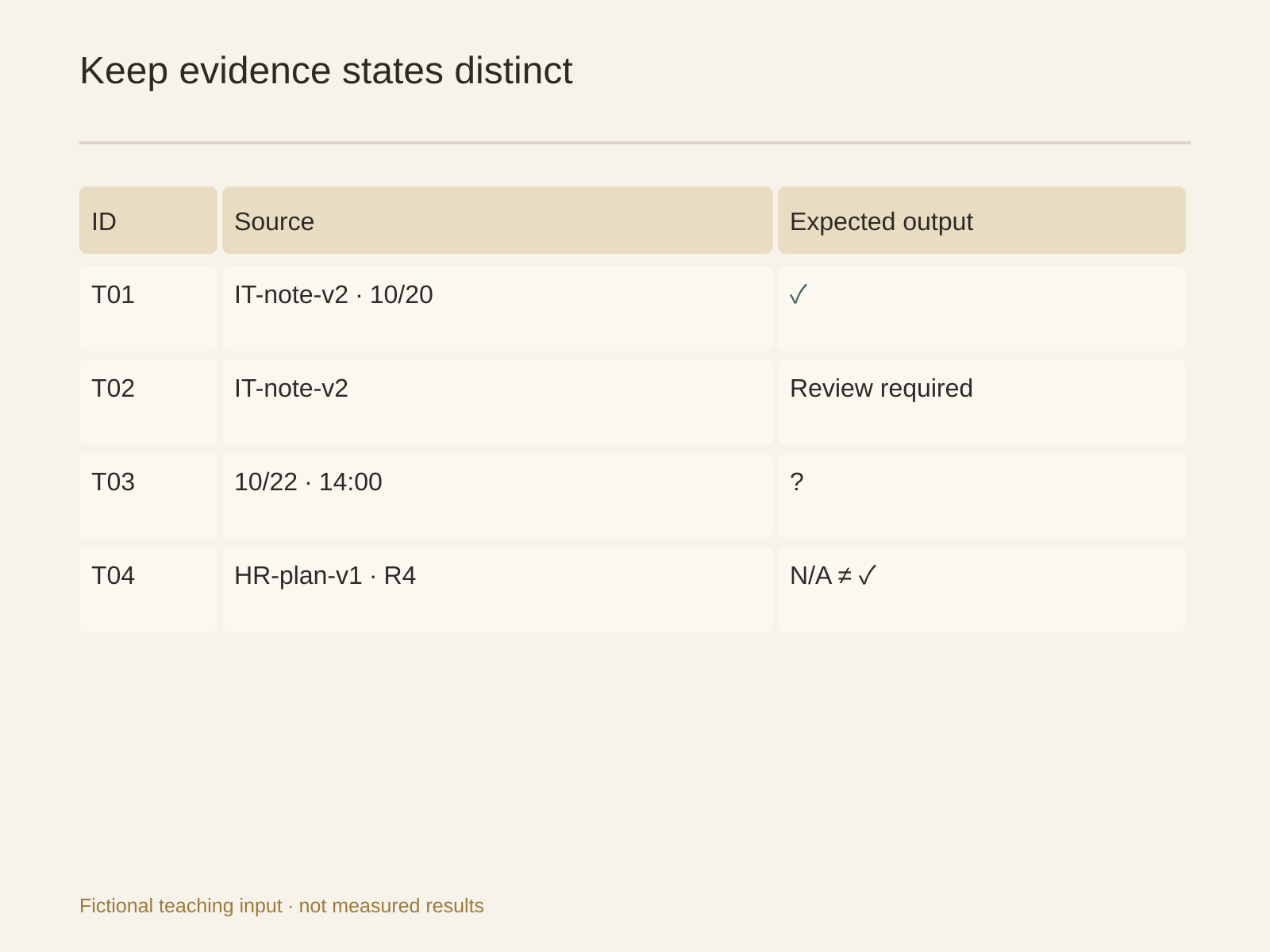
| Task / source | Original statement | Review state | Responsible check |
|---|---|---|---|
| T01 equipment; IT-note-v2 item 1 | “EMP-A receipt confirmed Oct 20” | Confirmed complete | IT checks authorized receipt evidence |
| T02 account; IT-note-v2 item 2 | “Request submitted; activation pending” | Pending action | IT completes and confirms activation |
| T03 training; training-note-v1 item 1 | “Booked Oct 22 at 14:00” | Pending action | Training owner later supplies attendance |
| T04 general training; HR-plan-v1 item 4 | “Exempt for this cohort; approval R4” | Not applicable | HR checks R4 scope and person ID |
Completion evidence must concern the exact task, match the person and have an intelligible evidence date. A tick is insufficient. T01 confirms receipt, not business-system access.
Missing attachment or missing action?
If training time has passed and the only statement is “arranged,” mark pending confirmation. Do not conclude non-attendance, failure or non-completion. Ask the training owner for minimal authorized confirmation, recording the missing location and question.
“Equipment shipped” proves shipping, not receipt. If transit is known, preserve pending action and progress rather than inventing delivery. More text is not automatically stronger evidence.
If IT says activated but HR says waiting, retain both sources and dates. Ask IT to verify the task identity and current state. Do not vote between documents or silently pick the newer message.
Dependency blocking is not lateness
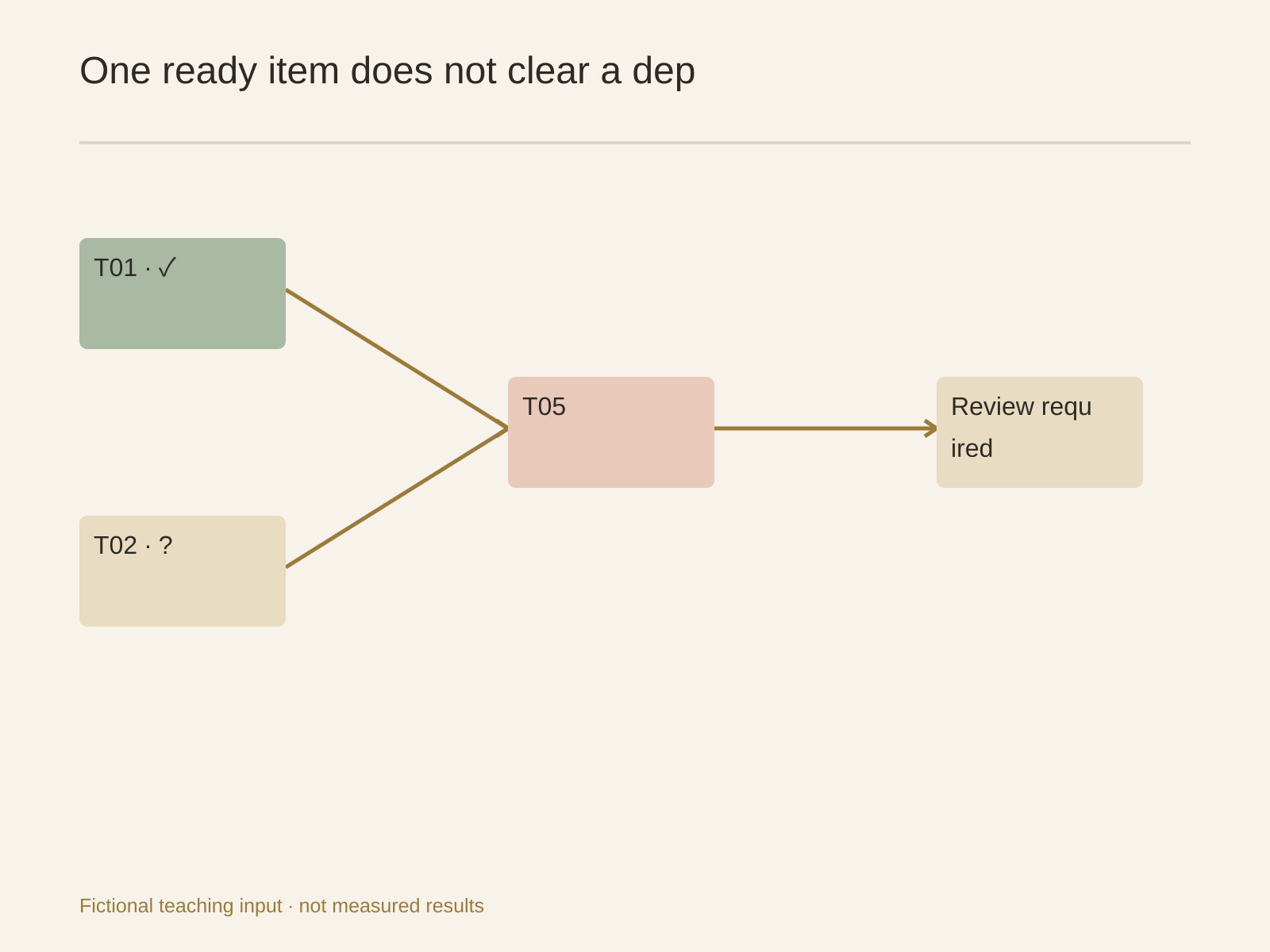
Manager-led system practice T05 depends on equipment T01 and account T02. Completed T01 plus pending T02 leaves a dependency open even before the scheduled practice time.
A blocked dependency does not necessarily mean overdue. Compare against the cutoff only when the planned deadline and local timezone are explicit. Unknown dates stay null. “Wednesday” alone does not identify a date. Regional templates retain their local rules rather than silently borrowing headquarters time.
onboarding-readiness.csv needs employee ID, task ID, owner, dependencies, planned date/timezone, original wording, review state, evidence location and date, open question and rule version. Store dependency satisfaction and lateness separately—not one red warning that hides why.
Not applicable is not attendance
T04 needs valid R4 approval. Preserve approving role, scope, template version and authorized evidence location; check EMP-A belongs to that scope. Exemption does not create an attendance record and should not inflate completed-training counts.
Use HR-approved regional templates for local requirements. The agent does not infer employment law, hiring decisions or compliance. If the right template is unknown, ask HR rather than fill the gap from another region.
One handoff, three accountable roles
missing-confirmations.md is a question queue: task, missing evidence, owner, authorized location and affected next step. It is not a batch of messages already sent. manager-handoff.md describes what can begin, remaining dependencies and the next responsible person—not a blanket declaration of readiness.
HR verifies template, exemption and identity mapping. IT verifies actual account/equipment state. The manager verifies role preparation. The agent does not edit employee records, open accounts, grant access, send automatic reminders or assess the employee.
Read only the three named authorized inputs using EMP-A mapping. Retain source wording and location. Classify confirmed complete/pending action/pending confirmation/not applicable. Booking is not attendance; application is not activation; dispatch is not receipt; missing evidence is not failure. Keep unknown dates null and dependencies separate from lateness. Produce onboarding-readiness.csv, missing-confirmations.md and manager-handoff.md. Do not access unrelated staff data, change systems, send, open accounts or judge compliance.
Store copies in Buda Drive and organize the batch in a dedicated Session. Sessions separate conversations, not file permissions; review Agent-versus-Space sharing first.
Four proposed acceptance cases
These tests have not run and establish no accuracy or time-saving figure: equipment received but account inactive must not imply role readiness; booked training without attendance must not imply attendance; a valid exemption must be not applicable rather than completed; two people sharing a name require stable IDs, with missing mapping stopping the join.
The test concerns employee dependencies, not whether an agent appeared active or wrote a file. The manager must be able to identify who confirms the next step.
Who proves completion?
The responsible function and authorized source: IT for accounts, training owner for attendance, HR for template applicability. A manager's checkbox cannot replace every department's evidence.
What if an attachment is missing?
Retain the statement and missing location, mark pending confirmation and request minimal evidence. Missing proof does not establish an unperformed task.
Can regions share a template?
They can share table structure, but HR must approve regional requirements. Preserve local deadlines and timezones; do not let an agent infer legal rules.
Can an exemption be marked done?
Keep it separate with its basis and scope. Not applicable, attendance and completion are different reporting categories.
Search for and install an appropriate organization Skill in the Buda AI Marketplace. Read its inputs and data limits, then validate redacted samples. Deliver a handoff someone can act on before expanding connections or reminders. A neat row of ticks is not the outcome; useful preparation is.