Introducing Gemini 4 Argon: test long workflows with evidence, not output length
Build task-specific acceptance around sources, equivalence and exceptions.

A code migration may require repeated profiling, implementation changes, regression tests and repairs. Financial research needs sources, consistent units and explanations of exceptions, not simply a longer report.
Google announced Gemini 4 Argon on September 30, 2026, emphasizing sustained professional workflows. The useful next question for a team is how to choose a task, retain evidence and decide whether the result passes.
What Google announced, and who has access
The official announcement positions Argon across software engineering, legal and financial knowledge work, and cybersecurity defense. Initial rollout is to trusted cyber defenders through the Fairwind Program, followed by phased expansion and feedback.
The announcement checked on October 8 still describes broader release as an expansion path, including paid API customers and Google AI Ultra subscribers. It is not evidence that every account can use the model now. Verify the current account and latest product documentation before planning an operational trial.
This article discusses upstream capabilities and an evaluation method. It does not infer a third-party product's availability or billing from Google's launch.
One million output tokens is a distinct parameter
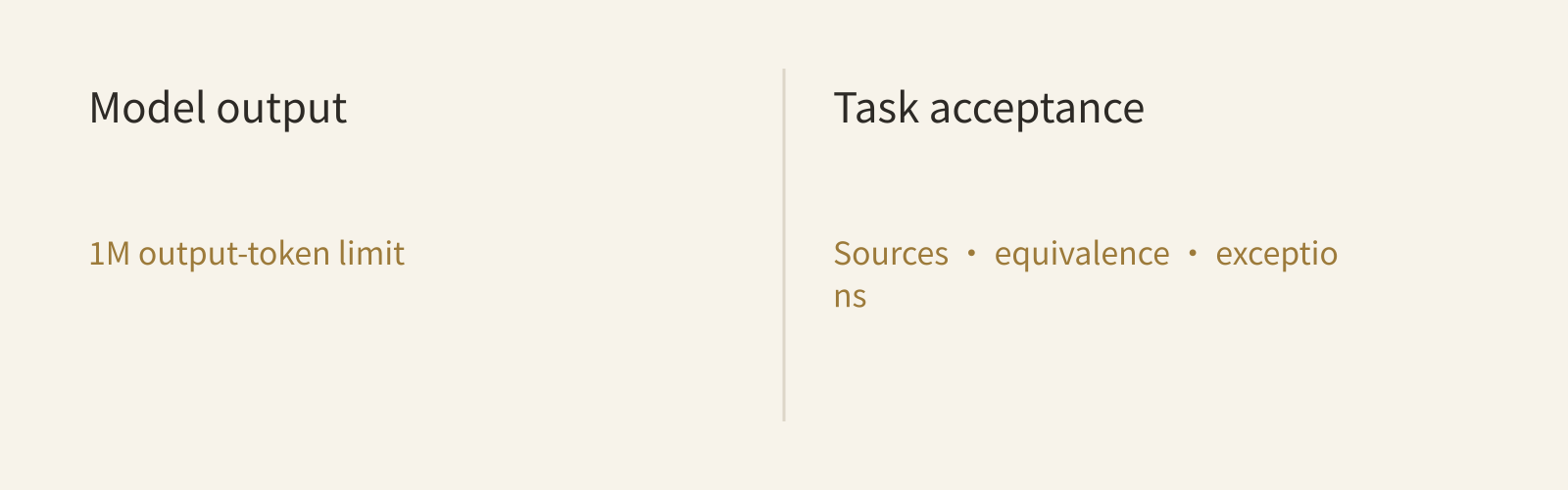
Google says the output-token limit rises from 64K to 1M. That gives a single trajectory more room for generation and multi-step work. It is not the input context window and does not establish permanent agent memory.
More output does not require reviewers to read every intermediate token. Specify a compact final package: conclusion, openable files, changes, tests and unresolved decisions. Otherwise the larger output budget can also enlarge the review burden.
Three engineering examples suggest what to measure
Google reports that Argon agents analyzed fleet profiling telemetry, identified and applied memory optimizations, and freed more than 300 TiB after rollout. Its estimate of 500 TiB to 1 PiB in total savings is a separate projected figure. Neither number should be scaled into a predicted saving for an ordinary server fleet.
The announcement also discusses C/C++-to-Rust migration, from core libraries to large codebases. It explicitly describes automated and manual auditing, emulation testing and review before production rollout. The operational lesson is increased execution capacity accompanied by acceptance steps, not unattended deployment.
For libgav1, Google says agents replaced about 32K lines of SIMD code in an existing Rust port through profile-guided experiments and compiler-output analysis. Safe Rust enabled automatic vectorization. The result was 2.7 times faster than that Rust port, with identical video output, bringing it closer to optimized C++.
The comparator is a specific Rust port, not every program or the original C++ implementation. Transfer the method: retain the baseline, profile, output equivalence, safety properties and regressions. Do not transfer the performance number.
Benchmarks help choose a workload, not forecast company returns
Google reports 77.9% on DeepSWE v1.1 and 51.3% on AutomationBench, alongside financial, legal and long-video evaluations. Those tasks and scoring conditions differ. Combining them into a universal work success rate would be misleading.
AutomationBench's 51.3% is not a proportion of your company's jobs or processes ready for automation. This article treats it as Google's disclosed benchmark result and has not reproduced these evaluations in Buda or another environment.
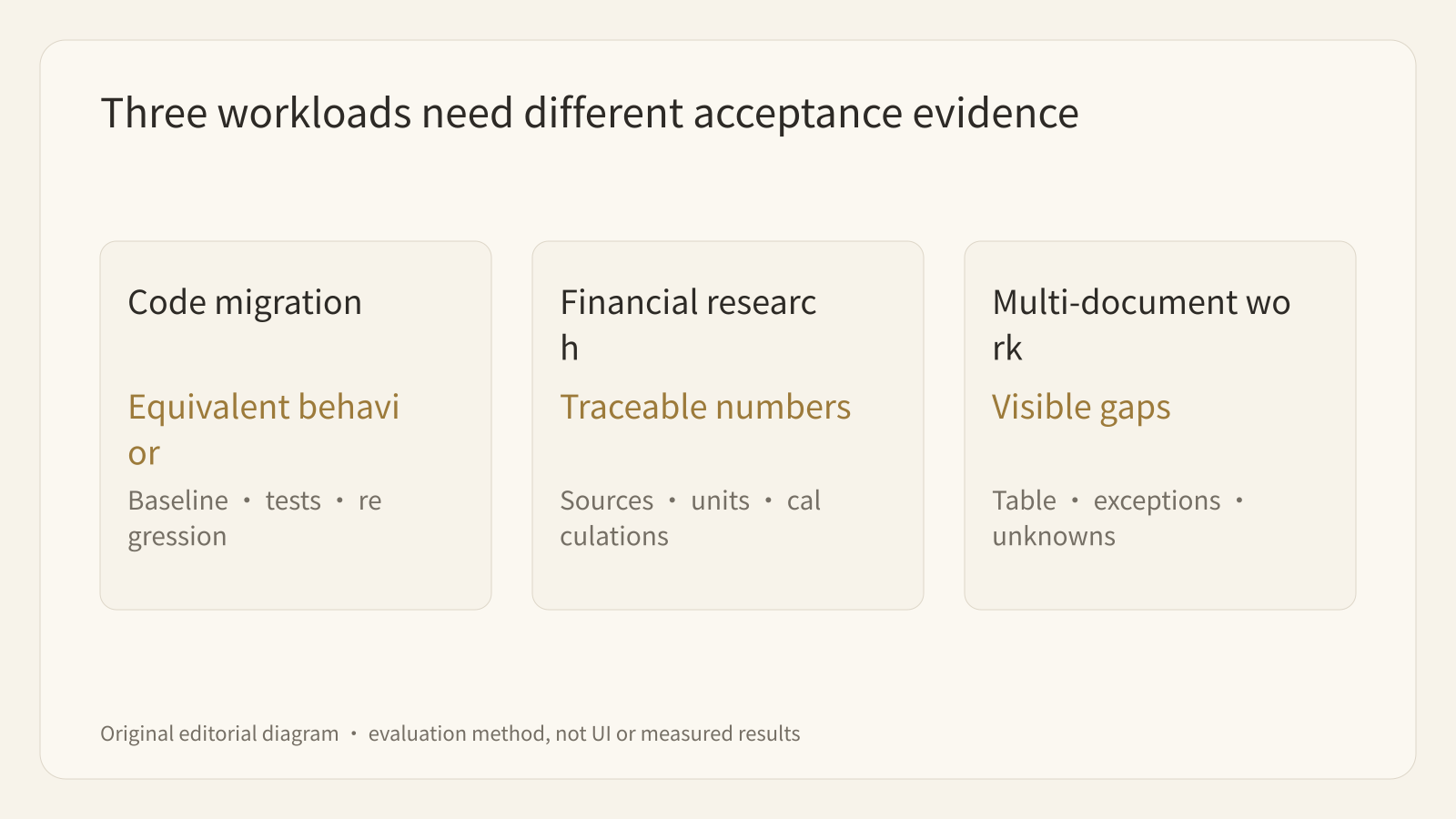
The team's acceptance standard must be visible in its own outputs. Code, research and business compilation require different evidence.
Build three different acceptance packages
Code migration: equivalent behavior before faster execution
Use a non-critical module or sanitized copy. Fix baseline version, input and test set. Require a diff, build commands, regression results and measurement procedure. Verify output equivalence and edge behavior before measuring latency, throughput or memory.
List uncovered platforms, dependencies and inputs. Data differences, test regressions or out-of-scope edits block acceptance even if the agent says it passed. Deployment and rollback belong to an authorized person.
Financial research: trace each important number
Use public or authorized reports and specify currency, period, units and comparison rules. Request a findings table, links, calculations and exceptions. A reviewer should be able to move from a number to the underlying statement or calculation.
Acceptance is traceability and consistent treatment, not polished language. Separate inference from fact. Qualified people retain investment, tax and customer-advice decisions; do not introduce unauthorized personal or financial data to make a test realistic.
Multi-document business work: deliver exceptions separately
A constructed pilot could compile public supplier material into a comparison table, flag unverifiable entries and draft a procurement note. Its package includes the table, sources, unresolved questions and draft.
Check omissions, outdated references and guesses entered as facts. Confirming quotes, placing orders and sending messages are not default permissions for a compilation task.
Cyber defense requires authorization
The announcement discusses vulnerability discovery, validation and patching for trusted defenders under specific access conditions. It does not authorize scanning arbitrary external targets.
Any security pilot needs explicit target authorization, isolation, least privilege and professional review. This article does not supply exploitation procedures or infer production safety from a benchmark. Prefer authorized, recoverable, low-risk workloads.
Make the trajectory inspectable
Buda's Agent Workspace groups conversation, persistent files, Terminal, browsers, preview and Git in one cloud environment. Use those surfaces to organize sources, execution and results so reviewers can inspect versions, files and tests rather than receive only a completion message.
That is a workflow pattern, not evidence that Argon is available in Buda or that Google's examples have been reproduced. On any execution platform, define inputs, permissions, deliverables and acceptance before expanding task scope.
FAQ
Does 1M refer to the context window?
The announcement specifies an output-token limit. Do not describe it as input context or permanent memory.
Can every developer use Argon now?
The checked announcement begins with trusted Fairwind defenders and describes phased expansion, including paid API and Google AI Ultra access later. Verify current account access and product documentation rather than assuming universal availability.
Can the libgav1 speedup be expected in another repository?
No. It describes a particular Rust port and experiment. Measure against your own fixed baseline and regression suite.
Is 51.3% the share of business tasks that can be automated?
No. It is the disclosed AutomationBench score under that evaluation's conditions.
What should a reviewer inspect first?
Deliverables, sources and tests, followed by exceptions and uncovered cases. Output length and agent self-evaluation do not establish acceptance.
Design a pilot that can fail
Write failure conditions as well as success criteria: insufficient sources, incorrect key numbers, regressions or unauthorized actions must stop acceptance. Choose one complex but recoverable task before increasing execution scope.
Checked October 8, 2026. Model facts, rollout statements and numbers come from Google's September 30 announcement and are upstream disclosures. Acceptance methods and the supplier scenario are proposed evaluations, not measured returns or customer cases.