Gemini 4 Carbon: long-running work needs a chain of evidence
Separate benchmark claims, phased access and the evidence needed to accept long-running engineering work.

Better reasoning changes the work an agent can attempt. Teams still need to inspect the path from a finding to an accepted result.
Google announced Gemini 4 Carbon on October 28, 2026, emphasizing cybersecurity defense and long-horizon engineering. The announcement describes work such as tracing subtle bugs across large codebases and low-level systems, trying alternatives when an approach reaches a dead end, and producing patches.
For a team assigning real work, the practical consequence is straightforward: a longer run needs more than a longer closing summary. It needs reproducible findings, reasons for changes, actual diffs, verification results and a clear stopping point.
A confirmed announcement with a phased rollout
Carbon is a formally announced model, beyond earlier reports about an internal checkpoint. Google says initial access goes to a subset of cyber defenders, followed by additional trusted partners through its Fairwind Program, before broader product access for developers, businesses and consumers.
Separate the capabilities announced from the access available in a particular account and environment. A procurement or migration decision needs an actual access path, relevant permissions and a compatible operating setup. A launch headline does not settle those questions.
Google presents Carbon as building on Argon. That is a reason to investigate hard tasks, rather than a reason to move every existing request. A short document cleanup and a cross-repository defect investigation have different costs of failure and different verification needs.
Three benchmarks, three different questions
Google reports 88.2% on SEC-bench Pro, 54.8% on ExploitGym and 71.0% on CWE-bench. These concern vulnerability discovery, exploitation and patching respectively. The announcement says these external benchmark evaluations ran without guardrails.
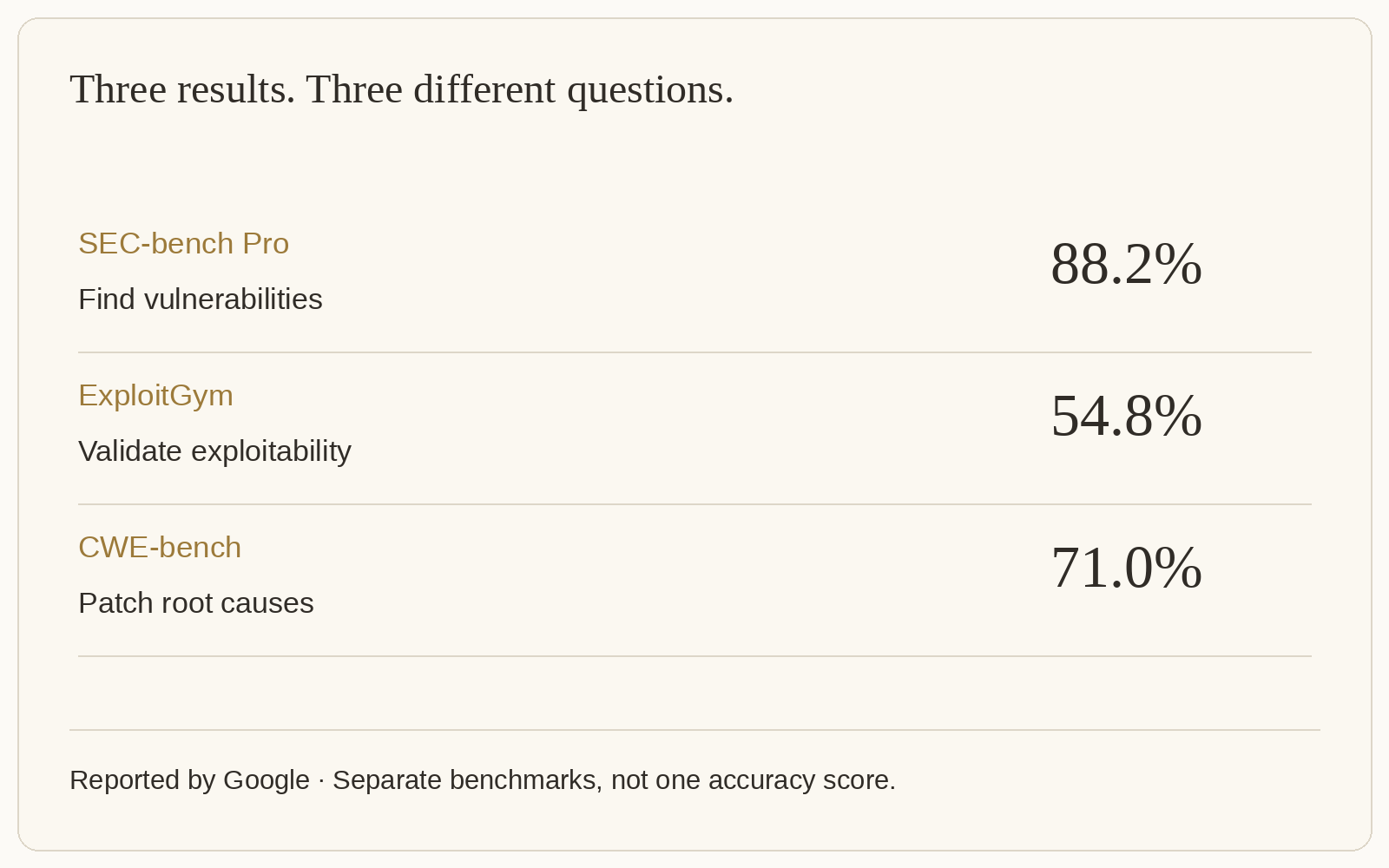
They cannot be collapsed into one security accuracy figure. Finding a flaw does not establish that a proposed fix works. Demonstrating exploitability does not authorize testing against a production service. Each stage requires its own environment, permission and evidence.
Google also reports more than twice Argon's secure-code generation success rate on internal benchmarks. This is a vendor-reported result. A team evaluating its own codebase still needs its own tests and review criteria. Internal improvement figures and external benchmark scores should remain distinct.
Work that lasts days needs intermediate handoffs
Google says internal teams have seen Carbon run for days on complex engineering problems. Persistence can help a model explore alternatives and continue after failed attempts. It also makes intermediate state essential.
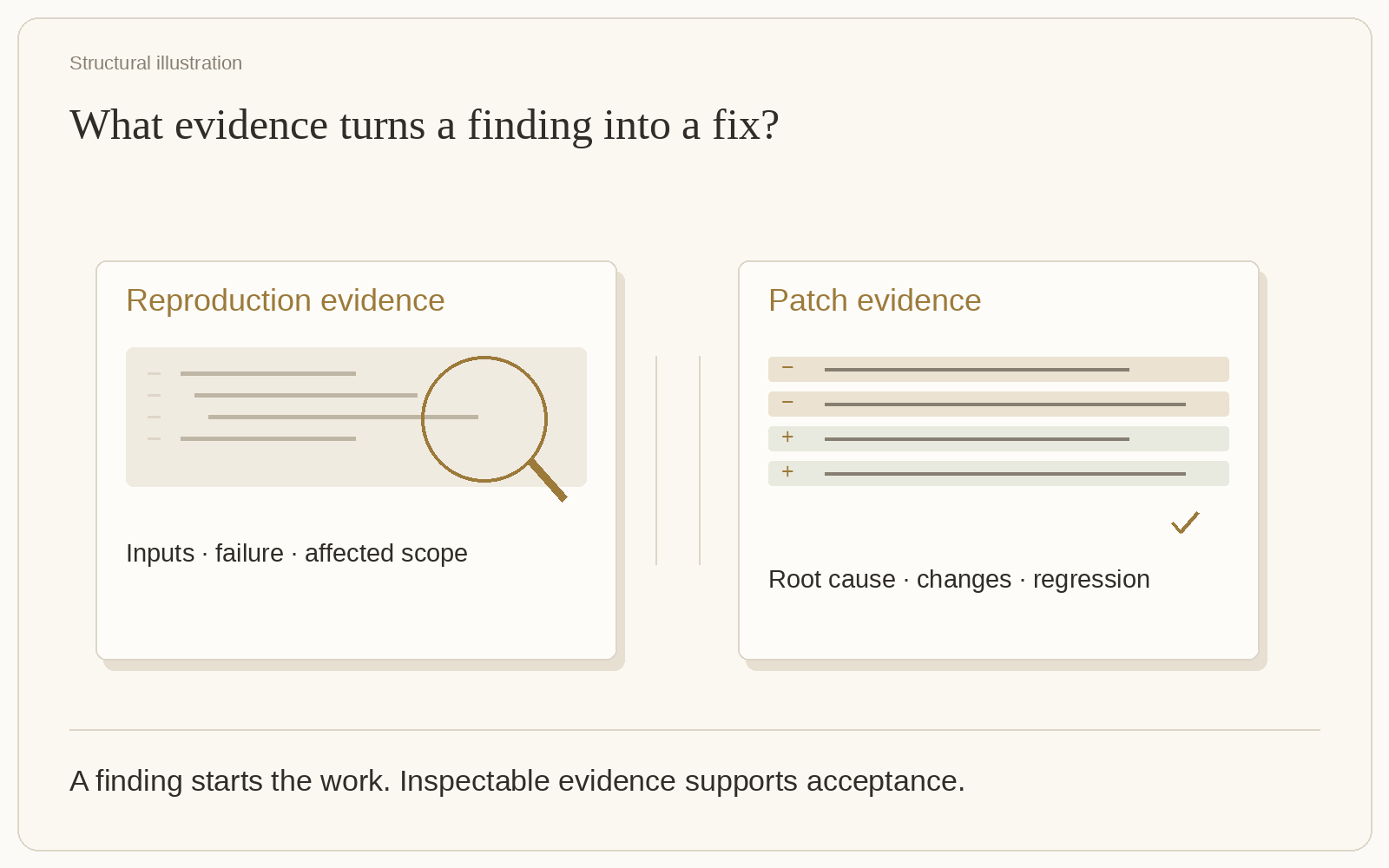
A useful repair handoff contains four kinds of evidence. First, the reproduction: conditions, observed failure and affected scope. Second, the reasoning behind the chosen fix, including explanations ruled out and unresolved assumptions. Third, the actual changes and interfaces they affect. Fourth, the checks performed, their results and anything that still requires production validation.
Revisit the relevant stage when input versions, permissions or scope change. Initial permission to investigate should not silently become permission to write to a service or deploy a patch. The transition from reading to changing an external system deserves an explicit boundary.
This is a recommended acceptance method, not a claimed customer experiment. Teams can examine an existing task's artifacts against these categories without inventing a sample project or a success percentage.
A stopping point is part of the result
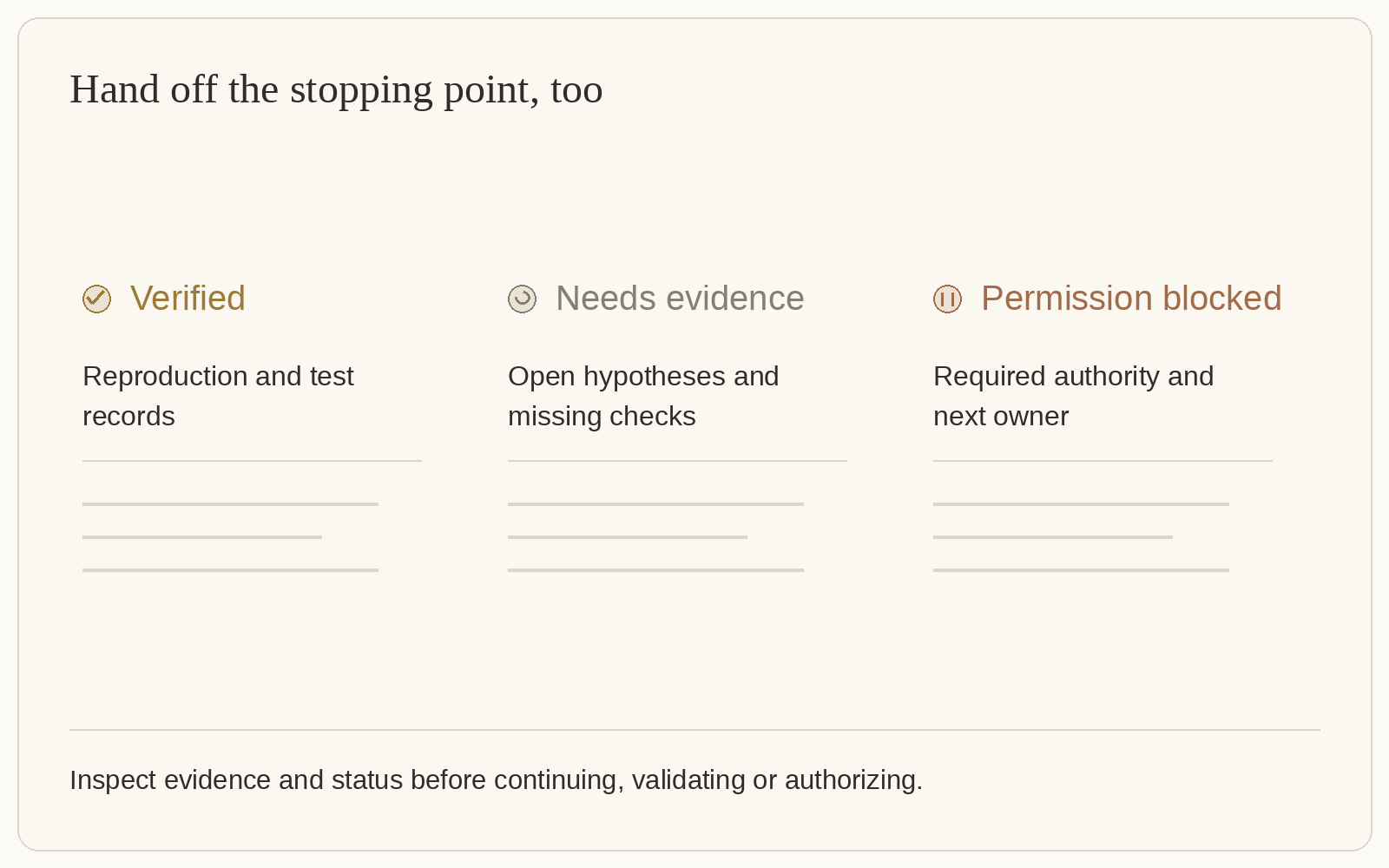
A common failure in long work is presenting a locally plausible change as a finished outcome. A useful report distinguishes results supported by actual output, checks completed only in a limited environment, and work stopped by missing information or access.
Google reports fewer unsupported claims and better disclosure of methodological limits in internal testing. Teams should still retain their own completion standard. A model describing a boundary more accurately does not replace verification through real tools.
For a software change, code merged, tests passed and production validated are separate states. Research and document work have equivalent distinctions: sources read, draft prepared and official record updated. The next person needs to know whether to review, gather evidence or execute.
Put acceptance criteria beside the work
Teams can use Buda to build a workflow around source material, execution and review. Prepare the relevant files in the responsible Agent, state the permitted actions and requested deliverables, and ask it to preserve the results. Drive and memory explain how material can support continuing work.
Ask for specific evidence: a change explanation, checks actually performed and unfinished items. The reviewer should open the artifacts before approving further action. The Agent Workspace brings those materials and execution tools together; model capability and operating authority remain separate decisions.
Two practical decisions
Should an existing model be replaced immediately?
Choose a real task category where the current setup repeatedly fails and results can be inspected. Keep inputs and acceptance conditions fixed. Compare correctness, omissions, human rework and total waiting time. Tasks already meeting the bar need not migrate merely because a new model was announced.
Can stronger security performance justify automatic production fixes?
Start in an explicitly authorized isolated environment. Require a reproducible finding, root-cause explanation, patch diff and regression results. Keep production changes within the existing review and release process. Decide who may authorize an action before deciding how long the model may run.