Google I/O 2026 AI Features: How Gemini 3.5 Flash Reshapes AI Agent Execution
Google I/O 2026 made Gemini 3.5 Flash a practical signal for AI agents: faster execution, clearer model routing, and more efficient workflows.
Google I/O 2026 had plenty of AI announcements. Gemini 3.5 Flash is the one that feels most practical for teams building with AI agents.
Not because it is the loudest launch. Because it points to a quieter shift: agents are becoming less about one brilliant answer and more about repeated execution. They need to read, route, summarize, call tools, draft, verify, and hand work back for review.
Google says Gemini 3.5 Flash is generally available across the Gemini app, AI Mode in Search, Google Antigravity, Gemini API in Google AI Studio and Android Studio, and Gemini Enterprise. Google also describes it as its strongest agentic and coding model yet, with speed positioned as a core advantage for long-horizon agent tasks.
That matters. A slow agent feels broken even when the model is smart.
What happened at Google I/O 2026
Google introduced the Gemini 3.5 model family and started with Gemini 3.5 Flash. The official announcement frames it around “frontier intelligence with action,” with particular emphasis on agents and coding.
The practical details are straightforward:
- Gemini 3.5 Flash is available now through consumer, developer, and enterprise surfaces.
- Google says it outperforms Gemini 3.1 Pro on several coding and agentic benchmarks.
- Google positions it as a fast model for multi-step work, tool use, and agentic workflows.
- It is now part of Google Antigravity, the agent-first development platform where agents can plan, execute, and verify tasks across editor, terminal, and browser.
The point is not only “a new model is available.” The more important signal is that Google is treating speed, tool execution, and agent orchestration as first-class AI product requirements.
Why Gemini 3.5 Flash changes the Agent conversation
A lot of early AI agent demos focused on autonomy. Can the agent do the whole thing by itself?
In real work, the better question is simpler: can the agent move through the boring steps quickly enough that humans actually want to use it?
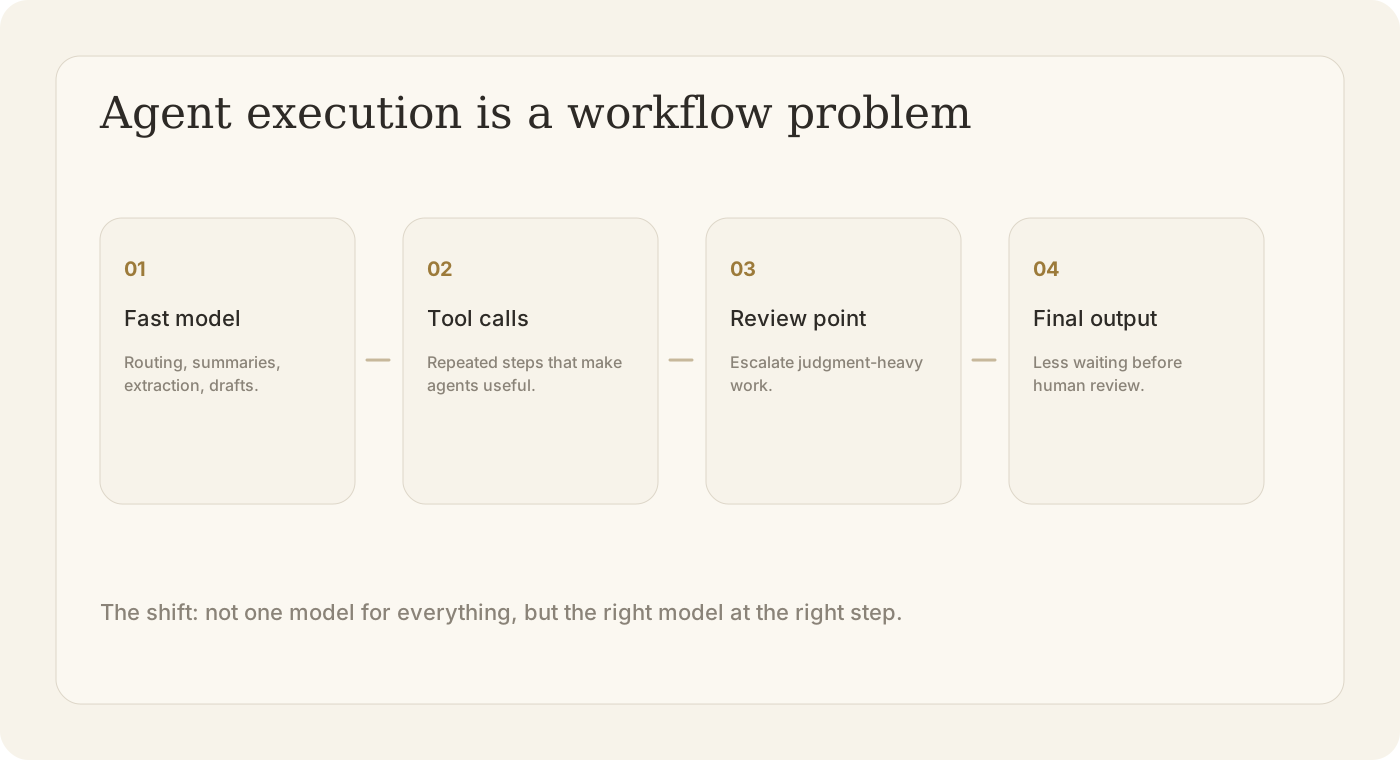
Most agent work is not one dramatic reasoning problem. It is a chain of smaller actions:
- classify a request;
- read a few files;
- decide which tool to call;
- summarize what changed;
- create a first draft;
- prepare something for review.
These steps do not always need the most expensive model. They need a model that is fast, capable, and reliable enough to keep the workflow moving.
That is where Gemini 3.5 Flash becomes interesting. It gives teams another execution-layer model: useful for repeated work, coding loops, summaries, routing, and other high-volume steps where latency directly affects the experience.
Execution is not the same as judgment
The useful distinction is not “weak model versus strong model.” It is execution versus judgment.
Execution is the work of moving the task forward. Judgment is the work of deciding whether the result is good, safe, tasteful, or strategically correct.
An AI agent can do a lot of execution:
- collect context;
- normalize messy inputs;
- draft a response;
- reproduce an issue;
- prepare a patch summary;
- create a checklist for a human reviewer.
But judgment still needs a gate. Some steps should be escalated to a stronger model. Some should stop for a human.
This is the real lesson from faster agent models. They do not remove review. They make review more valuable, because humans can spend less time waiting for routine steps and more time deciding what should actually ship.
What teams should do next
Gemini 3.5 Flash is a reminder to design agents as workflows, not as single prompts.
Here are the practical moves:
1. Split your agent tasks by risk
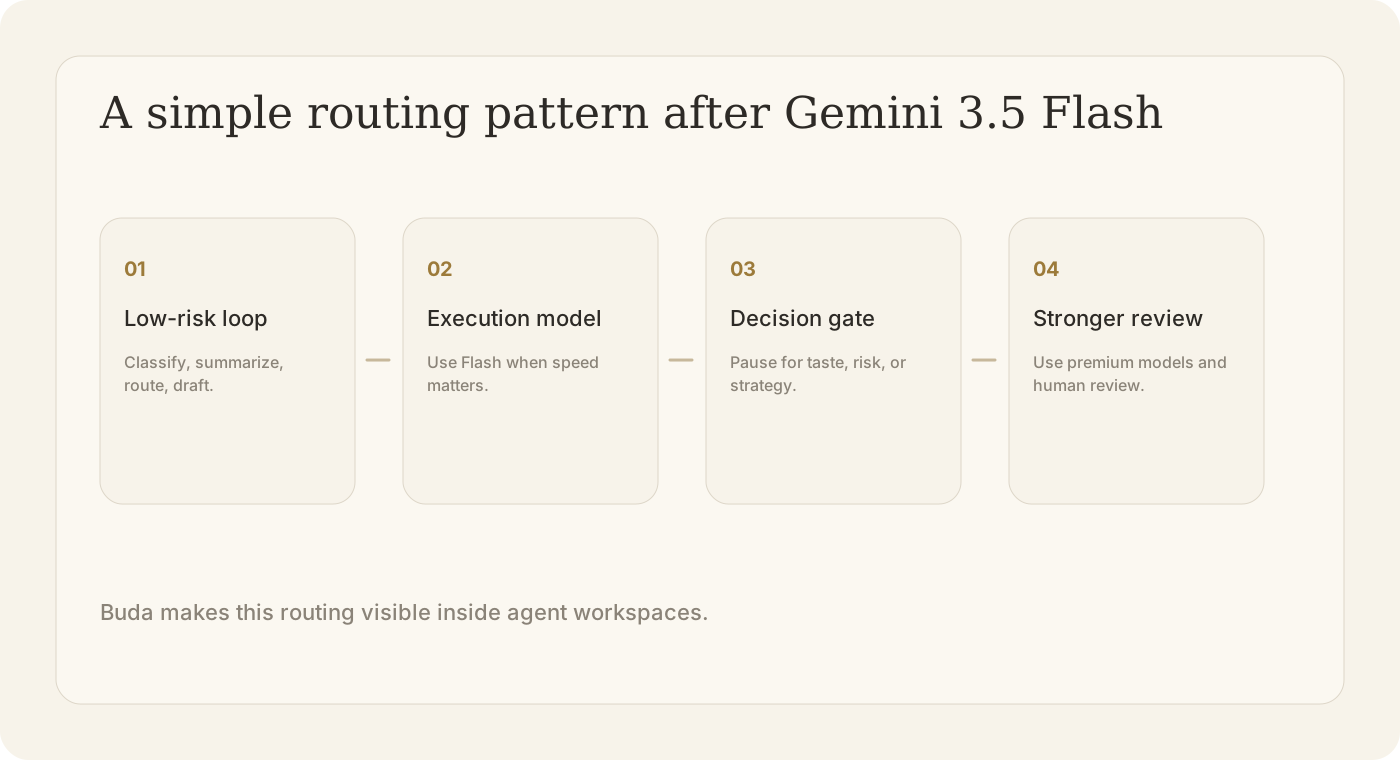
Use fast models for low-risk execution loops: triage, extraction, formatting, summaries, routing, and first drafts.
Reserve stronger models for high-risk or high-judgment work: architecture decisions, security review, legal or financial content, final customer-facing copy, and complex debugging.
2. Make model routing explicit
Do not hide model choice inside an invisible backend rule. Teams should know when an agent is using a fast execution model and when it is escalating to a stronger review model.
Visibility builds trust.
3. Keep humans at the review point
Faster agents can create more output. That is useful only if the review layer stays clear.
The goal is not to flood people with drafts. The goal is to move repetitive work out of the way so people can judge fewer, better-prepared outputs.
4. Measure waiting time, not only model quality
For agent workflows, latency is part of quality. If an agent needs ten model turns and every turn is slow, the whole workflow feels heavy.
Track how long it takes from request to reviewable artifact. That is the metric teams will feel.
How this connects to Buda
Buda has added Gemini 3.5 Flash to the model selector, priced at 0.6x credits.
That means you can try it directly in Buda for agent sessions where speed and execution efficiency matter: issue triage, content drafts, summaries, routing, lightweight coding loops, and repeated automation steps.
Buda’s position is simple. Agents should do the execution. Humans should manage direction and review the result. Faster models make that division of labor easier to feel in daily work.
Try Gemini 3.5 Flash in Buda at buda.im.