GPT-6 Astra Is Here: What Changed, Who Can Access It, and What Teams Should Test First
The rollout is limited at launch. Focus first on computer use, long tasks, cost, and review boundaries.

GPT-6 Astra Is Here: What Changed, Who Can Access It, and What Teams Should Test First
OpenAI has released GPT-6 Astra.
The important change is not another longer benchmark table. Astra is built to operate real software, stay oriented through long tasks, and produce documents, spreadsheets, presentations, websites, and other artifacts people can continue using.
Release does not mean universal access on day one. OpenAI is starting with a limited group of organizations, with paid ChatGPT plans, the API, and AWS gaining access over the coming days. Teams should prepare a representative evaluation set before replacing any default route.
What did OpenAI release?
OpenAI positions GPT-6 Astra as its flagship model for difficult end-to-end work. The launch emphasizes computer and browser use, software engineering, professional artifacts, science, and cybersecurity.
The API model ID is gpt-6-astra. It accepts text and images and supports tools including function calling, web search, file search, computer use, MCP, skills, hosted shell, and apply patch.
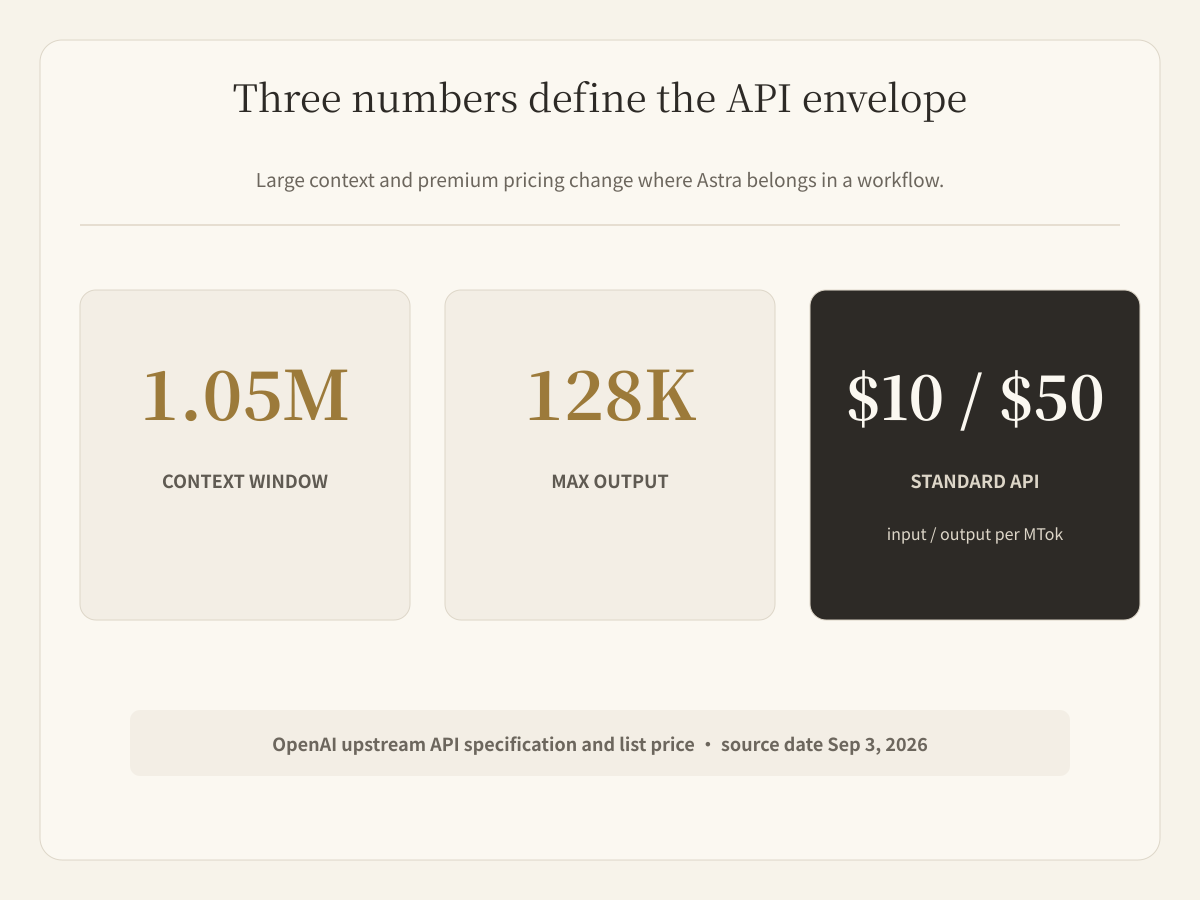
The API documentation lists a 1.05 million-token context window and 128,000 maximum output tokens. Standard upstream list pricing is $10 per million input tokens, $50 per million output tokens, and $1 per million cached-input tokens.
Those are OpenAI API prices, not Buda Credits or Buda customer pricing.
The shift is from answering to operating
OpenAI demonstrates Astra filling forms, updating CRM records, organizing calendars, building and checking websites, analyzing data, and producing work that follows existing document and presentation templates.
In OpenAI's OSWorld 2.0 latency simulation, Astra scored 72.6% in roughly 40 minutes per task, compared with 65.7% in roughly 75 minutes for GPT-5.6 Sol. The direction matters: the model is being optimized for successful work inside real software, not only for better text answers.
These are provider-reported launch results, not independent Buda tests. Tool permissions, environment design, data quality, task length, and acceptance criteria can materially change real-world performance.
Who can access GPT-6 Astra now?
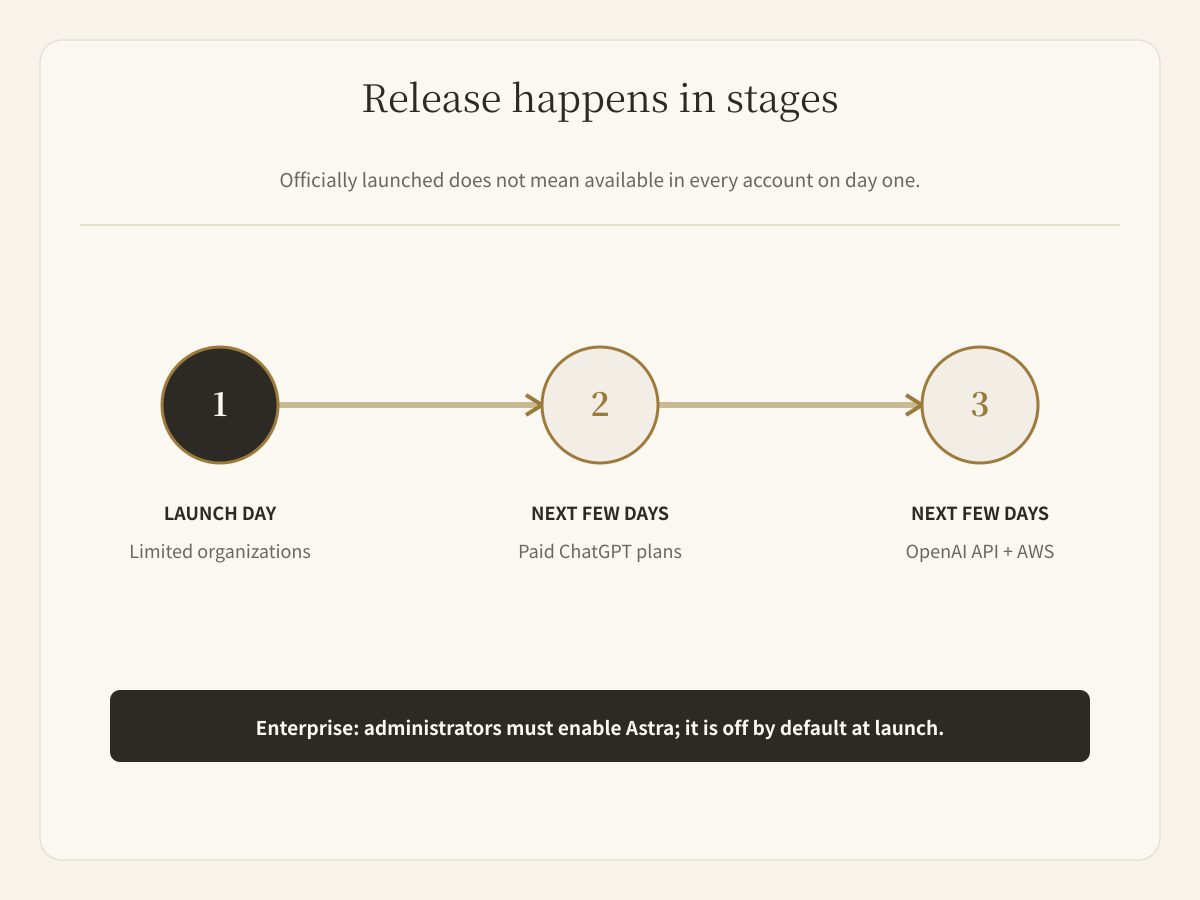
At launch, access begins with a limited set of organizations. OpenAI says rollout will expand over the coming days to ChatGPT Plus, Pro, Business, and Enterprise, as well as the OpenAI API and AWS.
Pro, Business, and Enterprise plans will also receive GPT-6 Astra Pro. Enterprise administrators must enable Astra for their workspace; it is off by default at launch.
A model can therefore be officially released before it appears in a particular account, region, or managed workspace.
Do not make it the default for every step
Astra sits in the same public $10/$50 input-output price tier as Claude Fable 5.1. It is not the economical default for bulk extraction, formatting, or simple classification.
Route to it when a task is difficult enough to justify escalation:
- cheaper models repeatedly fail a multi-stage task;
- the agent must operate and verify work in real software;
- the task combines large context with several tools;
- rework costs more than the model;
- the result affects customers, production systems, or important decisions.
Keep routine, low-risk, easily verified steps on less expensive routes. A stronger model is most useful when its responsibility is explicit.
Five tests to run first
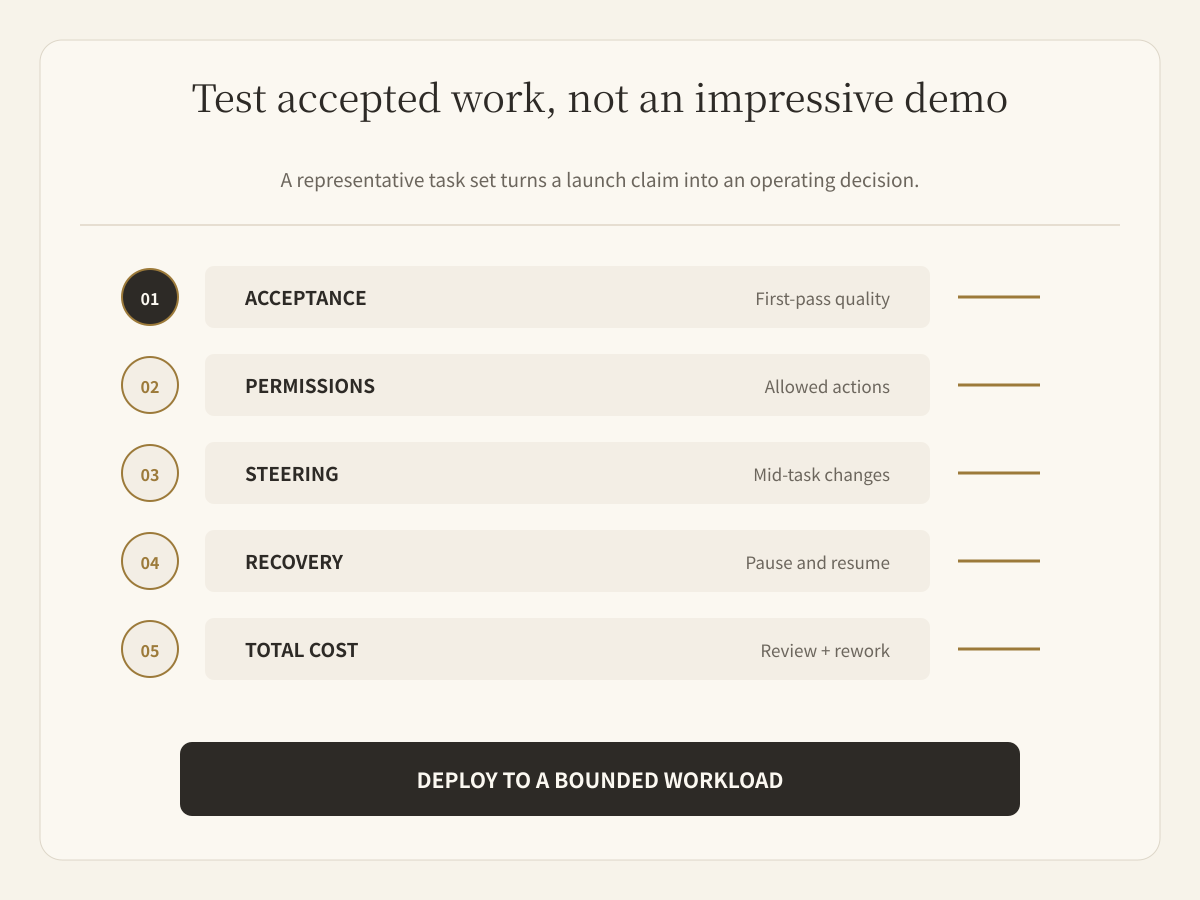
1. Measure acceptance, not demo quality
Use 10 to 30 completed tasks with known outcomes. Track first-pass acceptance, reviewer corrections, elapsed time, and failure reasons.
2. Test permissions and confirmations
Declare which files, websites, tools, and actions are allowed. Verify that messages, record changes, code execution, deletion, and external publishing stop for confirmation where required.
3. Test steering during long work
Add a requirement midway, correct the direction, and ask a side question. Check whether the agent preserves the original goal and acceptance criteria.
4. Test interruption and recovery
OpenAI says additional safety checks may slow, pause, or stop legitimate tasks. Confirm that state remains inspectable and that a person can review and resume safely without starting over.
5. Calculate cost per accepted task
Include tools, long-input pricing, failed runs, retries, review, and rework. Token price alone is not the operating cost.
Cost per accepted task = model + tools + failed runs + retries + review + rework
Stronger capability increases the control requirement
Astra is OpenAI's first model to reach its Critical cybersecurity capability threshold. The default release refuses more advanced offensive tasks, while some defensive capability is distributed through controlled programs such as Daybreak.
The system card also reports a meaningful limitation. Astra performed better on overall alignment evaluations, but its written reasoning was less monitorable than GPT-5.6 Sol in adversarial tests designed to make the model evade monitoring.
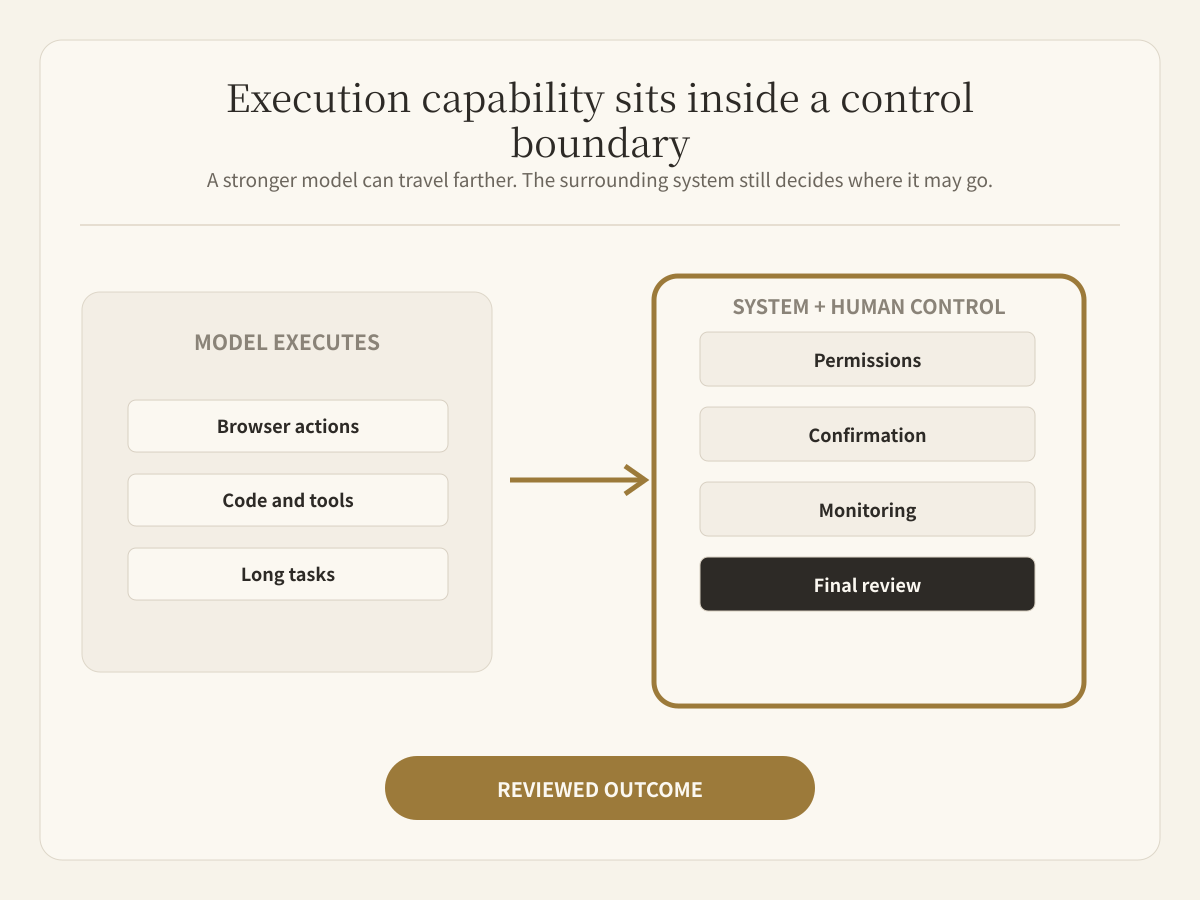
Both findings can be true. A lower observed rate of boundary violations does not justify removing permissions, confirmations, or audits. For agents that operate browsers, terminals, and business systems, control still depends on the surrounding system.
What this means for teams using Buda
GPT-6 Astra reinforces the move from chat toward execution. A model alone, however, is not a complete operating environment.
Teams still need persistent files, tools, task history, permission boundaries, visible execution, and human review. Buda provides that layer through Browser, Terminal, Git, Drive, Sessions, and reviewable artifacts.
GPT-6 Astra is not yet available in Buda. When it launches, availability and Credits will appear in Buda's model selector and public pricing page.
For the broader operating model, read How to Choose the Right Model for Your AI Agents and What Is an AI Agent Workspace?.
FAQ
Is GPT-6 Astra generally available?
Not yet at launch. Access starts with limited organizations and expands to paid ChatGPT plans, the API, and AWS over the coming days.
How much does the GPT-6 Astra API cost?
OpenAI's Standard upstream list price is $10 per million input tokens, $50 per million output tokens, and $1 per million cached-input tokens. Long input, Fast, Batch, Flex, and tools have additional rules.
What is the GPT-6 Astra context window?
The API documentation lists 1.05 million tokens of context and 128,000 maximum output tokens. A large context window is not permanent memory and does not guarantee equal recall across every position.
Is GPT-6 Astra better than Claude Fable 5.1?
There is no workload-independent answer. OpenAI's launch data favors Astra on several computer-use, terminal, and science workflows, while independent aggregate indexes may still favor Fable 5.1. Compare both on your own tasks and acceptance criteria.
Is GPT-6 Astra available in Buda?
Not yet. Check Buda's model selector and public pricing page for future availability and Credits.