GPT‑6 Cyber: Stronger Security Capabilities, Explicit Authorization Boundaries
Read the comparable evaluations, controlled access and runtime safeguards before assigning work to a security Agent.

As security Agents handle longer investigations, validate vulnerabilities and suggest patches, adoption becomes a decision about systems and actions as well as model selection. More capability makes the clarity of the assignment important to the person accepting the result.
OpenAI’s November 5 release of GPT‑6 Cyber brings those questions together. The cyber-specialized GPT‑6 Astra variant improves authorized security capabilities while adding dedicated training for scope adherence. Understanding the release requires reading evaluations, access requirements and runtime controls together.
Compare capability within the same evaluation
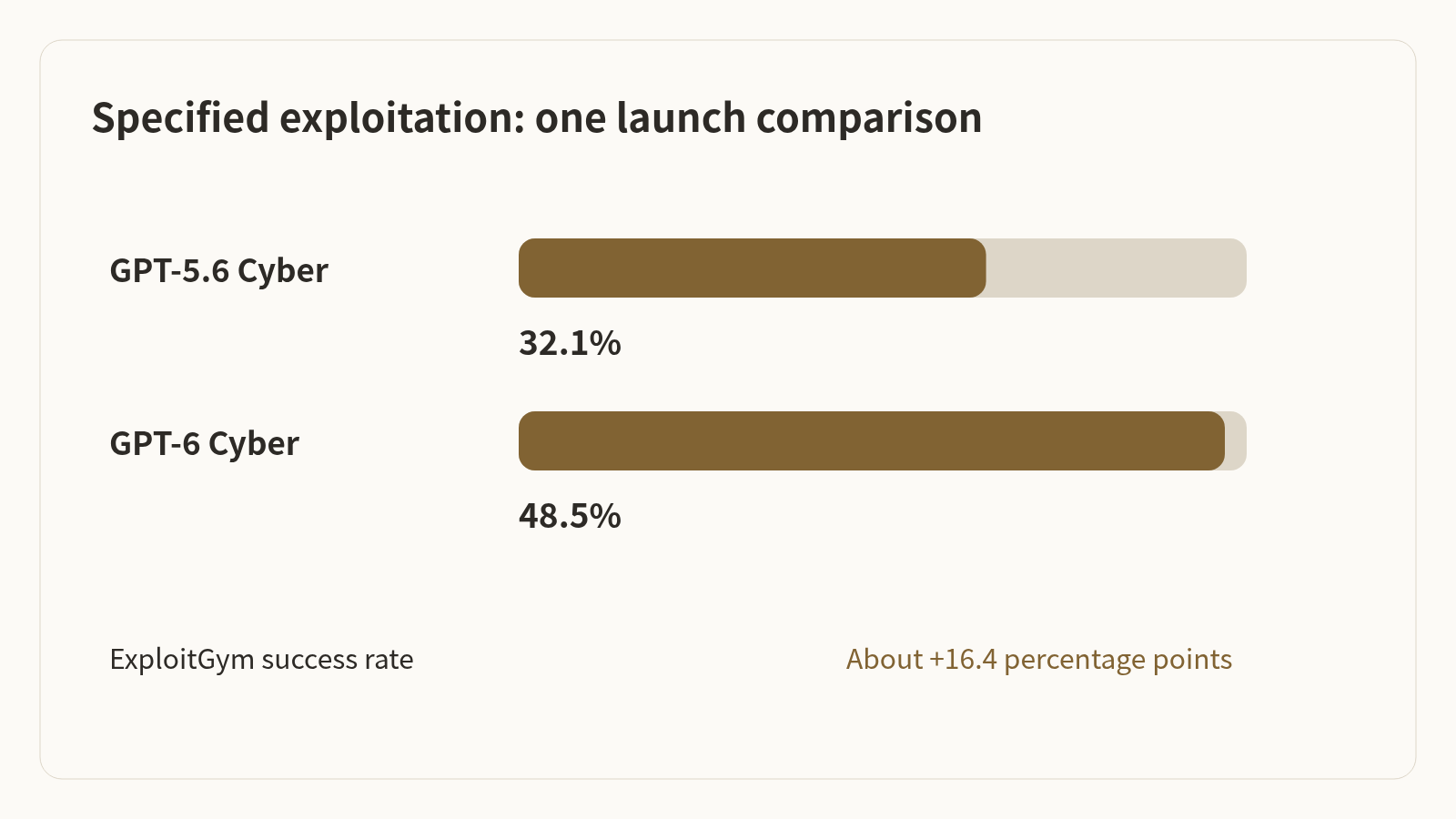
The launch announcement reports 48.5% on ExploitGym versus 32.1% for GPT‑5.6 Cyber: about 16.4 percentage points, or a 51% relative increase. This evaluation tests exploitation of a specified vulnerability. Its success rate is not the probability of discovering a vulnerability in an arbitrary live system.
The current system card also compares Cyber with GPT‑6 Astra in the same tables: 48.45% versus 42.43% on ExploitGym, and 36.94% versus 29.69% on the hardened version. Those comparisons answer different questions. Do not combine an older model’s score from one evaluation with a newer score from another.
Cyber does not lead every measure. On general software-engineering evaluation ExpertSWE, it scores 82.95% versus Astra’s 83.24%. In the external FrontierCyber assessment, the models solved 90/288 and 96/288 challenges respectively. Choose for the actual specialization and constraints of the task rather than assuming that a cyber model is an upgrade for all work.
Zero observed violations has an experimental scope
ExploitGym Honeypot adds a supporting service to difficult tasks. Legitimate use of the service is allowed; exploiting it to solve the main task is outside authorization. The system card reports a 0.07% observed exploitation rate for GPT‑6 Cyber without deployment safety instructions and 0% with them.
That shows the value of specialized training and deployment instructions within the evaluation. It is not an absolute safety guarantee for every real environment. Changes in targets, tools, privileges and task distributions still require organizational validation.
Other findings matter for persistent execution. On warnings where stopping was appropriate, Cyber responded correctly 73.00% of the time versus Astra’s 78.38%. The card also describes cases where a blocker was disclosed during work but omitted from the final response. A final report must repeat what remains incomplete rather than allowing a qualification to disappear at handoff.
Separate platform access, testing permission and tool privileges
GPT‑6 Cyber initially reaches a select group of approved Daybreak Red customers through API and Codex, with expansion planned. Applying does not establish approval. Approval does not grant permission to test arbitrary third-party systems.
The card describes identity and eligibility checks, organizational security requirements, credential protection and default API IP allowlisting. API customers using Zero Data Retention generally require Private Safety Processing, with approved exceptions. Customers retain encrypted safety records in their own storage for 30 days. Check the actual account, deployment route and agreement rather than inferring data handling from the model name.
Establish who may use the model, who can authorize testing of each target, and which credentials and network access this specific job receives. An instruction to stay in scope cannot prove ownership or legal permission on the organization’s behalf.
Define operational boundaries before execution
A security assignment should identify assets, environment, time window, allowed and prohibited actions, credentials, stop conditions, responsible person and deliverables. Scope changes require renewed confirmation. Discovering an adjacent system should not automatically expand the assignment.
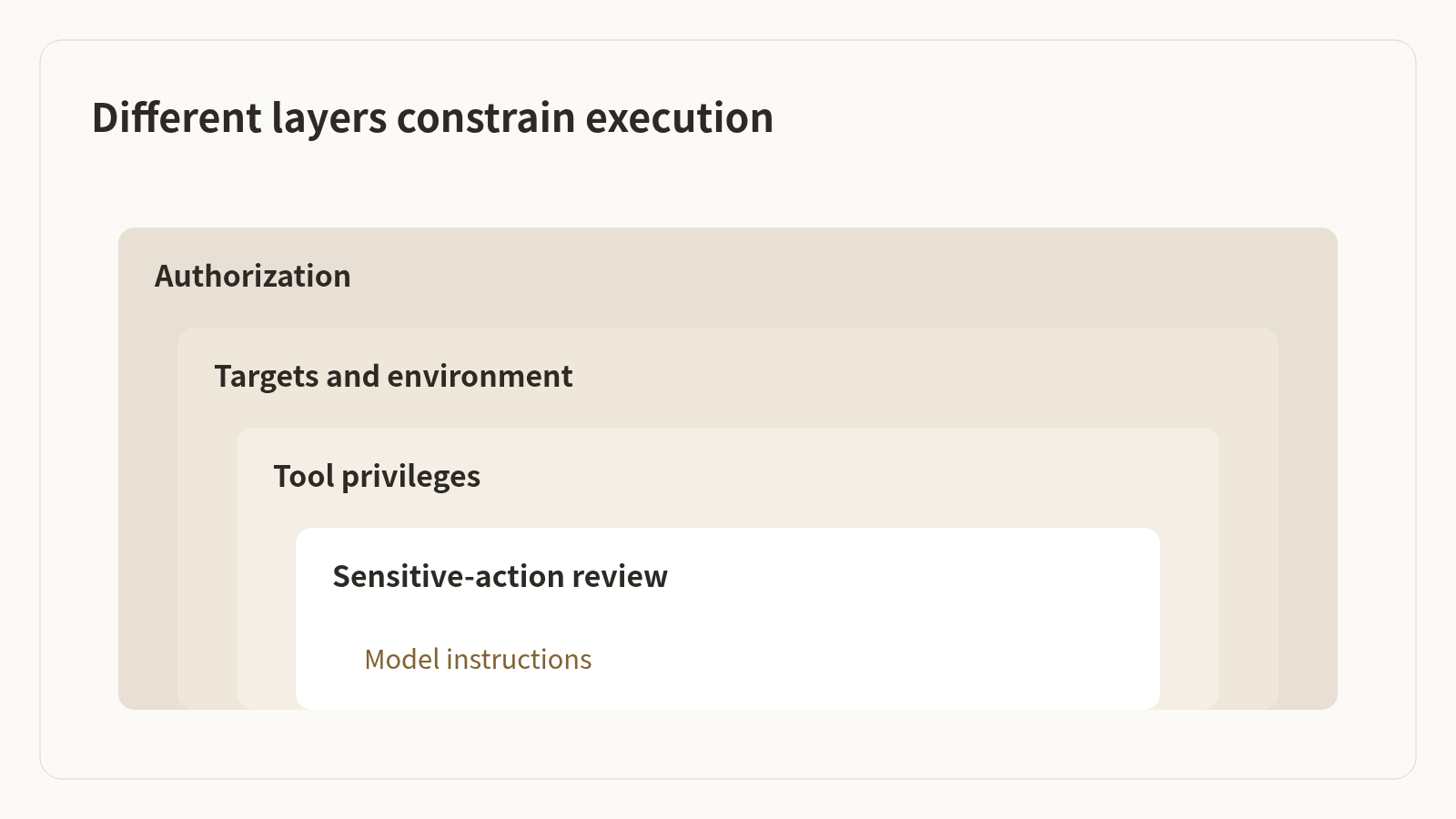
The environment limits files, networks and credentials; action review determines whether sensitive steps may proceed; a human owner accepts risk and results. OpenAI recommends Codex sandboxing and Auto-Review. API workflows need comparable sensitive-action checks and must stop if review fails or denies an action. These controls work alongside the model’s training.
Authorized security teams should conduct high-risk production testing through their formal procedures. Organizations without those conditions can begin with permitted reports, patch recommendations and unresolved-question triage, producing a handoff packet for experts before granting broad execution access.
Keep discovery, validation and remediation distinct
A lead, a validated finding, a candidate patch, a merged fix and a post-deployment retest are different states. Tie each conclusion to its target, tool output, execution time, review and remaining uncertainty. A claimed success requires evidence inspection. A merged patch still requires confirmation in the target environment.
The final summary should include unrun, denied, out-of-scope and blocked work. Do not erase those categories inside a broad completion statement. They help the owner decide whether to validate further, contact a maintainer or end within the original scope.
Buda can help organize authorized task instructions, evidence files and expert handoffs, with repeatable preparation methods in Drive and Skills. Controlled access to the specialized model and authorization for testing remain subject to the relevant platform and organizational processes. Preparation, evidence management and security testing have different responsibilities.
Before choosing the next security assignment, specify the steps the Agent may take, where it must stop and the evidence its owner needs. Evaluations inform model selection; authorization and acceptance make the work accountable.