AI Claims Intake: Build an Evidence File for Licensed Review
Keep incident facts, document versions and open questions traceable before a coverage decision.

Three claim folders contain a notice, a policy schedule and photographs. That tells an intake team what arrived, but not whether the incident date is known, the correct endorsement is present or the documents agree. A useful handoff makes those differences visible.
You can use Buda to build a claims intake workflow for organizing notices and missing documents under licensed review. Use it to organize authorized files into a fact packet. Coverage, exclusions, limits, payment and denial remain decisions for the accountable licensed professionals.
Start with the identity and source register
Assign a stable claim ID before extracting facts. Keep masked policy number, insured party, affected property, incident time, reporting time, source quotation, file version, page and uncertainty in separate fields. A similar policy number is a matching lead; confirm the full authorized identifiers before linking files. Do not merge cases by name or timestamp alone.
Keep incident time and reporting time apart. A notice received on October 20 does not establish that the loss occurred that day. Record the original time zone when supplied. If a source only names a date, preserve that precision rather than inventing midnight.
Three fictional files with different gaps
The following records are teaching examples, not processed claims. An approved illustrative checklist calls for a notice, policy schedule, relevant endorsement information and a readable loss account.
| File | What is available | What to hand over |
|---|---|---|
| C01 | Notice gives Oct 18 incident and Oct 20 report; schedule and E1 attached; readable account | Index received files; endorsement applicability still needs licensed review |
| C02 | Notice gives Oct 20 report; incident time blank; schedule present; relevant endorsement not supplied | Ask for incident timing and missing endorsement information |
| C03 | Notice describes damage to item A; photo label says item B; endorsement scan unreadable | Preserve discrepancy; request readable version and identity clarification |
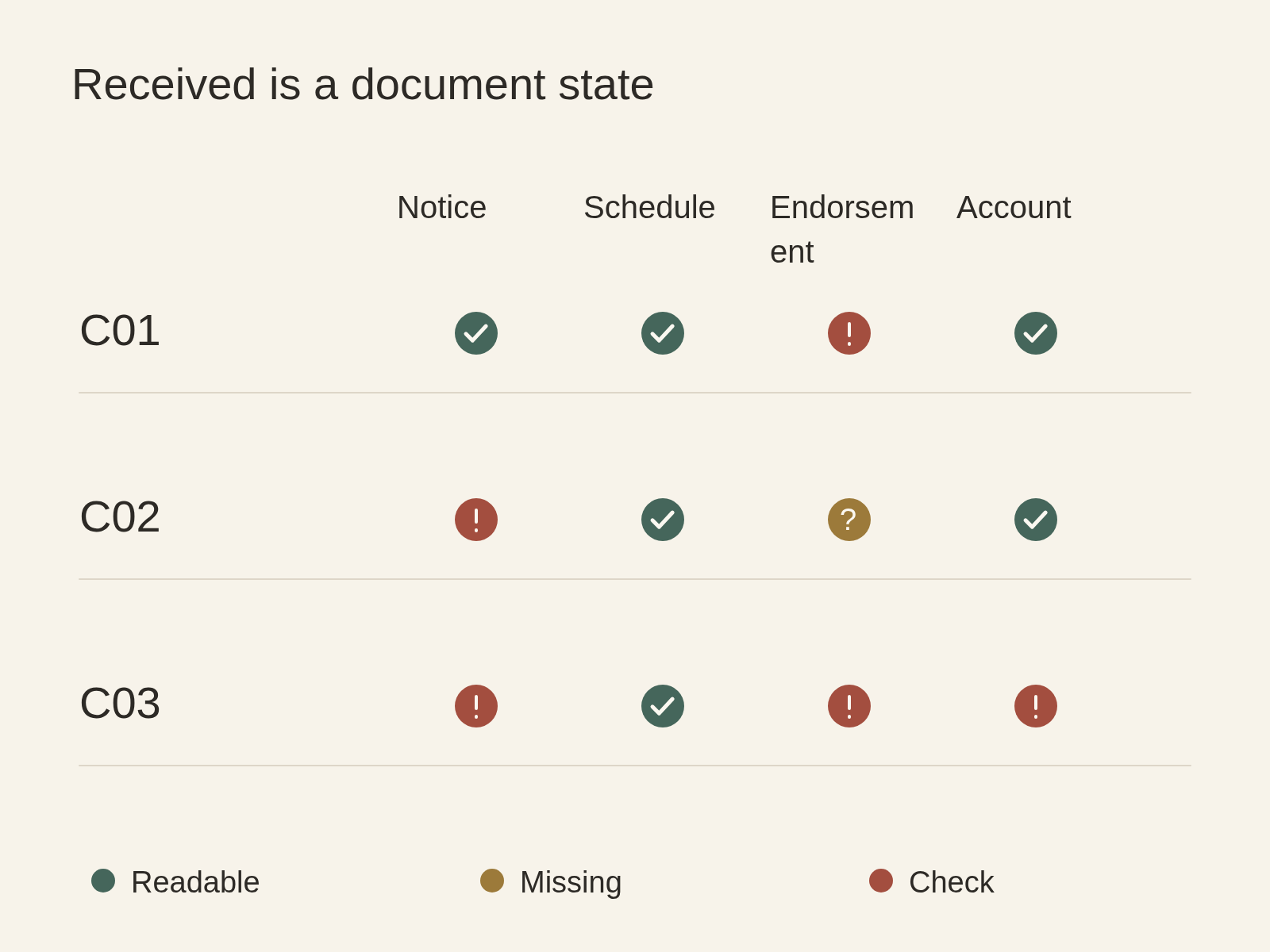
For C01, “received” describes possession, not coverage validation. C02’s missing time is not a zero-day delay. For C03, a photograph and narrative can both remain in the packet while their relationship is unresolved. Do not silently pick the more confident source.
Deliver a file index and a decision handoff
claim-file-index.csv should list one claim-document reference per row: claim ID, masked policy number, source path, version, page, material type, readability, facts extracted and outstanding question. Use distinct states for received and readable, received but unchecked, unreadable, and missing from the authorized set. “Missing” describes the supplied set, not a claim that the document never existed.
claims-handoff.md groups facts by case, quotes the source for every incident assertion and lists questions for intake staff separately from decisions for licensed reviewers. Staff can ask for a readable E1 or the claimant’s incident-time statement through an approved contact process. The licensed reviewer decides which endorsement and policy provisions apply, where exclusions or limits need analysis, and whether any further professional investigation is necessary.
Keep previous versions. If E2 arrives, record its issuer, stated effective information and relationship to E1. Do not let the newer filename automatically supersede an earlier document. Deduplicate identical attachments by reference while preserving submission history.
Give the agent a narrow instruction
Read only the authorized notices, policy schedules, endorsements and attachment register. Produce claim-file-index.csv and claims-handoff.md. Quote source locations. Keep unknown incident times unknown and separate report times. Flag identity conflicts and unreadable pages. Do not estimate payment, approve or deny claims, interpret coverage as settled, or contact policyholders.
Use the Agent Workspace to keep input files and the review packet together. Configure actual data and tool permissions separately from the task instructions. Begin with one clear file, one incomplete file and one contradiction. A reviewer should reconstruct the packet before the procedure becomes a reusable Skill. Relevant Skills can be searched and installed in Buda AI’s Marketplace.
Questions intake teams encounter
Which endorsement version should be used? Register both and their stated effective information, then ask the licensed reviewer to confirm applicability. Recency alone is insufficient.
What if the incident time is unknown? Preserve the field as unknown, quote the report time separately and request the appropriate statement. Do not substitute dates to complete the table.
Is an unreadable file received or missing? Mark it received but unreadable, preserve the original and request a readable copy. A duplicate scan does not resolve readability.
Does a complete checklist authorize payment? No. It makes the handoff easier to review. The policy analysis and claim decision remain separate, documented professional work.
Start with one authorized batch and a named licensed reviewer. Measure whether each fact can be traced and each unresolved question has an owner before expanding the workflow.