Turn saved sources into a maintainable wiki with Karpathy LLM Wiki
Separate original material, compiled knowledge and read-only answers so updates remain traceable.

You ask about the same collection twice and get two different accounts. Now the work starts again: reopen the PDF, find the passage and check which version supports the claim. Saving material has preserved the files, but it has not preserved the reasoning you need for the next decision.
Karpathy LLM Wiki, maintained in Astro-Han’s repository, makes that maintenance explicit. Keep the originals, update the compiled knowledge, check related claims when evidence changes and answer ordinary questions without silently editing the library. The useful question is how a source enters that system—and what must change when it challenges an existing conclusion.
Understand the files before the first run
The Skill separates immutable raw/ material from compiled Markdown in wiki/. Raw files retain original text plus source URL, collection date and publication date. Compiled articles organize concepts rather than mirroring every incoming filename. wiki/index.md maps those articles; wiki/log.md records operations without rewriting earlier entries. The persistent artifact is a body of files, not a promise that the model’s weights learn your knowledge.
This separation matters when an answer changes. You can revise an interpretation while retaining the material that supported its previous version. Do not ask the Agent to rewrite an original source to agree with the latest conclusion.
Step 1: Install the Skill and ingest a real source
In Buda AI’s Marketplace, search for Karpathy LLM Wiki and check its maintainer and source repository before installation. Choose a dedicated project directory and provide a source the Agent can actually read. A PDF that cannot be extracted needs a readable version before reliable compilation. Installing a Skill does not grant access to private links or external accounts.
An adaptable instruction is: “In this project, ingest this source using Karpathy LLM Wiki. Preserve its original text and metadata in raw. Search existing wiki articles before deciding whether to create, update or mark a dispute. Return the affected files and the passages supporting key claims.” The first ingest creates only missing directories, index and log; Query and Lint do not initialize an absent wiki.
Step 2: Decide what the source changes
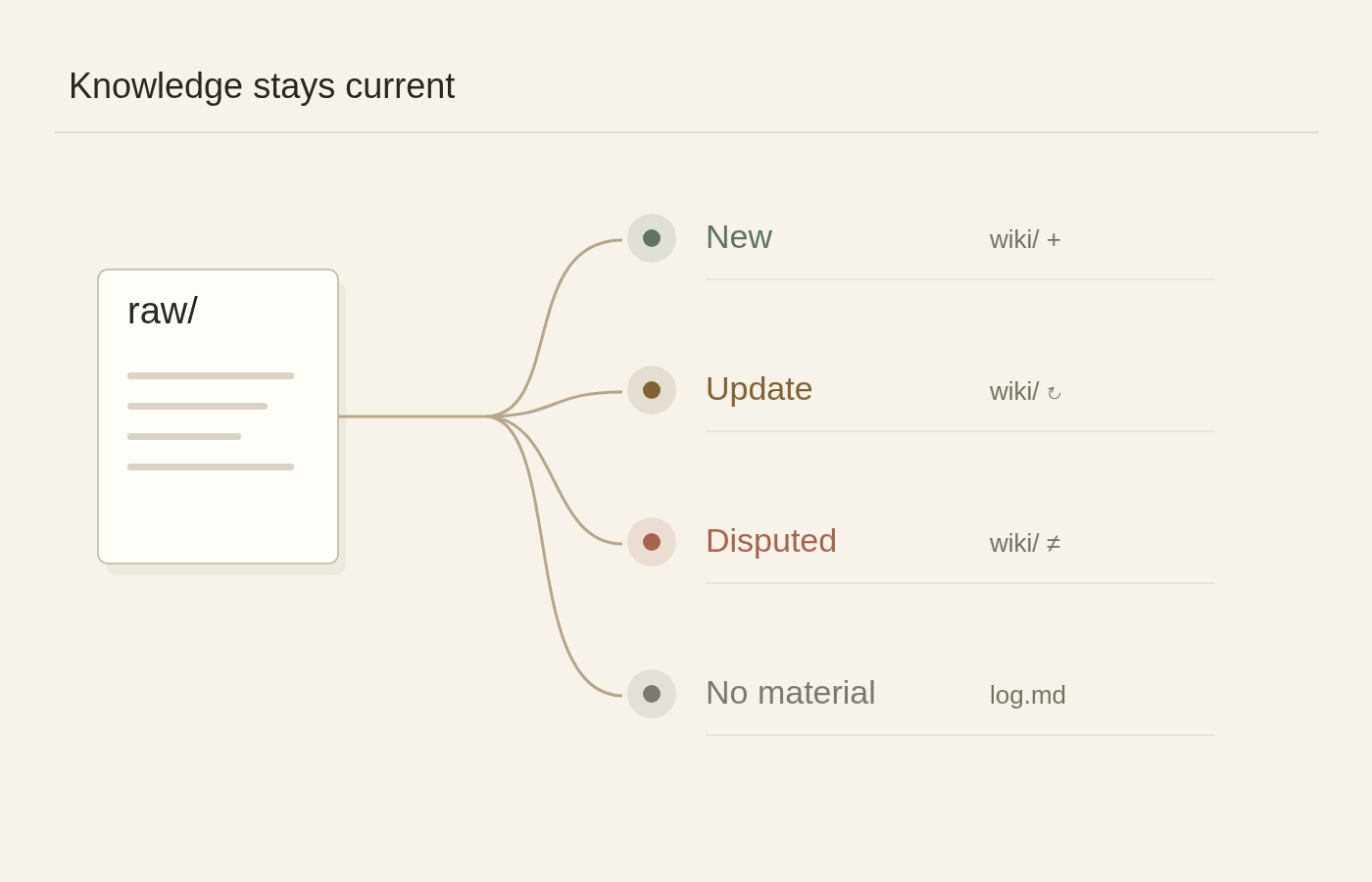
After saving the source, the Agent searches existing knowledge using entities and synonyms. New material may create an article, update an existing one or dispute a claim. These outcomes can combine. No material is exclusive: keep the source and log that it added no knowledge, rather than manufacturing another page.
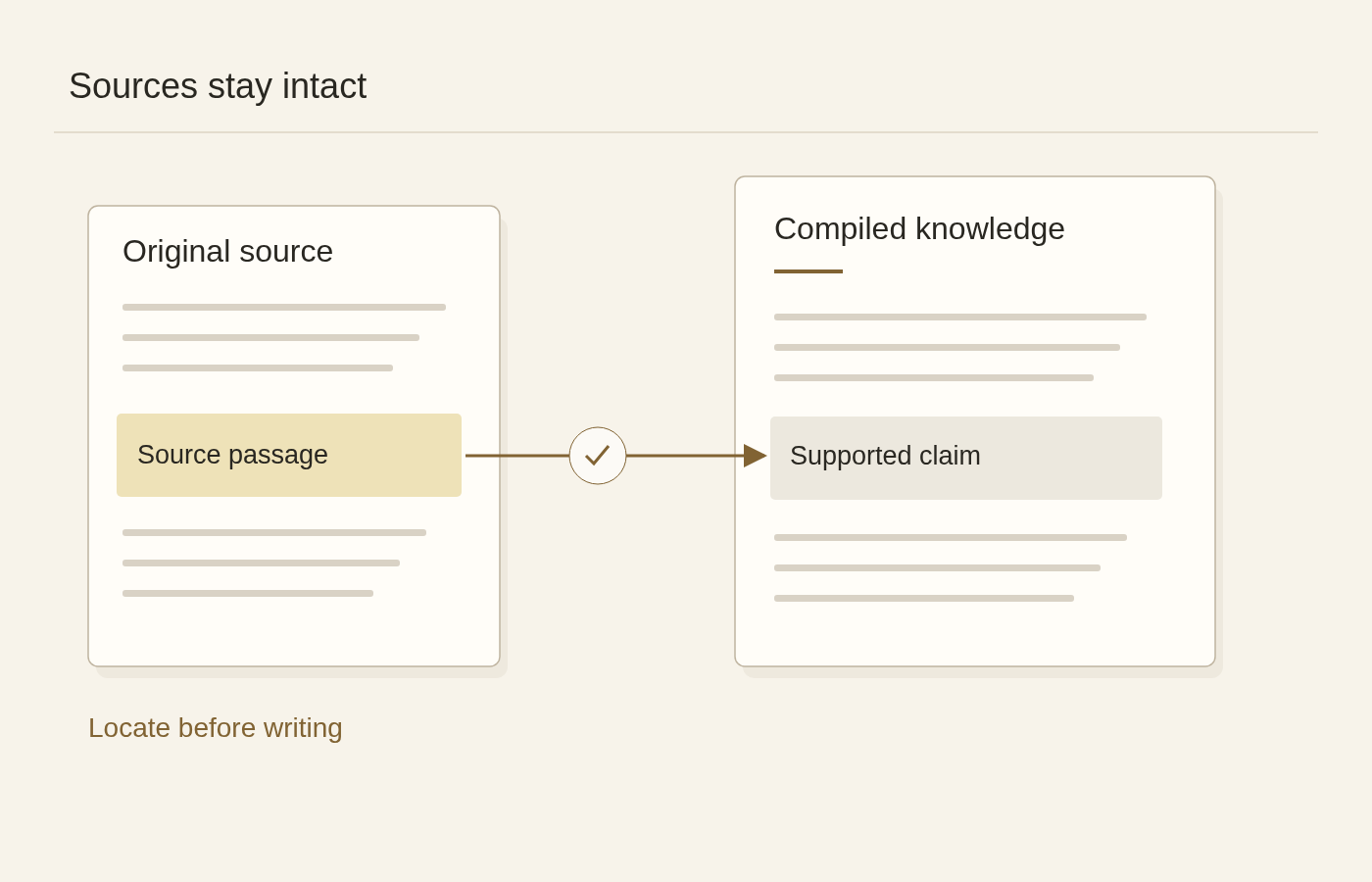
Before writing a number, date or quote, locate it in the linked raw file. Preserve its literal form; calculations need their components. This prevents a polished summary from quietly introducing unsupported precision. It does not establish that the source itself is true.
Step 3: Update connected claims
A changed claim can affect several articles. Cascade updates search full article bodies, not only index entries. Superseded statements retain an Outdated annotation; competing accounts receive Disputed annotations and cross-links. Point-in-time archive pages are excluded from cascade updates. Refresh the index for changed knowledge and append the operation to the log.
A review should therefore ask which files changed, which source passages support those changes and whether related articles still repeat an obsolete conclusion. A growing article count alone is a poor success measure.
Step 4: Query knowledge and archive deliberately
Query reads the index, searches full text with synonyms and answers with links to wiki articles. Ordinary questions do not write files. Saving an answer is a separate, explicit archive request: it creates a new archive page citing the wiki articles, updates the index and appends the log. This keeps a temporary conversational synthesis distinct from source-based compilation.
Step 5: Check links and evidence
Lint can repair structural issues such as a uniquely identifiable moved link or an index omission. Ambiguous links need a decision. The repository’s check_evidence.py scans high-signal literals in linked raw files; suspected mismatches require reading context, and factual contradictions are reported rather than silently repaired. Matching text proves traceability, not independent truth or source reliability.
A first useful cycle ends with a preserved source, an explained triage decision, supported articles, an updated index and an appended log. Use Buda Drive and file tools to build this process around material you control; check the Agent’s actual environment and installed Skill files before relying on its scripts. Start with one topic, inspect the output, then expand the collection. The upstream procedure provides the exact formats and command contract.
Start with a source you will need again
Open the Karpathy LLM Wiki Skill page, then find and install it for an Agent in Buda AI’s Marketplace. Give it one real source and inspect the preserved original, compiled article and source links before adding the next. Build a library you can check from its first entry.