“Please Review This Contract” Is Not a Legal Intake Brief
Separate missing facts, attachment versions, and business dates so legal operations can route a request responsibly.

“Please review this contract urgently” does not identify the counterparty, the question, or which attachment is current. Routing that sentence quickly can send incomplete or restricted material to the wrong team.
A legal workflow you can build with Buda supports preparing matter-intake summaries with missing information and sources. The agent organizes a factual packet from authorized requests. Legal operations confirms classification and routing; lawyers retain legal interpretation and advice.
Four requests need different missing facts
The following are fictional requests reviewed on October 26, 2026, using an approved intake taxonomy and routing rule R1. They are proposed teaching examples, not processed client matters.
| Request | Supplied facts | Gap before routing |
|---|---|---|
| L1: NDA | Named parties, request to review confidentiality terms, business date October 30 | Attachment called final; execution status not established |
| L2: Supplier MSA | Counterparty and draft supplied | No business deadline or governing-location information |
| L3: Employment question | Requester and responsible team identified | Relevant location, dates, and specific question missing |
| L4: DPA | Counterparty, privacy question, draft version DPA-R2 | Attachment access restricted; authorized reviewer unresolved |
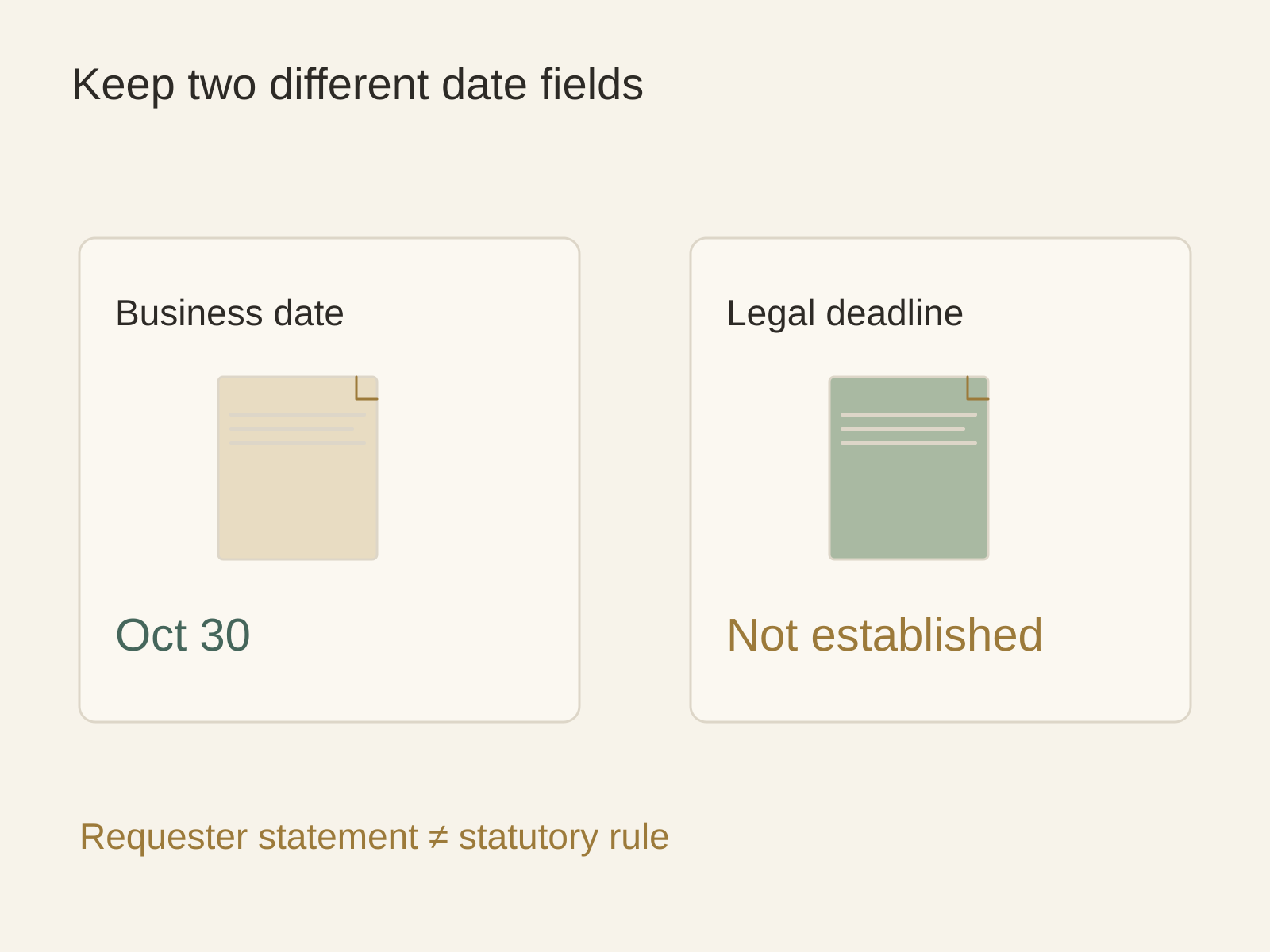
The word “urgent” is not a priority rule. L1’s October 30 date is a business deadline reported by the requester, not a statutory deadline or a promised legal turnaround. Preserve the original sentence and its timestamp. If the email lacks a timezone that matters to scheduling, ask for it.
Extract what is known without inventing the matter
For each request, retain requester, business entity, counterparty, requested work, jurisdiction or unknown, business date and its source, attachment version and execution evidence, responsible team, and the specific question needing a lawyer. Preserve quotation and location for every extracted field.
A file named final.pdf is not necessarily signed. A missing attachment is not evidence that no contract exists. An employment label alone does not establish jurisdiction or a legal deadline. When classification is uncertain, propose a question for legal operations rather than guessing a specialist queue.
Separate readiness from urgency
Ask for matter-intake.csv, one row per explicit matter ID, with the known facts and unresolved fields. Add missing-information.md naming the document or clarification required, who can supply it, and the proposed next action.
Use the approved routing rule to distinguish ready for routing, missing facts, and restricted-reviewer confirmation. A near business date may warrant attention under that rule, but it cannot erase an access restriction or missing core facts. Do not invent an SLA.
A bounded instruction is: “Prepare intake facts from authorized emails, forms, and attachments. Quote sources and preserve unknowns. Use only the approved taxonomy and routing rules. Do not analyze legal risk, create statutory deadlines, copy restricted material, send responses, or promise turnaround.”
Link messages using matter identity
Two emails from the same person may concern different contracts. Combine records only with an explicit matter ID or human-confirmed relation. Retain each original message and attachment version. If L2 receives a new draft, record which version the requester wants reviewed rather than treating the newest filename as authoritative.
If two messages disagree about a deadline, preserve both statements and ask the requester to confirm. Do not select a date solely because one message arrived later.
Keep restricted material with the right reviewer
L4 may have enough factual fields but still need permission confirmation. Record that access is unresolved and route the access question to an authorized person. Do not copy privileged or restricted attachments into a general team packet to make the table look complete. A summary does not automatically remove the underlying confidentiality concern.
Legal operations confirms the proposed queue and the person who may read the sources. Preparing a packet is not authorization to distribute it to a client, another team, or an external lawyer.
Intake questions
What if the request type is unclear?
Quote the requested action and ask legal operations to classify it. Keep the proposed type provisional instead of routing by a model’s confidence score.
Can the deadline come from an email?
Yes, as a requester-stated business date with the exact source and relevant time details. It does not become a legal deadline or an accepted service commitment.
How should duplicate requests be handled?
Use explicit matter identity or a human-confirmed relation. Keep the source messages; do not merge solely on a person’s or counterparty’s name.
What if an attachment is missing or inaccessible?
Name the missing version or access permission and the responsible owner. Keep the matter in the corresponding unresolved state instead of inventing its contents.
Make the next handoff complete enough to route
Keep the authorized sources, intake register, missing-information list, and routing decisions in the Agent Workspace. Accept one packet by tracing fields to their sources, then reuse the preparation steps as a Skill. Search for and install suitable Skills in the Buda AI Marketplace, or adapt the team’s method. The next reviewer should know what is being asked, which facts remain missing, and who can safely receive the matter.