The agent says “working on it.” What evidence shows real progress?
Compare tool activity with the next inspectable artifact to distinguish progress, missing inputs and repetition.

The browser has opened many pages. A terminal has run several commands. The agent says it is still organizing the findings. The supervisor needs a different answer: what is closer to being usable now?
Live AI agent observability is not a test of how convincing the narration sounds. Nor does it require hidden reasoning. Tie each stage to evidence someone can open. Visiting a source, extracting a fact and drafting a comparison are different states.
A Agent Workspace you can build with Buda brings chat, Drive, Terminal, Browser and Git into one workbench. Visible actions help people intervene; they are not a complete audit log or a guarantee of correctness.
Agree on the next thing someone can open
Consider a fictional, low-risk internal research task: use authorized public materials to summarize three suppliers' service scope, pricing entry points and unknowns. It does not include requesting quotes, sending messages or handling account secrets. Paths and snapshots below explain a method, not actual run screenshots or measured results.
Replace “tell me when you're done” with a small checkpoint agreement:
Current subgoal: locate the three official information sources
Next artifact: sources.csv with URLs, reading state,
               verifiable facts and unknown fields
Checkpoint: show this manifest before writing the comparison
Stop if: page unreadable, material fact unsupported,
         account permission needed
Allowed: read public pages; write this run's result folder
Forbidden: contact suppliers, log into personal accounts,
           update production records
A checkpoint is not a timed “still working” message. It occurs when evidence changes: entry points found, facts extracted, enough material for comparison. That granularity tells the reviewer what to inspect next.
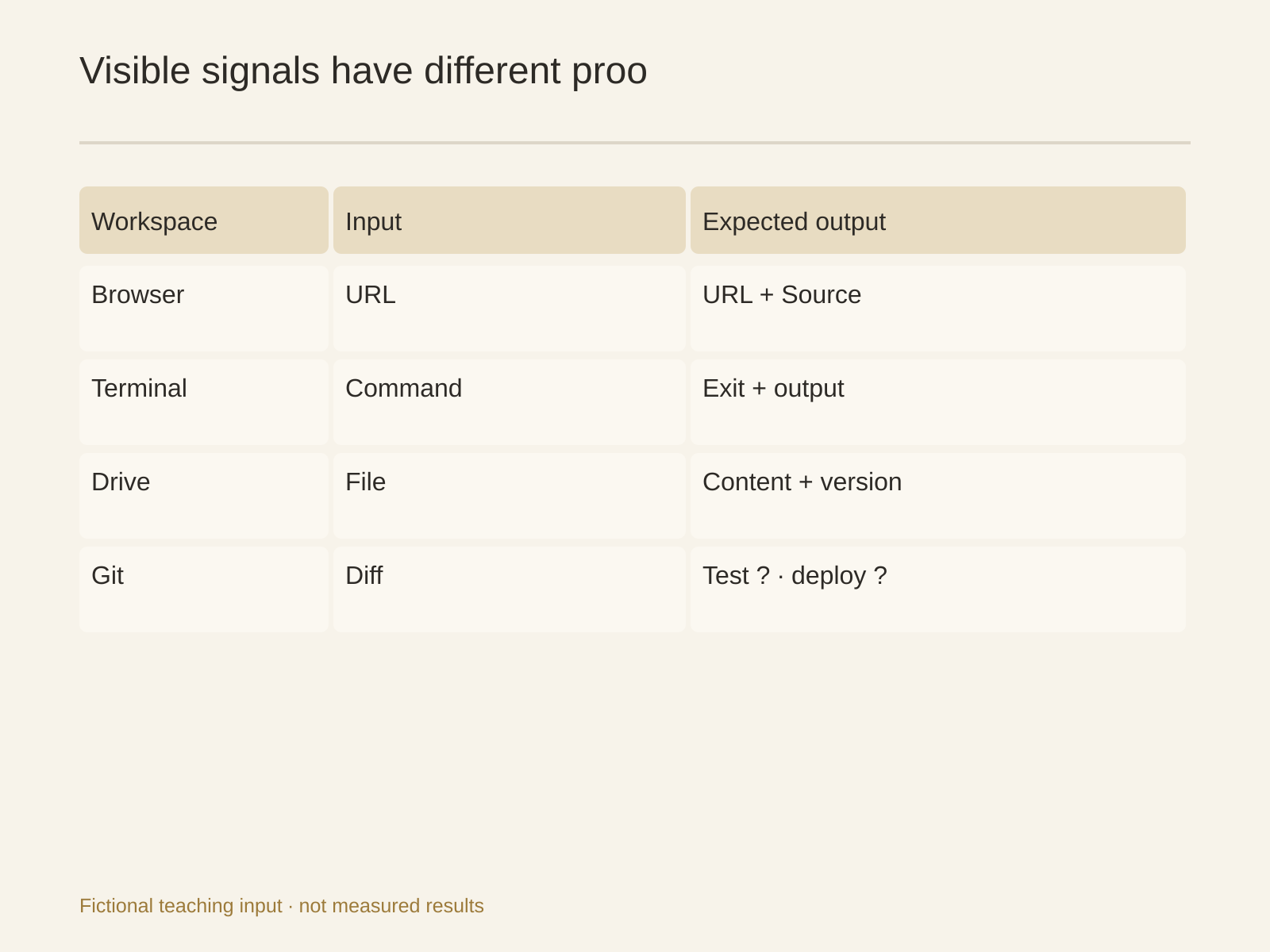
Four signals with four different limits
| Signal | What it establishes | What remains unproven | Next check |
|---|---|---|---|
| Browser opens a page | A visit occurred; readable content may supply evidence | Official origin and presence of the claimed field | Compare URL and source text |
| Terminal displays a command | An operation was attempted | Exit state, errors and usable output | Inspect completion and relevant output |
| A Drive file exists | An artifact is present at a path | Contents, completeness, version and provenance | Open it and inspect the actual changes |
| Git shows a diff | Content changed | Tests, review and deployment | Read the diff; require separate test and deployment evidence |
Tool calls in the Agent tab expand to show inputs and outputs. That makes “organized” inspectable. But absence from one tab does not establish that an event never happened. Confirm progress with positive evidence without promoting interface visibility into an exhaustive record.
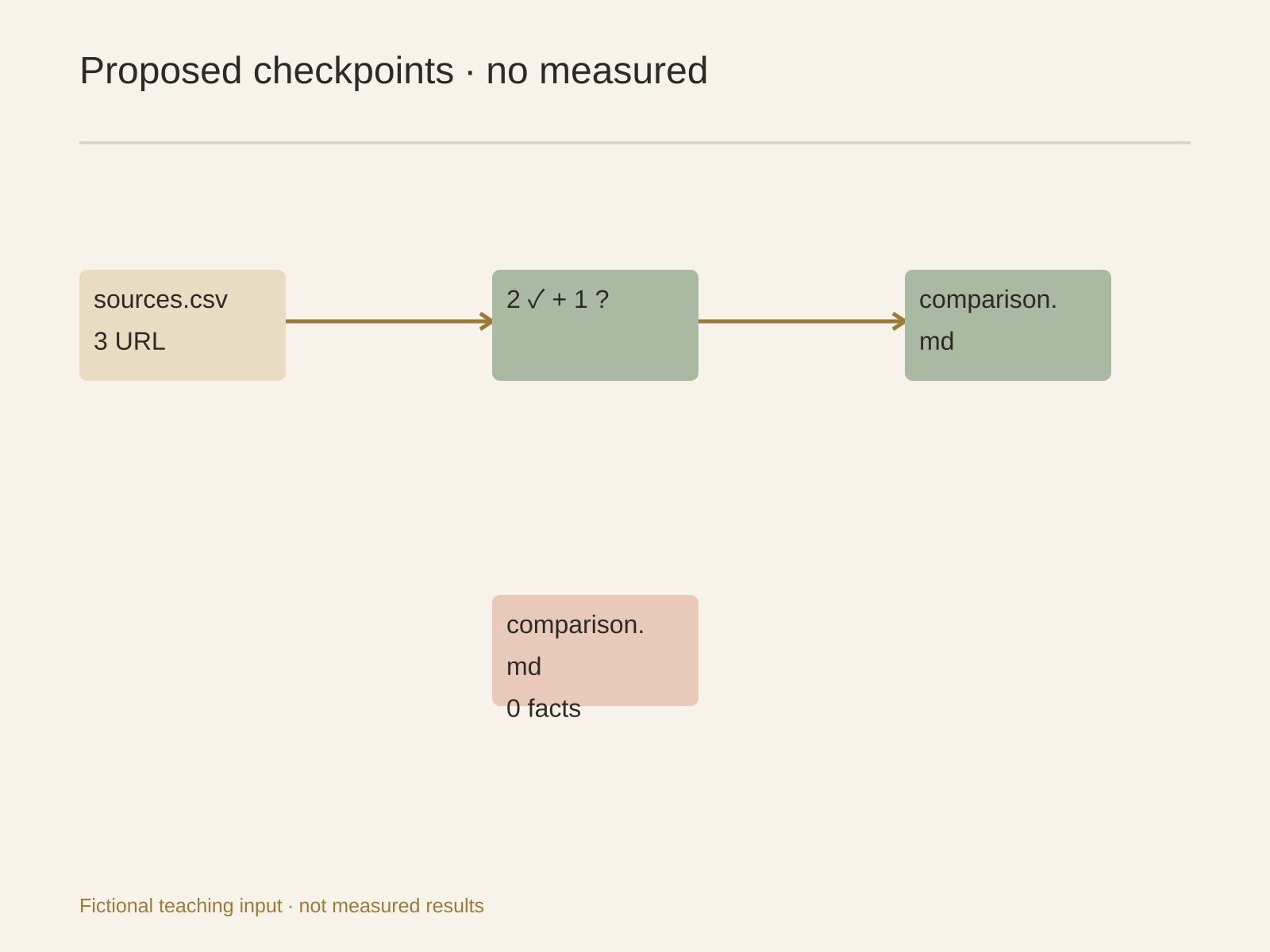
Three snapshots distinguish activity from advancement
These are expected evidence states for the fictional task, not three completed evaluations.
Snapshot one: entry points located. Three websites are open; sources.csv contains URLs and reading status. The manifest shows where research can begin, not that service scope has been verified. Ask next for sourced facts, not an immediate supplier ranking.
Snapshot two: two sources yield facts; one remains incomplete. The file adds service descriptions, source locations and retrieval times for two suppliers. The third pricing page cannot be read; price remains unknown. More evidence is usable than in snapshot one. Accurately narrowing an unknown is progress; inventing a price to fill all rows is not.
Snapshot three: a comparison draft is inspectable. comparison.md cites facts, distinguishes confirmed information from unresolved fields and links back to the manifest. A supervisor can now assess suitability for internal discussion. Producing the draft does not authorize contacting suppliers or making procurement decisions.
All three stages may involve many pages and commands. The useful questions are whether verified facts increased, gaps became clearer and the next stage has sufficient inputs.
An empty file defeats a completion claim
Suppose the agent says the comparison is generated, and Drive contains comparison.md. Opening it reveals only a heading—or nothing at all. Existence establishes a path, not delivery.
Check the named suppliers, required fields, citations and unresolved items beneath the heading. File growth is not quality evidence either: repeated pasted prose also increases byte count. Modification time helps locate a write; it does not replace content inspection.
Do not immediately restart the agent or rerun every step. First request the artifact location, completed part, remaining obstacle and smallest next action. Preserve files and the session when state is uncertain rather than overwriting evidence with another attempt.
Ask different questions for different pauses
Waiting for permission: which permission is missing? A login wall may be a legitimate boundary. Identify an authorized route or retain the gap. Do not quietly grant private-account access just to keep research moving.
Source failure: can the deliverable be narrowed? Ask which comparison field the unreadable page prevents and which lawful alternatives require confirmation. The owner might accept an internal draft with two verified suppliers and one unknown. A cached summary is not automatically the official source's current statement.
Repeated activity: what evidence did the last attempt add? Refreshing the same failing page or rerunning an unchanged command is not stage progress without new inspectable information. There is no universal five-minute threshold for being stuck; judge source state, work size and the next artifact.
A useful intervention is:
Give the current subgoal, latest evidence file and version, verified facts, remaining unknowns and next checkpoint. If permission or source access is missing, state the smallest gap. Do not invent fields, expand scope or automatically restart.
This is a proposed supervision request, not an automatic control policy running behind Buda's interface.
Continue, supply input or narrow the job
Continue when evidence and artifacts advance within the authorized scope. Supply the specific missing date, path or permission when the owner can provide it. Narrow the deliverable—or stop that judgment—when available evidence cannot support the original goal.
Record the decision concretely: “Third supplier's price remains unknown; compare verified service scope only and defer procurement.” That survives handoff better than “mostly complete.”
During-run checkpoints decide the next move; they do not replace final acceptance. Integrating parallel deliverables still requires aligned definitions and ownership. Monitoring boundaries cannot be resolved by a persuasive self-description.
Practical supervision questions
Must a non-coding job produce terminal output or Git commits?
No. Inspect evidence relevant to the task: input manifest, extracted facts, sources and output versions. No Git diff does not mean no work. Do not manufacture commits merely to look observable.
The agent says done and a file exists. What remains?
Open the file against the agreed entities, fields, sources and unknowns. Check separately whether sending or publishing was requested and authorized. Generation is not sending; a diff is not deployment.
Can another agent read the same files?
Do not assume access. Check the actual authorized path and sharing scope. Agent Drive and Space Drive differ. Name the approved location and version during handoff rather than copying private material into shared storage for convenience.
Start with one internal research checkpoint
In Buda, agree on the next artifact for a low-risk task, then compare workspace actions with that actual file. If the method repeats, search for and install a suitable Skill in the Buda AI Marketplace and inspect its source, gap and checkpoint outputs.
Make “working on it” evidence-based before reducing supervision. Fewer interruptions should come from knowing exactly what to inspect—not from trusting more status prose.