A Full Content Calendar Is Not a Publishable Plan
Check source readiness, editorial capacity and review dependencies before turning approved topics into dates.

Six topics can fill a calendar without producing one releasable article. A product detail is still missing, the same reviewer is booked twice, or the editor has more estimated work than the available week.
Use the Agent to propose a feasible sequence from authorized inputs, not to invent capacity or the best posting time. Separate a desired publication date from the earliest possible preparation date and from a confirmed publishing decision.
Fix the planning units before assigning dates
The following is a fictional planning exercise, not measured Buda performance. The planning week is October 26–30, 2026, in Asia/Shanghai. Workdays are Monday through Friday, 09:00–18:00; deadlines and all slots below use that zone. A holiday or a different local workweek would require another calendar.
The manager supplies six approved topics, two editors and three intended channels: Blog, LinkedIn and X. A topic reused across three channels is one topic with adaptation work, not three independent topics. Language versions are also deliverables, not extra topics.
Each input row preserves the topic ID, audience and question, approved scope, required sources and assets, their arrival state, editor, estimated drafting/adaptation hours and estimation source, reviewer and estimated review hours, approval dependency, channel, earliest start and desired date. Missing estimates are unknown, not zero. All estimates below are fictional values explicitly supplied by the manager, not predictions made by the Agent.
Six topics, three different reasons to hold
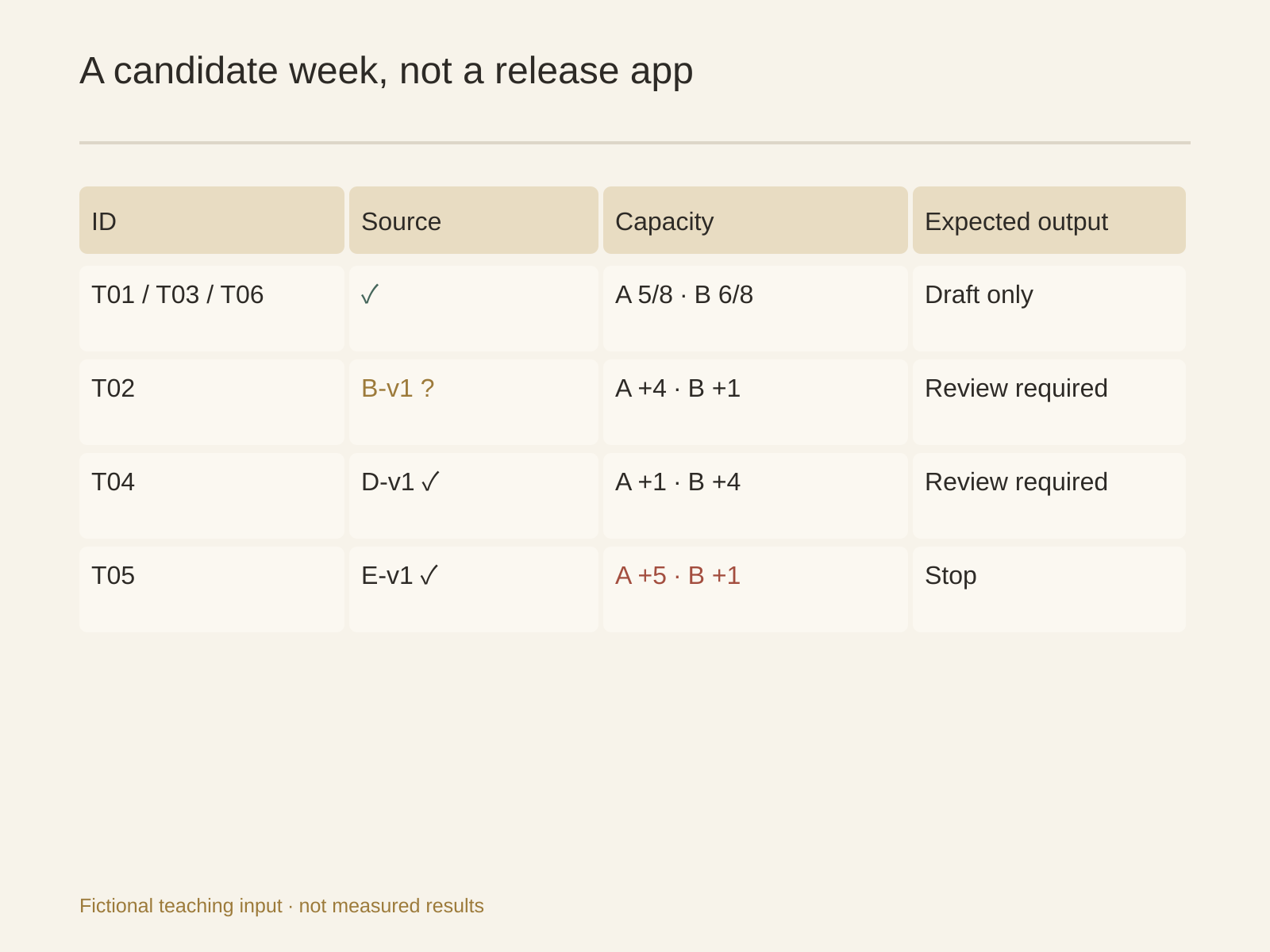
- T01 — Product FAQ: current customers need an explanation of an approved feature. Approved source pack A-v1 is ready. Editor A needs 3 hours, including Blog/LinkedIn adaptations; editor B provides 1 review hour. Desired publication: Tuesday October 27 at 17:00.
- T02 — Customer result: prospects need an approved result and permission to quote it. The promised source pack B-v1 is due Tuesday at 12:00 but has not arrived. Editor A would need 4 hours; editor B needs 1 review hour; Blog/X. Desired date: Wednesday October 28 at 17:00. Hold for material, not a firm booking based on its promised arrival.
- T03 — Buyer's checklist: small-team buyers need a checklist for one agreed decision. Approved C-v2 is ready; editor B needs 3 hours, editor A 1 review hour; Blog/LinkedIn. Desired date: Wednesday October 28 at 17:00.
- T04 — Release explanation: existing users need a factual walkthrough. D-v1 assets are ready, but the product owner's approval time is unknown. Editor B needs 4 hours plus 1 review hour from editor A; LinkedIn/X. Desired date: Thursday October 29 at 17:00. Hold for approval, not ready merely because screenshots exist.
- T05 — Workflow guide: operators need a bounded process. Approved E-v1 is ready; editor A needs 5 hours, editor B 1 review hour; Blog. Desired date: Friday October 30 at 17:00. The inputs are ready, but the current capacity plan cannot fit it without another decision.
- T06 — Short Q&A: team leads need a response to an approved common question. F-v1 is ready; editor B needs 2 hours, editor A 1 review hour; LinkedIn/X. Desired date: Friday October 30 at 17:00.
The proposed outputs are calendar-draft.csv, readiness-board.md, capacity-check.csv and change-notes.md. They are planning files, not native publishing controls. Preserve all six topics, including held items.
Count review as work, not free space
The manager provides 8 available hours for editor A and 8 for editor B after other duties. Those hours are not their entire employment week. Time blocks matter as well as totals.
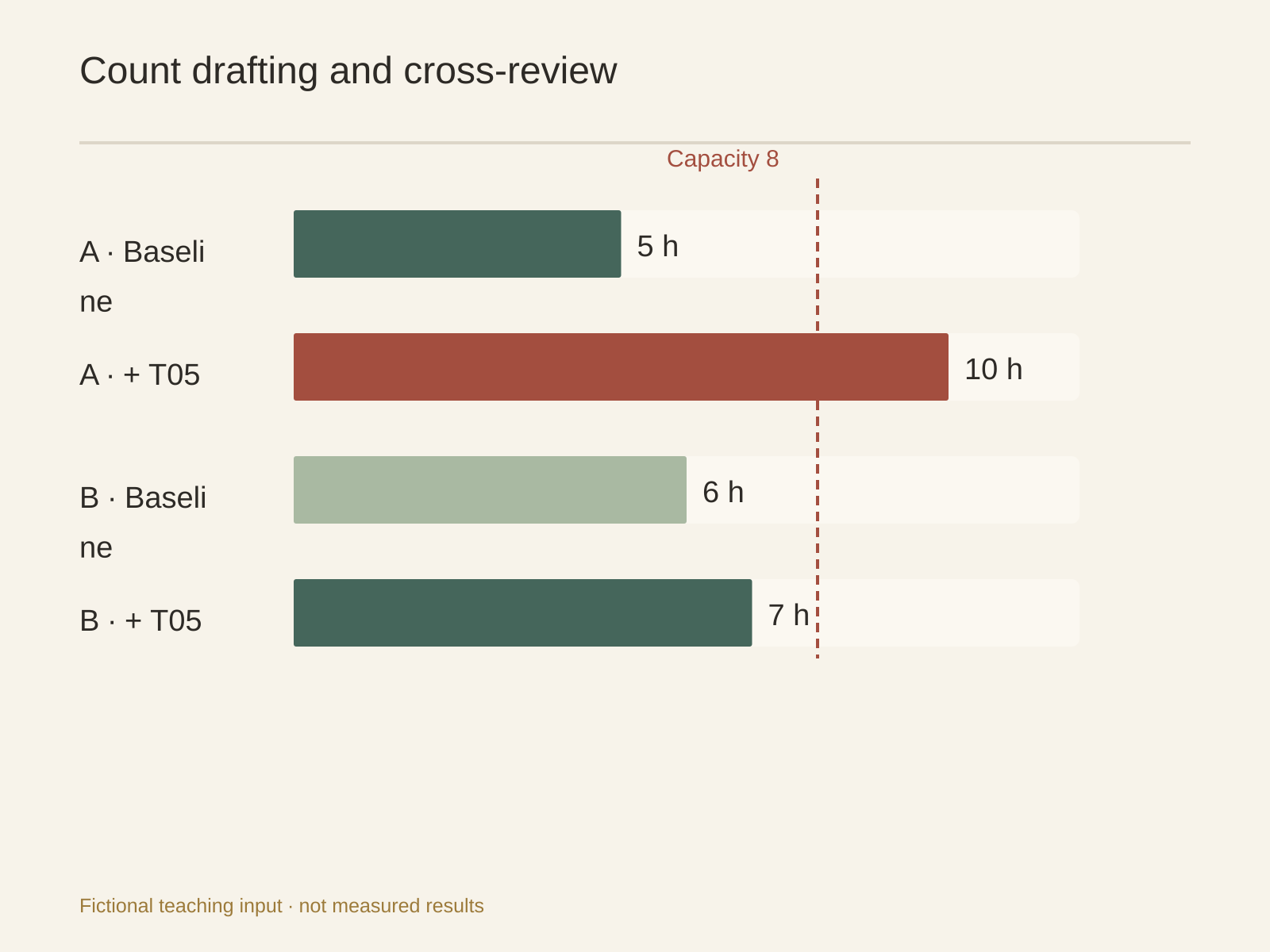
A candidate baseline selects T01, T03 and T06. Editor A uses 3 drafting hours plus 1 review hour for T03 and 1 for T06: 5/8 hours. Editor B uses 3 drafting hours for T03, 2 for T06 and 1 review hour for T01: 6/8 hours. Remaining capacity is A=3 and B=2 hours.
Adding T05 would make A=10/8 hours and B=7/8 hours. It therefore exceeds A's capacity by 2 hours even though B still has room. An Agent cannot transfer that work to B without checking skills, scope and the manager's authorization. Adding all six would require A=15 and B=12 hours, including cross-review. A calendar that hides reviews reports a false capacity picture.
For the selected baseline, the manager supplies these non-overlapping candidate blocks: A drafts T01 Monday 09:00–12:00; B reviews it Tuesday 09:00–10:00. B drafts T03 Tuesday 10:00–13:00; A reviews it Wednesday 09:00–10:00. B drafts T06 Thursday 09:00–11:00; A reviews it Friday 09:00–10:00. The desired dates remain targets, subject to review and a separate publishing decision.
A competing suggestion that places B's T01 review Tuesday 10:00–11:00 conflicts with B's T03 drafting block. Reject that suggestion or ask for an authorized reschedule. Weekly totals alone would not catch it.
Define readiness without claiming approval
A topic is ready to draft when its authorized inputs, scope, estimates and preparation capacity are known. That does not mean ready to publish. A reserved review slot is an appointment, not editorial approval. Final release also depends on factual review, approved media, channel requirements and the publisher's decision.
Use separate hold reasons: missing material for T02, unknown approval timing for T04, insufficient capacity for T05. These are different recovery actions. For each, list the owner, missing input or decision, affected topic and earliest point to re-evaluate. Never replace a missing case study with an invented customer result.
The marketing use case and content marketing guide provide broader context. This planning step comes before adaptation or distribution: a new channel's format, image or review work changes the estimate even if the source topic is shared.
A delayed source changes the proposal
Suppose T02's material arrives Thursday at 15:00 instead of Tuesday at noon. It misses Wednesday's desired date. Do not backdate readiness or write that it “published late” when nothing was published. Its 4 drafting hours still exceed A's 3 remaining hours in the baseline, before fitting B's review slot.
The Agent should show that dependency and offer bounded alternatives: move T02 to the next planning period; replace selected work only with the manager's explicit reprioritization; or obtain additional confirmed capacity. T06 is an already-ready alternative for a later slot, not a replacement invented by dropping its review. A scope reduction requires a new approved estimate; the Agent must not declare the same output achievable in half the hours.
Store source-version and capacity-version references on each affected calendar row. A revision to B-v1 should trigger another facts and permission check for T02. A change to editor A's availability should recalculate all assignments that use A, including reviews. Keep the old plan, the changed inputs, the candidate dates and the human decision separately in change-notes.md.
Set up an authorized planning task in Buda
Use Drive for approved topic lists, source copies and capacity sheets. Organize the planning run in a Session, while recognizing that a Session is not a file ACL. Specify allowed files and do not connect social accounts merely to generate a calendar.
Read approved-topics-v1, source-readiness-v1 and capacity-v1 only. Use Asia/Shanghai and the stated workweek. Preserve six topic IDs and the manager's estimates. Count preparation, adaptation and cross-review against the named person's availability and actual blocks. Separate desired dates, earliest preparation and approval state. Leave unknowns unresolved. Return the four planning files and explain every hold or conflict. Do not publish, send reminders, connect accounts or configure automations.
Before repeating the process, try these proposed, unexecuted checks: delay T02's source; put two B tasks in the same block; add T05 to exceed A's capacity; remove a review approval. A correct draft preserves the affected topic and explains the dependency instead of simply moving the date until the calendar looks full.
After reviewing a sanitized sample, a stable planning method can become a reusable Skill. Search the Buda AI Marketplace for a suitable Skill and review its instructions and permissions before installation. Any automation requires a separate scope and schedule authorization; a planning draft does not create one.
What if the team has no reliable hour estimates?
Keep the topic in an estimate-needed state. Start with one bounded deliverable, record actual preparation and review effort with human agreement, then revise later estimates. Do not infer spare capacity from an empty calendar.
How should a breaking topic enter the plan?
Ask the manager which selected work may move, verify its sources and estimate, and recompute both people and time blocks. “Urgent” is a priority decision, not extra capacity.
Does one article on three channels count as three topics?
No. Keep the shared topic ID and separate adaptation deliverables, requirements and effort. Reuse does not make formatting, image preparation or approvals free.
Is a topic ready when an approver has not replied?
It may be ready for drafting if the allowed scope permits that, but not for release. Preserve the outstanding decision and name its owner. A calendar proposal is useful precisely because it makes those limits visible.